Month: March 2013

  • Toby and Alyssa Take on Istanbul

    For the last six days I had the great pleasure of traveling with the beautiful, brilliant, best of friends, Alyssa Raven Thomas.  What a welcome change from the repetitive (though largely enjoyable) pattern of spending my time with people who don’t know me.

    Just the highlights, then. We met up Sunday at our hotel in Sultanahmet, one of several historic districts of Istanbul. Reunion joy. Our hotel room was called the Grand Bazaar. The next day we visited the real Grand Bazaar, an enclosed warren of alleys and shops that housed a frenzy of action, color, light and exchange.  There, Alyssa purchased  enough evil eye bracelets to protect a Sultan’s entire army.  We spent the afternoon at Hamam Cagaloglu, Istanbul’s oldest and grandest Turkish bath, sweating and scrubbing out at least a week’s worth of grime (on my part, anyways). We scooped water from marble basins and lounged on heated marble slabs as gray light and a few drops of rain filtered through small holes in the domed marble ceiling.  The Blue Mosque, Haiga Sofia (pronounced and spelled Ayasofia, it would seem), and Topkapi Palace of course had their places of honor, and despite the aggressive masses of anxious cattle pushing to the feeding troughs (over-zealous tourists), these sites were spectacular.  Huge Turkish breakfasts, nearly unlimited cups of free tea (thank you, Turkish hospitality!), and squares of flaky baklava dripping with honey formed the delicious brackets between which our sightseeing took place.  We cruised the Bosphorous, took a ferry from Europe to Asia and back, criss-crossed nearly every inch of the city by foot, and braved wind rain and cold to take on Istanbul.  I’d say we emerged victorious.

    ~
    The Blue Mosque (Sultanahmet Cami) as seen from the Bosphorous.

    Stunning Byzantine mural inside the Ayasofia.

    Alyssa and I enjoy one of the best views of the Ayasofia from a rooftop bar in Sultanahmet.
    ~

    Alyssa is now heading home and I am about to set out for Cappadocia, land of the fairy chimneys. I will find out what that means and report back.

  • Paradise in Pictures

    A typical day on Koh Rong:

    Wake up to this.
    Run through the jungle…
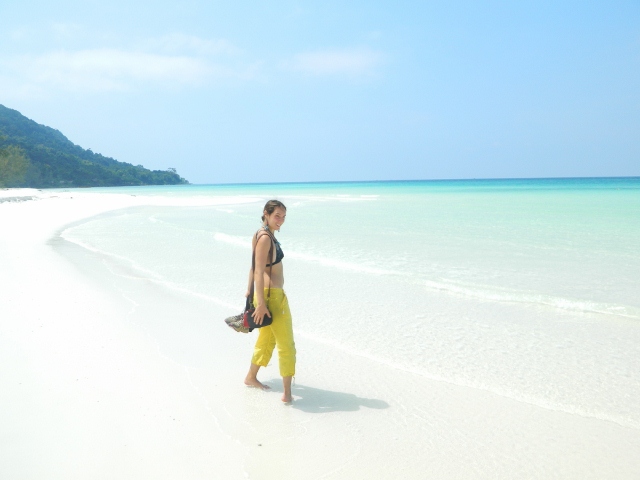
    To this, the “other side” of the island, also known as Long Beach.
    Run back to this and paint these:


    Spend the night bar-tending or enjoying an open no-mic night.

    And a few shots from Angkor Wat…

  • Escape to Paradise


    The universe provides. Yes, she really does, and I will explain the recent series of events that have bolstered my belief in that statement.  Three days ago I woke up at the Golden Fisth Guesthouse in Siem Reap, the developing Cambodian town twelve kilometers from Angkor Wat.  The temple ruins were as spectacular as I had hoped, with the murmurs of history humming beneath every stone, and I had spent two days biking back and forth to visit them.  I had also spent an enjoyable couple of evenings at the Angkor What? Bar with some new friends. In short, now I was ready to leave.
    I packed my bag (a process that has shortened from thirty minutes to ten), checked out, and spent a while deciding where I wanted to go next.  The boat to Battambang, a pretty colonial town a few hours downriver and one of my potential stops, had already left. Not wanting to waste a day, I bought a ticket to Sihanoukville instead and spent a decently comfortable night’s sleep on the ten hour bus to the coast.  In the interim, I began to hear rumors that Sihanoukville—praised for its pristine beaches and calm atmosphere—had been ruined by an excess of parties, neon paint, construction, loud music and loud tourists… exactly what I was not looking for.
    I arrived at 7am and set out on foot for town, as per usual, stubbornly ignoring the tuk tuk drivers’ warnings that it was eight kilometers away. Eight means four, generally, which is manageable.  I must have taken a wrong turn somewhere along the way, because after well over an hour I arrived not at the beach, but at the port.  It is a large, dirty collection of warehouses, smog, street food I don’t want any part in, construction, and minimal signage.  Frustrated and unwilling to retrace my steps, I formed a plan B.  Maybe I shouldn’t be stopping in Sihanoukville at all, I thought.  Maybe this means I should be continuing straight to the islands, said to be some of Southeast Asia’s finest.
    I found my way to the passenger ferry area where a few tourists from the Czech Republic were waiting.
                “Where are you guys going?” I asked.
                “Koh Rong.”
                “Is it a nice place?
                “We hope so!” They laughed.
                “Alright, works for me!”  Tickets were twenty dollars and the boat left four hours later.  I bought my ticket, found breakfast (hunted down breakfast, really), and played cards and chatted until 2pm—departure time.  In the interim, I flipped through my friends’ Lonely Planet and realized the island was a bit beyond my budget.  Oops! Perfect timing for Dave to step on the scene. The dreadlocked Aussie appeared around 1pm wearing angry birds shorts and carrying bags of supplies to the docks.  I guessed that he must work on the island.  He owns two guesthouses, in fact, one about to open, and that is how by the end of the two hour boat ride I had work decorating the soon-to-be Vagabonds Bar in exchange for room and board.  And that is how, less than twenty-four hours after leaving Siem Reap I found myself behind the bar of Island Boys Guesthouse mixing drinks and drinking in my fully affordable  new island life.
    So if you don’t hear from me over the next week, it is because I am temporarily lost in paradise with a lot to get done.  You can call it luck, fate or providence, but I am exactly where I was meant to end up, and I credit the universe.
  • Everything is Possible; Nothing is Free


    The hub of my front tire was bent at a worrisome angle. The brakes screeched so loudly they forgot to perform their intended function.  The bell did not ring and my feet did not reach the ground, but paying 10,000 kp, or $1.25 per day, I couldn’t complain about my rented bicycle.  It carried from the northwestern tip of Don Dep four kilometers along a wide dusty path to the southern side of the island, across a bridge to Don Khone, around, and back—about 25 kilometers in total—and never once muttered about the heat of the midday sun, which is more than I could say.  Don Det and Don Khone are two of the largest of the four thousand[i]islands that break up the Mekong River at the south of Laos.  I stayed on Don Det for four nights instead of my expected two, lolled into oblivion by the heady lotuses of palm trees, green water, good company and late-night bonfires.
    Both Don Det and Don Khone are incredibly flat, and my bicycle and I managed to navigate them easily enough. I stopped to see the Phapheng Falls—the massive series of cascades and rapids that thwarted 19thcentury French efforts to chart a water route from Vietnam to China.  I still haven’t seen the Phapheng Falls because when asked to pay a 25,000 kip entrance fee (approximately $3 and by all accords an inconsequential sum) I had a minor breakdown and went on my way instead.  Let me explain… I am more than happy to give my money to fledgling tourism industries, support the countries I am visiting within my means, and in normal circumstances I would never forgo a stunning natural sight over three measly dollars.  However, at that particular moment, something inside me snapped, perhaps triggered by the cold and offhanded attitude of the ticket taker: I wanted my humanity back! I was tired of being a wallet on legs, and I could not bear, at that moment, to pay for one more thing.
    A few hours later, repenting somewhat and feeling rather silly, I thought about doubling back, but the distance left to travel and the thought of the ticket taker’s face deterred me and I continued on without another thought for the waterfall.  I am not the only foreigner to lose patience with the aggressive profiteering in Southeast Asia, and I think I conducted myself relatively well.  In my two weeks in Laos, I witnessed shameful shouting matches between backpackers and tuk tuk drivers over a couple of dollars’ misunderstanding; I watched haggling turn ugly over the last quarter, and I saw smiles turn to anger in countless market interactions.
    In most of Asia, where haggling is accepted and even expected, the problem lies not in the bargaining itself, but in its tenor.  Backpackers especially complain that the locals try to cheat them and see in them only potential profit; locals complain that backpackers, who measure their poverty by a different scale, are stingy, want everything “cheap cheap” and ask rudely.  Both sides give reasonable cause for the other’s accusations.
    Everyone wants to be treated like a person. No one wants to feel like a tray of samosas or a wallet on legs, or a scheming villain.  In my opinion, for tourism to truly succeed someplace, a country’s motivation for drawing visitors cannot be solely monetary.  Obviously tourism is an industry and its purpose is to generate income, but when the desire exists to share one’s culture with outsiders, welcome them into it and benefit from their presence not only in a financial sense, transaction takes the leap to interaction.  In this best case scenario, we break the too-common boom-bust cycle of the tourism industry and see the birth of a new sustainable development model, with tourists returning regularly to places that are welcoming— neither “untouched” nor “ruined,” but real, warm, and human.


    [i]An approximate measure which I suspect was chosen for its poetic appeal in collusion with the ministry of tourism.
    ~
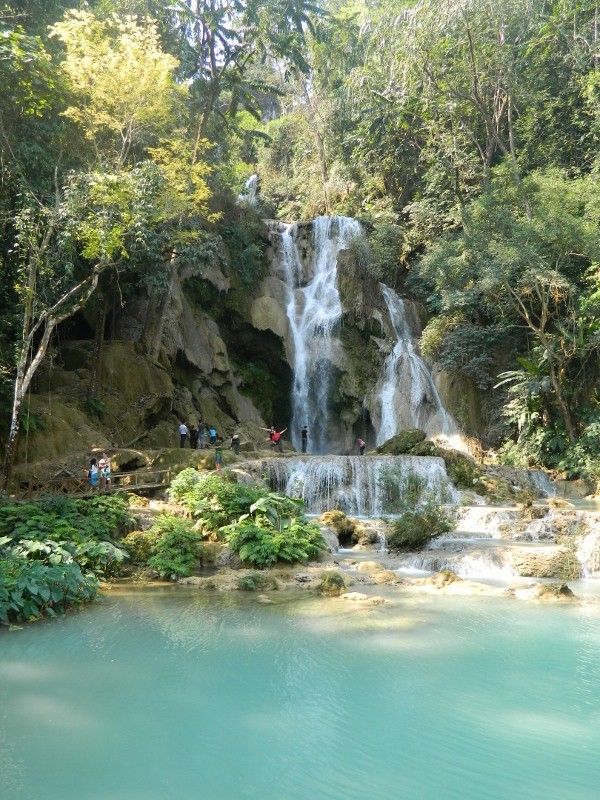
    Another beautiful waterfall in Laos, which I did pay to see. 🙂