Month: May 2016

  • Olive Oil on Everything—A Gastronomic Diary of Italy

    Sicily, 2013—where I first learned about putting olive oil on everything.
    Florence, Tuscany
    Gnocchi with fennel, mint and gorgonzola. A generous drizzle of olive oil (the frisky, green, good quality kind) on plain, unsalted bread.
    A lake near Rome somewhere
    Tiny fried fish, fresh marinated anchovies, mussels, salad with potato and octopus. Gnocchi with clams. Zucchini with mint. A drizzle of olive oil.
    Perugia, Umbria
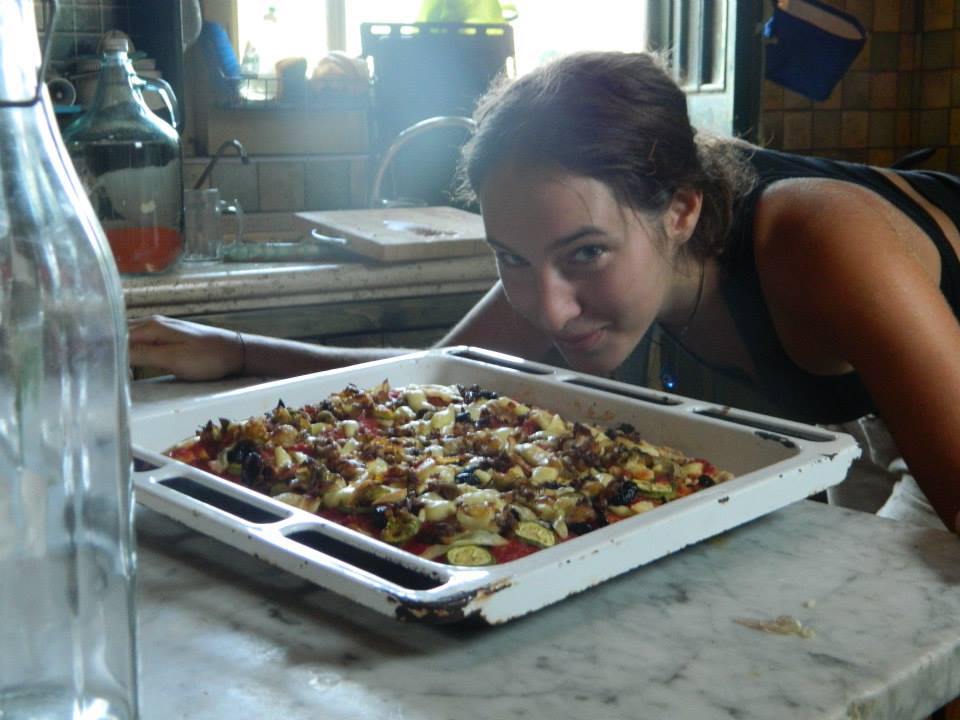
    Hands dry from chalk after climbing. Spaghetti with shrimp, zucchini and tomatoes. Olive oil from my host’s grandmother’s home. On the pasta—and on my hands.
    It was in Italy that I learned you can truly put olive oil on everything. 

    This most recent visit was no different.
    I mean the good stuff, of course. The fresh, tangy-green and gorgeous kind. The kind with bite and soul that tastes like it came from somebody’s grandmother’s farm (it probably did).
    Here is a short list of ways I have seen olive oil used to perfection:
    • Drizzled (well, poured, really) into tomato sauce after it is cooked and off the heat.
    • Applied to dry hair, skin and lips—best directly after the shower while skin is damp.
    • On a plate with sea salt and balsamic vinegar, for dipping (soaking) bread.
    • Drizzled over pasta, salad, cut vegetables, meat, pizza—everything, I’m serious.
    • Straight from the jug—just a taste, a drop.

    Olive oil is everything. Condiment and cooking base. Start and finish. Salve for the body and soul. I suspect it could heal a broken heart, too, though I haven’t tried yet.

    In the North, butter features prominently in many recipes—but in the South, it’s always olive oil.
    And that’s really it. I mean, I could keep listing mouthwatering Italian meals. That never gets old for me… but I suspect others might have a shorter attention span.
    Olive oil. On everything. My time in Italy, in a nutshell.
    Try it. Don’t be moderate. Italian grandmothers never are. 
    Find the good stuff. Apply liberally. Buon appetito!

  • What Makes this Mountain Different from all other Mountains?

    Villa Borghese Gardens, Rome
    Valle Aurelia, Rome, Italy
    This could be any street in any city.
    Mixed-era apartment buildings. Imposing stone architecture at turns. Cobblestones and pavement following no particular logic. Crush of cars and scooters. Cafes. Hairdressers. Passerby dressed in scales of gray.
    So, what makes this different from any other street—any other city?

    ***
    As we made our way along a dry riverbed, through native South African fynbos vegetation, toward a spectacular (but, again, arguably nondescript) stretch of shoreline, my friend put to me a similar question. Not quite verbatim, it was this:

    Most mountains are pretty similar. Most cities are pretty similar. There are trees and rocks and wide sky spaces. There are streets and cafes and passerby in scales of gray. So, what makes these mountains different? If we can go hiking at home, why ever go anywhere else? And if we do go, how do we choose? 

    Why these mountains?

    The question was philosophical in nature. My friend is nearly as avid a traveler as I.
    I would like to offer three answers to these questions—one of which sounds nice, one of which I believe most strongly, and one of which I feel, irrationally, to be true.
    It doesn’t matter which is which.
    First, terroir. Terroir is a French term I fell in love with while studying the anthropology of food. Essentially, it claims that taste is deeply rooted in place—territory. The elements unique to a given locale—water, specific bacteria, culture, human traditions, soil, weather, everything—combine to create the particular circumstances in which a given food item is produced. And we can taste it. While terroir is a culinary concept, I believe it can just as easily apply to cities, landscapes and really anything else.
    Thus, these mountains are made unique by an intangible yet undeniably meaningful agregate of water, culture, air, bacteria, soil, and human idiosyncrasy. 
    Why go anywhere? Terroir.
    Second, intuition. Some part of our deepest self knows where we need to be. It doesn’t make sense, and it can’t be proven, but those who have experienced will swear that the voice of intuition is real—and that it is always right.
    So, how do we know, how do we decide where to go? Instinct.
    Or third, the difference isn’t out there at all. It’s us. The mountains are, more or less, all the same. Trees and rocks and wide sky spaces. The cities, too. We, however, change, and we can understand that change by observing its reflection in the places we visit—or rather our experiences of them.
    What makes these mountains different from all the rest? We do.
    Or, most probably, the answer is some combination of the three.
    What makes these mountains different from any others? Nothing, or precious little. Yet, they will be different, because we will change—always.
    Why go anywhere else? Terroir. 
    And if it’s all the same, how do we possibly decide on one mountain, one city, one street over another? Oh yes, intuition.
    Maybe this could be any street in any city, but it isn’t. It’s this one—the one I’m in. And it is utterly unique, both for its composition of individuals, elements and other intangibles, and for my experience of it, in this particular moment. No other street in any other moment will ever be this. I don’t know why I’m here—and not in another street, city, mountain—but I trust the voice that called me.

  • Pillowcases in the Desert, Rainbows in the Forest, and Hippies in the Holy Land: Another Perspective on Israel

    Tzukim, Arava, Israel
    The whirring of the machine as I touch my foot to the pedal brings me back.
    To my grandmother’s home and her ancient Singer. To the costume room in the basement of my middle school theater. To my projects on the kitchen table in my childhood home in Brookline, Massachusetts.
    I haven’t used a sewing machine in a long time, and the rhythmic pull of needle on fabric is bringing me to a good meditative place.
    The air is so dry that drinking water does nothing for my thirst—the liquid seems to evaporate on my tongue—and there’s a super-fine layer of desert dust beneath my bare feet. (Hardly had we swept the floors, cleaning house to usher in Passover, than the relentless winds brought the dust back.)
    I’m staying with my brother’s friends and their five beautiful children in the mud house they built for themselves here in Tzukim; we (my brother and I) have been invited for Passover seder. They study and speak openly about Kabbalah, a central tenet of which is the concept of togetherness. And indeed, I feel more than welcomed here on my second stop of my second visit to Israel—I feel involved.
    Tonight, I am helping to sew pillowcases to decorate the rounded, light-filled common area of their home. Deep green, vivid red, heavy, rough, intricate, beautiful textiles. I hum tunelessly as I work; it’s a new habit I’ve found myself adopting since the term, “humming tunelessly” caught my eye in a book.
    The pillowcases are definitely of the wabi sabi variety—as is everything about the house. Perfectly imperfect. Made by hand with care and natural irregularity. Human. Filled with meaning.
    My brother’s friend works beside me, and she smiles when she tells me that each person who has stayed in the house has left a part of themselves in it. The pillowcases will be my part.
    ***
    After my last, particularly heavy post on Israel, I wanted to offer something lighter. A balancing perspective, if you will.
    The question came to mind: How would one write about Israel if it were just a place, with no history, no complexities and no enigmas—just sun and desert and sandy beaches and olive groves—a beautiful spot on the map? How would one describe it?
    Is such a thing possible? Of course not. Not for anywhere in the world. Total nonsense.

    And, what’s more, maybe misguided. 

    For, like my wabi sabi pillowcases, Israel is not beautiful—cannot be beautiful—in spite of its rough edges (rough edges is putting it mildly), but because of them. The same is true, I believe, for every spot on the map.
    ***
    Somewhere near Modi’in, Israel
    A man with one leg and no clothing flashes by, moving faster on crutches than I can usually manage to run.
    As we traipse in with our camping gear a little before dusk, a crowd near the entrance shouts, “Welcome home!” as they always do at these gatherings. Participants spread out across the forested space to make camp, collecting in small population centers, or venturing further afield in search of silence and solitude.
    The activity centers around the communal cooking area, and a large bonfire where most gather after the shared evening meal for drumming, singing and sometimes dancing. Gauzy dresses, dreadlocks and bare skin are as common here as head scarves and black hats in Jerusalem.
    This is Rainbow Israel, and if you aren’t familiar with Rainbow Gatherings and you want to understand what they are (you do), you should go here.
    We stay only one night, but I could have happily stayed a week. There’s something special about a community where anything goes, and (usually) nothing bad comes of it.

    Tel Aviv, Israel
    On my last night in Israel, I sit with an old friend on the steps of the big Synagogue, sipping a beer as we catch up on six or seven years of life. 

    He describes his experiences with medicines in Peru (yes, others would call them drugs), his work with sound healing and his studies on homeopathy and Kabbalah. I describe my work with elephant journal, a publication focused on mindfulness, my yoga teaching and my nomadic lifestyle. I think the intervening years have brought us both a good deal closer to our life paths.

    This last evening, along with other conversations, meetings and interactions like it, balances out my more complicated experiences of Israel, renders me more grounded in my time here. There’s violence and oppression in the Holy Land, but there are hippies too.
    So, what do wabi sabi pillowcases, rainbow gatherings and hippies all have in common?
    For starters, they’re all positive, forgiving, inclusive and somewhat alternative entities.
    And, they all exist in Israel.
    It would take many lifetimes to write enough to do justice to a single spot on a map. It would take a million voices, on a thousand days, to tell every facet of every side of every story cradling that spot.


    For now, I’ll content myself with having told two facets of one story—my own—and I hope you’ll be wise enough and brave enough not to take my word for it. Make your own stories, wherever you may be called to do so!

    ***

  • Okay, Let’s Talk about Israel

    View from Old Jaffa, Tel Aviv
    “If the Arabs didn’t kill me, my wife would.”
    Bloody hell. Did he just say that?
    After the split second necessary for me to process his words and maintain a neutral expression, I answer:
    “Why’s that?”
    “She doesn’t want me walking through the Arab neighborhood.”
    Obviously.
    We are talking, of course, about which gate to use to exit the kotel (the Western Wall, the holiest place for Jews to pray in Jerusalem).
    I think he means it as a joke, but it’s not funny.
    On this visit to Israel, I have been floored multiple times by this kind of abject fear, prejudice and even hatred—veiled and otherwise—toward the vaguely-defined “Arabs.”

    ***
    I don’t want to write about this hatred, but I feel I must. I could not in good faith write at some length on post-apartheid South Africa, yet stay silent on the subject of Israel. I don’t mean to criticize the incredible people who have welcomed me here, but I feel an obligation to present my experiences as they have been—without convenient omissions. I come from a class of American Jews for whom criticism of Israel is practically the equivalent of self-hatred. Yet, to be silent is to be complacent.
    ***
    Imagine my surprise when, fifteen minutes later, I learn that we are to join this man and aforementioned wife for Shabbat dinner.
    As we walk across the large stone plaza by the Western Wall (toward the “safe,” acceptable gate), the call to prayer echoes across the open space. It is, as I always find it to be, hauntingly beautiful.
    Dissonance.
    I steel myself for an… interesting (challenging) evening.
    But nothing ever happens the way we expect.
    Eighteen guests break bread (matzah) around a generously laden table, and before we take turns introducing ourselves, our hostess delivers a brief speech full of lovely sentiments on perspective, understanding and peace. 
    How we should all get along.
    Our hosts turn out to be warm, exuberant, slightly odd, good-hearted and generous humans. They delight in opening their homes to strangers every Friday night.
    The dissonance still has me reeling three days later.
    How can people who live according to laws of loving-kindness, compassion, charity and devotion also spread hate?
    It is the paradox of our times—perhaps of every time.

    ***
    I do not want to write about this ugly, complicated tangle of politics, identity, religion, culture and hate. But to stay silent is to be complacent.
    Growing up in Jewish communities in the U.S., I have seen how stories of persecution and oppression—and survival—perpetuate themselves.
    I know how seductive it is to believe ourselves always the David to another’s Goliath. Such archetypes are practically written into our genetic code. After all, everyone wants to be the hero, the victorious underdog, the resilient victim. To put it in contemporary terms, most of us see our obstacles with clarity—but rarely our privilege.
    All of us have our hands too close to our faces to read our palms.
    And six years ago, when I first visited Israel, I was still too close to the flattering, awe/fear-inspiring story with which most Jews are inoculated. Two years ago, when I wrote my senior thesis in Anthropology on female Jewish identity, I had taken a few steps back.
    Again, I have gained more perspective.
    I am hardly informed enough to offer you a well-shaped, well-researched and well-defended opinion, but neither am I too scared to present my experience and observations as I have found them, with as much accuracy as any individual could hope to achieve.
    I don’t have any answers to offer, but I have questions that are churning in my brain, and I want them to churn in yours, too.
    ***

    Market abundance.
    “Now, some people are saying that Israel is an apartheid state,” he says in a classic Brooklyn accent unaffected by twenty plus years living in Israel.
    The patriarch of the family (another family, in another Jerusalem neighborhood, for another Passover week dinner) sits at the head of the table.
    I certainly wasn’t planning on opening that can of worms, and I hold my peace while he holds forth.
    “That is simply not true.”
    He goes on to explain why point-to-shoot, border walls, checkpoints and other security policies are justified and necessary to the self-preservation of the Jewish people.
    I hold my peace and wait for the subject to pass.

    But it’s so much more complicated.
    While in Cape Town, I, too, heard some people—many people—referring to Israel as an apartheid state.
    Takes one to know one?
    I don’t know. I do know, however, that the arguments are compelling and not insubstantial. It’s not an entirely ludicrous claim, as others would declare.
    This family of religious Jews is, like the other, extraordinarily kind, warm, welcoming, generous and loving.

    They ply us with food, wine, friendly interrogation on every aspect of our lives. There is joy and laughter and exuberance at this table, and we are folded into the melody. Yet, every so often a “joke” slips out at the edge of conversation, and the note falls flat on my ears.
    Dissonance.
    Again, my mind turns over and over the same questions:
    How can people have such open hearts, yet such narrow minds? How can we preach love, but spread hate? How can we celebrate our survival, and at the same time justify—advocate for—the oppression of our fellow man?
    I’m not deaf. I’ve heard this dissonance a hundred times in a hundred places. Contradictions spoken by a hundred mouths in a hundred languages. The pairing of hate and love in a hundred hearts; the conflict of logic and fear in a hundred minds.
    But this, now, in Israel, is different for me.
    It hurts me to see a group of people—to whom I belong; whom I am proud to call my own; whose story of survival is my story of survival—display these confusing contradictions.
    Dissonance.
    The shelves of history are crowded with stories of the oppressed who became the oppressors—the Hutu and the Tutsi; the early pilgrims to America; Britain (if you go far enough back); Burma/Myanmar—a narrative so common as to almost be an historical cliché.
    It is easy—too easy—to live out the patterns of conflict handed down by past generations. In Israel and Palestine, these stories exist now in abundance on both sides of the proverbial—and literal—fence.
    It is far harder to pull our hands away from our eyes and read the map of where we have walked—and where we are walking.
    Is Israel an apartheid state? I’ll leave that to the history books to answer, though we know those will only ever tell part of the story.
    I am far more concerned with the answer to this:
    How can people have such open hearts, yet such narrow minds? How can we contain such love and generosity—and such anxiety and fear—within our individual—or national—bodies?
    I would like to know.
    I don’t.

    I do know, however, that I wish I had not held my peace for the sake of harmony—as I so often do. For to stay silent is to be complacent.
    ***
    I regretted saying nothing at that first dinner, so at the second dinner, when I introduced myself to the 19 other guests and our hosts (the instructions? talk about something—anything), I told a story. It wasn’t a Jewish story; I think I’ve heard it’s Cherokee, and the original version I saw goes like this:

    An old man is teaching his grandson about life. “A fight is going on inside me,” he said to the boy.

    “It is a terrible fight and it is between two wolves. One is evil – he is anger, envy, sorrow, regret, greed, arrogance, self-pity, guilt, resentment, inferiority, lies, false pride, superiority, and ego.” He continued, “The other is good – he is joy, peace, love, hope, serenity, humility, kindness, benevolence, empathy, generosity, truth, compassion, and faith. The same fight is going on inside you – and inside every other person, too.” 

    The grandson thought about it for a minute and then asked his grandfather, “Which wolf will win?” 

    The old Cherokee simply replied, “The one you feed.”

    I don’t know if my message reached anyone, but at least this time I tried. 

    And I’ll keep trying.