Month: August 2016

  • La Notte della Taranta—or, Where I was on Saturday

    A post shared by Toby Israel (@tobyintheworld) on


    On the road to Melpignano

    Melpignano, Puglia, Italy; Saturday, 8:00 p.m.

    The sound of tambourines fills the air—not just from the stage, where the opening acts are performing, but also from thousands of tambourine-bearing audience members.

    Raucous festival-goers pass around three-liter jugs of local red wine. They dance in pairs, sometimes circles, in a style of dance that (to my Jewish eyes) most closely approximates the hora.

    It’s an odd blend: mostly Italians, from babies in carriages to elderly observers avoiding the crush in the center of the crowd (here, things more closely resemble a mosh pit), but mostly young people. Most appear to know the songs and sing along; many know the traditional steps, too.

    The main concert hasn’t even begun, and it’s already difficult to find a free patch of ground close to the stage. I have come from Rome for five days, pretty much just to witness this unique event. After hearing about the Notte della Taranta and the Pizzica style of dance and music that goes with it, I became fixated on experiencing it for myself.

    The History:

    In the twenty-first century, La Notte della Taranta (the Night of the Tarantula) is a modern music festival occurring every August throughout the Salento region of Puglia (Apulia) and culminating in a finale event in Melpignano. Its roots, however, stretch much, much farther back. The event centers on the Pizzica, a style of folk music and dance that originated in the Salento region in pre-Christian Italy.

    According to tradition, women in this region would become possessed by the spirit of the tarantula after being bitten by a spider during a certain season. They would begin to act out with strange antics and wild dancing. Nights of the Tarantula would break out in various villages as the spirit spread and more and more women succumbed to its grip.

    Now, through a modern anthropological lens, this is a clear case of a ritualized upheaval of social order and codes, whereby women living in an oppressive culture could express rage and wildness in a way that would normally be totally unacceptable. Stories of possession by various animal spirits, leading to trance, hysteria or other phenomena, abound across world folk cultures.

    La Notte della Taranta Today:

    I can’t speak too much to this, having only been to the main concert. Today, at least in Melpignano, the tradition seems to have been somewhat sanitized. 200,000 attendees can do that. The Pizzica has come a long way from the village square, and it looks a lot different with lights and sound production and weeks of rehearsal than (I imagine) it would have even a century ago.

    But who cares? I was hypnotized by the twirling white skirts on stage, fascinated by the folk lore surrounding the spirit of the spider, and enchanted by the percussive rhythms rolling on for hours.

    Worth the trip? Absolutely.

    Some outcomes of this excursion:

    1. I own a tambourine—which i can’t stuff into my backpack and which I will have to figure out how to carry with me everywhere.
    2. I must add another dance style on my to-learn list.
    3. I have a new love for a layer of Italian culture I never even knew existed until a few months ago.

    Looking for somewhere to go next August? Maybe check it out—don’t buy a tambourine, though.

    Youtube video

    Skip to minute 4:00 if ten minutes of Italian folk music isn’t your thing.


    Youtube video
    Skip to minute 5:00 to see a bit of traditional dancing.


    ***
     
  • The Intoxicating Unknown, and Solitude

    The Intoxicating Unknown, and Solitude

    The plane lands with a jolt. Rolls to the gate. Shuts off the engines.

    You and the other passengers file off the aircraft. Through the terminal. Past immigration. Baggage Claim. Customs.

    You step outside into a country where you know no one.

    Perhaps you don’t speak the language. The air is different. Heavy and humid. Or maybe cold and sharp. Your nose catches new smells and catalogues them as memories—later, this will be a remembered place.

    Welcome. You have just crossed into a vast field of unknowns.

    Is it terrifying—or exhilarating?

    Someone asked me recently if it ever gets lonely, this solo traveling.

    There are many answers to that question. I’m having a bit of deja vu, because I think I’ve offered some of them before (maybe in this, or this), but I have something new to say about it today.

    Basically, no, I don’t.

    I have experienced dozens of iterations of the above scenario—arriving by air, land or sea—and for me it is always exhilarating. That is, in part, why I will fly from Rome to Agadir, Morocco at the end of September—to spend six or seven weeks in a place where I know nobody.

    While I love traveling with or visiting friends (and do so often), I crave the spaciousness that only comes with solitude. Maybe you do too.

    Nothing can replicate it. It arrives the moment we leave every known thing behind us. Hug our loved ones goodbye outside the airport. See our traveling companion to the train station, then turn back to a foreign city alone. Click “complete payment” on a one-way ticket for one.

    Solitary spaciousness arrives when face the forest, the mountains, the desert—whatever our alluring yet frightening place may be—with a pack on our shoulders and uncertainty in our chest, knowing that no one is coming with us this time.

    Does that scare you? It probably should. There are monsters in the forests, the mountains and most of all the cities. But more than that—more than that there are monsters in our hearts and minds.

    I believe that is what people fear most of all when they fear setting out to travel alone. There is the external risk, of course, but I suspect loneliness—ourself facing ourself—instills greater terror.

    Why don’t I ever get lonely, then? I’m not actually sure, not entirely. Maybe I do, but it no longer scares me, and so I call it solitude instead of loneliness. I do know this:

    Our comfort zone expands every time we step outside of it and thrive there. There is nothing more intoxicating, full of life and purpose, than entering the unknown territory alone.

    So go.

    “The cave you fear to enter holds the treasure you seek.”

  • This Is Why We Walk—Maybe

    This Is Why We Walk—Maybe

    spain, camino, walk

    Ancient Practice in the Modern Landscape


    Sixteen kilometers of open road. No turns. No twists.
    The trees are thick on either side, and I’m grateful for the shade they provide. The road tilts up, then drops down again. Relentless.
    It is my third-to-last day on the Camino del Norte. My legs are already tired, my feet already sore. I have walked already ten kilometers when I begin this section of road.
    Normally, there are trails, or a dirt edge to walk on at the least. Not today.
    The occasional car speeds past. They will arrive at the end of the road in minutes.
    The road is hard. Straight. Empty.
    Relentless.

    ***

    I’ve said it before: traditions have a way of reviving themselves.

    We as humans are wired for ritual. We seek it, gravitate toward it and cling to it, and when we don’t find it the world suffers.

    It has been theorized that there is a cross-cultural link between lack of ritual and conflict. Or, to put it positively, ritual is a necessary component of conflict resolution. That’s a longer discussion I’d love to have with you personally.

    If this gravitation is (as theorized) a response to a lack of ritual in modern society, the wild success of trends like yoga and meditation would arguably be the same. I believe that tendency to seek meaning through practice has everything to do with the recent resurgence of interest in the Camino—and other pilgrimage.

    The juxtaposition of this ancient journey with the modern landscape through which it now passes fascinated me from start to finish.

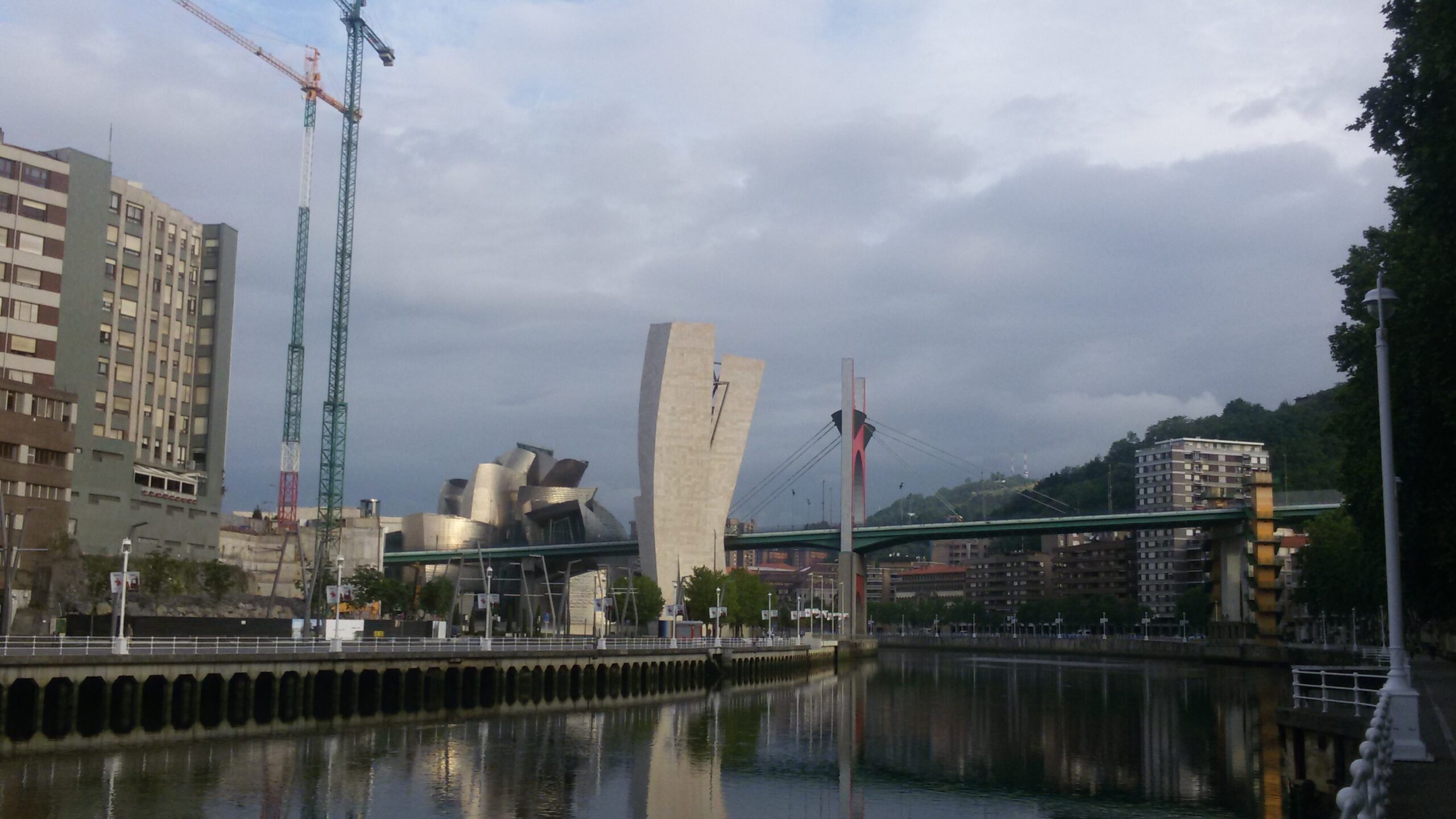
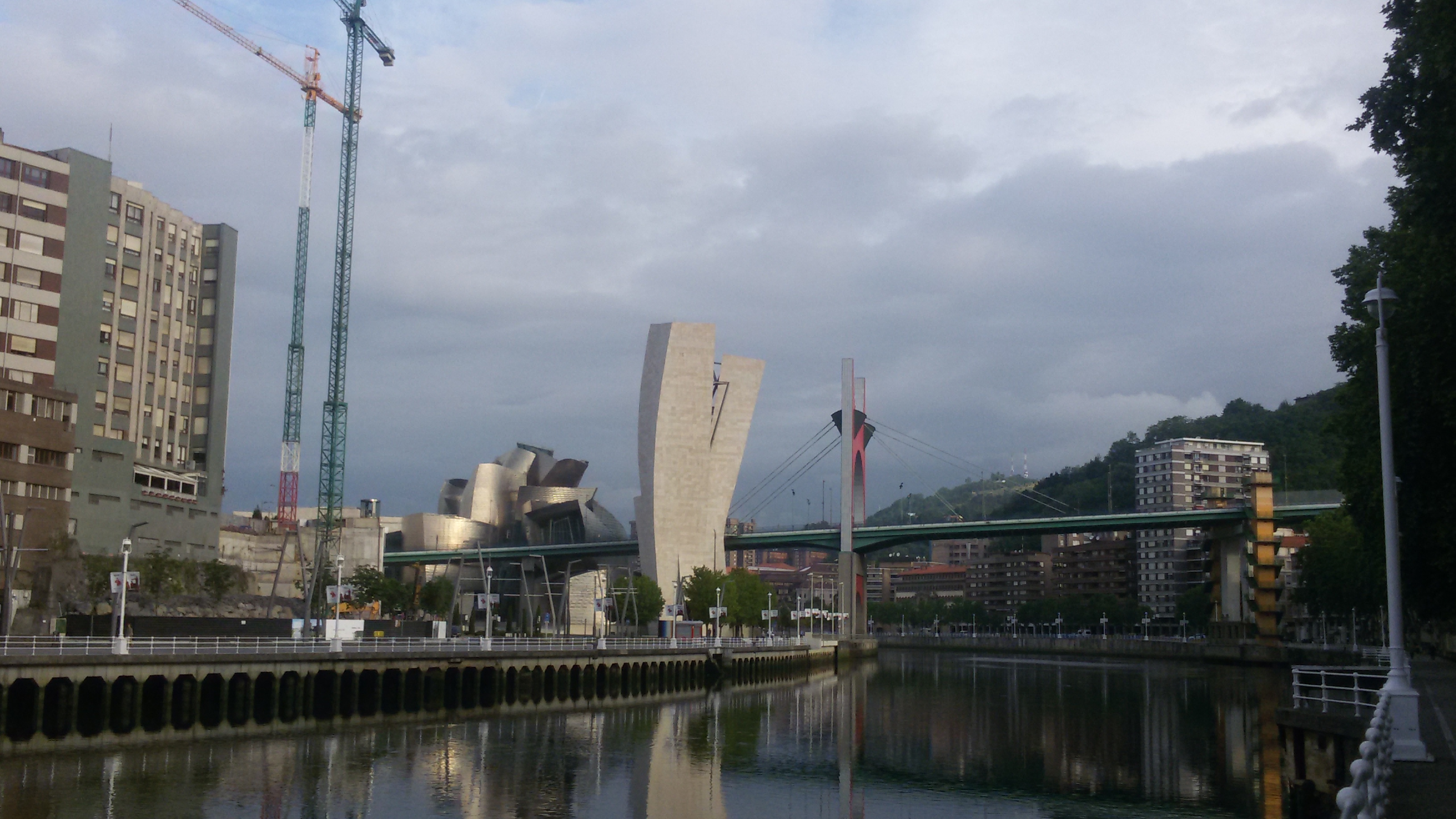
    What does it mean to walk a centuries-old trail alongside a six-lane highway? Beside a railroad track? Through a buzzing city like Bilbao?

    How does the addition of asphalt, smartphones, gortex and wifi change the experience? Enhance it? Devalue it?

    If you change everything—the trappings, the clothing, often the landscape, the food, the language, the Road itself—but keep the journey, is it still the same Camino?

    I’m inclined to say yes—in spirit.

    If you take a human body, give it artificial limbs, blood transfusions, organ transplants—replace everything, say—do you still have the same person?

    Your answer may depend on whether or not you believe in a consciousness, a soul, a Self (call it what you will) that is greater than the sum of all its parts.

    If you change every piece of the Camino, from the culture around it and the people walking it to the very structure and environment of the journey, what remains the same?

    In my opinion, it is the spirit of the journey. It is the seeking, the act of walking, that has somehow drawn us across history to follow the same path.

    And you can lament the omnipresence of wifi or cell service, you can dismiss the validity of smartphone navigation, you can wax poetic about the good old days when pilgrims carried nothing but a skein of water and the cloaks on their backs…but to what end?

    This is our world.

    There is asphalt that wears down our joints. There are trains that travel many times faster than our feet. There is social media and multiculturalism and sturdy trekking gear.

    One thing has not changed.

    Us.

    We still walk on two feet (when we choose).

    We still require food and water to survive—for now.

    We still seek—relentlessly—to create meaning in our lives.

    That is why, I believe, an ancient rite like the Camino de Santiago still makes sense. In spite of this modern world and modern landscape. Maybe because of it.

    It is not just possible, but perhaps necessary to walk the same paths we have walked for centuries. Maybe that connection is the ritual we’re seeking.<

    What do you think?

  • Did You Find What You Were Looking For? (Camino Reflections, Part 10000)


    My last visit to London, in July of this year, I had dinner with a former classmate. We had taken “Intro to Buddhism” together.
    I didn’t know it then, in my first semester at Middlebury College, but many themes from that course would wind their way through the following years of my life.
    Over our glasses of red wine—Merlot, I think—I recounted a memory of that class that stands out from the rest. It’s funny, sometimes, what ends up sticking in our minds.
    Someone had asked our professor if he wanted to reach enlightenment—if that’s what he was seeking.
    He had answered softly (he always spoke softly):

    “I’m not so interested in enlightenment. I’m interested in the possibility of expanding my awareness.”

    Maybe this is unhelpful, and maybe I’ve spent too much time around Buddhist philosophy, but this is what I have to say in answer to that oft-repeated question, “Did you find what you were looking for.”

    No.

    Longer answer: 

    I wasn’t looking for anything, so I doubt I would find it. That’s the difference between a trip and a journey—only one has a destination.
    I found no thing on my Camino journey. Nothing. I did not have any epiphany. My life did not change.
    If you set out walking (meditating, praying, anything) in search of enlightenment, I think you will be disappointed.
    And that’s not depressing; it’s inspiring. It is exhilarating, this not knowing. It is enthralling, this seeking-but-not-finding. It is magnetic, this grey in-between-ness of no-thing—neither empty of wisdom nor full of answers.
    If “no” is not a satisfying response, I’m sorry, but it’s the only one I’ll give—at least for now.
    No, I did not find what I was looking for.
    I wasn’t looking for, you see.
    Something on the same subject I wrote about halfway through the Camino, in a moment of clarity:

    “Will I come back wiser?” asked my ego. 

    I don’t know, my more honest self replied. I think I’d be the last to know.Do any of us come back “wiser” from anything? 

    I have my doubts. 

    I will come back with bigger calves from walking and stronger shoulders from carrying my pack. 

    This is certain. 

    I will carry in my heart thirty peaceful mornings where dawn breaks over still meadows, and the wind whispers a song only I can hear. 

    This is certain.

    I’m not interested in finding. The beauty is in the in-between.

    ***