Month: September 2016

  • “Don’t go to Morocco Alone.” And other Fear-mongering you should Ignore.

    A rooftop terrace in Taghazout, Morocco.

    Me: “I’m thinking of going to Morocco.”

    Everyone: “Awesome! Just don’t go alone.”

    As you may have guessed, I didn’t listen to everyone, and here I am: in Morocco, very much solo, and so far quite pleased about it.

    (For the next month, I’ll be living in Taghazout, a small town on the Atlantic coast, teaching some yoga, learning the fine art of surf bummery, and generally winding down after an overly hectic few months. And I’ll have time to visit a few Moroccan cities afterward, not to worry!)

    There is a saying here, which a new friend taught me:

    One rotten fish can make the whole bucket stink.

    For those who work in the tourism industry, that rotten fish (in the form of robberies, political unrest or an isolated attack) is the proverbial boogeyman. Just a whiff of danger and foreigners will cancel their flights. An act of terror (as occurred while I was living in Kenya)? Total disaster for the industry—and, by extension, a great many people’s livelihoods.

    I digress somewhat. I don’t to tell you what happens to the tourism industry when the fear-mongers win. I want to tell you why you shouldn’t listen to them in the first place.

    Every country- or city-shaped bucket has a rotten fish—often many.

    In my opinion, those rotten fish are the reason why people will tell women not to travel solo to India, Zanzibar, Turkey, fill-in-the-blank-with-your-country-of-choice. “It’s not safe.” “Men don’t respect women there.” “It won’t be pleasant.” Et cetera, et cetera, et cetera.

    And sure, there’s a good chance I will encounter an asshole or two before I leave Morocco in six months’ time. I’ve spent time alone in all of the aforementioned countries, and I’ve had occasional negative experiences in all of them (though always far outweighed by the positive). But do you know where I’ve encountered the most assholes? On college campuses in the U.S. In Parisian metro stations. Walking down the street in Boston.

    So what can we learn here?

    ***

    Well, for starters, check your assumptions. Are you giving more credence to warnings of danger or disrespect because the destination in question is “over there”? Keep in mind that nowhere is perfect, and nowhere is particularly “safe.” I have yet to investigate, but I’ve heard Morocco may be one of the statistically safest countries in the world. Chew on that.

    Second, ask yourself if you’re discounting cultural differences. If so, you may be falling victim to the understandable yet problematic epidemic of Western ethnocentrism. That is, judging another culture purely by your own values. Quick tips for women wishing to avoid harassment while traveling alone: cover your hair, cover your shoulders, and cover your legs (generally, follow cultural codes for modesty and behavior). Oh yes, that’s problematic in its own way, and I take issue with it sometimes, but we don’t get to make the rules when we visit someone else’s home.

    Lastly, choose your devil, because there is nowhere—nowhere–you will be utterly and inalterably at ease.

    ***

    I (and just about every woman ever) learned since birth to fear. Fear attack. Fear violence. Fear bad men. Fear everything, right? Society teaches us that.

    And it’s true. Of course it’s true! The world is a scary place. Especially for women. We’re working on it, but we have a very, very long way to go. Change, however, has never happened when we stick to the status quo. Fear-mongering doesn’t keep us safe; it keeps us the same. So if you want something different, you have to ignore the fear-mongers.

    There’s a lot of space between reckless risk-taking and bubble-girl-style caution. Here’s what you may find there:

    > Deserted tropical islands where you can run naked across miles of sand, because you are totally, beautifully alone.

    > Kind shop owners who will invite you inside for tea, show you pictures of their wife and children, and invite you to stay with their family if ever you return to their country.

    > Fascinating strangers on trains, buses and trails, in hostels, campsites and smoke-filled restaurants, whom you never would have met if you hadn’t been traveling solo.

    > The best meal of your month, discovered only by following your nose and your intuition (yours alone) through a labyrinthine bazaar.

    > And last, but unavoidably, rotten fish. It’s part of the travel bucket. But hey, it’s part of every bucket, and you can’t avoid them all.

    I hope, if nothing else, this will make you think—maybe reconsider. Please share your thoughts in the comments if so inclined!

    ***
  • Zen & the Motorcycle Passenger

    Sorrento Coast,  Italy

    (Mom, you’ll want to skip this one.)
    The headlights of oncoming cars are a blur as we race down the center line of the autostrada (highway) from Sorrento to Napoli. I settle into the peculiar flow of this navigating traffic as we weave in and out.
    Yellow lines, black sky, breathe in, breathe out.
    Yellow lights, black tires, breathe in, breathe out.
    Accelerate, brake. In. Out.
    It’s just me (passenger-monkey) and my friend (driver-pilot). Fear hopped off this train hours ago, and I’ll tell you why.
    ***
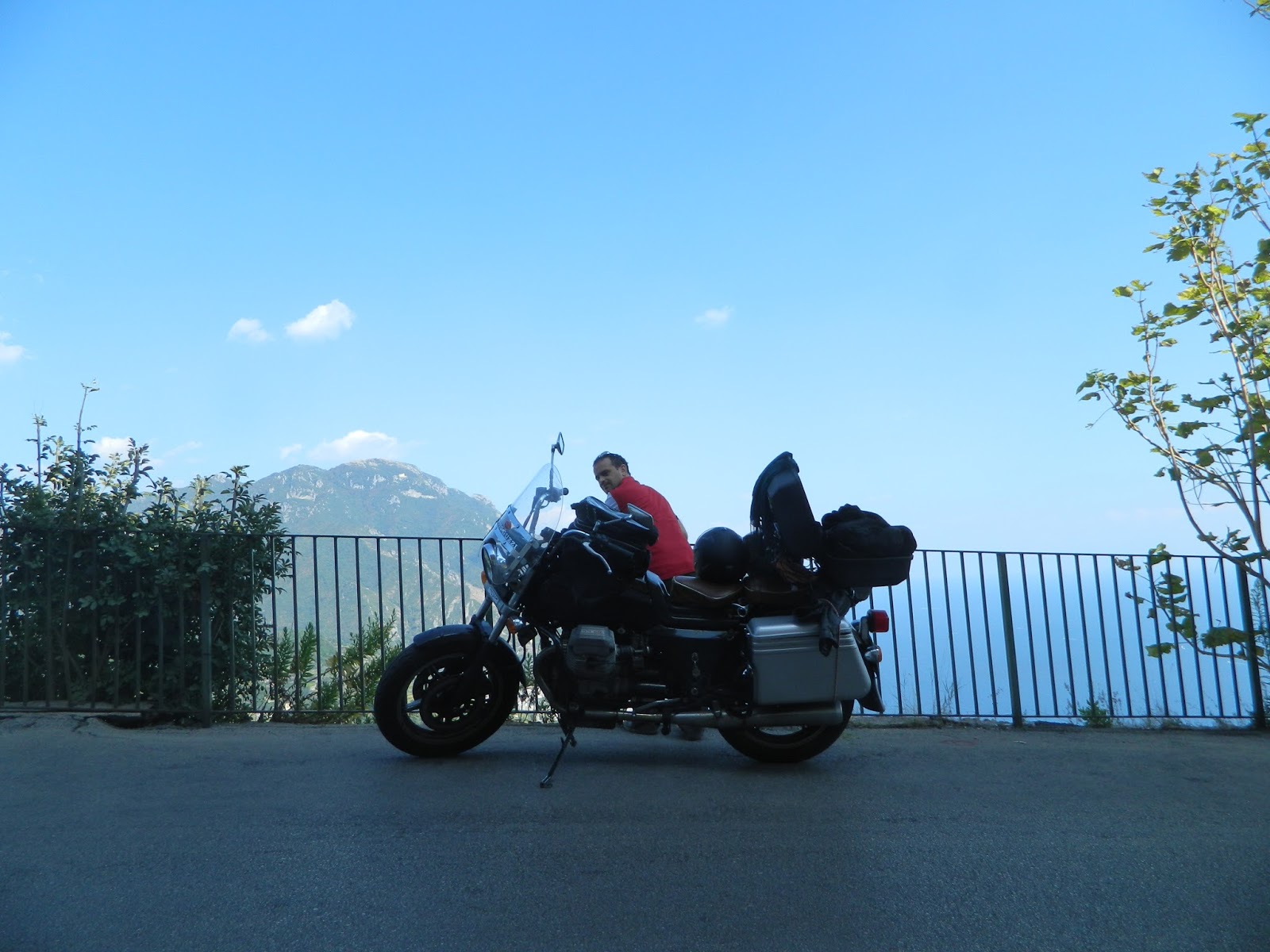
    È stata una giornata bellissima. It was a gorgeous day. Perfect. My friend met me with his vintage motorcycle at the Salerno train station (a half-hour train ride from Napoli), and we (along with seemingly every Italian ever on this last weekend of summer) set off for the Amalfi Coast.
    The fresh wind in my face balanced the hot sun as we followed hairpin turns opening onto one dazzlingly beautiful vista after another. The hum (or, more accurately, roar) of the engine blended with the waves and the wind, and conversation was sparse. The sky turned to dusty rose, orange, teal as we rounded past Amalfi and up the Sorrentino coast at sunset.
    I must have contemplated my death a hundred times that day.
    I usually do when I travel as a motorcycle passenger, and I don’t think it’s morbid. There is a quality of zen to this process of that renders it uniquely compelling for me.
    There’s the, “oh shit, this is dangerous” moment, followed by the, “there’s nothing I can do to change my vulnerability in this situation” realization, culminating in (temporary) total surrender to the inalterable fact of my own mortality.
    Then a sudden acceleration and, “oh shit,” and we begin again. As the minutes or hours blur on, I slowly stop picturing the many gruesome ways in which this could end badly, my pulse slows, and my shoulders relax. Once that last ripple of fear smooths out, I ender a space of zen acceptance—it’s pretty blissful there.
    If you’re thinking I sound nuts, allow me to ask you a question:
    How often, in your day-to-day life, do you contemplate your own mortality?
    If you’re a healthy, well-enough-off human, I’m guessing it’s not all that often. And yet, we are all mortal; we are all helplessly vulnerable to myriad risks. We all walk a fine line between life and death all the time.
    We are all on a precipice.
    ***
    That yellow double line of a Napoletano highway, framed by black sky and black asphalt, is only a metaphor, no more and no less terrifying than the reality we all face. Every day.
    The magic of this motorcycle zen is not the “added risk.” Rather, it (and surely a thousand other activities) forces me to reckon with the transience always enveloping me—always enveloping us—and to breathe in, breathe out, and enjoy the view.
    ***

    I took a video so you could catch a view, too!

     
  • 3 Macabre Stories that Capture the Essence of Napoli

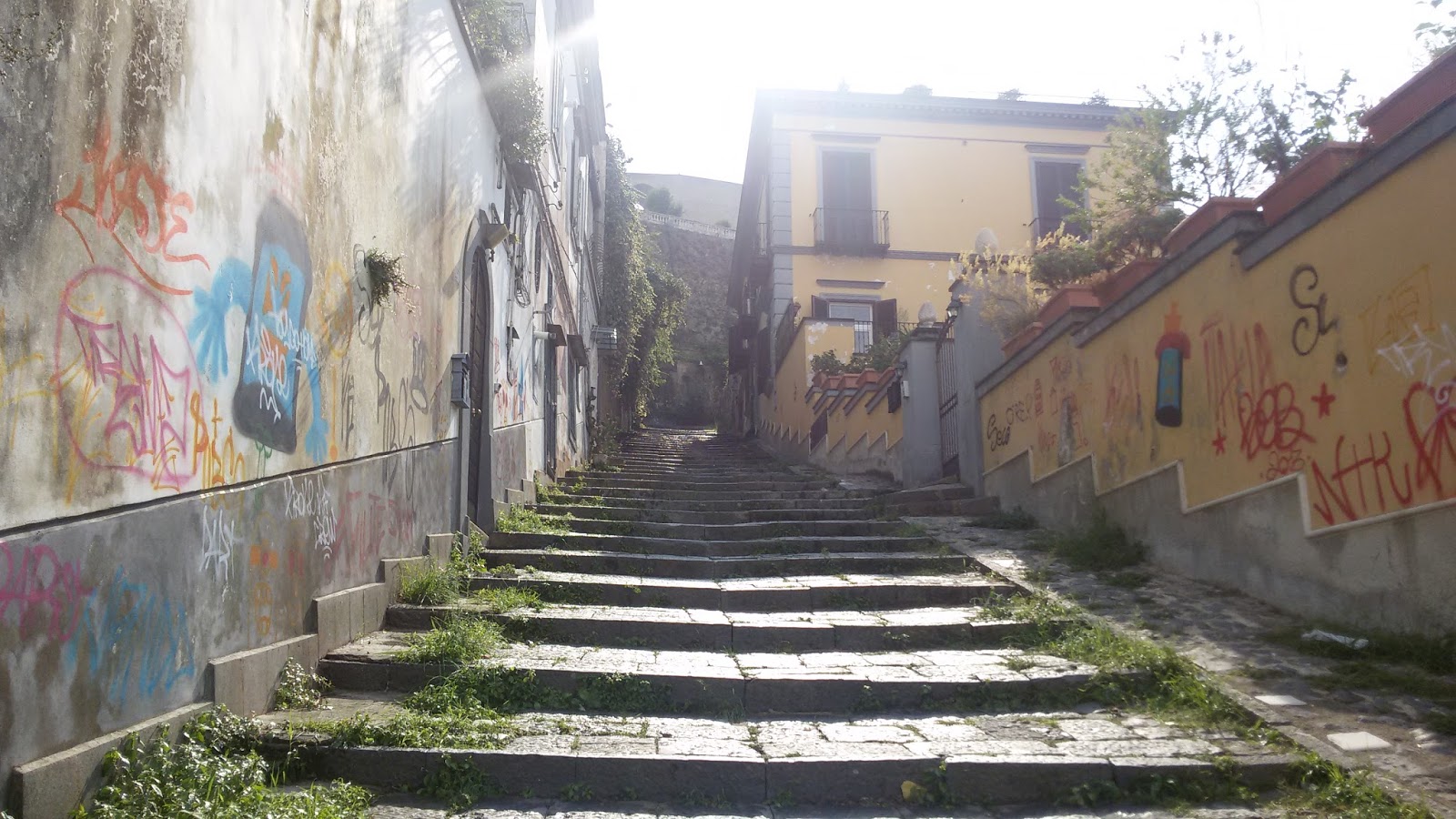
    Climbing hundreds of stairs for a good view, as per usual.
    Thursday, 1 September, Napoli, Italy

    The weather was a bit mercurial, and we took shelter from a sudden downpour in a nearby cafe. As the storm passed and we prepared to continue on our way, my friend (a Napoli native) informed me that we were about to cross an invisible boundary. 
    The police don’t come to this part of the city. It’s controlled by a powerful family (think mafia). Recently, three young men from a different, neighboring family were shot dead as they walked down the street.
    Suffice it to say, this was not a safe neighborhood. At least, unlike most tourists, I was acutely aware of the risk involved as we ambled onward on our quest for the best sfogliatelle in Napoli (and thus, seeing as it’s a Neapolitan specialty, the best sfogliatelle in the world).
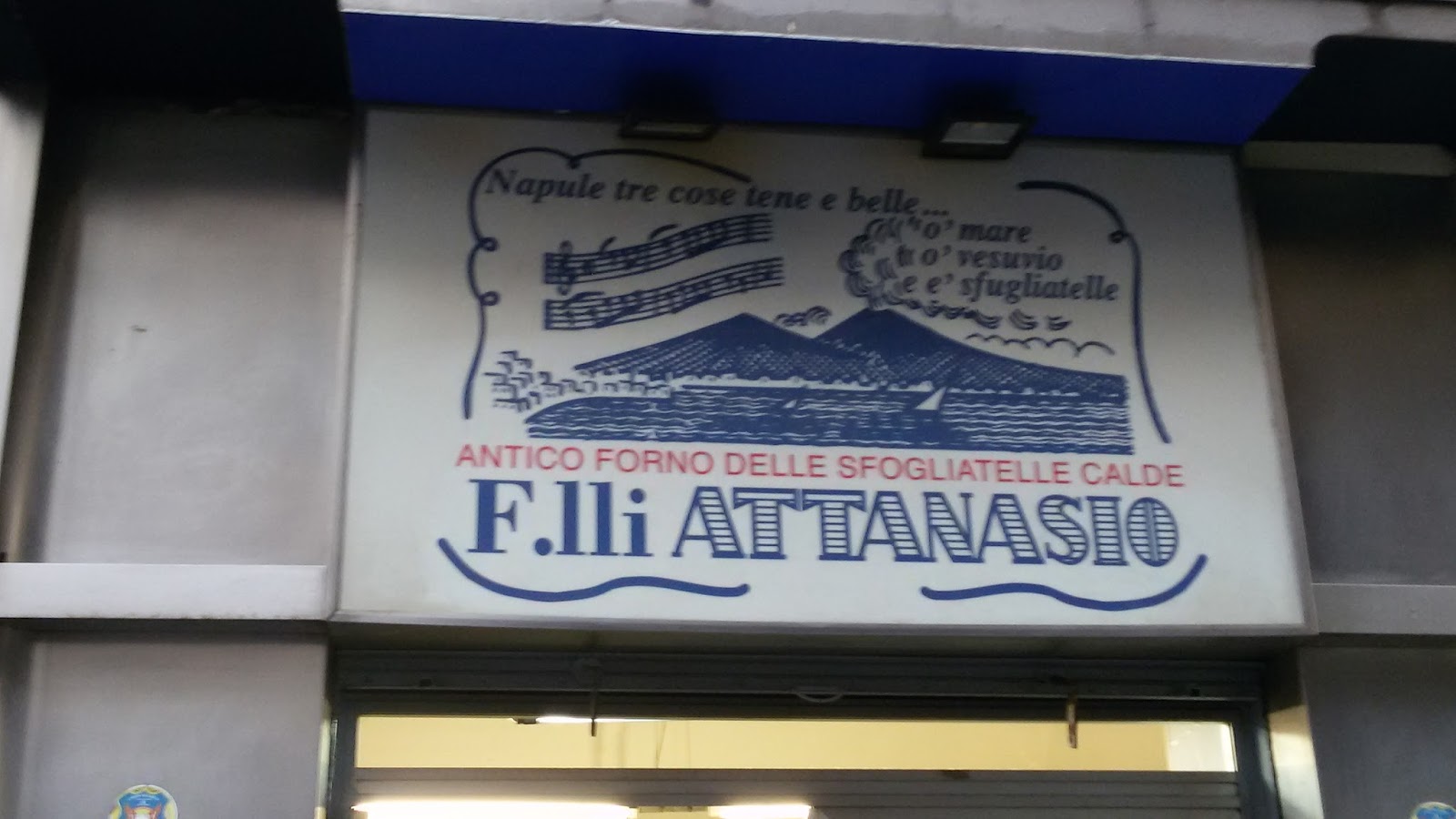
    Go fish! Can you find this famous Napolitano bakery? 🙂
    Now, if you’re thinking it’s insane to risk your life for a pastry, you’ve never eaten sfogliatella.
    Flaky layers of crisp pastry, artfully shaped to resemble a seashell, filled with sweet ricotta cream lightly flavored with local orange, and dusted with powdered sugar—one is already too much, too rich, and yet I bought four just in case.
    Napoli has a bit of a reputation as the more dangerous, more sordid Southern cousin of the well-frequented tourist destinations to the North (Rome, Florence, Venice, Milan). And indeed, the crowded warren of twisting streets layered atop a cavernous subterranean void (in turn layered atop the lava fields that fuel Vesuvius) is not the Italy many tourists may imagine.
    It may be better.
    As we walked from one end of the city to the other on our quixotic pastry mission, my friend, uniquely knowledgeable about Napoli’s architecture, history, language and culture, regaled me with stories—many macabre—that endeared me to this dark gem of a city.
    Here are three of them:

    Rub a skull for good luck.
    The Old Ladies and the Catacomb Skulls
    Twenty years ago, the old ladies of Napoli still maintained this tradition, originating in the plague years, or perhaps the war years (regardless, years of extraordinarily high mortality rates). Each would “care for” a particular skull in the catacombs beneath the city, bringing it flowers, offering it prayers, and grieving the death of a stranger who perhaps had no family left to mourn their passing. Sometimes, vicious arguments would break out over a particular skull when more than one woman lay claim to it. Questa è la mia testa! No! È la mia! (This is my head! No! It’s mine!) Talk about macabre.
    San Gennaro (Saint Januarius), Patron Saint of Napoli, and the Curious Affair of the Keys to the Church
    San Gennaro is not officially a saint, but don’t try telling that to the citizens of Napoli, who are particularly dedicated to their patron. A vial of the saint’s blood purportedly resides in the main church of the city, and twice a year, the miracle of the liquefaction takes place, in which the dried remains turn to liquid once again. Interestingly, the remains of San Gennaro do not belong to the church, but rather to a mysterious ancient sect with a centuries-old history in Napoli. They allow the church to hold the remains in exchange for the keys to the building. If you’re picturing creepy Satanic rituals in the catacombs of the cathedral, yeah, I’m right there with you.

    L’Ospedale delle Bambole (Doll Hospital)—a whole different kind of creepy.
    The Hospital of the Incurable Ones
    In medieval times, when pilgrimage to Jerusalem was a popular undertaking, Napoli occupied an important step along the journey. In plague years, and other times too, pilgrims would frequently fall ill and find themselves unable to complete their pilgrimage. Many of these stopped in Napoli, and the city became their final resting place. The Church built a thriving business around this occurrence, constructing buildings to house the sick and dying—partially out of Christian charity, surely, and partly because dying pilgrims, unable to reach Jerusalem, proved particularly disposed to leave everything to the Church instead. One of these, L’Ospedale deli Incurrabili (Hospital of the Incurables), still operates today, although I believe it is more concerned with saving lives than saving souls.

    This dark and fascinating history lays a particular foundation for the vibrant crush of life filling Napoli today. Young people sporting dark 70s-style fashion, 80s-style hair, lots of attitude and even more tattoos loiter outside cafes, nightclubs, pizzerias and bars. Crowds line up outside the best gelateria, stroll along the waterfront and press into the narrow streets of the Old City. The Napoletano language is alive and well, spoken by many if not most locals, changing and adapting as any healthy, living language should. Musicians play tarantela in the streets, and motorcyclists and pedestrians weave past, seemingly unaware of one another, in a seething dance. 

    There is life here. Tons of it. And maybe that’s the point of all the macabre underpinnings; they tell a story about all the living happening now.

    ***