Tag: solo travel

  • Did You Find What You Were Looking For? (Camino Reflections, Part 10000)


    My last visit to London, in July of this year, I had dinner with a former classmate. We had taken “Intro to Buddhism” together.
    I didn’t know it then, in my first semester at Middlebury College, but many themes from that course would wind their way through the following years of my life.
    Over our glasses of red wine—Merlot, I think—I recounted a memory of that class that stands out from the rest. It’s funny, sometimes, what ends up sticking in our minds.
    Someone had asked our professor if he wanted to reach enlightenment—if that’s what he was seeking.
    He had answered softly (he always spoke softly):

    “I’m not so interested in enlightenment. I’m interested in the possibility of expanding my awareness.”

    Maybe this is unhelpful, and maybe I’ve spent too much time around Buddhist philosophy, but this is what I have to say in answer to that oft-repeated question, “Did you find what you were looking for.”

    No.

    Longer answer: 

    I wasn’t looking for anything, so I doubt I would find it. That’s the difference between a trip and a journey—only one has a destination.
    I found no thing on my Camino journey. Nothing. I did not have any epiphany. My life did not change.
    If you set out walking (meditating, praying, anything) in search of enlightenment, I think you will be disappointed.
    And that’s not depressing; it’s inspiring. It is exhilarating, this not knowing. It is enthralling, this seeking-but-not-finding. It is magnetic, this grey in-between-ness of no-thing—neither empty of wisdom nor full of answers.
    If “no” is not a satisfying response, I’m sorry, but it’s the only one I’ll give—at least for now.
    No, I did not find what I was looking for.
    I wasn’t looking for, you see.
    Something on the same subject I wrote about halfway through the Camino, in a moment of clarity:

    “Will I come back wiser?” asked my ego. 

    I don’t know, my more honest self replied. I think I’d be the last to know.Do any of us come back “wiser” from anything? 

    I have my doubts. 

    I will come back with bigger calves from walking and stronger shoulders from carrying my pack. 

    This is certain. 

    I will carry in my heart thirty peaceful mornings where dawn breaks over still meadows, and the wind whispers a song only I can hear. 

    This is certain.

    I’m not interested in finding. The beauty is in the in-between.

    ***
  • Vagabonding vs Bonding: On Staying in Touch

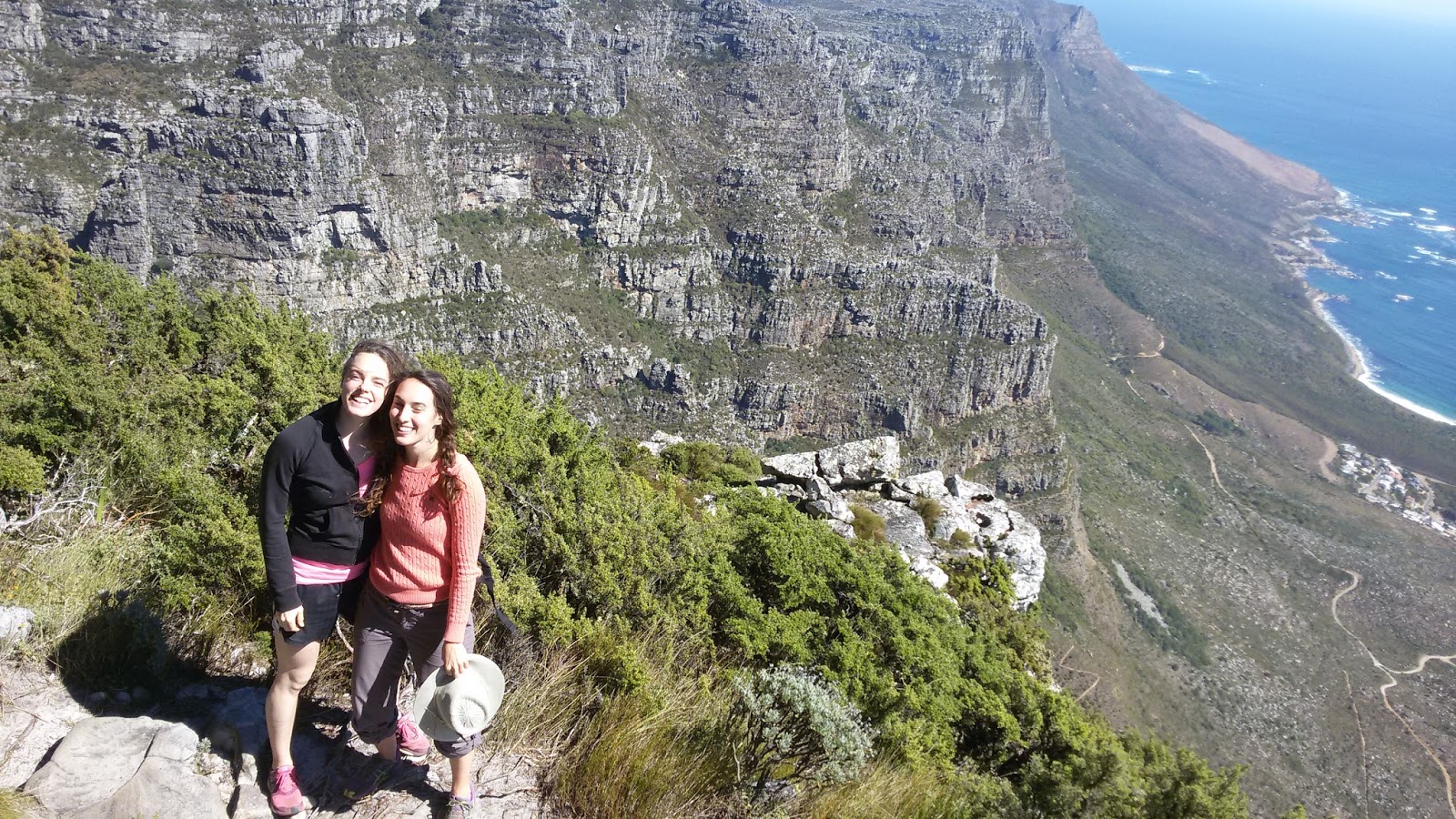
    Reunited in Cape Town: Hiking Table Mountain
    Is it hard to form deep, enduring friendships when you’re always moving around?
    I get that question a lot.
    The answer, as you could probably guess, is no and yes.
    My close friends and family span the globe, but I know I could call any one of them today—or, better yet, show up at their doorstep—and they would offer me all the love and support I could need. Of course, it goes both ways… minus the doorstep, which I don’t always have.
    And then, I typically find it easy to connect with the people around me, wherever I find myself.
    My neighbor? New friend and dance buddy.
    My housemate? New friend and hiking buddy.
    Strangers on a train? You get the idea.
    Answer one: Depth is easy. So no, it’s not difficult to connect deeply—be it for an hour, a week or a month. The more layers of artifice I burn, the more easily, and more deeply, I find connection—everywhere.
    But then there’s that other, more elusive quality: endurance. 
    Does it last? How? And if it doesn’t, how meaningful is a friendship formed in Thailand and set to rest in Laos? How deep does connection really run if it can’t follow me across borders and years?
    Answer two is longer…
    Recently, a close friend from university paid me an impromptu visit in Cape Town. Keeping the spontaneity flowing, we rented a car, picked it up the next day, and drove nearly 1,000 kilometers east, toward the Garden Route (a popular region for tourists) and a particularly beautiful place called Nature’s Valley (though we didn’t know yet that we were going there).
    As we drove on the wrong side of the road through endless stretches of caramel-colored hillsides, we caught up on the milestones of the last year of our lives. As we hiked through fynbos (vegetation unique to the Western Cape) and down to wild, windswept beaches, we discussed philosophy and travel, mistakes and purpose. As we pitched our tiny camping tent amidst rows of elaborate palatial campsites in a dilapidated caravan park, we laughed like no time at all had passed.
    Time had passed. Clear from the very new lines around my eyes and the shifting sands of love, death and discovery that shaped the contours of the interim months—or was it years?—of our lives.
    And yet, connection had endured.

    Roadside picnic on the Garden Route, and a very rare selfie.
    I could list a dozen more examples off the top of my head. Old friends joining me for segments of my travels; new friends opening their homes to me when I arrive in their city; strangers offering me a place to sleep, and becoming friends through that inimitable alchemy of giving and gratitude.
    And then there are the other friendships, the ones that take root in the rich soil of new experiences shared, yet wither when transplanted to the barren realms of social media and virtual communication—or perhaps they refuse to leave in the first place.
    Still, these, too, endure in their own way.
    A note out of the blue from a passing acquaintance met several years prior.
    A supportive comment on an article from a familiar face whose name I had forgotten.
    An unexpected coffee with a high school friend with whom correspondence had been sporadic and stunted.
    Silence doesn’t always mean disinterest.
    I should know, since I rarely hear from many I consider my closest friends.
    Distance doesn’t mean detachment.
    I should know, since I repeatedly choose to be continents, miles and time zones away from my loved ones.
    Staying in touch is remarkably difficult for an era of unprecedented “connectedness.” I have nothing to brag about—those who know me will be sure to tell you—but I am constantly working to do better.
    I’ll repeat: distance doesn’t mean detachment. 
    Connection is there. Depth is there. Consistency? We’re all working on it. 

    Forced to choose between travel and connection (that is, vagabonding and bonding), I’ll choose “C” every time. No and yes. Both. I think it’s possible.

    ***
  • The Bittersweet Beauty of Goodbye

    If I sift through the shadowy pathways of my memory, I will touch a hundred moments of parting and a thousand words of farewell in an instant.
    A woman stands on a provincial train station platform with her son, waving goodbye, goodbye, goodbye as my train pulls away.

    A friend hugs me in the pre-dawn shadows of an empty parking lot, then stands aside as my bus coughs to life and I step inside.

    An open window lets in dust and exhaust fumes and the last echoes of Good luck!

    The sterile lights of an airport terminal look on as I hug loved ones goodbye; they stay to watch as I pass through security and disappear.

    A last smile at the threshold before the house, car, bus, taxi, train door closes. A last wave. A last glance.
    These memories are steeped in the mixed emotions that partings will inevitably evoke—the fragrant cinnamon of nostalgia, and the piquant tingle of anticipation; the bitter smoke of an ending, and the sweet pine needle smell of journeys beginning.
    When we travel often, some things become easier with practice.
    We learn to sit with discomfort, be it overpacked buses, insufficient legroom, long flights, missed meals or interminable waiting—for delays, friends, food and horizontal sleep. And we come to accept a certain level of stress, uncertainty, insecurity—all fundamental tenets of life on the road—as the norm.
    We learn the language of timetables and airport terminals, maps and foreign street signs, and perhaps we come to navigate these worlds with a degree of ease. We find ourselves at home in a sea of strangers, untroubled by change—exhilarated, even.
    And finally, we become accustomed to goodbyes (comfortable may be too strong a word). Without a doubt we come to realize the ineptitude of words—the insufficiency of phrases like, I’ll miss you, See you soon, Good luck with everything, or even the more sardonic, Have a great life and, See you when I see you—to serve in these situations.
    We become accustomed to goodbyes, yet there is no art to them, or none that I have found. No failsafe formula. No skillful lyricism to master.
    Each one is unique in its blend of sadness, resignation, looking forward and looking behind.
    Each one is, in its singular fashion, beautiful. 
    Or, this is what I am beginning to believe. For, more than cinnamon nostalgia or pine needle anticipation, a goodbye is steeped in love. Platonic, familial, romantic, age-old or brand new, this  is love surrendered to the utter unknowability of what lies beyond this moment.
    If that love, tempered by the bittersweet awareness of impermanence, is not beautiful, then I don’t know what is.

    And so, as I say See you soon, Good luck, I’ll miss you, and Goodbye to friends and loved ones in the U.S. and turn toward the next leg of my journey, I hold onto that beauty, and my smile smells like cinnamon and pine needles, chili and smoke.

    ***
  • Strangers on a Train

    “We’re on our way to bible study,” says my friend. (He likes to make up stories, but let’s get real, who doesn’t?)

    It’s 10:00 pm, and we’re on the Circle Line, retracing our steps into Central London after hopping the wrong train. Across from us sits a young couple—friendly, talkative, and maybe a touch too willing to believe his absurd stories. They are sipping from a water bottle of vodka and fanta, on their way to a night out “raving.”
    Thus begins my Saturday night this past weekend. My friend alights at King’s Cross Station to head home, and I follow these strangers (soon to be friends) to Fabric, one of London’s most famous House clubs.
    We will meet another stranger on our way out of the Tube, and together walk to the venue. We will spend the next four or five hours dancing to some of the best House music I’ve heard in a year, adding new strangers (new friends) to our group as we went, and they will become, over the course of the night, no longer strangers.
    And all because we had all looked up across the aisle of a Circle Line train and said hello.
    A week prior, I went to meet my coworker in Oxford for the first time. On the trip home, the train was rush-hour packed—standing room only. Series of unexpected events, I found myself squished next to a fellow American; as foreigners are wont to do, we struck up a conversation, found it fascinating, and continued it over a particularly delicious dinner in Notting Hill.

    And all because I had asked (in my unmistakably American accent), “Is this the train to London?”
    When did we grow afraid of strangers? When did the popular wisdom for travelers shift from, trust the road and the good Samaritans who walk it, to, trust no one? When did two strangers—or four strangers—talking on the train become the exception, rather than the rule?
    I have an advantage, in that nothing about my thin five foot five frame and wide smile inspires fear or mistrust. There are fewer barriers for me to cross to arrive at the human beings inside their protective circles.
    Some of my most entertaining nights out, fascinating conversations and closest connections have occurred simply because I looked up and said hello. Though I occasionally forget and succumb to the comfortable bubble of my own world, I try to make a rule of talking to strangers—I have yet to regret it.
    And then, when you think about it, aren’t we all just strangers on a train?
    Busy watching for our station, looking out the window, or within, or anywhere but around us, we don’t realize that the train is it. There are no stations, no stops, and for all we know no destination.
    Our fellow passengers? We’re stuck with them—better hope they don’t smell—and we can make of that a party or a burden. The Buddhists will tell you the train is an illusion; the Jews will tell you it’s the only thing that’s real. One thing I know for certain: It’s what we make of the ride that counts.
    So we can either look up and say hello, and make the journey worthwhile, or we can keep staring at our shoes, waiting for the conductor to call our stop.

    Try saying hello to a stranger today and see what happens. Maybe they’ll tell you their life story. Maybe they won’t respond. Maybe that stranger will change your life—or your day, or your next ten minutes. But no matter what, isn’t it more interesting than your toes?

    ***
  • What is this Feeling? …Nostalgia??

    Stunning views from my seat flying Catania, Sicily to Istanbul (on my way to Stockholm…
    I should not have opted to fly that way, and now I have no luggage… ah, well… collateral.)

    Lately, I’ve been experiencing a sentiment I’ve never known before.

    A strange tightening in my chest when it’s time to pack.

    An odd sensation as I watch the ground shrink below me during take-off.

    An unfamiliar twinge as I lift my hand to wave goodbye.

    I feel excited to be continuing on to the next place—of course, that goes without saying, and, I suspect, will never change.

    And yet… and yet…

    I think I would call it nostalgia, this new feeling.

    First it was Zanzibar, and now Sicily.

    Maybe I’m growing sentimental in my old age. (Just kidding—my old age is a long, long way away!) Maybe I’m allowing the places (or these people… or these lives, discretely wrapped packages of time, space and possibility) I briefly inhabit to reach a little bit deeper than I used to—sending out just the finest roots beneath my skin.

    Or maybe it’s an inevitable side-effect, which has simply run unrecognized along the sidelines up until now.

    Wherever it comes from, this nostalgia weaves a duskier hue at the edges of my leave-takings. A slight reluctance (never stronger than the bolder urge to continue on, but there nonetheless). A bittersweet recognition that I may in fact miss this place (these people… this time… this particular configuration of life)—that I was happy here.

    It’s the taste of the last sip of hot chocolate, and the color of the faded corner of a photograph. Savoring. It’s the feeling of lingering before standing up to leave a cafe… and it adds, I think, a lovely dimension to each journey onward—a depth, a balance to anticipation.

    While this feeling—this nostalgia—is unfamiliar to me, I welcome it. I acknowledge it (for it undoubtedly deserves its place in the scheme of things), and then I leave it beside the photographs, memories and written pages—where it belongs.

    So. Nolstalgia… welcome to the adventure!

    ***
    Greetings from Stockholm, Sweden, where I am visiting my oldest friend for the week. My luggage is dwelling in Istanbul at the moment, but I will be sharing some amazing shots from Sicily as soon as it finds it’s way over here!
    ***
  • Lamu, Kiwayu and the Danger of Playing it Safe

    For those of you who have been following recent events in Garissa, Kenya, and who were aware of the proximity of Lamu and Kiwayu Island (my location this past week) to the Somali border, you will be happy to know that I am back safe in Kilifi, several hundred kilometers away.
    As events progressed and the news of Al Shabab’s brutal attack on Garissa University broke, sitting on a bus for eight hours while following updates on Twitter, stopping at multiple police checkpoints and traveling with a police escort could have been a nerve-wracking experience, but with the company of my three travel mates and the shaky consolation that lightening rarely strikes twice, we managed to comfortably ride out the journey.
    I don’t want to write about Garissa today, though. (I’ve done that already here.) I want to share a little about the gorgeous regions in the north of Kenya devastated not just by attacks, but also by foreign travel advisories. 
    At 7:30am on Friday, March 27th, three friends and I boarded a bus bound for Lamu, a Unesco World Heritage Site on the north coast of Kenya accessible only by boat.
    Well, to be exact, we waited at the bus stop for three hours first, bags baking in the sun, and then boarded…
    ***
    Day 1: Friday
    At 3:00pm, we pull off the road and wait a couple hours more for an armed convoy to escort us and the other buses of the afternoon through the more forested area north of Garsen. The roads become increasingly rough as the buses continually race past one another for no apparent reason.
    We arrive at Mokoi Port around 7:30pm and crowd into an already packed ferry. The stars grin overhead as we move towards Lamu Island, and I trail my fingers in the dark water.
    After a quick meal of the best nyama choma (grilled kebabs) I have yet tasted in Kenya, I sleep heavily.
    Day 2: Saturday
    I rise at dawn in order to wander the alleys of Lamu before the town and the sun are fully awake. 
    Winding stone pathways tinted with just the slightest bit of tension (or perhaps desperation would be more precise) speak eloquently of Lamu’s prosperous past as a key Swahili port. The sunlight glows on the waterfront, casting in shadow the men who accumulate around boats and food stalls, hoping for better business. 
    We are the only tourists in sight so far. Gorgeous old houses filled with guest rooms stand empty.
    At 6pm, we learn that the dhow (boat) that should have carried us on to Kiwayu Island (originally at noon, then at 7pm) will not leave until the next day. We make a split-second decision to take a speed boat instead, and are spirited away in the night to an even more remote location. We hurriedly load water, produce and other supplies for 5 days and head out into open water.
    The stars are bright bright and curved around the sky like a snow globe.
    Around 9pm, we arrive at Champali (a luxury camp made available to us four grateful travelers through family connections). My room is quintessential island paradise in one room-sized package: big bed, balcony overlooking the ocean, woven mats and open windows on all sides.
    Day 3: Sunday
    I wake again at dawn in a pool of light, the soft sounds of birds and water lapping at the shore welcoming me into the day. I move slowly, from morning yoga to a brief walk away from the camp, to cooking breakfast.
    We play cards and lounge for a while, then make the fifteen-minute “trek” to the other side of the island and eight kilometers of wild, empty beach. Strewn with seaweed, backed by sand dunes and with an unobstructed view of the Indian Ocean, this beach is the definition of remote. My definition, anyways. You would never guess, to stand there, that several hundred people inhabit the island, residing largely in two villages.
    The cicadas in the trees here are terrifyingly loud at times, their buzzing so pervasive it seems to be coming from inside my own head. A noise like that could drive you crazy if you were stuck in a tree with it for long enough.
    Day 4: Monday
    This time we bring boogey boards to the other beach, and for the first time I really understand why people find this activity fun. The waves are just big enough to carry me all the way to shore when I catch them right. I stand up dripping seaweed and sand, and feel decidedly like a six-year-old mermaid version of myself.
    A walk into the village later in the afternoon reveals the hub of human activity that the exterior of the island obscures. The women are beautiful, dressed in a style that looks almost Indian to me, and the children are utterly enthralled by our appearance, trailing behind our small group as we wander a web of thatch-roofed homes and dirt paths speckled with shells—remnants of an aquatic time long past.
    As the sun begins to set we start for Champali, stopping at a beach along the way to watch the color show.
    Day 5: Tuesday
    We all wake up before dawn to race to the top of “Conical Hill,” the tallest point on the island, in time for sunrise.
    Afterwards, we visit Mike and his camp a long walk further down the beach. He, like Kenya’s tourist economy, is struggling. Since two English tourists were kidnapped in 2011, Kiwayu has hardly been a popular destination. All of Lamu region, really, has suffered.
    Gorgeous island getaways stare out at a magnificent ocean view, empty and waiting to be filled again.
    That afternoon, I return to the village and a local woman covers my left arm—from fingers to shoulder—with bold henna designs.
    Day 6: Wednesday
    I wake up slowly, recovering from the long day on Tuesday, luxuriating in the comfort of my big bed. We savor our last hours on Kiwayu, knowing that we will leave at 4am the next day.
    We sit on my balcony to watch one more sunset, the day fading from yellow to orange to dark.
    Day 7: Thursday
    Our boat is late bringing us back to Lamu. We leave at 5:30 instead of 4:30. When we sit down at La Banda, a reasonably priced restaurant overlooking the water, for breakfast, the first news on the Garissa attacks plays on a television at the back of the room.
    The bus ride back to Kilifi is as long and dusty as the first. I feel refreshed and content, though—despite the danger, despite the unrest, I feel secure…

     ***

    I describe my trip in such detail not to brag, but rather to make a point.

    I almost didn’t go.
    When Earl backed out days before our planned departure, I considered doing the same and making the trip another time. Finally though, despite increased travel advisories, Kiwayu’s proximity to Somalia, and the general tone of fear set by foreign governments, international media and even some locals, I decided to go.
    I do not believe I put myself in any serious danger, but I certainly did not “play it safe” according to the conventional wisdom of travel. As more and more tourists opt to visit Tanzania rather than Kenya (playing it safe), unemployment rates here continue to rise (48% for Kenyan youth). These are not conditions for recovery, stability or growth. There is a serious danger there.
    The region of Kenya I just returned from is among the most beautiful areas I have ever visited… the whole coast of Kenya is, in fact. Following yesterday’s events, this hardly seems the moment to encourage anyone to visit, and yet, I want to remind you that there is more here than what you see on the news. That is true everywhere—everything is more than what you hear secondhand.

    Everything you see is certainly true, but it is only one piece of a 1,000-piece puzzle.

    ***

  • Time to Move

    Once upon a time, nomads—largely hunter gatherers or pastoralists—knew it was time to move when the game animals moved on, or the fields became depleted. They followed the tides of nature.
    Some traveled in caravans of camels or on horseback. They were self-sufficient. They carried their homes with them—bundled tents, cookware and provisions.
    I will be the first to admit I have nothing in common with those nomads.
    I travel by bus, train, or car. Boat if I’m lucky. I do not gather my food—though the markets in Mbita are hardly a walk in the park. If you dropped me in the middle of the desert, I would not have the requisite resources for survival…
    I carry no tent; no cookware; few provisions.
    But maybe I still share something with those wanderers of old who have always captured my imagination.
    I, too, follow a kind of tide.
    An initial wave of excitement carries me to a new place. The promise of a work exchange. The open door to a friend’s home. A spark catching in my belly and igniting my anticipation.
    That first surge crests, and the tide begins to ebb—weeks later, or maybe months. The work is monotonous. The place too isolated or too busy. The enthusiasm never dies, but it smolders more faintly.
    Then a new opportunity calls. This time on the coast, or in the mountains, or across the border. Another surge gathers momentum and I follow.
    I can usually feel when it is time to move.
    No matter how many times I follow this cycle, that initial burst of excitement never seems to lessen. The making of plans, the preparation to move, transition, journey, holds a special kind of magic for me.
    In three days, it will be time again. The ocean is calling. The sand, waves, salt and always, always the

    unknown beckon. From tides of intuition to tides of water.

    There is a backpackers on Diani Beach (30 km south of Mombasa) with room for volunteers. I still have 2 months left on my Kenyan visa, so I think I may stay there a month if it fits.
    Time to say goodbye to Rusinga Island and the rock paintings I may never find. Time to pack up and head east to meet the sun.
    Time to move.

    ~
  • A Vagabond’s Manifesto

    I believe in coincidence. Happenstance. Chance. It has been responsible for so many of my experiences—too real to ignore—creating connections where I expected none, and repeatedly linking past interactions to present ones. I recently picked up Milan Kundera’s “The Unbearable Lightness of Being,” and he believes in coincidences too. He writes, “Only chance can speak to us. We read its message much as gypsies read the images made by coffee grounds at the bottom of a cup.” I believe that meaning pools in the cracks between our expectations.
    Only this kind of meaning-full coincidence could explain how often the word “vagabond” crossed my path during my travels through Asia and Europe.
    I saw it painted across the front of buses in Nepal. Printed on a license plate in Thailand. Written on a Guest House sign in Cambodia. On graffiti. On T-shirts. Everywhere. I took its recurrence as an endorsement of my wandering activities by the world of signs.
    “Be Happy. Be Free. Vagabond,” became my motto for that year. I carved it into trees, painted it on walls, and tucked it into emails and postcards.
    In most every religious tradition, words themselves are understood to have power. That is why we are encouraged to repeat mantras or prayers even when we don’t understand them. I had long been drawn to words like “gypsy,” “wander,” “journey,” “nomad,” “wayfaring,” and, of course, “vagabond,” not only for their meanings and the images they conjured, but also for their taste in my mouth, rich and piquant. Their sensual, abstract power touched me deeply. I wrote essays on wanderlust, papers on nomads, and blog posts on wandering. These words cast a spell on me, saturating my dreams, and my waking life too.
    According to the Merriam Webster dictionary, a vagabond is, “a person who travels from place to place and doesn’t have a home or much money.” It can also refer to “leading an unsettled, irresponsible, or disreputable life.” Well, yes. The word “vagabond” often does, admittedly, hold negative connotations. Vagabonds are gypsies, tramps, and vagrants too. Our society often stigmatizes and demonizes these titles and the people who hold them. There is an implied element of disreputability, unsavoriness, or indolence.
    Such definitions have merit, too, and yet, I never lost my love—idealistic though it may be— for the vivid flavor of these words and what they describe. One word, “vagabond,” through chance or predestination, came to inspire my actions, beliefs and perspectives over the course of that year-long journey, and it continues to do so.
    For me, a vagabond is indeed one “who travels from place to place and [maybe] doesn’t have a home or much money,” but he or she is also one who is content with little, open to the world, and ever curious and optimistic. A vagabond defies society’s rules, certainly, but is by no means immoral; we need rule-breakers, (well-meaning) trouble-makers and chance-takers in the world. Vagabonds defy what is expected of them and read signs in the coffee grounds of coincidence. By this definition, I am proud to assign myself such a title.
    In sharing this accumulated list of a vagabond’s guiding principles, garnered from my experiences, I hope to highlight the beauty of this word and its impact on me and my travels. Maybe I will succeed in redefining it for you as I did for myself.
    A Vagabond’s Manifesto:
    • Always expect the absolute best of others, but have the resourcefulness and resiliency to recover when you encounter the worst.
    • Be fluid, open and expansive.
    • Carry little on your back, much in your mind.
    • Embrace spontaneity. Have contingency plans.
    • Never turn down free food.
    • Turn theory into action. Learn courage and fearlessness by doing things that are courageous and fearless.
    • Trust your instincts. Your intuition. Your belly.
    • Never say no to an adventure.
    • When unsure how to proceed, laugh.
    • Play often.
    • Walk everywhere. (Or bike. Or hitchhike. Or scooter. Or swim.)
    • Don’t believe anything everyone tells you. Believe everything anyone tells you.
    • Love and live like your train is leaving tomorrow.
    • Find joy in movement. Find joy in stillness.
    • Wander. Seek. Pursue. In body, mind and soul.
    • Be Happy. Be Free. Vagabond.

    ~

  • And How Is Your Family?

    A recent conversation with the lovely Alec MacMillen (Arabic speaker and traveler on his way to Jordan on a Fulbright at the end of this month) reminded me of this topic…

    And How is Your Family? Making Connections Abroad

    In the first unit of my Tibetan language class, we learned words for family members and how to ask about them. “Do you have any brothers or sisters? Where are your children? What do they do?” Beyond “how are you?” these were the first questions I learned how to ask the Tibetan residents of my neighborhood in Boudha, Kathmandu, Nepal.
    My friend, a novice monk. We could converse only at a very basic level, but he knew that I had one brother who lived in Canada.
    When I traveled to Senegal on a High School summer exchange program, I learned much the same phrases in Wolof. “Where is your family?” “They are here,” was a classic exchange between strangers or friends. What I didn’t quite understand at age 16, I began to see more clearly while studying in Nepal: In almost any corner of the globe, family is literally the foundation of every relationship. If you want to form a friendship, begin by asking about someone’s parents, sisters, brothers, children. If you wish to grow closer to your host family, ask about children, cousins or siblings abroad.
    In most beginning language courses, vocabulary for family members and questions about family almost always show up in the very first unit. In 6th grade French, I remember finding this awkward and a little bit silly. Many college language students feel much the same way.
    In the U.S., these are not the first questions we are taught to ask. At least, these were not the questions I was taught to ask. For many Americans I know, inquiring about family members is intimate, almost invasive for acquaintances or strangers. Here, if you want to form a friendship, begin by talking about shared interests, food, school… Family comes later.
    In that Tibetan language class, my teachers stressed the importance of asking about family first, before anything else. This was crucial to respectfully initiating conversations and friendships; omitting to ask about family could be perceived as inconsiderate or even offensive.
    Istanbul, where I probably sat down to drink tea in every candy shop over the course of my week-long visit.
    Once learned, this was a lesson I would carry with me. In Turkey, I made friends with every shopkeeper I met, exclusively by asking about family. In Italy, I remembered to ask new friends the same. Regardless of country or age, new acquaintances responded with warmth and enthusiasm to my queries. Do you have children? Where are they? What do they do? Do you have any brothers or sisters? What do they do? Where are they? Are you married? Where is your husband? Your wife? What are their names? Detailed, personal questions repeatedly forged an immediate intimacy and connection that flippant conversations about the weather or school could never produce.
    I became more comfortable in the asking as I saw how people opened to my questions. When I returned home and began conducting interviews for my senior thesis work, I employed the same technique, with surprisingly similar results.
    There exists in the U.S. an individualism that de-emphasizes the role of family. We are individuals. We are not where or who we come from. As I traveled and made friends, however, I found that most people do not agree. Questions about family are so crucial to forming relationships because family is crucial to forming individuals. No matter how much we pretend, we do not exist independently of it.
    While hitchhiking, I bonded quickly with strangers by asking about siblings, children, parents, etc.
    At least, that is the belief that drove my experience of connecting with strangers. Whether or not I believed it didn’t even matter so much; my new friends did.

    So, if you are traveling and you want to make friends, after you ask “how are you?” remember to go on with, “And how is your family?” See what happens.