Tag: movement

  • The Sacred Pause: from Dance to Self-Defense

    The Sacred Pause: from Dance to Self-Defense

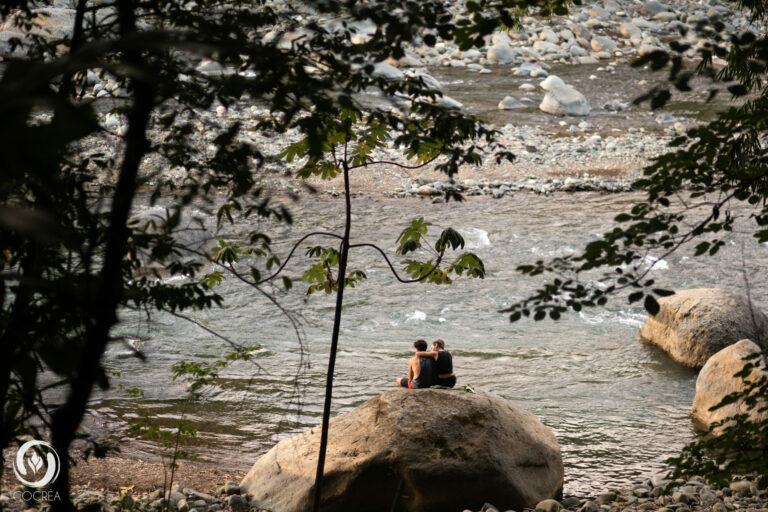
    March 24-31, 2023 – Dance Your Medicine Retreat at Posada Natura Healing Center in Londres, Costa Rica. (Photo by: Foster Snell | @FosterTheEexplorer)

    One breath can change everything.

    The “sacred pause” can be the difference between reaction and response, between contraction and expansion, between inaction and action.

    In the spaciousness at the top of our inhale, everything expands and possibilities open before us. In the emptiness at the bottom of our exhale, clarity crystalizes.

    After a week of exploring “mindful partner dance” with the amazing humans behind CoCrea last month, I found myself thinking a lot about the “sacred pause.” In dance, this pause can be a single breath, or even a microsecond of stillness that allows us to listen to our own body and our partner’s—and allow movement to arise from there.

    It is a moment of beauty, attunement, and awareness, rich with potential. And it is a moment to reconnect with our own body and its needs, giving ourselves the opportunity to act in integrity with our own self-knowing.

    Here is where we can carry the sacred pause with us from dance into self-defense.

    That same, seemingly-insignificant moment of renewed awareness, when applied to a situation of danger or violence, can again change everything. The sacred pause can restore our agency and power when we find ourselves in an adrenalized or activated state, helping us to access our self-defense toolkit, in spite of fear or confusion.

    In the holistic self-defense classes I teach through my empowerment project, Mujeres Fuertes, we often encourage participants to take a breath before practicing a strike. We also regularly discuss the importance of taking time to check in with ourselves when a person or situation makes us feel uncomfortable or unsafe. In this moment, we choose how we want to respond, if we need to set a boundary, if we would rather get up and walk away, and so on.

    Fear can easily cloud our judgment as well as affect our coordination; pausing helps us choose, speak, and act with clarity.

    Similarly, the social contract and social conditioning around “niceness” and “politeness” often keep us in places we actually don’t want to be. Utilizing the pause to touch base with our intuition and listen to the body, we can recognize more easily when a situation is “yellow” or “red.”

    From a trauma-informed perspective, the sacred pause—taking a breath and bringing awareness back to the present moment—can mean the difference between freezing or acting (yelling, running, fighting, and so on) to defend ourselves. When the alarm system is activated in the brain, most people unconsciously default to their go-to adaptive strategy: fight, flight, freeze, flop, or fawn. For many, and especially for women, the freeze/flop/fawn response is a well-honed survival strategy.

    “What if I freeze?” is probably the most frequent question in our self-defense classes.

    No one can guarantee breaking the freeze response, nor do we wish to write it off entirely, as it is itself a survival strategy. However, we do know that the more we practice pausing, breathing, and bringing awareness to the body when adrenalized or activated, the more we augment our capacity to notice—and to choose a different response.

    Furthermore, we invite participants to reframe freezing as “active waiting.” The animal that freezes in nature when danger approaches often proceeds to run away or otherwise act in self-preservation. People are no different. Through training our body to breathe through discomfort or fear, notice our instinctive reactions, and then yell, run, or fight, we curtail the freeze response and prepare ourselves for what follows.

    The more tools and options we have, the more possibilities will open ahead of us in the momentary lift of the sacred pause.

    Why “sacred”? Because for me, anything that connects us with our embodied wisdom, intuition, or inner knowing is a mystical practice. Anytime we enter into communion with that soft, clear voice who speaks or dances from our center, I believe we are in conversation with the divine. And what is more sacred than that?

    How do you apply the sacred pause in your life, relationships, or creative work? I would love to read your perspectives!

    Finally, I invite you to remember the sacred pause when you feel afraid, uncomfortable, confused, or overwhelmed.

    In the spaciousness of this moment, everything is possible.


    Originally published at elephant journal.

  • If I Could Fly: Seeking Stillness in Movement

    If I Could Fly: Seeking Stillness in Movement

    Vermont. Early August, 2017. Stillness.

    It’s 1:04pm, and the August sun is hitting my laptop screen at just the right angle that I must squint to see what I write.

    The bus rattles and sways on the two-lane Vermont highway. Pen and paper prove unusable.

    I have music in my ears for a change, and it makes me think of caravan routes through the desert, the rolling gait of long-legged animals on sand, the scorching white heat of a cloudless sky at noon.

    I look out the window to my left and witness another set of elements entirely—green mountains, gentle New England sky. Yet, the felt sense is the same. It is a tenuous impression I have tried and failed to describe so many times, I nearly believe it impossible.

    It is the thing that calls me to move and whispers instructions to my intuition. It is the thing that taught me to dance, barefoot and alone. “Wanderlust” is an incomplete surrogate for the thing I mean.

    I look outside again.

    There is a story in the sky, like always; I could spend the whole ride watching the shapeshifting drama and chuckling to myself. Mountains undulate on the horizon, soft and green and melodic; I could spend the whole ride tapping out their rhythm against my thigh. Walls of trees enter and leave my sight, as varied yet indistinct as an ocean of faces in a crowded subway car. I could spend the whole ride absorbing their anonymous features.

    I could spend the whole ride sitting here, doing nothing, too—and for someone who loves to do things that’s already remarkable.

    Several weeks ago, I shared my favorite ways to pass a long train journey. Reading, writing, and snacking all featured on the list. So did “doing nothing.”

    stillness

    I wish I could remember the first time I experienced the peculiar, meditation-like (but not quite meditative) peace of being in motion, but I do remember the first time I wrote about it. Somewhere in Southeast Asia, frequently on endless bus rides through astonishing landscapes, I first tried to put words to an enigmatic sensation:

    What are you looking for?
    I am searching…
    I am searching for—
    I am searching because
    it is only in movement
    that I find stillness.
    In running I am free;
    In dancing I am liberated.
    But if I could fly—
    Ah if I could fly,
    I would be truly
    Boundless.

    — “If I Could Fly,” 2013

    ********************************

    I think it’s time to revisit this finding stillness in movement that has occupied my traveling thoughts for so long. I would like to try again to define the thing that calls me to move and calms me through action.

    What is it about being in motion—in trains or on foot, by boat or in dance—that soothes my mind into a stillness I have never found in sitting meditation?

    What is it about being in motion that, like an embodied lullaby, so entrances me—and, I suspect, many lovers of movement?

    The answer is in the question.

    Movement entrances. It occupies us—or at least it occupies me—so fully that there is absolutely no space for thoughts of elsewhere. Other times, other people, other places…these disappear in the all-pervading “this-ness” of moving. (Moving my body through space, or being moved through space, it hardly matters, so long as the coordinates change fast enough to pull my thoughts with them.)

    Four years ago I started writing about the inner stillness that arises when all else is in flux. Years before that, I experienced the same outcome in yoga and ecstatic dance. Its hold on me hasn’t loosened. I think it’s safe to say that this magic stillness is my only addiction. A single taste has you seeking it again for the rest of your life.

    A vagabond knows this. A dancer knows this. A meditator or a yogi knows this.

    However you step outside the borders of your skin and embrace “this-ness,” you will never be satisfied to remain inside the lines again.

    I hear two things more often than anything else:

    “What are you looking for?”

    and

    “I hope you find what you’re looking for.”

    But it’s not a “what.” It’s a who and a why and a how. It’s a voice that calls me to move and a sense of boundlessness that keeps me coming back. It is a way of moving through life and through space.

    It is not a thing I can find and then be done with.

    It is the searching that gives meaning and form to the sought.

    And so we keep chasing shadows through the desert and melodies through the mountains. We keep seeking stillness in movement.