Author: Toby

  • Every Day — and March 8 — is a Good Day to Fight for Women’s Rights

    Every Day — and March 8 — is a Good Day to Fight for Women’s Rights

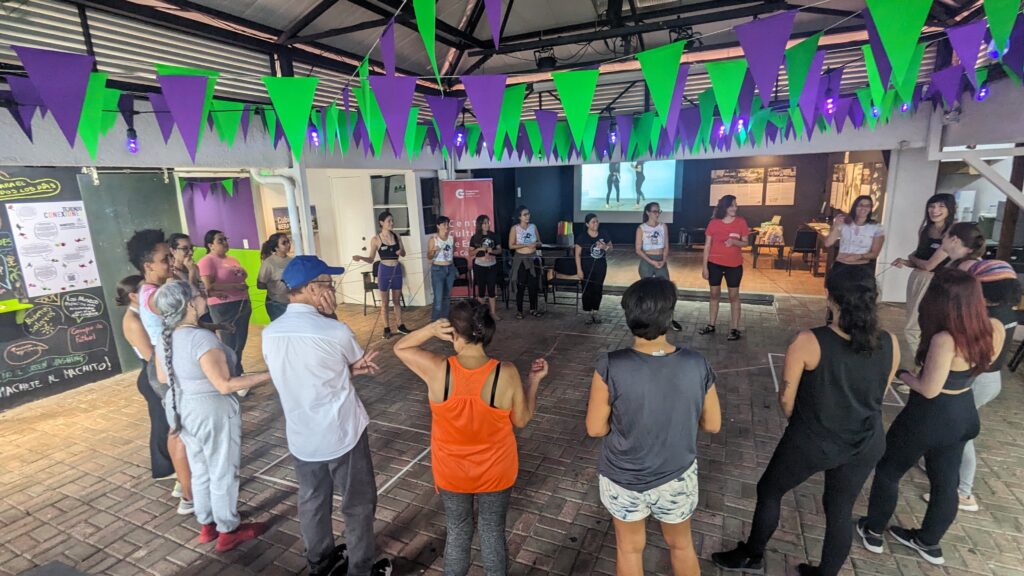
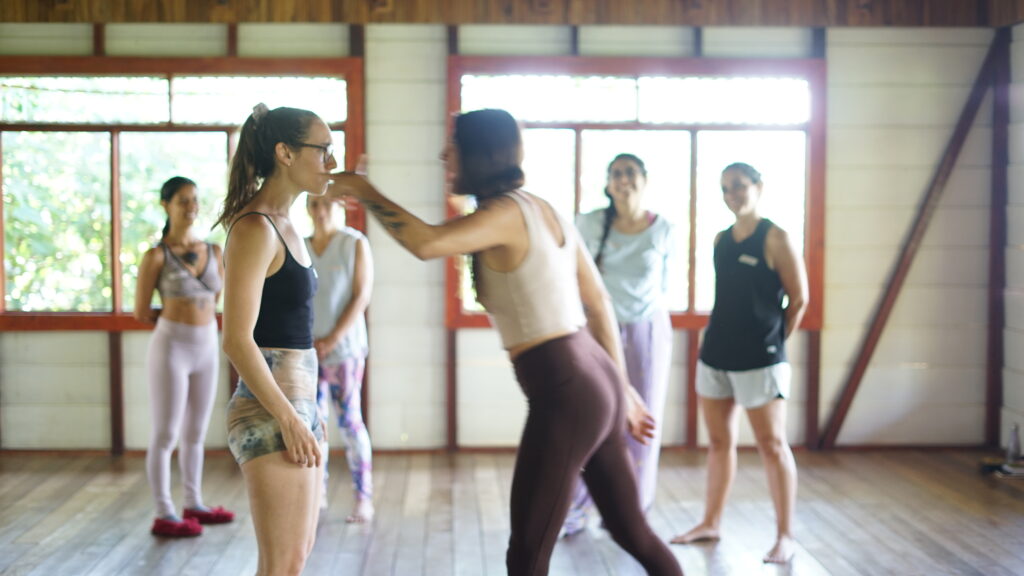
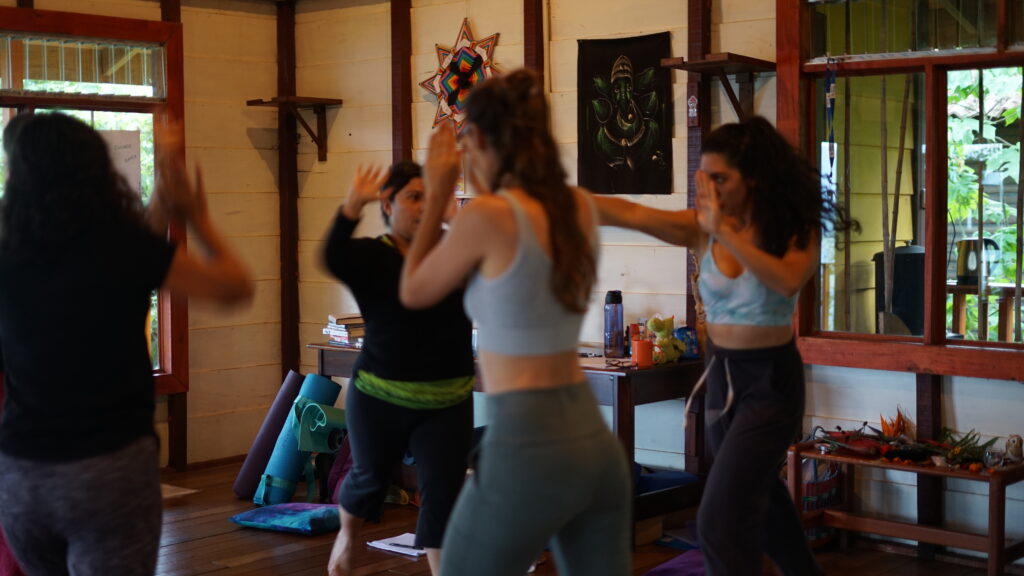
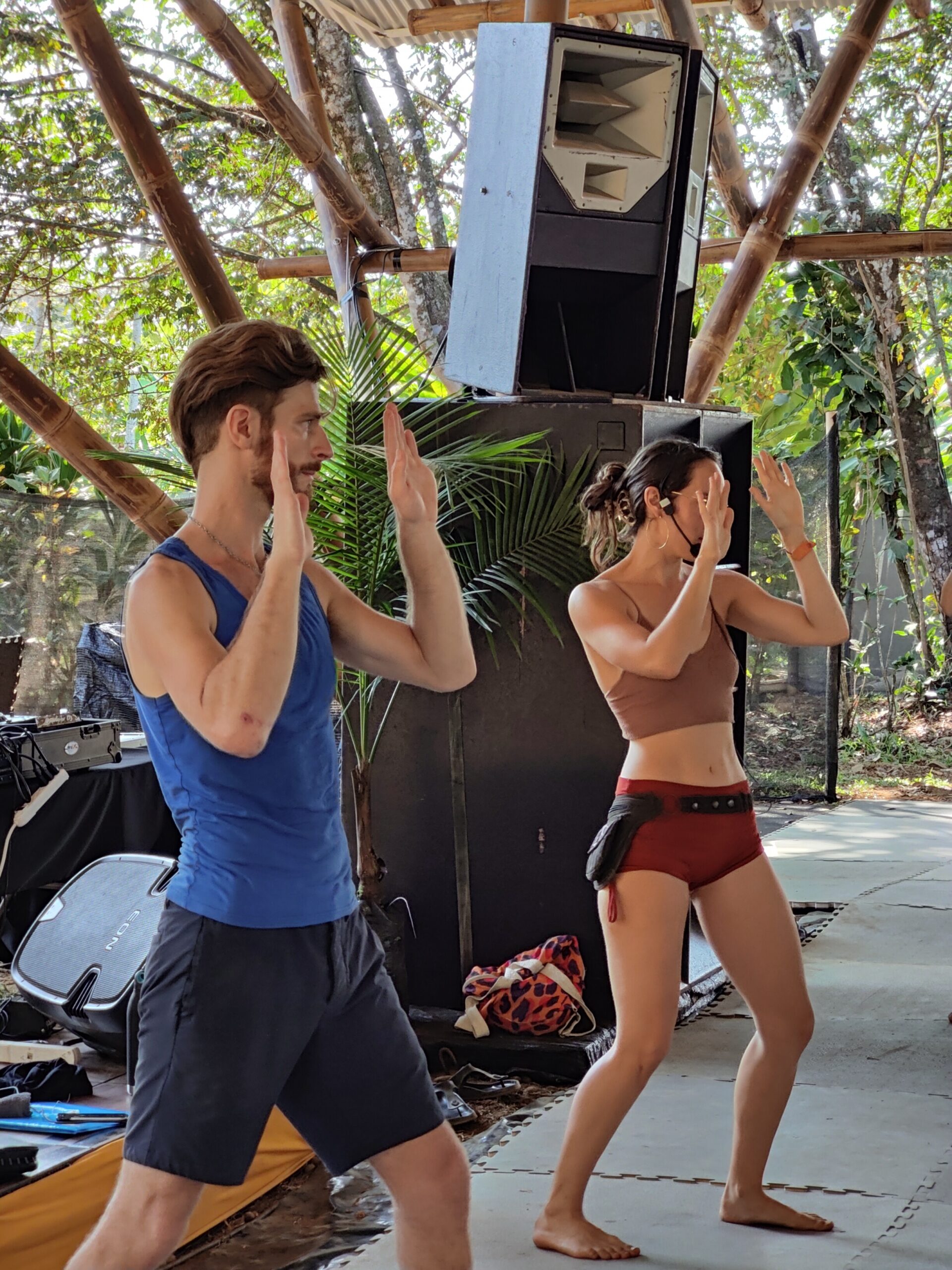
    It’s March 8, 2023. Between a “voice activation” exercise where we shout “no” at high, higher, and highest volume and a round of practicing palm heel strikes, my phone pings over and over. I’ve received a flood of messages wishing me a “Happy International Women’s Day.”

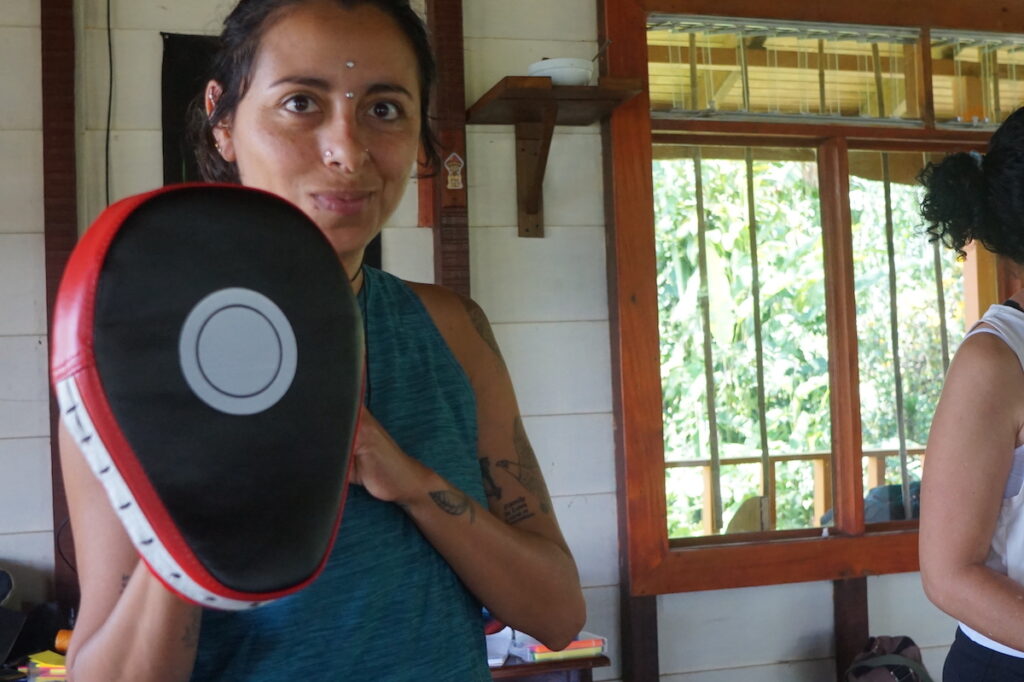
    I send back a few emojis without too much enthusiasm and continue with my empowerment self-defense (ESD) class. The participants yell, strike, play, and discuss gender issues. It’s neither a protest nor a celebration for March 8th; it’s part of the daily struggle for a world without violence against women.

    I work towards that world—a world where everyone can live with the freedom and dignity we demand each year on March 8th—every single day.

    This year will likely be similar. In over five years of teaching self-defense workshops, I’ve noticed a pattern: there is a spike in demand for classes during key dates like March 8th (International Women’s Day) and November 25th (International Day for the Elimination of Violence against Women). A month before, several companies, municipalities, hotels, and other groups call us to schedule activities. And at the same time, allied groups ask us if we will be participating in marches around the country.

    Every person in the Mujeres Fuertes Autodefensa network makes their own decisions. I tend to choose to give workshops on those dates.

    Of course, I’m thrilled that there are so many institutions and communities that want to commemorate March 8th with empowerment and violence prevention education. It is an aligned way to recognize women’s struggle for justice throughout history, which, as I understand it, is exactly the point of March 8th. I am inspired to see so many people take to the streets, from the center of San José to the beaches of Guanacaste and Limón.

    I don’t even mind—too much—when people congratulate me for being a woman, even though they don’t do it any other day of the year, and even though I believe the day deserves more solidarity than congratulations.

    What disappoints me is the lack of interest (and funds, and participation) in justice and violence prevention the other 364 days of the year. In the context of my work, an introductory empowerment self-defense (ESD) workshop of around two or three hours is a start, not the final goal. Of course, it’s better than nothing, and people can learn key tools to empower their personal safety in a very short time.

    But on March 8th, I would love to see all the companies, institutions, and individuals who support women’s rights back up their words with a larger time investment. In a 12-hour ESD course, lives can be transformed and statistics can be changed. In an annual, ongoing, committed ESD course, a community and a culture can be transformed.

    March 8th is a symbolic day that marks, represents, and commemorates a constant, generational struggle, which we continue to fight every day.

    I invite everyone to remember that March 8th is not really a special day, but a day like any other, where it is our responsibility and privilege to raise our voices for justice, equality, peace, and freedom.


    Originally published in Spanish at El Delfino.

  • State of the Holistic Self-Defense Revolution

    State of the Holistic Self-Defense Revolution

    Find your NO. Live your YES.

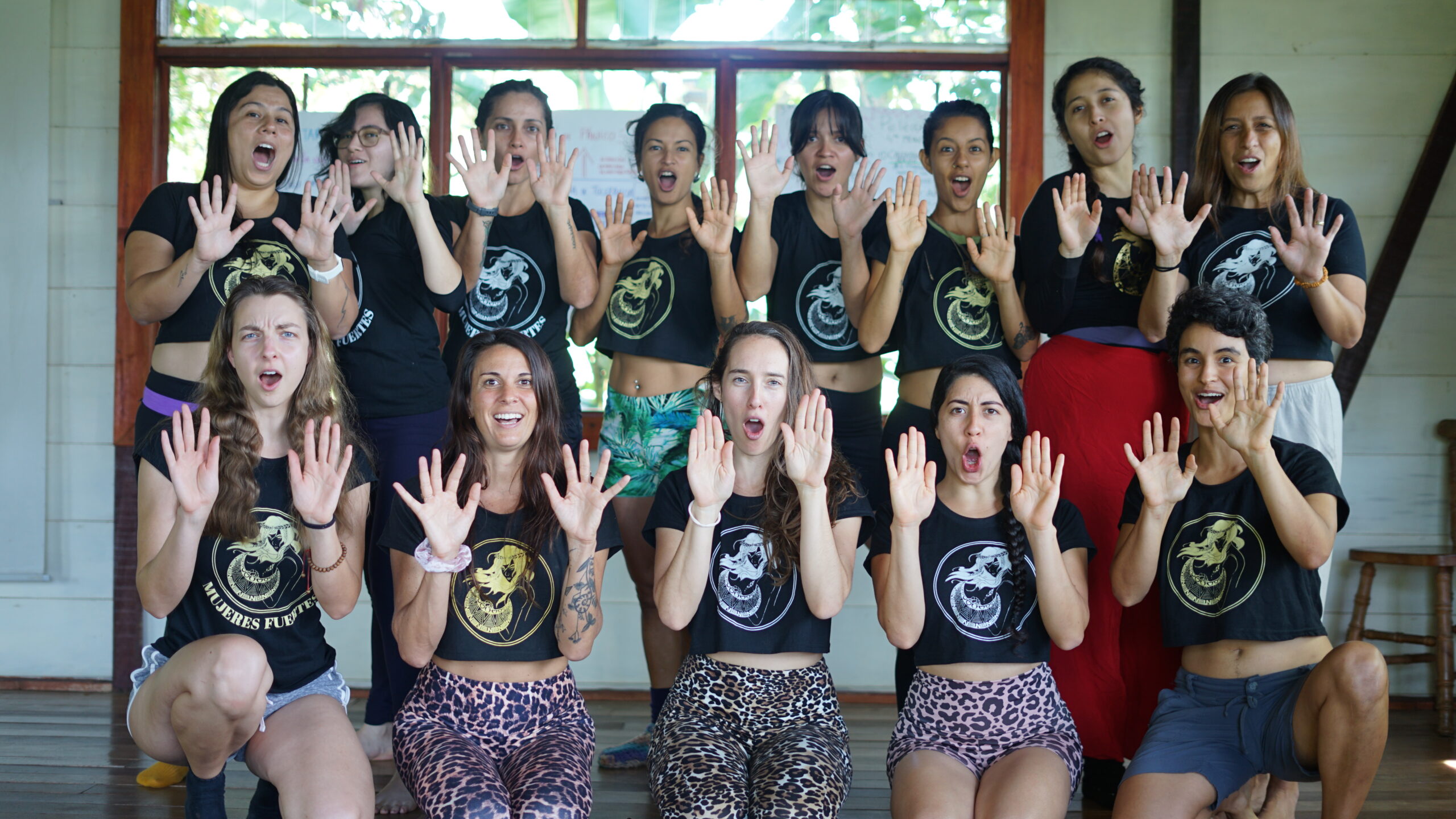
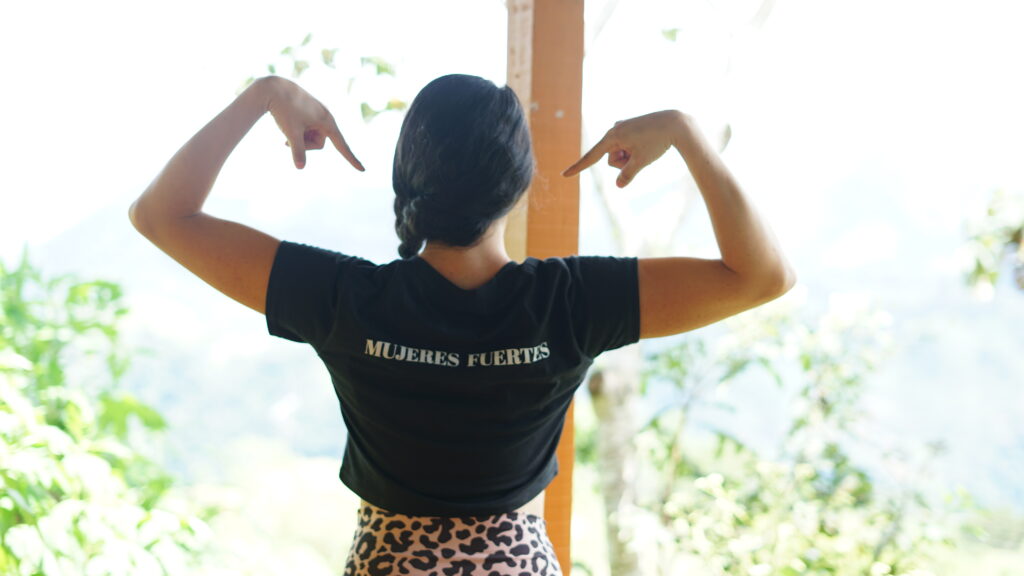
    We are Mujeres Fuertes.  As a Costa Rican-based social business, we are dedicated to supporting women, children, and all people to live lives free from fear and full of confidence through holistic self-defense workshops. 

    Our fundraiser seeks to raise sufficient funds to cover 2 years of operations and development. To reach more people, we need to develop our team of instructors and administrators to organize more trainings in more places. We want to realize our goal of being self-sustaining so that we can reach exponentially more people with our self-defense methodology.

    Give me the cliff notes, please!

    • Support a holistic self-defense project based in Costa Rica to scale up, become self-sustainable, and ensure long-term impact! (Think tens of thousands of students reached with our violence prevention methodology, at least.)
    • Our goal: $60,000 
    • What it will achieve: a 2-year runway to cover all operating and development costs
    • The pitch: Change lives. Prevent violence. Help us build a thriving community centered on empowerment and healing.
    • What’s the catch? There is none! 100% of your donation will go towards realizing our vision for delivering our self-defense training at a MUCH bigger scale! (Even if we don’t hit our full goal, we will be on our way.)

    State of the Holistic Self-Defense Revolution: Donor & Ally Update

    A huge thank you to all who joined us for our end-of-year ‘State of the Holistic Self-Defense Revolution’ event! And another huge thank you to the donors, allies and mentors who have made it possible to come so far in just a few short years!

    Youtube video

    What is Mujeres Fuertes Autodefensa (Strong Women Self-Defense)?

    Mujeres Fuertes is a Costa Rican-based social business dedicated to supporting women, children, and all people to live lives free from fear and full of confidence. Our holistic self-defense methodology connects our participants with a sense of power, freedom and agency through physical skills, communication strategies, mindfulness practices, and healing arts and connection. We offer profoundly transformative experiences, with a unique perspective on self-defense, empowerment, and learning.

    We work with various community, organizational and corporate allies to bring our holistic self-defense methodology to as many people as possible.

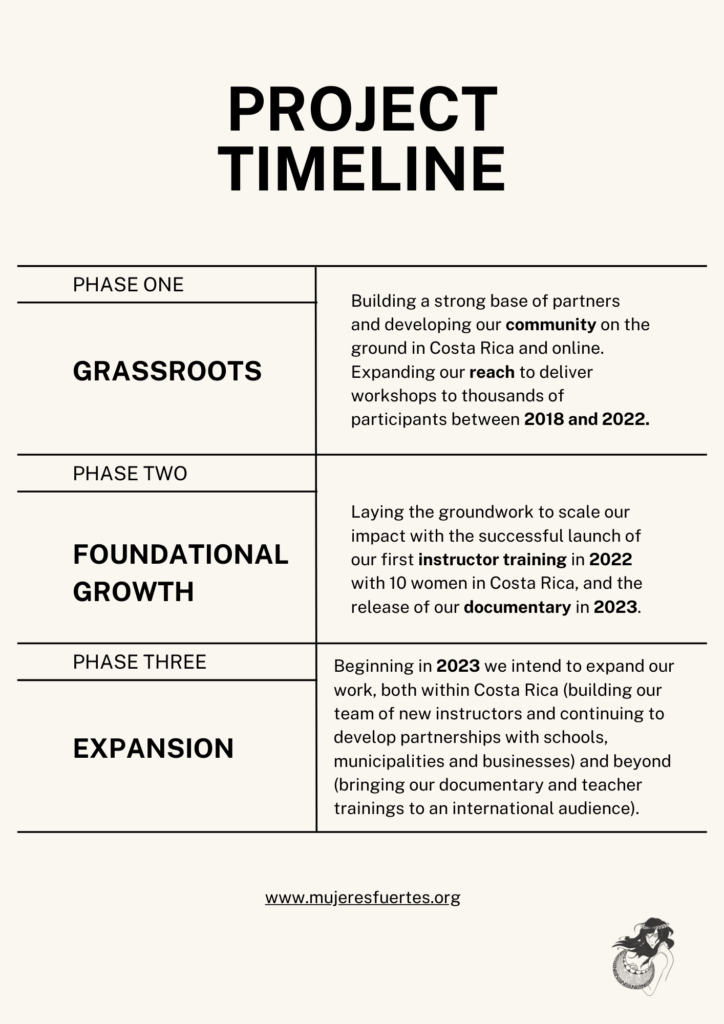
    In the interest of scaling our impact, since 2022 we have begun to shift our focus towards training trainers. Our yearly instructor training program prepares people of all backgrounds to confidently teach holistic self-defense in their communities.

    For the past 5 years, with plenty of help from incredible friends and allies in Costa Rica and around the world, I have sustained taken Mujeres Fuertes as a passion project. We have not generated enough income to regularly pay a team, so our team has been largely volunteer-based, and fueled by a lot of love, but very few monetary resources. 

    Despite such limited resources, we have managed to:

    • Run an “empowerment tour” of Costa Rica, visiting 11 locations in just 2 weeks to deliver 12 introductory ESD workshops.
    • Produced a documentary about the tour and about our violence prevention methodology with an all-women production team and a crowdfunded micro-budget.
    • Deliver thousands of hours of self-defense training around Costa Rica, and around Central America.
    • Reached thousands of students of all ages and social backgrounds.
    • Provided scholarships, work exchanges, or low-cost access to those who could not afford to participate at-cost.
    • Developed an online course that provides our full self-defense methodology at a low cost to anyone with an internet connection and a personal device.
    • Cultivated a community of students, allies and friends who are as passionate about our violence prevention work as we are.
    • Trained our first generation of holistic self-defense instructors in Costa Rica (10 women trained in 2022, and another 10+ to be trained in September of 2023).

    All of this because we believe deeply and fiercely in the value of this work. We don’t just dream of a world free from violence, where all people live with the freedom and confidence to exist as they are and move through the world however they desire… we work to make that world a reality every single day.

    The Catch 22: Without the resources to pay a team, we are stuck at a flexion point. 

    To reach more people, we need a proper team of instructors and administrators to organize more trainings in more places. To become truly self-sustaining, and ultimately to thrive, we need more clients—schools, districts, businesses and NGOs that wish to offer regular Empowerment Self-Defense (ESD) classes. To realize our vision, we need two things:

    1. More instructors fully trained and ready to give workshops on their own, first in Costa Rica, then around the region, and maybe one day… all over the world! (In the works as we speak! In the first days of August 2023, we ran a 2-day training with 6 of our most dedicated new instructors to provide additional training, strengthen our community ties, and get reenergized and re-inspired. In December of 2023 we ran the First National Gathering of Holistic Self-Defense Instructors in Costa Rica. We hope to make it an annual or bi-annual event to deepen our network and keep training up.)
    2. Money to pay our team to conduct outreach, manage social media, administrate our online and in-person workshops, provide ongoing professional training for our instructors, and cultivate community with regular gatherings and spaces for practice and support.

    Where will your money go?

    I believe in paying people what they deserve for the work they do. To realize this vision for a scaled-up project that can reach exponentially more people with our self-defense methodology and ultimately sustain itself (by holding onto a percentage of all fees charged for workshops and courses to pay our team and other organizational costs).

    “I dream of making a living doing what I would do for free.”

    —Mariel Carmona, long-time Mujeres Fuertes assistant, dear friend, and one of the first generation of instructors trained by Mujeres Fuertes in 2022.

    Every cent of your donation (with the exception of the transaction fees charged by this platform) will go towards the operating costs outlined below. All team members have been involved in this project for years and have demonstrated their passion for and commitment to its long-term success. What’s more, all administrative team members, as well as those in training to become members of our instructor team, are Costa Rican women, the right people to carry Mujeres Fuertes into its most sustainable, mission-centered and ethically aligned future.

    This fundraiser seeks to raise sufficient funds to cover 2 years of operations and development. Even if we do not reach this goal, any amount will support our ongoing sustainability and bring us closer to our long-term vision.

    We are a firmly anti-capitalist social business wholly unfit for traditional investment (registered in Costa Rica), and you can be assured that every cent of your contribution will go towards paying our team what they deserve to earn for the work they are driven to do by purpose, passion, and the belief that a more beautiful world is possible.

    With a two-year runway to conduct ongoing outreach, build client relationships and partnerships, and level up our digital marketing, we believe that this project can become self-sustaining, thus potentiating the scaling of our impact–first in Costa Rica, then in Central America, and finally… taking over the world! (But, you know, in a non-violent, feminist kind of way. 😉 )

    Currently, our only source of revenue is workshop participant or client fees, most of which goes to pay facilitators. Most workshops are offered on a sliding scale for payment, because we want this material to be accessible to everyone. And so, while we are not a nonprofit, we operate with a mission-first value system.

    You Can Make THE Difference

    See our fundraiser page (or watch the video above) for the full breakdown of our projected costs and growth strategy.

    I am asking YOU for your support to realize the full potential of this project. We have done so much already, and… it is only the beginning. Mujeres Fuertes (Strong Women) has already reached thousands with a research-backed violence prevention methodology, holistic healing arts, and meaningful networks of community and support. Now, we want to reach tens of thousands… to start!

    Will you help us to change lives, prevent violence, and build a future of peace, empowerment, and connection?

    Thank you so much for your support!

  • Yes, I’m Traveling Solo: Self-Defense as a Path to Freedom

    Yes, I’m Traveling Solo: Self-Defense as a Path to Freedom

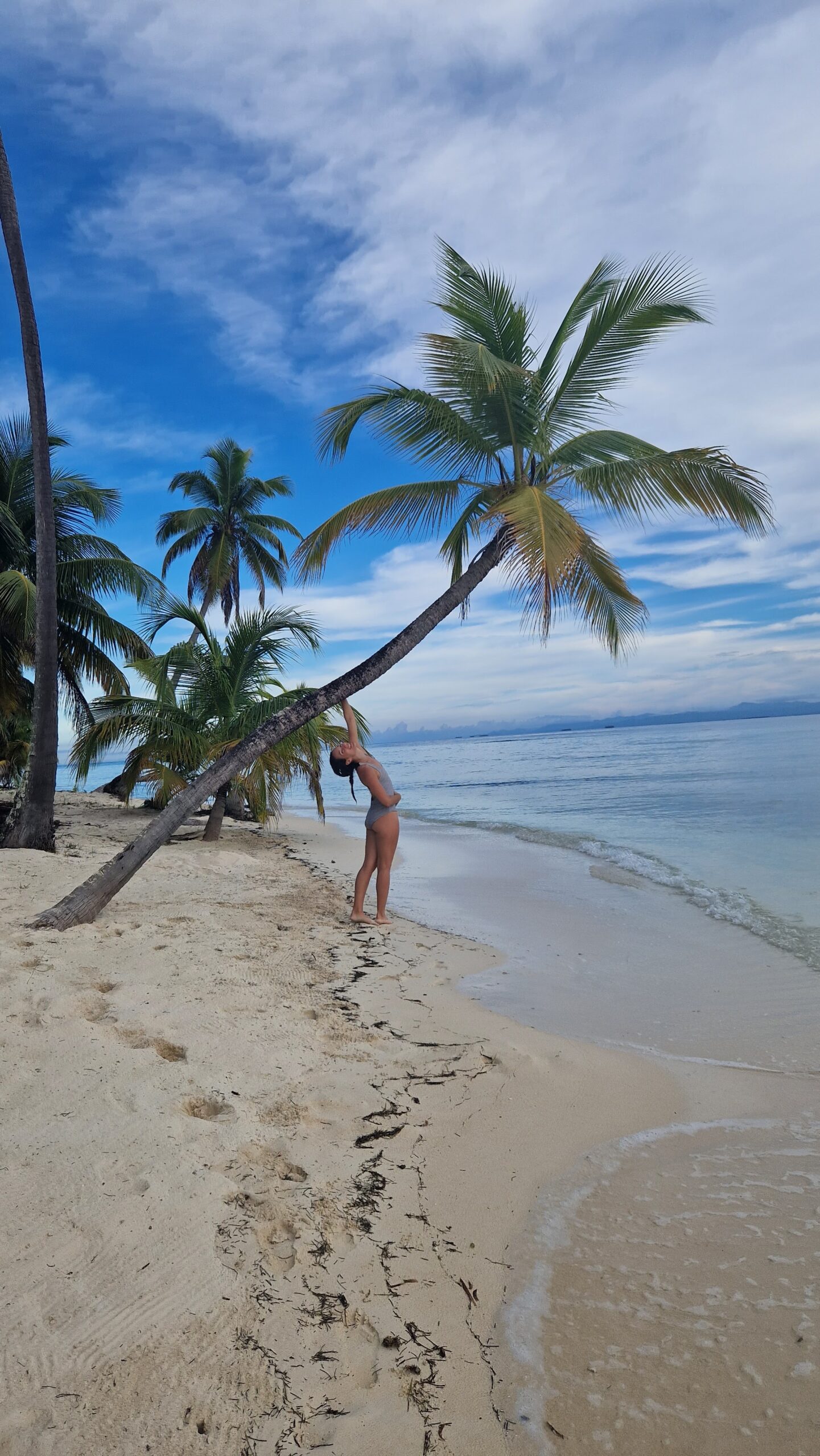
    Ometepe, Nicaragua | January, 2023 | Photo: Thomas Blanc

    Safety is a human right. So is solitude.

    Solo female travel? That’s not possible. It’s too dangerous. Women shouldn’t do that. You should never travel alone. What if you get kidnapped? Aren’t you scared? Go with someone, a friend, a partner—ideally a man.

    As a woman, I have heard every argument in the book against going out into the big, bad world on my own. The fears and warnings above are just the tip of the iceberg.

    These questions/concerns do not intend to fear-monger. They come from friends, parents, uncles, lovers, and well-meaning readers—people who want to see me safe and well. Yet it seemed unfair from the outset that I had to bear the brunt of my family’s concern as I traveled solo, while my older brother had jetted off first without much ado. The double standard always chafed. Of course it all came from love, but that’s not the point. 

    Why did everyone worry so much about my safety, and yet no one ever suggested I take it into my own hands?

    The problem is not so easily reduced to a few knee-jerk comments and Hollywood-induced travel phobias alone. Rather, it’s how these well-intentioned aphorisms reinforce an out-dated social contract that discourages women from enjoying the same freedoms men do that does the bulk of the harm.

    There is a depressing kind of fatalism in writing off solo travel for women forever because, “the world is a dangerous place,” rather than consider, for a moment, that there might be solutions. That there might be strategies for personal safety that do not come at the high cost of freedom and adventure.

    For most of my years of solo travel, I got by on instinct and bravado. “Fake it ‘til you make it” was my response to getting lost, harassed, followed, or accosted. Act like you know where you’re going, like you’re fearless, like you’re unshakeable. Most people will believe it. Eventually, you will too.

    And while this worked, I made it through a decade of solo adventures unscathed, I still lacked some basic tools to not only stay safe, but also enjoy solo travel more. 

    In 2018, however, I seized an opportunity to train as an Empowerment Self-Defense instructor with ESD Global, an organization dedicated to women’s safety around the globe. Realizing that many women yearned to travel solo, but were held back by fear, I decided to offer more than just words of advice or encouragement. It was time for practical skills.

    Action is the antidote to fear. 

    Developed over the past 50 years by female martial artists and violence prevention experts, ESD teaches a compelling mix of physical techniques and verbal strategies for deescalation and boundary setting. 

    It was the missing link, a one-stop shop for women desiring to feel both safer and freer in any environment. After nearly four years teaching this methodology across Central America, I can confidently attest to the transformative power of discovering our inner fire. Knowing what our body and voice can do, and trusting we know exactly how to use them, instills cultivates a valuable baseline of confidence and self-reliance for solo female travelers.

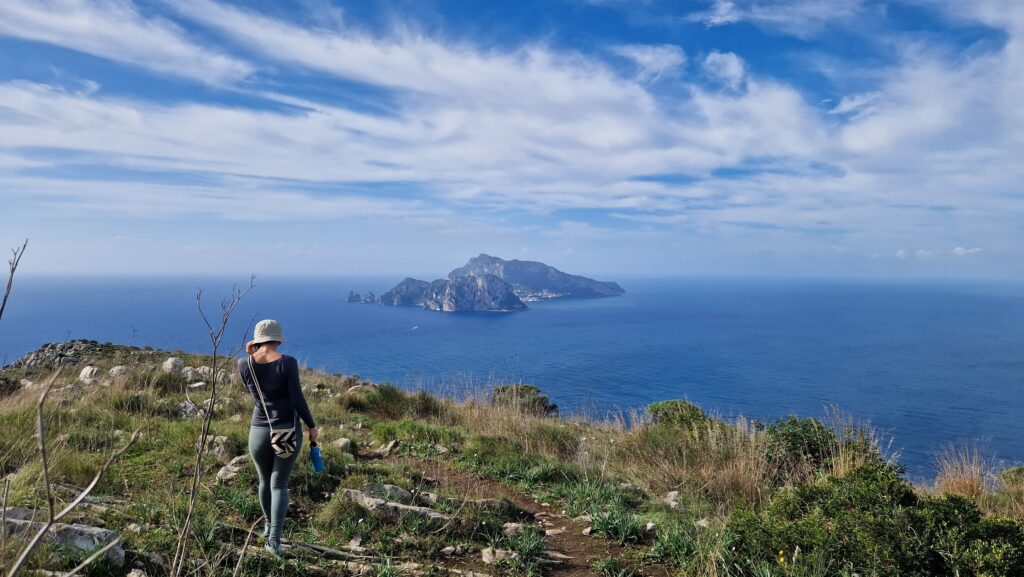
    Amalfi Coast, Italy | November 2023 | Photo: Thomas Blanc

    Below are my 5 go-to strategies for staying safe as you travel, without sacrificing a single glorious moment of your solo adventure.

    1. Listen to Your Intuition 
      Women too often internalize the social conditioning that everyone else knows more about our boundaries and our bodies than we do. In fact, we know very well when a situation is unsafe and, conversely, when we can relax and settle.Intuition is the soft, quiet voice that whispers in your gut, “Yes.” “No.” “This way, not that way.” “Danger.” “All clear. The trick is learning to listen, and then trust that voice. When we are conditioned to ignore our gut, intuition feels ungrounded and impractical.In fact, it is very much the opposite. Intuition warns us when a person, place or situation is potentially dangerous. It may feel like tightness in the chest or belly, shaking in the hands or legs, buzzing in the forehead, or a general sense of tension or closing in. And, it will guide us to know when to trust new friends or dive into “risky” adventures. That may feel like openness in the chest, relaxation or softness in the belly or jaw, or a general feeling of leaning in. The more we heed these signs and engage with our intuitive mind, the sharper it will become.We can practice listening to our intuition in small ways—eating when hungry, resting when tired, changing position or taking a deep breath when our body asks for it—and with mindfulness practices such as yoga, meditation, martial arts, or unhurried time in nature.
    2. Understand “The Interview”
      The interview is a well-documented occurrence in gender-based violence, whereby a potential attacker “interviews” a potential victim by slowly and progressively pushing her boundaries to see if or when she will act in self-defense.Whereas popular culture leads us to think that violence against women is sudden and unexpected, most attacks are in fact slow and deliberate. Each step of the interview is an opportunity to set a boundary: They follow you in the street or on the trail. They start to ask you personal questions on the bus or at your campsite. They touch you in a way that feels uncomfortable. They don’t respect your “no.”We will often wait to be “sure” of a person’s intentions before setting a hard boundary or expressing a firm “no.”Fear of offending or overreacting leads us to disregard our own needs and our own intuition to avoid rocking the boat. This is exactly what a would-be attacker is counting on. The sooner you can identify an “interview” situation while traveling, the more easefully you can de-escalate, speak up, escape, seek support, or otherwise stay safe.
    3. Use Your Voice
      Be loud, assertive, and unapologetic. The best way to stop “the interview” in its tracks is to use one of the most powerful weapons in our arsenal: our voice. Setting clear, firm boundaries can deter a would-be attacker and deescalate a potentially violent situation before it starts. Your intuition will tell you when and how to use your voice, be it calmly stating a boundary, or shouting “NO” at the top of your lungs.
      Women often learn from a very young age to stay quiet, to play nice. And so it takes practice to override this conditioning and train ourselves to speak up when we feel uncomfortable or unsafe. It is vital that we do so, however. In a situation of attempted assault, it can save our life. (Note: Using the voice is not about calling for help, although we can also ask for support from bystanders if that feels like an option. Activating the voice connects us to our own core power, disrupts the “freeze” response to danger, and also discourages a potential attacker.)
    4. Stay (& Look) Aware
      Whether on the road, in the woods, or right at home in your neighborhood, awareness is key for personal safety. Staying vigilant—no need for stress or tension—not only helps us to identify danger or risk well before it becomes an emergency; it also can help us get oriented in a new environment, observe more details and beauty along our journey, and enjoy our adventure with full-bodied presence. As we rely more and more heavily on technology for navigation and communication, we may feel the urge to check our phones frequently. As a traveler, the best thing you can do is keep your eyes up, phone away, and look and act like you are confident and at ease, regardless of how you feel.
      Keeping your shoulders back, your chin up, your gaze relaxed and alert, and your feet wide serves two purposes: It communicates to the outside world that you are confident and aware (and you are). And, it sends a message to your own brain and body that you are not afraid to take up space, increasing your self-confidence and security at a cellular level.
    5. Keep it in Context
      Let’s put the concept of women’s safety in context. At least 90% of gender-based violence worldwide is perpetrated by someone known to the victim. 59% by an intimate partner. The “stranger danger” narrative of personal safety and self-defense ignores the bigger picture: As women, we are not at higher risk out in the woods or on the road. In fact, we may be safer there. Despite the cultural narrative around personal safety, all the fears and warnings I shared above, solo female travel is not in fact more dangerous than being a woman at home, at work, or in a relationship. So if doubts about safety are holding you back, or if friends or family challenge your travel choices, it may be helpful to consider that just being a woman is risky stuff.
      Staying home won’t necessarily keep you safe, and neither will staying close to friends or significant others. At times, these may in fact pose a greater threat. So you might as well go out there solo and live your adventure. (If you would like to dive deeper into this kind of training, I recommend exploring ESD or IMPACT Personal Safety Classes in your area.)

    Empowerment Self-Defense is about offering new options and alternatives, not tossing out all the strategies we already have. I know every single one of you already has a toolkit packed with self-defense techniques, whether you call them by that name or another.

    So what would you add to this list? What are your go-to strategies for feeling secure and confident on your solo adventures? Share your experience in the comments!


    Originally published on Roofnest.

    Learn more about my empowerment self-defense work at www.mujeresfuertes.org, or support our fundraising efforts here.

  • How Empowerment Self-Defense Can Improve Our Relationships

    How Empowerment Self-Defense Can Improve Our Relationships

    empowerment self-defense, toby israel, envision festival, costa rica
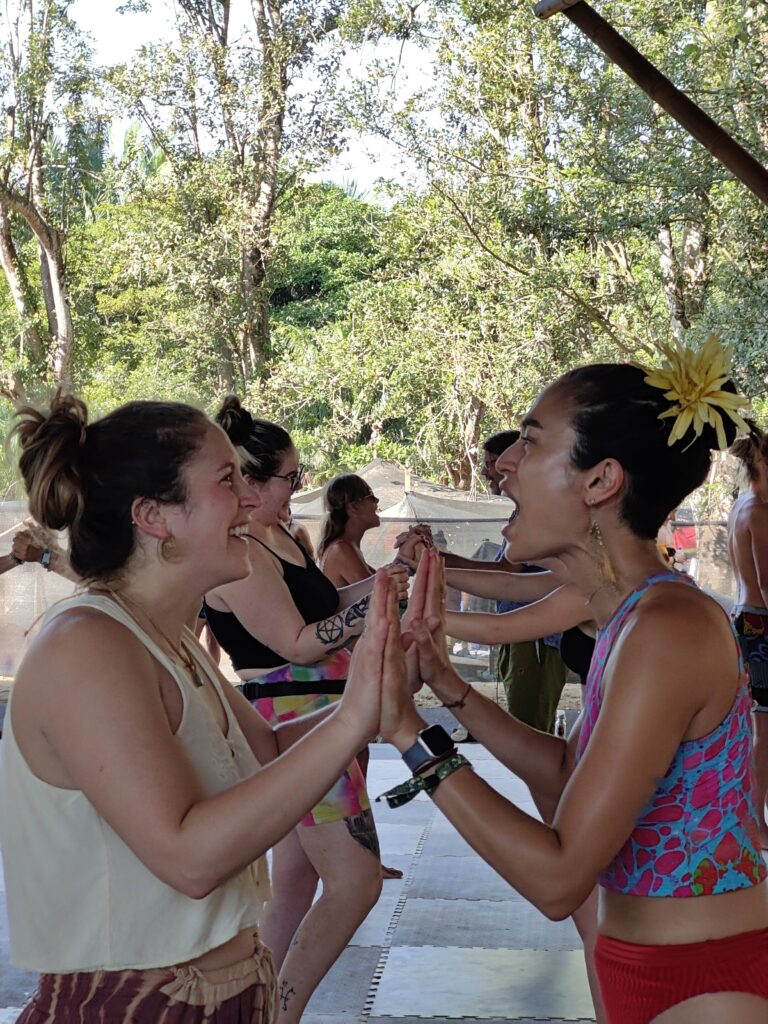
    Empowerment Self-Defense workshop at Envision Festival in Costa Rica, 2023.

    Understanding the traffic light approach to evaluating risk — & safety.

    What does self-defense mean to you? Is it just about martial arts strikes and yelling at an attacker? Or is it also about expressing firm boundaries, communicating a “No” without excuses or apologies, and interrupting uncomfortable situations before they become dangerous.

    Or, is it about improving our relationships, relaxing into deeper connection and pleasure, knowing that the tools for self-defense are within reach, just in case.

    For me, the answer is D, all of the above.

    As an empowerment self-defense instructor, I define both violence and self-defense along a broad spectrum. An attack by a stranger in the street or on the beach is violence. Emotional abuse is violence. Street harassment is violence.

    As a general rule, we humans don’t learn basic skills for defending ourselves anywhere along this spectrum. Empowerment self-defense provides choices and practical strategies — both verbal and physical — for dealing with risk, danger, or simple discomfort in ways that support safety and agency.

    At its best, I think it can also improve our day-to-day interactions with family, friends, and partners by helping us dial into our needs, desires and boundaries, hone our intuition, and speak from it with confidence and power.

    The Interview: Leaning Back from Danger (Red)

    Perhaps the first step to building healthy relationships is learning to listen to the voice of intuition and hit the brakes at the red flags.

    News stories and popular culture give the impression that gender-based violence always appears out of nowhere. You’re walking down the street and someone attacks you. You’re alone at the beach and someone attacks you. You’re in your house and someone attacks you…

    While these situations are real, they don’t represent the majority of cases of violence.

    It is a well-documented fact that gender-based violence (whether initiated by someone known or unknown) normally begins with an “interview.” In an interview, the potential agressor tests your boundaries, little by little, to see how you will respond. In a public space, the interview might start with a simple, “Hey, how’s it going?” and then escalate to more intimate questions or a breach of your personal space. With someone known, the interview could begin with “innocent” but undesired touch, and then proceed to cross more serious boundaries.

    The interview (along with domestic violence) makes it especially difficult to practice self-defense, for two reasons. First, the social contract demands that we respond politely (or politely ignore) these first, “harmless” steps of the interview process, even if we feel uncomfortable. Second, agressors aptly erode a person’s boundaries and trust in their own intuition.

    The question is: When will you pay attention to your intuition and put a stop to the behavior that is making you uncomfortable? This is exactly what a potential aggressor is waiting to see.

    We can interrupt the interview with the assertive and direct communication of a boundary: “I don’t want to talk.” “Don’t touch me.” “You’re making me uncomfortable. Stop.” If successful, we won’t have to use any other self-defense techniques.

    That’s why I don’t like to draw a distinction between physical and verbal self-defense. All the techniques have the same objective: to protect your safety.

    The Traffic Light: Leaning into Safety (Green)

    In empowerment self-defense, we like to use the metaphor of a traffic light to understand boundaries and risk.

    When we are in green, everything is okay, normal, calm. The body should be relaxed, without too much tension, the breath even, and the heartrate at a natural resting rhythm.

    An intimate relationship, friendship, or work environment should feel green most of the time, for most of us. This is a healthy place for our nervous systems, a place where healing and learning can occur, because the heart and mind are open to receive and connect.

    When we are in yellow, we are on higher alert. We notice that something isn’t right, we feel uncomfortable, or someone is crossing a personal boundary. The body may become more tense, the heartrate or breath might accelerate, and our posture and body language display more awareness.

    And finally, when we are in red, we are already in danger, and we need to apply self-defense principles (Think, Yell, Run, Fight, or Tell/Seek Support) in order to stay safe. Unfortunately, these situations often occur with someone we know, but we have the power to interrupt them.

    It is critical to understand that self-defense does not begin when we are in red. Self-defense begins when we are in green, with a continual process of self-discovery and exploration. It starts with knowing our boundaries, understanding what we like and want, and getting clear about which behaviors we will not allow.

    This clarity can improve all of our relationships — especially with the people we really want to have close to us.

    Then, empowerment self-defense continues in yellow, when we express our boundaries and put a stop to potentially risky situations before we get to red.

    Staying Curious about Our Needs & Boundaries (Yellow)

    Boundary work is complex and constantly changing. Keep in mind that your red and green zones may look different than your best friend’s, your partner’s, or your family’s. Rembember that no one else gets to tell you where your boundaries are, or if the lines you draw are “reasonable” or “valid.”

    We can stay curious about our yellow zone, especially, asking ourselves when discomfort is an invitation to question our biases or explore the possibility for healing, and when it is a simple warning cry to step away from danger and into safety. We can embrace the discomfort of genuine growth, while also protecting our hearts, minds, and bodies against violence.

    Remember, too, that we are in a process of constant evolution, and that we may have different boundaries today than we did yesterday, and that tomorrow will surely bring another shift. Accepting and honoring this process of change and growth — in ourselves and in our loved ones — is a perpetual challenge. But, I think the rewards are worth it.

    A Short Exercise in Defining Boundaries

    Where are your boundaries today? Make a list of ten “green” situations, ten “yellow” situations, and ten “red” situations. Don’t forget that boundaries are personal! The important thing is how each situation feels for you.


    Originally published on Medium.

  • The Sacred Pause: from Dance to Self-Defense

    The Sacred Pause: from Dance to Self-Defense

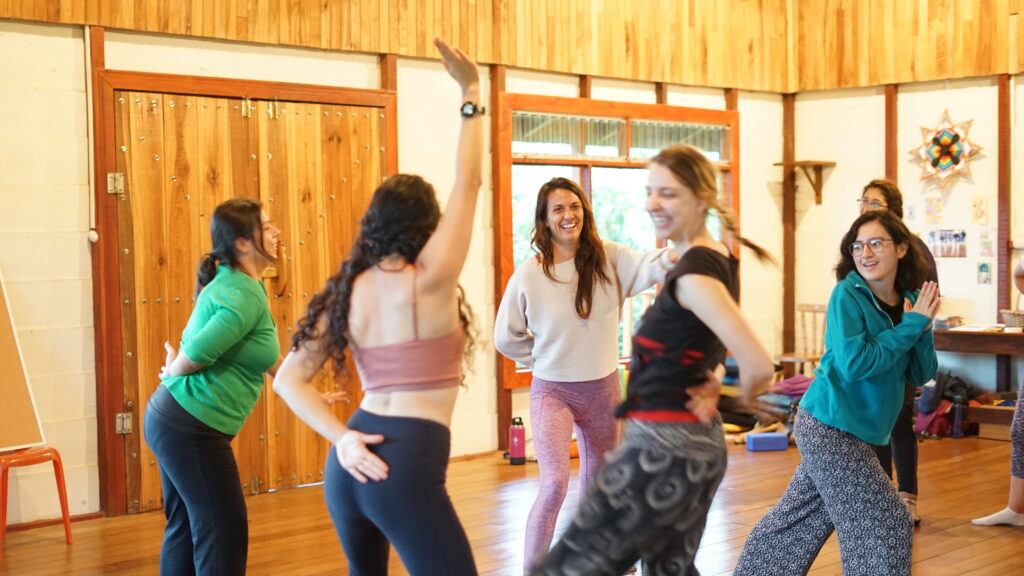
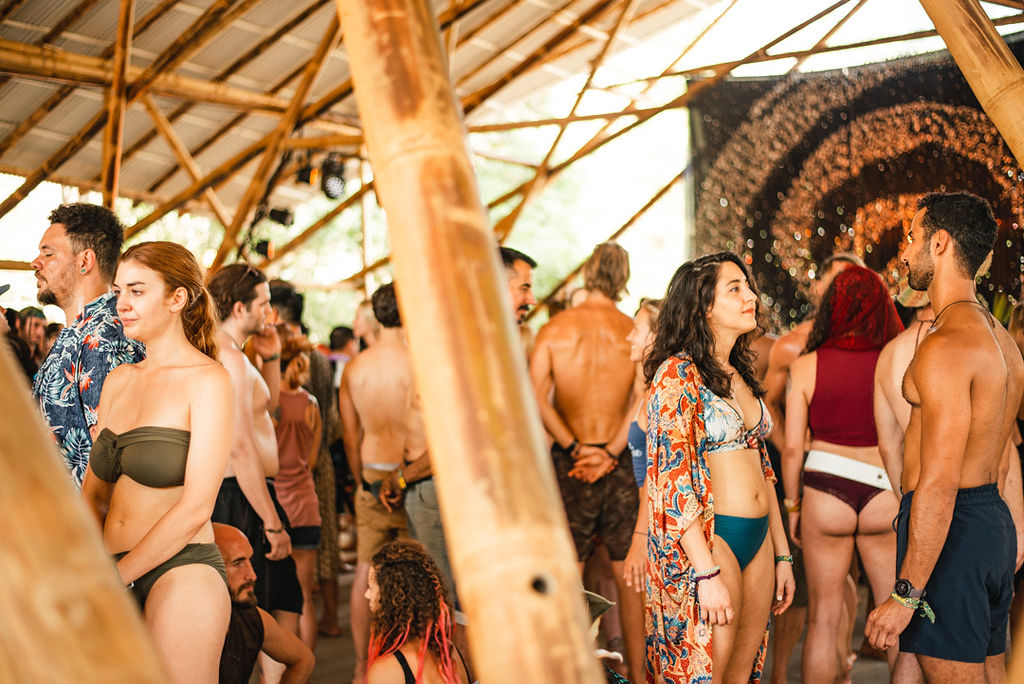
    March 24-31, 2023 – Dance Your Medicine Retreat at Posada Natura Healing Center in Londres, Costa Rica. (Photo by: Foster Snell | @FosterTheEexplorer)

    One breath can change everything.

    The “sacred pause” can be the difference between reaction and response, between contraction and expansion, between inaction and action.

    In the spaciousness at the top of our inhale, everything expands and possibilities open before us. In the emptiness at the bottom of our exhale, clarity crystalizes.

    After a week of exploring “mindful partner dance” with the amazing humans behind CoCrea last month, I found myself thinking a lot about the “sacred pause.” In dance, this pause can be a single breath, or even a microsecond of stillness that allows us to listen to our own body and our partner’s—and allow movement to arise from there.

    It is a moment of beauty, attunement, and awareness, rich with potential. And it is a moment to reconnect with our own body and its needs, giving ourselves the opportunity to act in integrity with our own self-knowing.

    Here is where we can carry the sacred pause with us from dance into self-defense.

    That same, seemingly-insignificant moment of renewed awareness, when applied to a situation of danger or violence, can again change everything. The sacred pause can restore our agency and power when we find ourselves in an adrenalized or activated state, helping us to access our self-defense toolkit, in spite of fear or confusion.

    In the holistic self-defense classes I teach through my empowerment project, Mujeres Fuertes, we often encourage participants to take a breath before practicing a strike. We also regularly discuss the importance of taking time to check in with ourselves when a person or situation makes us feel uncomfortable or unsafe. In this moment, we choose how we want to respond, if we need to set a boundary, if we would rather get up and walk away, and so on.

    Fear can easily cloud our judgment as well as affect our coordination; pausing helps us choose, speak, and act with clarity.

    Similarly, the social contract and social conditioning around “niceness” and “politeness” often keep us in places we actually don’t want to be. Utilizing the pause to touch base with our intuition and listen to the body, we can recognize more easily when a situation is “yellow” or “red.”

    From a trauma-informed perspective, the sacred pause—taking a breath and bringing awareness back to the present moment—can mean the difference between freezing or acting (yelling, running, fighting, and so on) to defend ourselves. When the alarm system is activated in the brain, most people unconsciously default to their go-to adaptive strategy: fight, flight, freeze, flop, or fawn. For many, and especially for women, the freeze/flop/fawn response is a well-honed survival strategy.

    “What if I freeze?” is probably the most frequent question in our self-defense classes.

    No one can guarantee breaking the freeze response, nor do we wish to write it off entirely, as it is itself a survival strategy. However, we do know that the more we practice pausing, breathing, and bringing awareness to the body when adrenalized or activated, the more we augment our capacity to notice—and to choose a different response.

    Furthermore, we invite participants to reframe freezing as “active waiting.” The animal that freezes in nature when danger approaches often proceeds to run away or otherwise act in self-preservation. People are no different. Through training our body to breathe through discomfort or fear, notice our instinctive reactions, and then yell, run, or fight, we curtail the freeze response and prepare ourselves for what follows.

    The more tools and options we have, the more possibilities will open ahead of us in the momentary lift of the sacred pause.

    Why “sacred”? Because for me, anything that connects us with our embodied wisdom, intuition, or inner knowing is a mystical practice. Anytime we enter into communion with that soft, clear voice who speaks or dances from our center, I believe we are in conversation with the divine. And what is more sacred than that?

    How do you apply the sacred pause in your life, relationships, or creative work? I would love to read your perspectives!

    Finally, I invite you to remember the sacred pause when you feel afraid, uncomfortable, confused, or overwhelmed.

    In the spaciousness of this moment, everything is possible.


    Originally published at elephant journal.

  • Boundary Skills 101 for Festivals—& Life

    Boundary Skills 101 for Festivals—& Life

    Empowerment Self-Defense at Envision Festival, Costa Rica, 2023 | Photo Credit: Hestia Photograph Experience

    Heading to any festivals this year? Brush up on your boundary skills before you go to make it the most integrated, aligned and FUN experience possible!

    The motto of my holistic self-defense project, Mujeres Fuertes Autodefensa, is “Find your NO. Live your YES.” I believe that when we understand our boundaries and have the tools to express them (and defend them if necessary) we are better equipped to fully embody our “yes”—to live with openness and curiosity, and to enjoy deep connection, pleasure, and play.

    Festivals are unique spaces for exploration, expanding limits, and broadening comfort zones. This is a wonderful thing, as long as we go into them with self-awareness, a working understanding of consent, and a toolbox full of tools for staying safe.

    It is my wish that every festival-goer, dancer, lover, and seeker be able to experience the magic of these spaces feeling secure and confident in their safety and agency. To that end, below I will share 6 tools for boundary setting and assertive communication. I hope they will empower your festival journey—and your day-to-day life!

    Before we dive in, remember: 

    1. Boundaries are personal. No one else gets to tell you where yours are… and vice versa.
    2. Boundaries can change. It is okay and totally normal to want one thing one day, and something different the next. You get to decide how and when your boundaries shift, always.
    3. It depends on context. Your boundaries may be different with different people or in different spaces or situations, and again, that’s okay and normal!
    4. It is never too late to set a boundary. You can always let someone know a minute, hour, or year later that they crossed a line.
    5. You are responsible for communicating your boundary, but not for how other people react to that. Usually the people who react negatively to your boundaries don’t want you to have any.
    6. There are always (at least) two sides to consent. Try to treat other people’s boundaries the way you would like yours to be treated.
    7. When in doubt, trust your gut. If it feels wrong, unsafe, or undesired, it is.

    6 Boundary Setting Tools for a Safe & Expansive Festival Experience

    1. Listen to Your Intuition. 

    We often internalize the social conditioning that everyone else knows more about our boundaries and our bodies than we do. In fact, we know very well when a situation is unsafe and, conversely, when we can relax and settle. Intuition is the soft, quiet voice that whispers in your gut, “Yes.” “No.” “This way, not that way.” “Danger.” “All clear. The trick is learning to listen, and then trust that voice. 

    Intuition warns us when a person, place or situation is potentially dangerous. It may feel like tightness in the chest or belly, shaking in the hands or legs, buzzing in the forehead, or a general sense of tension or closing in. And, it will guide us to know when to trust new friends or dive into “risky” adventures. That may feel like openness in the chest, relaxation or softness in the belly or jaw, or a general feeling of leaning in. The more we heed these signs and engage with our intuitive mind, the sharper it will become.

    1. Be Aware.

    Awareness is key for staying and feeling safe, no matter where we are. Staying conscious of our environment—no need for stress or tension—not only helps us to identify danger or risk well before it becomes an emergency; it also can help us get oriented in a new environment, observe more details and beauty along our journey, and enjoy our adventure with full-bodied presence. As we rely more and more heavily on technology for navigation and communication, we may feel the urge to check our phones frequently, even at festivals. But the best thing to do is keep your eyes up, phone away, and look and act like you are confident and at ease.

    Alert body language communicates to the outside world that you are confident and aware (and you are). And, it sends a message to your own brain and body that you are not afraid to take up space, increasing your self-confidence and security at a cellular level.

    The Power Stance, Mujeres Fuertes Handbook
    1. Say No.

    Remember, you have a right to set the boundaries that feel good to you, no explanation required. With the crowds and stimulation of a festival environment, sometimes you need to say “no” to a dance, a hug, or any number of other invitations. It can be a “no” with a smile, or a “no, but thank you so much.” However, if the message isn’t getting across with gentle, polite communication, sometimes you have to be more assertive: “I said no,” on repeat, with an even, low tone of voice and confident posture, usually gets results.

    “No” is a complete sentence, requiring neither apology nor explanation. Do not fall into the trap of negotiating over your no, or you will end up spending time and energy on conversations, situations, and people you don’t actually want. Of course you can apologize or explain if you want to. The point, as I am constantly reminding students in my self-defense classes, is that it is a choice, not an obligation.

    1. Be a Broken Record. 

    When dealing with harassment—unwanted touch, flirtation, or other behavior—a similar technique works well. Choose one line (e.g. “I don’t want to talk right now.” “Do not touch me.” “Leave me alone.”) and stick with it. It is hard to argue or manipulate past stolid repetition. Be a broken record, repeating your one, assertive line until the person gets the message. There is no need to shout or get defensive unless the harasser becomes more threatening.

    A low, even tone, confident body language, and a refusal to enter into any negotiations (but why? Come on… I’m just being nice, etc.) can put a stop to a lot of unwanted behaviors. Even in festival spaces, where consent culture tends to be dominant and the vibes are high, it is good to be prepared to neatly end unwanted interactions or uncomfortable, potentially unsafe situations.

    1.  Name and Transform It. 

    An alternative strategy involves “naming” the behavior we want to change or stop. This is one of my favorite techniques. We first name the behavior (e.g. “Your hand is on my leg.” “You’re staring at me.” “You’re following me.”) without questions or qualifications. Questions invite response, denial, or negotiation. In a dangerous or uncomfortable situation, we don’t want to start a conversation or argue over the facts; we just want to make the necessary changes to feel safe. 

    After naming the behavior, we demand the change we wish to see (e.g. “Stop touching me.” “Leave me alone.”) without feeling obliged to ask nicely or say please. If once is not enough, we can return to repetition until the message lands.

    I love this technique for several reasons. First, it leaves no room for doubt; we both know what’s going on here, and we’re not going to argue over that. Second, it alerts any bystanders to the situation. Finally, it clearly states a boundary: “You’re doing this. I don’t want you to. Stop.” If the behavior persists, we then know a person does not respect our boundaries or care about our needs.

    1. Don’t be Afraid to Get Loud.

    If the situation calls for it, you may also want to turn up the volume. Yelling has been shown to prevent as many as 50% of assaults against women. The voice is a powerful self-defense tool. To yell effectively, be sure to use your belly—singers, actors, and public speakers will already know how to do that—to protect your vocal chords and bring more power and resonance to your voice. 

    I encourage trying this at home! Grab a few friends, blast some music, and practice shouting “NO!” as loud as you can. Remember to yell from your center; it can be helpful to keep your hands on your belly as a tactile reminder when practicing.

    Boundary Skills for Festivals—& Life (on YouTube)

    Youtube video
  • Assertive Communication for Solo Female Travelers

    Assertive Communication for Solo Female Travelers

    assertive communication, envision festival, empowerment self-defense
    Teaching Empowerment Self-Defense & Assertive Communication at Envision Festival, March 2023.
    Photo Credit: Hestia Photo Experience.

    Originally published on Roofnest.

    How to set boundaries and utilize assertive communication tools in any culture and any situation

    Stories of harassment and stalking for solo female travelers are a dime a dozen. At home as much as on the road, a woman’s body, space, and boundaries are liable to be disrespected on a daily basis. Assertive communication can make a world of difference—wherever you want to go in the world.

    Harassment is an unforgivably common part of the female experience, and it has become unremarkable in its ubiquity. However, just because we have normalized this behavior, that does not mean it is in any way acceptable. 

    Particularly for women traveling alone, harassment can be a serious issue, causing feelings of insecurity, potentially leading to serious danger, and almost always turning an epic adventure into a battle for basic respect. The good news? It is entirely possible—and necessary!—to communicate and enforce boundaries with grounded assertiveness whenever you feel unsafe or at risk. 

    It may feel uncomfortable at first. That’s okay. It gets easier. You’ll probably even start to enjoy your newfound no-nonsense communication style after a while. 

    You have a right to move through the world without the socially mandated protection of a travel companion or partner. You have a right to define and defend your boundaries, regardless of who is traveling beside you—if anyone.

    As women, as travelers, and as human beings, we have an opportunity to practice setting and standing up for our boundaries in small ways every single day. As a self-defense instructor, I believe it is imperative that we do so.

    In this blog I will share my top three strategies for boundary setting and assertive communication. These are my favorite verbal techniques to teach in my self-defense workshops, and I believe they are critical skills to practice in daily life—whether in your home territory, out on the road, or on the other side of the world.

    Note: While it is good to push beyond your comfort zone and engage with an unfamiliar culture as much as possible, a hard no is still a hard no. Cultural differences are real, and may impact norms around communication, personal space and physical affection. Nonetheless, you are in charge of your body and your space, and ultimately you decide what is okay for you, and what isn’t.

    3 Fundamental Boundary Setting Techniques for Solo Female Travelers:

    1. Say No. As a solo traveler, you should quickly get comfortable with saying no: “No, I don’t need a taxi.” “No, I don’t want a guide.” “No, thank you, that’s beautiful, but I don’t want to buy it.” It can be a “no” with a smile, or a “no, but thank you so much.” However, if the message isn’t getting across with gentle, polite communication, sometimes you have to be more assertive: “I said no,” on repeat, with an even, low tone of voice and confident posture, usually gets results.

      Unfortunately, just about anywhere you go in the world, a woman’s “no” doesn’t receive the same immediate respect as a man’s. Nevertheless, “no” is a complete sentence, requiring neither apology nor explanation. Do not fall into the trap of negotiating over your no, or you will end up spending time, money, and energy on conversations, things, and people you don’t actually want. Of course you can apologize or explain if you want to. The point, as I am constantly reminding students in my self-defense classes, is that it is a choice, not an obligation.
    2. Be a Broken Record. When dealing with harassment—unwanted touch, flirtation, or other behavior—a similar technique works well. Choose one line (e.g. “I don’t want to talk right now.” “Do not touch me.” “Leave me alone.”) and stick with it. It is hard to argue or manipulate past stolid repetition. Be a broken record, repeating your one, assertive line until the person gets the message. There is no need to shout or get defensive unless the harasser becomes more threatening.

      A low, even tone, confident body language, and a refusal to enter into any negotiations (but why? Come on… I’m just being nice, etc.) can put a stop to a lot of unwanted behaviors.
    3. Name and Change It. An alternative strategy involves “naming” the behavior we want to change or stop. This is one of my favorite techniques. 

      We first name the behavior (e.g. “Your hand is on my leg.” “You’re staring at me.” “You’re following me.”) without questions or qualifications. Questions invite response, denial, or negotiation. In a dangerous or uncomfortable situation, we don’t want to start a conversation or argue over the facts; we just want to make the necessary changes to feel safe. 

      After naming the behavior, we demand the change we wish to see (e.g. “Stop touching me.” “Leave me alone.”) without feeling obliged to ask nicely or say please. If once is not enough, we can return to repetition until the message lands.

      I love this technique for several reasons. First, it leaves no room for doubt; we both know what’s going on here, and we’re not going to argue over that. Second, it alerts any bystanders to the situation. Finally, it clearly states a boundary: “You’re doing this. I don’t want you to. Stop.” If the behavior persists, we then know a person does not respect our boundaries or care about our needs.

      If the situation calls for it, you may also want to turn up the volume. Yelling has been shown to prevent as many as 50% of assaults against women. The voice is a powerful self-defense tool. To yell effectively, be sure to use your belly—singers, actors, and public speakers will already know how to do that—to protect your vocal chords and bring more power and resonance to your voice. I encourage trying this at home! Tell your neighbors you’re taking an acting class (this explains everything), grab a few friends, blast some music, and practice shouting “NO!” as loud as you can. Remember to yell from your center; it can be helpful to keep your hands on your belly as a tactile reminder when practicing.

      People who attack, assault, or harass other people are not superhumans. They are vulnerable to someone shouting in their face, the shame of being called out publicly, or the human discomfort of being confronted directly with their bad behavior. While it should never, ever be anyone’s responsibility to avoid assault or harassment—and a victim is never, ever to blame—these are real risks, especially for women, everywhere in the world. Whether close to home or abroad, we should all feel prepared to take our safety into our own hands.

      Solo travelers, what are your go-to strategies for setting boundaries and keeping your communication clear and assertive? Share your wisdom in the comments!

      Want to learn more solo travel safety tips? Check out these 5 Essential Safety Strategies for Solo Travel.
  • 4 Steps to Transform Self-Doubt into Self-BeliefBelieve in Yourself First

    4 Steps to Transform Self-Doubt into Self-BeliefBelieve in Yourself First

    “I just don’t know if anyone really wants to hear what I have to say. I don’t feel confident that I am qualified to offer these services — or that anyone should be interested.”

    Rachel was a 30-year-old yogipreneur grappling with self-doubt about taking her workshop and retreat business to the next level. We needed to relaunch her website, start up a monthly newsletter, establish a consistent social media strategy, and develop a stellar brand identity. We had our work cut out for us, but first, we needed to move through Rachel’s own internal blocks.

    We couldn’t get anywhere until she got out of her own way.

    Rachel shared her misgivings with me during our second meeting as we began to discuss creating a content calendar for newsletters and social media posts. “I’m just not sure anyone is interested,” she confessed, “or that I have anything worth sharing.” Her insecurity was palpable through the two-dimensional Zoom window.

    I was a brand consultant, not a coach, I thought. Yet it was clear that I wouldn’t be able to deliver meaningful results unless we addressed my client’s paralyzing doubts first.

    Rachel’s body language and tone shifted drastically as I asked her to share about the success of her first workshops and the lives she had touched in her yoga classes. Voice firm, head high. Beneath the doubt and misgivings was a self-assured core of certainty: her work had value, it was of benefit, and there were people out there who wanted and needed to hear what she had to say and know about what she had to offer.

    When doubts resurfaced during our work together, we would come back to that essential knowing: this matters.

    Believe in Yourself First

    “The moment you doubt whether you can fly, you cease forever to be able to do it.” — J. M. Barrie

    No one will ever believe in us as much as we can believe in ourselves (with the exception, maybe, if we’re lucky, of our family, friends, or partners). Even so, we need to be our own best cheerleaders in the face of the inevitable failures, rejections, roadblocks, and doubts along the path of the fearless creative.

    What’s more, if we don’t think our business/book/art/fill-in-the-blank creative project is worthwhile, how can we expect anyone else to buy-in? Or, to rephrase that, if we truly believe in the value of our work, our audience, clients, or participants will pick up what we’re putting down — sooner or later.

    If only saying the words would make it so. I’m no psychologist, and motivational speakers usually make me slightly nauseous, so don’t expect too much of a pep talk here.

    The best advice for which I can personally vouch is simply this: fake it ’til you make it. Start this journey with all the bravado of a Greek hero(ine) — reluctantly, but inevitably, because the gods are breathing down your neck, and you have no choice.

    We don’t have a choice. We, humans, are creative in essence. We can let it move through us, or it will find a way to break out, probably in less beautiful ways.

    Sometimes, action has to come first, and belief follows. As a tween, I used to practice my self-confidence in front of the mirror. Somewhere along the way, it became real and effortless. I acted confident long enough, and my brain jumped on the bandwagon and believed it.

    Words and actions can shape our worldview, so start acting and talking like you believe in yourself 100 percent. I hope it will become your deepest truth somewhere along the way.

    Don’t Just Read About It, Be About It.

    Reading about doing stuff is not enough. If we want to do something, we have to actually do the things.

    Transforming Doubt

    1. Make a list in your journal or on your computer or phone of at least 10 (it can be more) doubts, fears, or limiting beliefs about yourself or your work. (e.g., “I don’t have enough experience on Xyz.” “I don’t have anything worthwhile to say.” “No one will want to buy it.”)
    2. Now, in a new column or on a fresh page, rewrite those doubts as positive statements, transforming them into encouragement or motivation. (e.g., “I have trained/studied extensively in Xyz, and I am ready to share my knowledge.” “I have a lot of meaningful things to say, and someone needs to hear them.” “Someone out there is waiting for the gift that only I can offer.”)
    3. Choose a few positive statements, the ones that make your heart race, or give you goosebumps, or feel like a “yes” in your belly. Copy them onto Post-it notes to leave on your desk, fridge, mirror, or anywhere else you will see them frequently. If it feels good, repeat them aloud whenever you need a boost.
    4. Come back to this practice anytime in the creative journey that you find yourself getting in your own way.

    How do you work with self-doubt and transform it into self-belief? I would love to read about your go-to strategies in the comments!


    Originally published in elephant journal.

  • From Dreams to Action with Regenerative Living

    From Dreams to Action with Regenerative Living

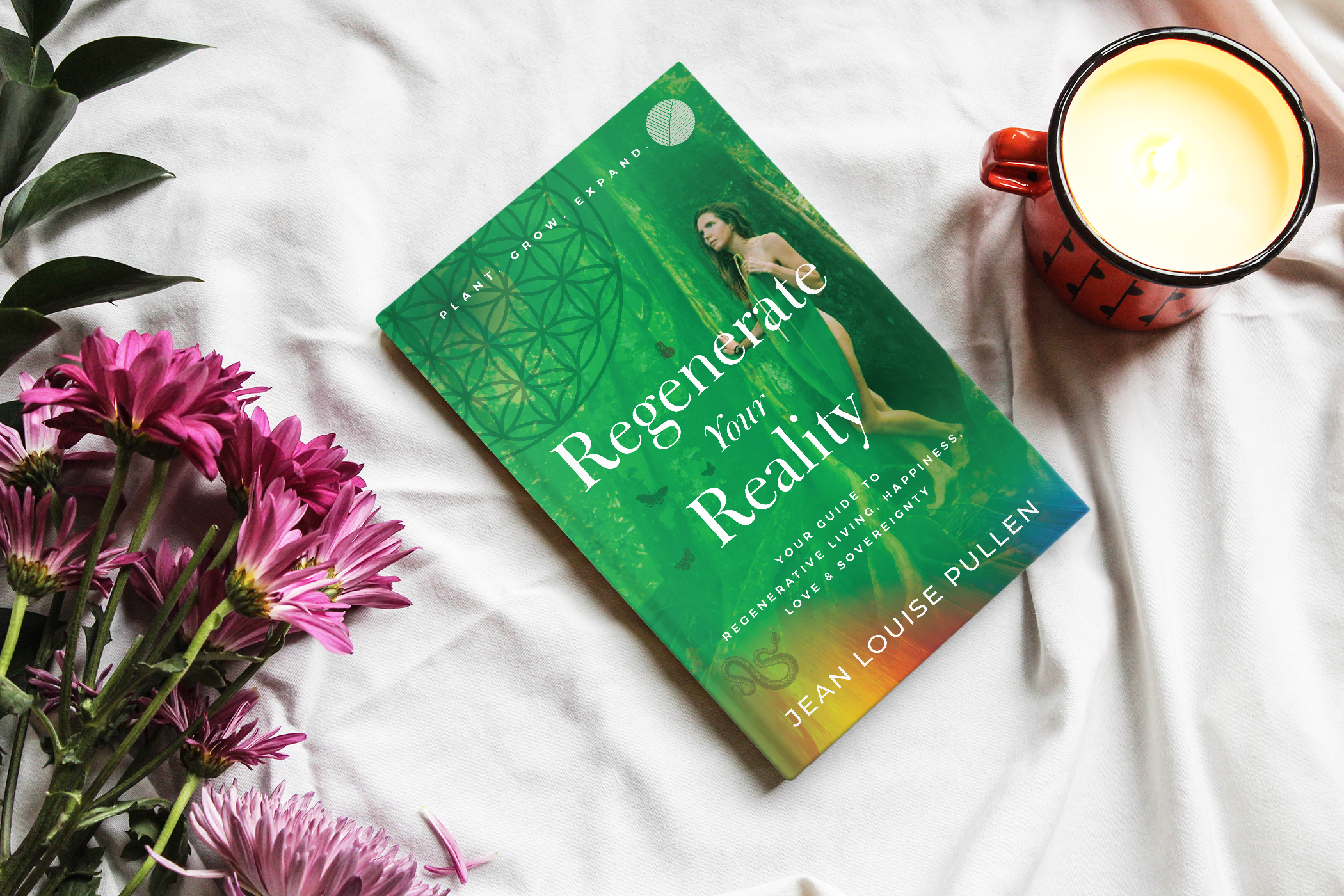
    An Excerpt from “Regenerate Your Reality: Your Guide to Regenerative Living & Sovereignty

    Guest Post by Jean Pullen

    regenerative living, regenerate your reality

    Jean Pullen is a multi-talented artist, gardener, cook, musician, writer, and entrepreneur. Jean is founder of Regenerate Your Reality, partner & director at  Jungle Project, and a Soil Advocate at  Kiss the Ground. Jean believes we can be part of the solution to the climate crisis, and that we all can play our part by living regeneration and coming back to our essence of love.


    regenerative living, regenerate your reality

    Writing a book about my regenerative lifestyle has been such a unique journey, and it wouldn’t have been the same without the support and involvement of many special humans, whose contributions appear throughout my book.

    Toby is one of those humans. She has also been my editor, walking me through the entire book creation process. I highly recommend working with her 🙂 I am so grateful for the beautiful insights and inspiration that she brings to my book, and I appreciate her allowing me to share a small piece of what we’ve co-created on her website.

    I am so excited to share with you all an excerpt from my soon-to-be-published book, Regenerate Your Reality: Your Guide to Regenerative Living, Happiness, Love & Sovereignty, including a special contribution from Toby!

    The book is already available for pre-order. If what you read here resonates with you, consider buying your copy now at: https://www.regenerateyourreality.com/bookpayment.

    regenerative living, regenerate your reality

    Affirmation: I take action on my dreams every day.

    As I write today, I know I live my dream, every single day. Freedom is a state of mind, a vibrant and holistic way of life. It is easier said than practiced. The freedom I’m talking about starts with loving ourselves, accepting ourselves, and liberating ourselves from limiting beliefs.

    Happiness is not a destination; it is a way of life. When I began traveling solo, I entered a “thrival mode” (the opposite of survival mode) of creating my own reality.

    When we live our dream every day—satisfying our basic needs, cultivating self-love, and taking care of the earth and each other—we live with purpose. We paint each brushstroke with beautiful moments and cherish the simple pleasures.

    As I started to go inward and assess each aspect of my life, I understood what was real and what was illusory. I followed my heart through Central America, and I thought I would make it all the way down to Patagonia, but found my home in Costa Rica instead.

    Just because we are born somewhere, that doesn’t mean we can’t migrate. Our dreams and outlook evolve as we grow and learn about the world. When our dreams and perspectives evolve and grow, sometimes we need a different environment to contain them.

    Our dreams and goals ebb and flow with the cycles of life. They can change in an instant when we wake up from the “fog” of social conditioning, or from familial expectations, and start to find our own way.

    My dreams changed as I grew and learned, evolving from my childhood dreams, to dreams in my early twenties, to the dreams I have today. Sometimes our deepest beliefs can change, and we open to new opportunities our minds can’t even comprehend. Perhaps we reach all our dreams and goals, and then we still keep dreaming, living in the present and believing that everything is possible.


    “Maybe you haven’t even dreamed it yet!

    —Toby Israel, Author of Vagabondess, Founder of Mujeres Fuertes @mujeresfuertescostarica@vagabondesstravel

    We often talk about making our dreams come true. The sky’s the limit, that kind of thing…

    But, going out on a limb here, what about the things we never dared to dream? What about the possibilities that didn’t even enter into our orbit of awareness? What if the sky *isn’t* the limit?

    I’ve had a lot of conversations recently about the gnarled, labyrinthine trails we call our life path.

    I didn’t dream up this life; I lived it into existence, one day at a time. In fact, I couldn’t have dreamed it even if I’d tried! So many key ingredients hadn’t come into my path yet.

    I think it’s great to have goals and aspirations. They keep us focused and challenge us to grow. However, I would argue that when we limit (yes, limit) ourselves *only* to what we can dream, two things happen:

    1. We dream small, because we are scared to dream too big. I notice this in myself all the time as I vision new projects. Why do you think it took me so long to write my book? A travel blog was an “achievable” dream. But a book… What if I failed? Or worse, what if I succeeded?!
    2. We don’t know what we don’t know. I can’t plan a future full of people I haven’t met yet, experiences I have yet to live, and information I haven’t yet learned. I can only set goals that exist within the realm of conscious possibility. But what about all the possibilities I can’t even imagine.

    Ten years ago, I never could have imagined the life I have today. Today, I know that I have *no idea* what my life will look like ten years from now. The people, places, ideas, and projects that will populate it—maybe I haven’t even met them yet. I certainly haven’t dreamed them.”


    The Regenerate Your Reality Book is ready to pre-order!

    Regenerate Your Reality will plant a seed of restoration in your path and remind you that we are all forces of nature. Pre-order your copy now to get it early 2022: https://www.regenerateyourreality.com/bookpayment (A portion of proceeds will support the planting of three trees for each book purchased.)

    Thank you so much for reading! If you don’t know the project, Regenerate Your Reality uses permaculture, agroforestry, and education to bring sovereignty and happiness to our communities. ⁣It is our mission to restore the relationship between humans and the earth and build a regenerative future. Share the mission and learn more at www.regenerateyourreality.com.

    Be sure to follow Regenerate Your Reality on Instagram and Facebook to stay tuned about all our upcoming webinars, workshops, farm tours, and book release.

    regenerative living, regenerate your reality

  • Co-Living is More than a Buzzword—it’s a Lifestyle

    Co-Living is More than a Buzzword—it’s a Lifestyle

    If I had to choose, I would probably call myself an introvert.

    As often as not, I don’t really like being around people. Solo time nourishes me. Silence feeds me.

    But then, I also crave (conscious) community, and I thrive on substantive social interaction. That’s why I let go of my isolated one-bedroom cottage in the Costa Rican jungle and moved to Unity, an urban conscious community and NuMundo impact center in the heart of San Jose.

    And I’m glad I did. Solitude may be very comfortable, but I have always found that co-living pushes me to grow—deeper, and at an accelerated pace.

    Most broadly defined, co-living describes, “any shared living space that improves quality-of-life for its residents.” The exact difference between a co-living space and an urban intentional community depends, perhaps entirely, on who you ask. For me, there’s a significant amount of overlap.

    co-living

    Here are just a few of the ways co-living and community living can support personal transformation and self-growth:

    1. Everyone is a mirror. People will push your buttons. All of them. And when something objectively unimportant, like forgetting to take out the compost, sets you off, you’ll realize a critical truth: your problems are… yours. Everyone is walking their path. It’s not about them. In co-living spaces, repeatedly confronted with qualities that irk us, we must acknowledge and overcome our own blocks and biases.
    2. Everyone is valuable. In co-living spaces, you will share time, energy, and maybe bathrooms with some people you may never have gotten to know otherwise. The inherent intimacy of co-living will continually remind you that every soul is equally bright—and equally important.
    3. You don’t have to like someone to live with them. I have long let go of the unfounded notion that I should like everyone. (I don’t.) However, when you connect with intentional communities and co-living spaces, you learn that respect—not affability—is the requisite foundation to harmony and evolution.
    4. Learn to Set Boundaries. Boundaries are everything. You’ll learn to say no. A lot. You’ll set firm-yet-loving boundaries around personal time and self-care—if not from day one, then very soon thereafter. In so doing, you’ll take a necessary step in personal development toward assertive communication.
    5. Co-Living is a Natural Incubation Process. Assuming your community or cohabitants are also committed to self-actualization (chances are good), then a co-living space will nourish your dreams, projects, and lifestyle in equal measure.
    6. Healthy Challenges. There’s a saying I’ve heard a lot in the ecovillage movement: community makes life easier. Now that may be true in some ways, but living in community—co-living—is also incredibly challenging, especially for those of us raised in individualistic cultures. The good news? That challenge is fertile territory for growth. Develop core life skills that you can’t learn alone: patience, compromise, and clear communication.
    7. Journey without to journey within. As with our physical travels, any foray into new external territory kindles deeper exploration of our inner landscape. Co-living is another adventure, both on our inner path to self-development, and on the outer one to global transformation.

    How has co-living supported your transformational journey? Please share in the comments!

    co-living, costa rica, digital nomads

    Want to experience transformational co-living—NuMundo style—for yourself? Sign up for the NuLiving Experience: 10, 5 or 3 days of coworking, living, and playing in paradise before Envision Festival… Enter my code, TOBY, at checkout for $100 off!

  • What is Transformational Travel, Really?

    What is Transformational Travel, Really?

    transformational travel, costa rica, toby israel, numundo

    Look closer. That yoga class is a portal into mindful movement and heightened self-awareness. That farm tour is an introduction to the revolutionary world of permaculture, closed-system loops, and community living. That simple sharing circle is an initiation into a different way of communicating and relating.

    Look closer. Our world is shifting…evolving…transforming — for better and worse. Widespread ecological degradation, disconnection from self and nature, and lack of purpose urgently demand solutions. We must respond with a global shift toward regeneration, reconnection, and repurposing.

    We are already responding. These shifts are happening.

    They are present in the inspiring growth of the global ecovillage movement. They are present in the increasing traffic to platforms like NuMundo, Gen Europe, and Fellowship for Intentional Community.

    Look closer, and you’ll see that the regenerative future is right under your nose.


    View this post on Instagram


    A post shared by lola méndez☽ ethical travel (@missfilatelista) on

    Last month, I had the unique privilege of both facilitating and participating in a press trip highlighting the thriving transformational travel movement in Costa Rica.

    We visited NuMundo impact center Rancho Margot, an exceptional permaculture research, education and retreat center in the Arenal area, and Nammbu, the physical manifestation of your dream (eco) beach getaway. Along the way, we explored the theme of transformation in theory and practice, with ceremonies, yoga classes, excursions in nature, sharing circles, profound conversation and a collective effort toward digital detox.


    View this post on Instagram


    A post shared by The Tico Times (@theticotimes) on

    The pre-trip documents included the following thoughts on the multifaceted travel phenomenon at the heart of our mission:

    “What is Transformational Travel?

    This is not a simple question. As “Transformational Travel” becomes an increasingly popular buzzword in the wellness tourism industry, it is getting harder to pin down the essence of this trend. But we believe it’s important to try…

    A woman jumps from a waterfall, conquering her fear of heights and reigniting her hunger for adventure and new experiences.

    Is this transformational travel?

    Following a difficult breakup, a young professional quits their job, sells everything but a backpack’s worth of belongings, and sets off to explore the world. They discover many ways of living they never could have imagined at home.
    Is this transformational travel?

    Burnt out from a stressful, overstimulated life in the city, a woman travels to Costa Rica for a 7-day nature and yoga retreat. After delving into many mindfulness practices she never had the time to try, she rearranges her world to support a healthy mind, body, and spirit.

    Is this transformational travel?

    A man participates in a plant medicine ceremony, facilitated by trained guides, and returns to his former life with entirely altered thought patterns and a new connection to nature.

    Is this transformational travel?

    The answer to all of these questions is yes. Each of these scenarios is, potentially, a perfect example of transformational travel. Of course, this is far from an exhaustive list.


    View this post on Instagram


    A post shared by Tui @ Blue Butterfly CR (@blubutterfly88) on

    Overall, this evolution marks an exciting progression toward traveling with greater intention, growth, positive impact, and (of course) transformation.

    Transformational travel is, to us, more than the “next big thing” to follow sustainable travel, intentional travel, and eco travel. It represents the deep potential for tourism (a rapidly growing global industry) to evolve into meaningful, life-enhancing journeys. And it simultaneously supports the notion that the tourism industry can be regenerative — rather than extractive — for local people and environments.

    Those are some big shoes to fill. It won’t happen all at once, but we’re extremely optimistic about the trends toward eco-restorative and human-restorative travel in our home of Costa Rica… and around the world!”


    View this post on Instagram


    A post shared by Nu_Mundo (@nu_mundo) on

    Beneath the Buzz: The reality of Transformational Travel

    As I’ve mulled over this concept in preparation for our press trip(s), I’ve come to believe we can break down this buzzword into a couple key components:

    Transformational travel is personal. It can be small, like deciding to keep a regular mindfulness practice or cooking at home more. It can be a massive life shift like moving to the other side of the world or starting a new business. But there is some kind of internal shift, personal growth, or deepening of self-awareness.

    But it also ripples out to touch our communities back “home.” Transformational travel doesn’t stop when the trip ends. Or rather, a transformational journey does not have a fixed end point. Transformation is about process, evolution, and action. And so, the movement sparked by a transformational experience continues, according to the laws of inertia, far beyond the initial impetus. It follows us, fuels us, and ignites further shifts in our communities.

    And it must have a positive impact on the places visited. This last element is crucial. It makes the difference between a nice-sounding travel trend and a real, meaningful shift in the tourist/traveler mindset. Transformational travel requires that we flip the traditional extractive model of tourism on its head — regenerating and contributing rather than Not to be confused with “eco-tourism” or “greenwashing,” transformational travel implies grassroots, integrated, inclusive initiatives that benefit local communities on their own terms.


    View this post on Instagram


    A post shared by Amarna Miller (@amarnamiller) on

    Of course, this summary is far from exhaustive. In conversations about transformational travel, each press trip participant offered their own perspectives, based on their own experiences, expertise, and passions. Some focused more on adventure and conquering self-imposed limitations, others on spirituality and self-actualization, and still others on getting off the beaten path and into truly local experiences.

    All of these are valid, and all bring value to our dynamic conversation about the evolution of travel.

    Because ultimately, transformational travel is about you. It’s about me. And it’s about how we’ll connect — to one another and to our communities — to create something real.


    View this post on Instagram


    A post shared by Toby Israel (@tobyintheworld) on

    What Do You Think?

    This is a conversation, and there are as many answers as there are travelers experiencing true transformation through their journeys. So, I’d love to hear from you:

    What does transformational travel mean to you? How can we do it, share it, and live it?

    Please share your thoughts and experiences!


    Originally published on the NuMundo blog.

    This unique experience came to fruition in collaboration with Desafio Adventure Company, Blue Butterfly Events, and the Costa Rica Tourism Board.

    Check out my upcoming transformational experiences at my retreats page!

  • The Floating Pirate Community you always wanted to Join is Real… & it has a Name

    The Floating Pirate Community you always wanted to Join is Real… & it has a Name

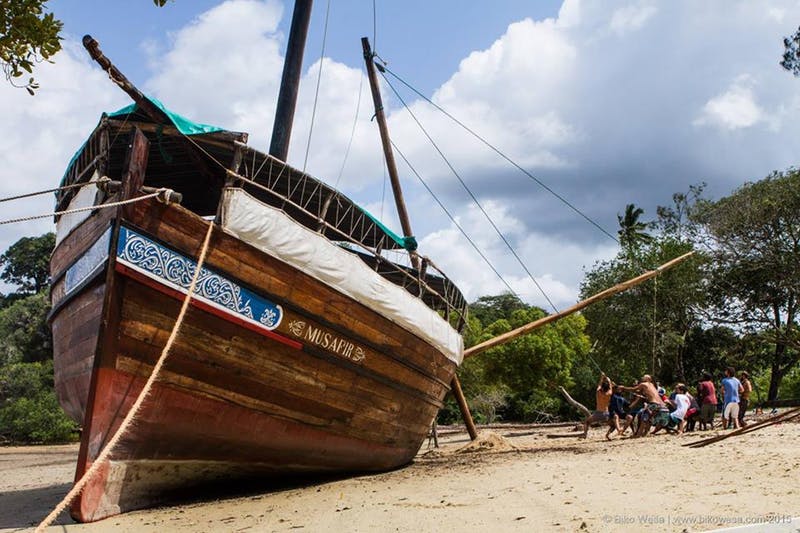
    Musafir is more than a ship. She’s an ideal—a vision and symbol of another way of life.

    Those who built her and those who meet her find themselves swept up by the singularity of her story.

    Musafir—or Msafr in Ki-Swahili—is Arabic for traveler. And indeed, the soul of the 70-foot (21-meter) dhow is travel. When I met her in early 2015, she lay at anchor in Kilifi Creek, on the North Coast of Kenya. Just 3.6 degrees south of the equator, Kilifi rests in equal proximity to the chaos of Mombasa to the south and the ancient port town of Lamu to the north, yet remains utterly tranquil.

    During my two months in Kilifi, I visited the nearly-finished vessel often.

    sailboat, dhow, musafir, distant relatives, toby israel

    The approach to Musafir required a two-minute swim, or a one-minute kayak ride, through calm saltwater. At the boat’s hull, the water glowed a brilliant green as though illuminated by the vessel itself.

    Louis, a 30-year-old Frenchman from Burgundy who arrived in Kenya in September 2011, rested on board, a feather in his dreadlocks and a worn pair of shorts around his narrow hips. He had been building the Musafir for three and a half years.

    Work on the deck had begun only a week prior to my arrival, and a jumble of boards—some secure, others less so—sprawled before him. From several beams a collection of items hung: one hammock; woven baskets; a blue glass evil eye; a shard of mirror; solar lights; and a Kenyan flag.

    The mirror reflected the bright afternoon sun as Louis spoke:

    “It was the idea of freedom that called to me. The idea of doing something else. That’s why I started traveling, because I saw that this life that was suggested to me was not exciting. I think with this vehicle [Musafir] we can send a message somehow to the world. Not screaming it loud, you know, but by touching people pole pole [slowly in Ki-Swahili], showing that another way is possible. And if you follow your dream, even if you think “no, it’s impossible,” it’s possible.”

    Louis, along with an Italian man named Paolo, is one of the project’s “initiators.”

    kenya, sailing, dhow, kilifi, musafir, numundo, transformational travel

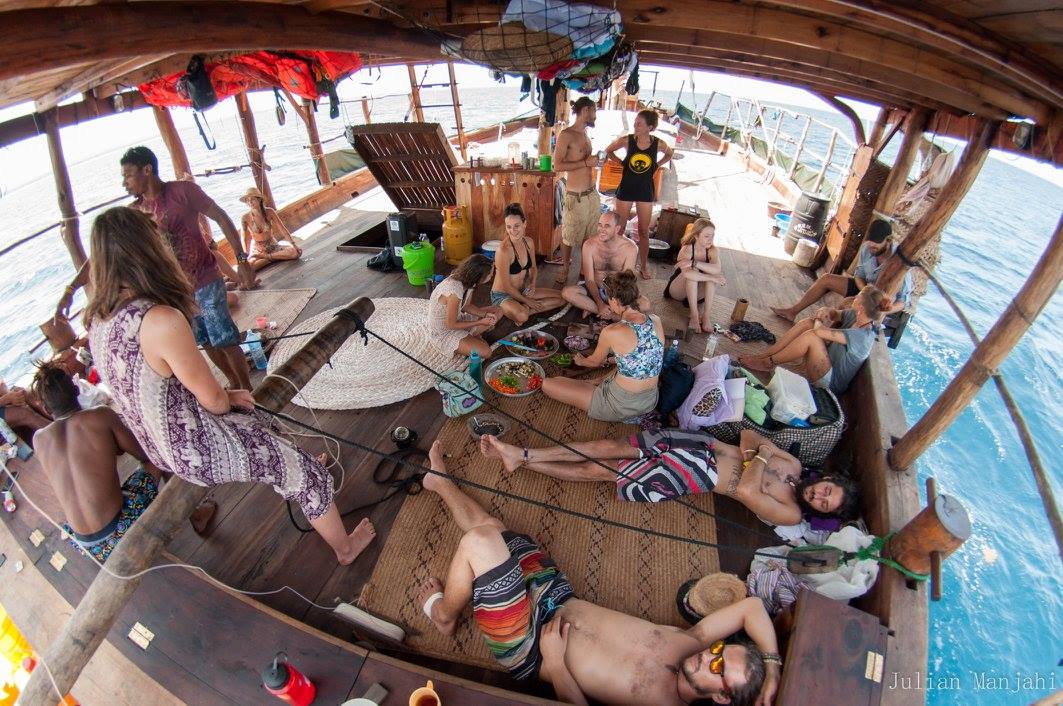
    In theory, however, “the boat belongs to whoever is on board.”

    He laughs and adds, “Me I’m just the Chai Wallah. My job on board will be to make chai and coffee. Just now, you know there are so many other jobs to do and no one else is around to do them.”

    The project relies on donations, crowdfunding, and—above all—the resources of those who have devoted their lives to actualizing it. Louis, Paolo and many volunteers repeatedly poured their savings into building costs.

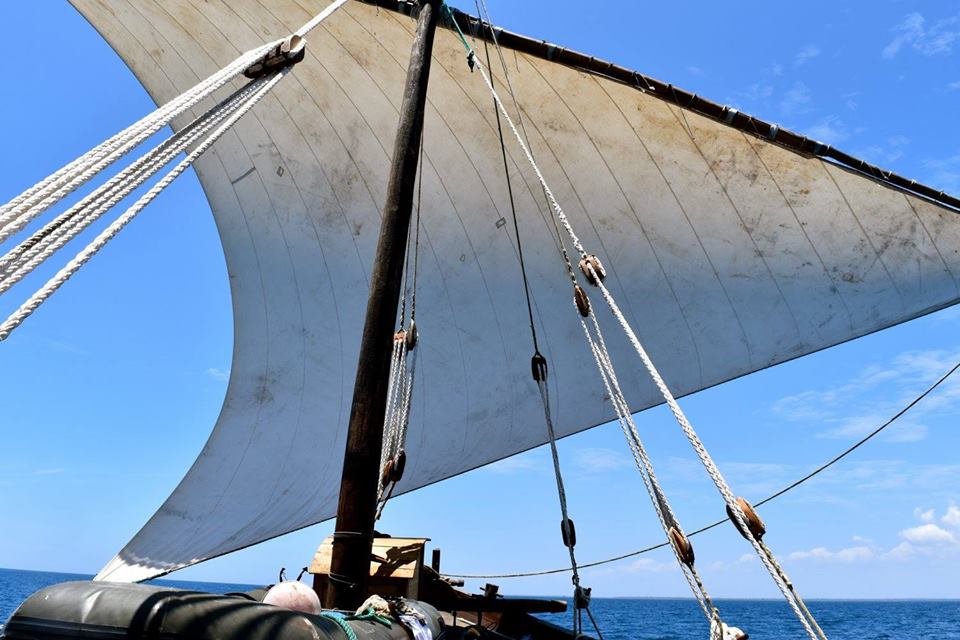
    Historians differ on the exact origins of the dhow (a broad category encompassing many particular models). Some declare it Arab in origin, while others trace its roots as far as ancient China. A lateen sail and long, narrow hull differentiated the dhow from its Mediterranean kin. Many were constructed in Kerala, South India, known for the quality of its timber. Until Vasco da Gama’s arrival to Africa in the 15th century, wooden pegs and coconut rope—not nails—held the vessels together.

    Kipini has long been a notorious hub of expert Swahili construction, and thus a natural, far-off-the-beaten-path starting point. Musafir made its maiden voyage from Kipini to Kilifi (more accessible and less isolated) in November of 2014. In four days, she traveled 75 nautical miles, carrying fifteen passengers, a goat who would not see the end of the journey, and several chickens who would.

    Musafir, which, more precisely, is a jahazi (a Lamu-style dhow), is held together by copper nails rather than coconut rope. A few power tools for sanding and drilling assisted her construction, and she will eventually have an engine, too. However, Badi (the fundi, or master ship-builder), largely employed traditional techniques.

    Cotton canvas sail; old wood from Kipini; axes and sweat.

    musafir, boat, dhow, sailing, kenya, africa, adventure travel

    Building a boat of this size by hand is an endeavor few would undertake, but those involved agree that their labor adds inimitable depth.

    Louis elaborates, “Does it have soul? Does it have a special energy added to it? I think it does… Day after day of work, you start to know every piece, every nail. It makes it totally unique. You can be sure there won’t be two dhows like this in the world.”

    Dhows once traversed the Indian Ocean, sailing along the Arabian and East African coasts, and following the monsoon winds all the way to India and back. They carried dates from Basra, curved daggers from Muscat, gold and ivory, carved chests, spices and mangrove poles—and ideas. The dhow enabled the exchange of languages, people and ideas as well as goods.

    Likewise, Musafir will transport stories, goodwill, and possibly trade items. When the traveler and its travelers make port, “the vision is to have this exchange of culture—learning from communities and doing what we can to fill any specific needs.”

    Louis, Paolo and others made an exceptional effort to integrate into their temporary homes. They learned Ki-Swahili and befriended the Kilifi men who spend vast swathes of time cleaning the nearby beach. They drank mnazi (coconut palm wine) and worked closely with local experts.

    Cross-cultural understanding, they have understood, is an integral component of modern-day travel. Along the Swahili Coast—a vibrant blending of deep Islamic roots and centuries of Bantu, Arab and Indian influence—such insight requires time and complex awareness.

    musafir, distant relatives, pirates, community, travel, africa, toby israel

    What could inspire a group of unconnected people from around the globe to live and work together towards a common goal? It’s not the physical ship, though many involved love to be at sea. More than anything, it is the promise of freedom.
    Dario, a volunteer from Sicily, explained,

    “I think it appeals to people who are curious, adventurous… and who have a little craziness around, because it’s not a safe environment. I fell in love with the idea. To travel, to have access to any country. There are no roads, you know; you are just thinking where to go and you go.”

    Travel represents both a means and an end. For these Musafiri, there is no “after” in sight—only oceans and journeys to discover.

    Dario peeled a mango with a recycled blade and spoke over the snapping of the green tarp overhead as the wind churned and the light became hazy with the setting sun.

    “Musafir is about traveling,” he says. “It’s about life. It’s about getting to know new cultures, new people. It’s about growing, because while you travel across the globe you’re able to learn many, many things that can be illuminating. It’s about helping out as well. It’s an idea that can amuse people, because if you think about building a 70-foot sailing boat in order to travel around the world, wow, it’s a bit of a crazy idea. But eventually… You’re sitting on it. The boat floats. We’re here talking about it. So it’s a project that shows that if you really want something, you can do it.”

    To leave the ship, I could either climb down the rope ladder on her port side or jump into the warm waters of Kilifi Creek. The inimitable Distant Relatives Ecolodge was only a five-minute walk away. Their eclectic blend of earthy vibes and tropical hospitality served as a base for the Musafir team, as well as myself, for some time.

    musafir, kenya, kilifi, distant relatives, transformational travel


    When Louis and Paolo first arrived in Kipini, many of the villagers regarded them with suspicion.

    Why did they live in poverty while spending large sums on Musafir’s construction? Why wouldn’t they use the finished ship to turn a profit? With their long hair and beards, the villagers concluded, the men must be undercover Mossad or CIA agents come to spy on them.

    The answer to these questions, however, was and is simple:

    Musafir is not a business. She is a message.

    Dario concluded, “It’s important as well to come down here and understand what it means to take part in such a big project. It’s very challenging, and it’s wonderful in itself. It teaches you a lot—shows you great beauty.”

    For those who dreamt her into being, Musafir is a message of freedom and unity. She is a lesson in perseverance and an example of a way of life not yet lost to the world.

    When she sets sail, a traveler’s soul will go with her.


    Anyone inspired by this project has several options. One can, if the fit is right, sign on as a volunteer for several months. Alternately, one may support the project financially by donating here.


    Originally published on NuMundo’s Transformational Times. 
  • Don’t Ask me where I’m From, Ask me where Home Is

    Don’t Ask me where I’m From, Ask me where Home Is

    One balmy evening in Domincal, Costa Rica, two friends and I found ourselves stuck in conversation with a friendly tourist from the United States. Despite the best of intentions, he was boring us all.
    We didn’t feel like chatting, and the dance floor was calling. So, when he inevitably asked, “Where are you all from?” we answered in the least gracious way possible:

    “I forgot,” said one friend.
    “I’m undecided,” said the other.
    “I don’t know,” I finished. 

    After close to a year living in Costa Rica, we thought our responses were a clever alternative to the repetitive small talk we had come to dread—with tourists and locals alike. Our unfortunate conversation partner doubtless thought we were very rude.

    However, our reluctance to answer a seemingly simple question touches on a deeper issue for me, and perhaps for many vagabonds.
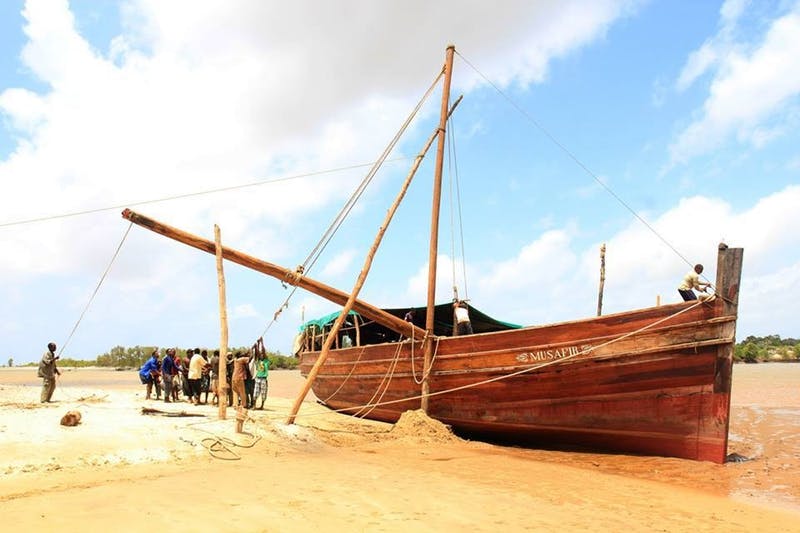
    I have small talk fatigue. I’m tired of regurgitating the same facts. What’s more, I haven’t lived in the place I grew up (is that where I’m “from”?) for 10 years. I haven’t lived in the pace I receive mail (is that where I’m from?) for five years. It just doesn’t seem like relevant information anymore.
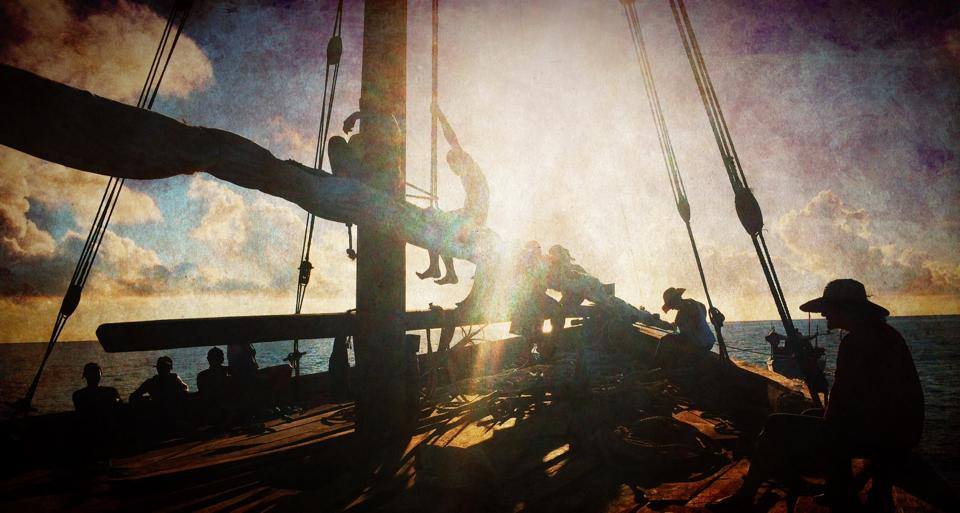
    I definitely have small talk fatigue. But that’s only part of the problem.

    As someone with vaguely European features, I never had to deal with the “No, where are you really from?” bullsh*t growing up. (That’s another ballgame entirely). But having spent most of my adult life outside the U.S., having a distinct accent in every other language I speak, and being obviously foreign more often than not, I face two questions with higher frequency than could possibly be healthy:

    Where are you from? And, why are you here?

    I just don’t want to answer these questions anymore. My place of origin is probably the least interesting thing about me. It leads inevitably to more uninteresting questions. Yet it is always, always the first thing we ask. (I am also guilty of this, though more and more I try to catch myself before it slips out). And, if I do answer the question, “ah,” they say, as if now they know everything there is to know about me.

    I reject the very premise of the question: that the world is made up of nations, and that we “belong” to the arbitrary borders within which we were born.

    I refuse to identify with a nation simply because we have collectively consented to buy into this fiction. I refuse to flaunt my country of origin (utterly accidental, and in no way representative of any personal merit), as if it were something to be proud of.

    Do the advantages and disadvantages of our birthplace, the cultural conventions of our upbringing, and the social constructs of our particular place in the world play a large role in shaping our selfhood? Of course. They play a massive role. I will be the first to make this point. But do these factors define us in our entirety? I strive every day to ensure that they do not.

    Is it an exceptional privilege to reject a national identity and seek a global one? In a way, yes. Few have the luxury to choose to dissociate from the title on their birth certificate or passport.

    Yet, I believe we are all capable of taking a critical look at the structures we have been handed as incontrovertible—at the stories we have been taught as truth. We all have the choice to accept the world given to us…or to deconstruct it, fiction by fiction, and build a new one.

    I was born in the United States. I have a U.S. passport.

    On the one hand, this tells you everything: my position of privilege, my opportunities for work and education, my background, and cultural references.

    But on the other, this tells you nothing about my values, my vision, my spirit, or my heart.

    I was born in the U.S., but don’t ask me about that.

    toby israel, home, travel, costa rica, nationalism

    Ask me, “Where is home?” I will tell you:

    Home is Costa Rica, for now.
    Home is with my family, wherever they happen to be.
    Home is my community—global.
    Home was South Africa, Zanzibar, London, and Italy… for a while.
    Home is in my body.
    Home is a hot shower and a good meal.
    Home is wherever I am welcomed—and wherever people are kind, good, and full of love (everywhere).
    Home is many, many places, and sometimes it is nowhere at all.

    And maybe tomorrow I will tell you something different. Isn’t that so much more interesting?

    Don’t ask me where I’m from, ask me where I’m at home. Then, maybe, we can talk about something real.


    Originally published on elephant journal.

    Image used with permission from Marc Maksim Photography.

  • No One is Talking about God (Poetry)

    No One is Talking about God (Poetry)

    Quite a few months ago, I traveled down to the south of Costa Rica to visit friends living in a remote community on a very special stretch of coastline.

    I had a lot of time to reflect. A lot of time to sit in the dark too. Real dark, untouched by any trace of electric light.

    That kind of darkness opens us up to a kind of spirituality, or creativity, often blinded by the modern world. At least, it seemed that way to me.

    That kind of darkness brought me a lot of words. These are a few of them:

    god, wanderlust, woman, travel, ocean

    Talking about God

    I went to the ocean on a cloudy night, just to stare at darkness.

    I felt my heart beat faster as the waves rolled against the beach,
    and my body rolled too, in sympathy.
    This was solitude.
    Utter blankness upon the canvas of my cornea.
    This was emptiness.
    Division between water and sky barely visible on the horizon.

    My voice, when I sang out to that ocean beat,
    was unique in all the darkness,
    for it was the only thing that told itself to itself.
    The sea spoke to the moon,
    the raindrops spoke to the trees,
    the rocky beach spoke to the colonies of crickets —
    and then, there was me.

    I want so much to be a part of it.
    To lose track of my voice in harmony with the waves.
    To see my footprints disappear,
    my skin melt into the everything
    of that shifting, sucking darkness.

    I love my life, my body, my breath.
    Just, I want to be a part of it.
    The whole.

    You see, no one I know seems to be talking about god —
    it’s out of vogue to seek the divine,
    the mysterious, the ethereal and the invisible;
    children learn to count money but hear nothing of souls;
    we don’t care why we’re here as long as there’s football —

    And no one I know seems to be talking about god;
    we’re all too educated for that,
    leave it to the zealots and the black hats,
    write your gratitude journal and bow down to the fat cats —

    No, no one I know seems to be talking about god,
    but I want to find her,

    so I go down to the water and look into my own heart,
    because a wise teacher or two once said
    I would find a spark —
    there, where all the secret things we pretend not to believe in sing;
    where the ancient longing we don’t understand goes to hide;
    where the invisible and magical and wild abide.

    I heard, once, that god was at the heart of everything,
    including me.
    I read, once, that gods played and ate and shifted faces
    at the bottom of the sea.
    I knew, once —
    I knew, I knew, I knew, I knew, I knew —
    about the mysteries dancing at the horizon,
    where water meets sky,
    about the spirits who live between worlds
    and send stories with serpents and dolphins and dragonflies,
    about the beauty that gave birth to every single thing.

    But I forgot,
    we forgot,
    and I want so much to remember:
    I am part of it.

    No one I know seems to be talking about god,
    but, call me crazy,
    I want to find her.
    So every day, for a few minutes,
    I try to stare at darkness.
    I dive into that shifting, sucking water,
    and I look into my own heart.


    Originally published on Rebelle Society, July 2018.

    Written in November, 2017 at Finca Morpho.

  • “How Many Countries Have You Been To?” & Other Questions I Avoid

    “How Many Countries Have You Been To?” & Other Questions I Avoid

    Originally published on elephant journal.

    Nowhere on my website will you find a tally of countries I’ve visited. Not on my Instagram either.

    Several times, I’ve debated changing my policy about this. It appears to be de rigueur for writers and bloggers in my niche of adventure travel and digital nomadism. And, I am proud of the ground I’ve managed to cover in relatively few years.

    However, I’m much prouder of how I’ve covered it.

    Hitchhiking thousands of kilometers through Europe, learning (basic) Swahili in Zanzibar, building community in Costa Rica—these are the stories I want to tell about my years on the road, which numbers can never do justice.

    Numbers may tell you how many kilometers I walked, how many years I lived out of a backpack, or—yes—how many stamps I have in my passport. But numbers won’t tell you what the Phnom Penh pavement felt like under my bare feet, how my shoulders ached after carrying my life with me across Spain, or the many amusing (stressful) ways I crossed all those borders.

    I think you get my point. The number of countries I have visited is, like any other tally, just a number. It is not, in my opinion, very interesting information.

    Furthermore, it is already an exceptional privilege to travel as I have done. I am deeply grateful to sustainably maintain the nomadic lifestyle I find so exhilarating. It seems unnecessary to proceed to flaunt that privilege in such a one-dimensional way.

    I also dislike the rhetoric, only too common in the travel blogosphere, that “more countries = more happy.” There is no happiness equation. A fuller passport does not equate to a higher happiness index—though travel can certainly lead us down many paths to fulfillment. I am wary of contributing to this superficial conversation in any way.

    countries, travel, vagabonding, nomadic

    All that said, I would hate to raise objections without offering solutions. I wouldn’t waste your time with criticisms of displaying the “travel number” if I didn’t have some alternatives in mind.

    When I tell new friends about my vagabondish lifestyle, more often than not their first question is, “So, how many countries have you been to?” I’ve come up with a lot of ways to avoid (or transform) that one. Here are my favorites:

    1. “Let me tell you about my most recent trip to X.” Stays on topic, but narrows the conversation down to a specific, less superficial angle that I actually want to explore.

    2. “A lot… I’ve been living nomadically for quite a few years.” Vague, but hopefully avoids anything that might come off as boasting.

    3. “Honestly, I’d rather answer a different question.” The most direct answer, and usually goes over well when delivered with a genuine smile.

    4. “I actually don’t think it’s that interesting. Let me tell you a story instead.” Also direct, and opens space for the exchange to move toward a subject of mutual interest.

    5. Just tell them the number…once in a while, it’s easier to go with the flow and answer the damn question.

    I like these answers because most of them are rather versatile. The same tactics can help us to gracefully evade personal questions we don’t want to answer, small talk we don’t want to engage in, and norms of conversation we don’t want to support.

    I hope travelers with similar misgivings to my own may take away a helpful solution or two.

    May your backpack be light and your feet happy—no matter how many borders they’ve crossed!


    I also don’t really like “Where do you come from?” Stay tuned for some thoughts on that.