Tag: communication

  • How Empowerment Self-Defense Can Improve Our Relationships

    How Empowerment Self-Defense Can Improve Our Relationships

    empowerment self-defense, toby israel, envision festival, costa rica
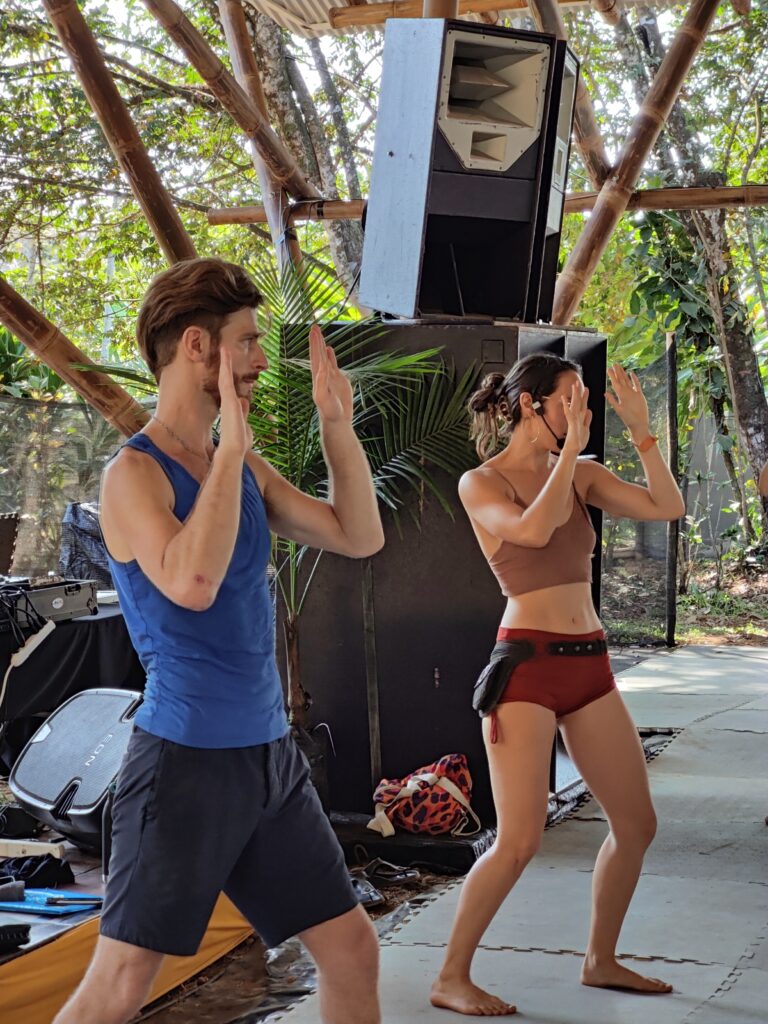
    Empowerment Self-Defense workshop at Envision Festival in Costa Rica, 2023.

    Understanding the traffic light approach to evaluating risk — & safety.

    What does self-defense mean to you? Is it just about martial arts strikes and yelling at an attacker? Or is it also about expressing firm boundaries, communicating a “No” without excuses or apologies, and interrupting uncomfortable situations before they become dangerous.

    Or, is it about improving our relationships, relaxing into deeper connection and pleasure, knowing that the tools for self-defense are within reach, just in case.

    For me, the answer is D, all of the above.

    As an empowerment self-defense instructor, I define both violence and self-defense along a broad spectrum. An attack by a stranger in the street or on the beach is violence. Emotional abuse is violence. Street harassment is violence.

    As a general rule, we humans don’t learn basic skills for defending ourselves anywhere along this spectrum. Empowerment self-defense provides choices and practical strategies — both verbal and physical — for dealing with risk, danger, or simple discomfort in ways that support safety and agency.

    At its best, I think it can also improve our day-to-day interactions with family, friends, and partners by helping us dial into our needs, desires and boundaries, hone our intuition, and speak from it with confidence and power.

    The Interview: Leaning Back from Danger (Red)

    Perhaps the first step to building healthy relationships is learning to listen to the voice of intuition and hit the brakes at the red flags.

    News stories and popular culture give the impression that gender-based violence always appears out of nowhere. You’re walking down the street and someone attacks you. You’re alone at the beach and someone attacks you. You’re in your house and someone attacks you…

    While these situations are real, they don’t represent the majority of cases of violence.

    It is a well-documented fact that gender-based violence (whether initiated by someone known or unknown) normally begins with an “interview.” In an interview, the potential agressor tests your boundaries, little by little, to see how you will respond. In a public space, the interview might start with a simple, “Hey, how’s it going?” and then escalate to more intimate questions or a breach of your personal space. With someone known, the interview could begin with “innocent” but undesired touch, and then proceed to cross more serious boundaries.

    The interview (along with domestic violence) makes it especially difficult to practice self-defense, for two reasons. First, the social contract demands that we respond politely (or politely ignore) these first, “harmless” steps of the interview process, even if we feel uncomfortable. Second, agressors aptly erode a person’s boundaries and trust in their own intuition.

    The question is: When will you pay attention to your intuition and put a stop to the behavior that is making you uncomfortable? This is exactly what a potential aggressor is waiting to see.

    We can interrupt the interview with the assertive and direct communication of a boundary: “I don’t want to talk.” “Don’t touch me.” “You’re making me uncomfortable. Stop.” If successful, we won’t have to use any other self-defense techniques.

    That’s why I don’t like to draw a distinction between physical and verbal self-defense. All the techniques have the same objective: to protect your safety.

    The Traffic Light: Leaning into Safety (Green)

    In empowerment self-defense, we like to use the metaphor of a traffic light to understand boundaries and risk.

    When we are in green, everything is okay, normal, calm. The body should be relaxed, without too much tension, the breath even, and the heartrate at a natural resting rhythm.

    An intimate relationship, friendship, or work environment should feel green most of the time, for most of us. This is a healthy place for our nervous systems, a place where healing and learning can occur, because the heart and mind are open to receive and connect.

    When we are in yellow, we are on higher alert. We notice that something isn’t right, we feel uncomfortable, or someone is crossing a personal boundary. The body may become more tense, the heartrate or breath might accelerate, and our posture and body language display more awareness.

    And finally, when we are in red, we are already in danger, and we need to apply self-defense principles (Think, Yell, Run, Fight, or Tell/Seek Support) in order to stay safe. Unfortunately, these situations often occur with someone we know, but we have the power to interrupt them.

    It is critical to understand that self-defense does not begin when we are in red. Self-defense begins when we are in green, with a continual process of self-discovery and exploration. It starts with knowing our boundaries, understanding what we like and want, and getting clear about which behaviors we will not allow.

    This clarity can improve all of our relationships — especially with the people we really want to have close to us.

    Then, empowerment self-defense continues in yellow, when we express our boundaries and put a stop to potentially risky situations before we get to red.

    Staying Curious about Our Needs & Boundaries (Yellow)

    Boundary work is complex and constantly changing. Keep in mind that your red and green zones may look different than your best friend’s, your partner’s, or your family’s. Rembember that no one else gets to tell you where your boundaries are, or if the lines you draw are “reasonable” or “valid.”

    We can stay curious about our yellow zone, especially, asking ourselves when discomfort is an invitation to question our biases or explore the possibility for healing, and when it is a simple warning cry to step away from danger and into safety. We can embrace the discomfort of genuine growth, while also protecting our hearts, minds, and bodies against violence.

    Remember, too, that we are in a process of constant evolution, and that we may have different boundaries today than we did yesterday, and that tomorrow will surely bring another shift. Accepting and honoring this process of change and growth — in ourselves and in our loved ones — is a perpetual challenge. But, I think the rewards are worth it.

    A Short Exercise in Defining Boundaries

    Where are your boundaries today? Make a list of ten “green” situations, ten “yellow” situations, and ten “red” situations. Don’t forget that boundaries are personal! The important thing is how each situation feels for you.


    Originally published on Medium.

  • Assertive Communication for Solo Female Travelers

    Assertive Communication for Solo Female Travelers

    assertive communication, envision festival, empowerment self-defense
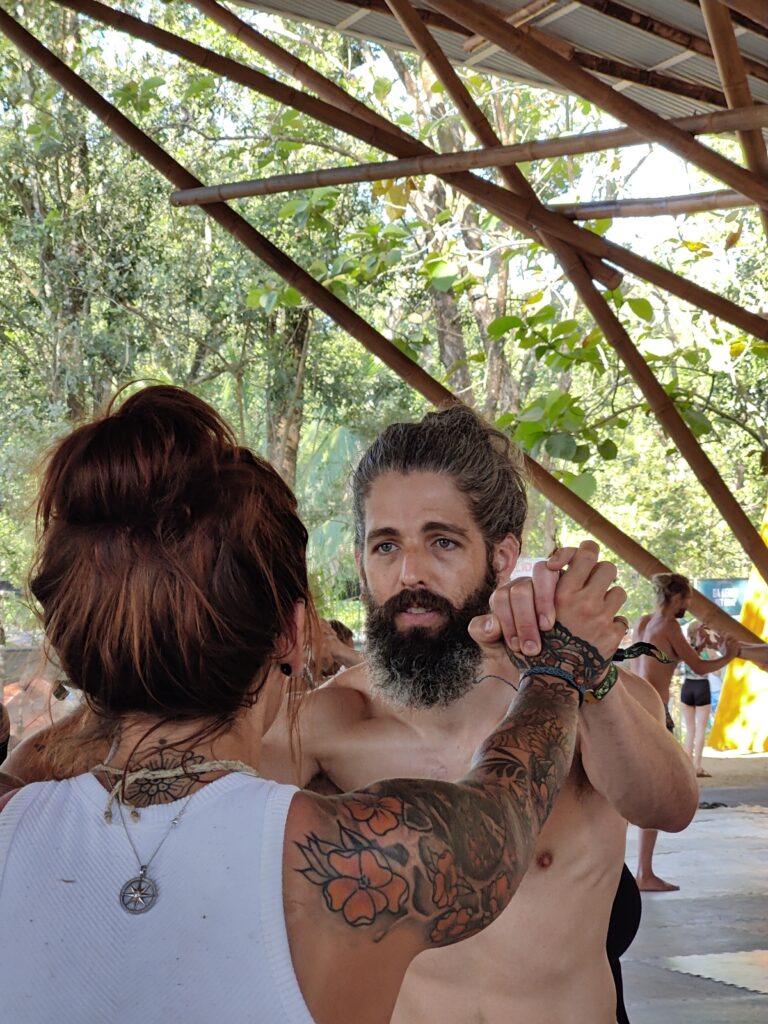
    Teaching Empowerment Self-Defense & Assertive Communication at Envision Festival, March 2023.
    Photo Credit: Hestia Photo Experience.

    Originally published on Roofnest.

    How to set boundaries and utilize assertive communication tools in any culture and any situation

    Stories of harassment and stalking for solo female travelers are a dime a dozen. At home as much as on the road, a woman’s body, space, and boundaries are liable to be disrespected on a daily basis. Assertive communication can make a world of difference—wherever you want to go in the world.

    Harassment is an unforgivably common part of the female experience, and it has become unremarkable in its ubiquity. However, just because we have normalized this behavior, that does not mean it is in any way acceptable. 

    Particularly for women traveling alone, harassment can be a serious issue, causing feelings of insecurity, potentially leading to serious danger, and almost always turning an epic adventure into a battle for basic respect. The good news? It is entirely possible—and necessary!—to communicate and enforce boundaries with grounded assertiveness whenever you feel unsafe or at risk. 

    It may feel uncomfortable at first. That’s okay. It gets easier. You’ll probably even start to enjoy your newfound no-nonsense communication style after a while. 

    You have a right to move through the world without the socially mandated protection of a travel companion or partner. You have a right to define and defend your boundaries, regardless of who is traveling beside you—if anyone.

    As women, as travelers, and as human beings, we have an opportunity to practice setting and standing up for our boundaries in small ways every single day. As a self-defense instructor, I believe it is imperative that we do so.

    In this blog I will share my top three strategies for boundary setting and assertive communication. These are my favorite verbal techniques to teach in my self-defense workshops, and I believe they are critical skills to practice in daily life—whether in your home territory, out on the road, or on the other side of the world.

    Note: While it is good to push beyond your comfort zone and engage with an unfamiliar culture as much as possible, a hard no is still a hard no. Cultural differences are real, and may impact norms around communication, personal space and physical affection. Nonetheless, you are in charge of your body and your space, and ultimately you decide what is okay for you, and what isn’t.

    3 Fundamental Boundary Setting Techniques for Solo Female Travelers:

    1. Say No. As a solo traveler, you should quickly get comfortable with saying no: “No, I don’t need a taxi.” “No, I don’t want a guide.” “No, thank you, that’s beautiful, but I don’t want to buy it.” It can be a “no” with a smile, or a “no, but thank you so much.” However, if the message isn’t getting across with gentle, polite communication, sometimes you have to be more assertive: “I said no,” on repeat, with an even, low tone of voice and confident posture, usually gets results.

      Unfortunately, just about anywhere you go in the world, a woman’s “no” doesn’t receive the same immediate respect as a man’s. Nevertheless, “no” is a complete sentence, requiring neither apology nor explanation. Do not fall into the trap of negotiating over your no, or you will end up spending time, money, and energy on conversations, things, and people you don’t actually want. Of course you can apologize or explain if you want to. The point, as I am constantly reminding students in my self-defense classes, is that it is a choice, not an obligation.
    2. Be a Broken Record. When dealing with harassment—unwanted touch, flirtation, or other behavior—a similar technique works well. Choose one line (e.g. “I don’t want to talk right now.” “Do not touch me.” “Leave me alone.”) and stick with it. It is hard to argue or manipulate past stolid repetition. Be a broken record, repeating your one, assertive line until the person gets the message. There is no need to shout or get defensive unless the harasser becomes more threatening.

      A low, even tone, confident body language, and a refusal to enter into any negotiations (but why? Come on… I’m just being nice, etc.) can put a stop to a lot of unwanted behaviors.
    3. Name and Change It. An alternative strategy involves “naming” the behavior we want to change or stop. This is one of my favorite techniques. 

      We first name the behavior (e.g. “Your hand is on my leg.” “You’re staring at me.” “You’re following me.”) without questions or qualifications. Questions invite response, denial, or negotiation. In a dangerous or uncomfortable situation, we don’t want to start a conversation or argue over the facts; we just want to make the necessary changes to feel safe. 

      After naming the behavior, we demand the change we wish to see (e.g. “Stop touching me.” “Leave me alone.”) without feeling obliged to ask nicely or say please. If once is not enough, we can return to repetition until the message lands.

      I love this technique for several reasons. First, it leaves no room for doubt; we both know what’s going on here, and we’re not going to argue over that. Second, it alerts any bystanders to the situation. Finally, it clearly states a boundary: “You’re doing this. I don’t want you to. Stop.” If the behavior persists, we then know a person does not respect our boundaries or care about our needs.

      If the situation calls for it, you may also want to turn up the volume. Yelling has been shown to prevent as many as 50% of assaults against women. The voice is a powerful self-defense tool. To yell effectively, be sure to use your belly—singers, actors, and public speakers will already know how to do that—to protect your vocal chords and bring more power and resonance to your voice. I encourage trying this at home! Tell your neighbors you’re taking an acting class (this explains everything), grab a few friends, blast some music, and practice shouting “NO!” as loud as you can. Remember to yell from your center; it can be helpful to keep your hands on your belly as a tactile reminder when practicing.

      People who attack, assault, or harass other people are not superhumans. They are vulnerable to someone shouting in their face, the shame of being called out publicly, or the human discomfort of being confronted directly with their bad behavior. While it should never, ever be anyone’s responsibility to avoid assault or harassment—and a victim is never, ever to blame—these are real risks, especially for women, everywhere in the world. Whether close to home or abroad, we should all feel prepared to take our safety into our own hands.

      Solo travelers, what are your go-to strategies for setting boundaries and keeping your communication clear and assertive? Share your wisdom in the comments!

      Want to learn more solo travel safety tips? Check out these 5 Essential Safety Strategies for Solo Travel.