Tag: intuition

  • How Empowerment Self-Defense Can Improve Our Relationships

    How Empowerment Self-Defense Can Improve Our Relationships

    empowerment self-defense, toby israel, envision festival, costa rica
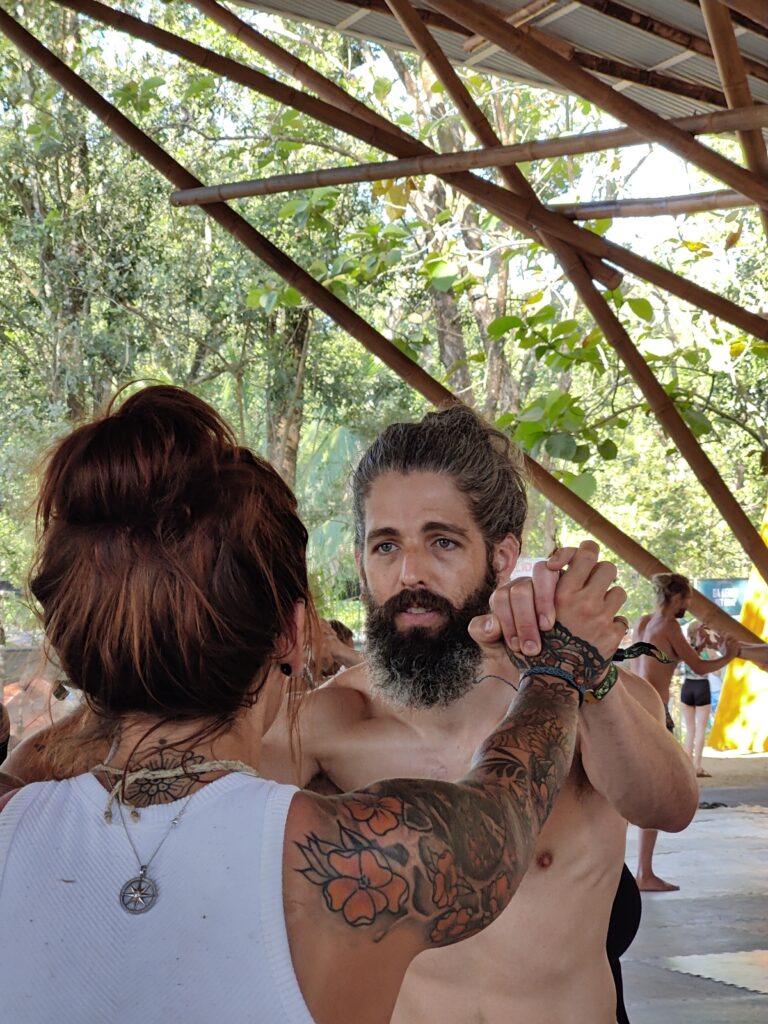
    Empowerment Self-Defense workshop at Envision Festival in Costa Rica, 2023.

    Understanding the traffic light approach to evaluating risk — & safety.

    What does self-defense mean to you? Is it just about martial arts strikes and yelling at an attacker? Or is it also about expressing firm boundaries, communicating a “No” without excuses or apologies, and interrupting uncomfortable situations before they become dangerous.

    Or, is it about improving our relationships, relaxing into deeper connection and pleasure, knowing that the tools for self-defense are within reach, just in case.

    For me, the answer is D, all of the above.

    As an empowerment self-defense instructor, I define both violence and self-defense along a broad spectrum. An attack by a stranger in the street or on the beach is violence. Emotional abuse is violence. Street harassment is violence.

    As a general rule, we humans don’t learn basic skills for defending ourselves anywhere along this spectrum. Empowerment self-defense provides choices and practical strategies — both verbal and physical — for dealing with risk, danger, or simple discomfort in ways that support safety and agency.

    At its best, I think it can also improve our day-to-day interactions with family, friends, and partners by helping us dial into our needs, desires and boundaries, hone our intuition, and speak from it with confidence and power.

    The Interview: Leaning Back from Danger (Red)

    Perhaps the first step to building healthy relationships is learning to listen to the voice of intuition and hit the brakes at the red flags.

    News stories and popular culture give the impression that gender-based violence always appears out of nowhere. You’re walking down the street and someone attacks you. You’re alone at the beach and someone attacks you. You’re in your house and someone attacks you…

    While these situations are real, they don’t represent the majority of cases of violence.

    It is a well-documented fact that gender-based violence (whether initiated by someone known or unknown) normally begins with an “interview.” In an interview, the potential agressor tests your boundaries, little by little, to see how you will respond. In a public space, the interview might start with a simple, “Hey, how’s it going?” and then escalate to more intimate questions or a breach of your personal space. With someone known, the interview could begin with “innocent” but undesired touch, and then proceed to cross more serious boundaries.

    The interview (along with domestic violence) makes it especially difficult to practice self-defense, for two reasons. First, the social contract demands that we respond politely (or politely ignore) these first, “harmless” steps of the interview process, even if we feel uncomfortable. Second, agressors aptly erode a person’s boundaries and trust in their own intuition.

    The question is: When will you pay attention to your intuition and put a stop to the behavior that is making you uncomfortable? This is exactly what a potential aggressor is waiting to see.

    We can interrupt the interview with the assertive and direct communication of a boundary: “I don’t want to talk.” “Don’t touch me.” “You’re making me uncomfortable. Stop.” If successful, we won’t have to use any other self-defense techniques.

    That’s why I don’t like to draw a distinction between physical and verbal self-defense. All the techniques have the same objective: to protect your safety.

    The Traffic Light: Leaning into Safety (Green)

    In empowerment self-defense, we like to use the metaphor of a traffic light to understand boundaries and risk.

    When we are in green, everything is okay, normal, calm. The body should be relaxed, without too much tension, the breath even, and the heartrate at a natural resting rhythm.

    An intimate relationship, friendship, or work environment should feel green most of the time, for most of us. This is a healthy place for our nervous systems, a place where healing and learning can occur, because the heart and mind are open to receive and connect.

    When we are in yellow, we are on higher alert. We notice that something isn’t right, we feel uncomfortable, or someone is crossing a personal boundary. The body may become more tense, the heartrate or breath might accelerate, and our posture and body language display more awareness.

    And finally, when we are in red, we are already in danger, and we need to apply self-defense principles (Think, Yell, Run, Fight, or Tell/Seek Support) in order to stay safe. Unfortunately, these situations often occur with someone we know, but we have the power to interrupt them.

    It is critical to understand that self-defense does not begin when we are in red. Self-defense begins when we are in green, with a continual process of self-discovery and exploration. It starts with knowing our boundaries, understanding what we like and want, and getting clear about which behaviors we will not allow.

    This clarity can improve all of our relationships — especially with the people we really want to have close to us.

    Then, empowerment self-defense continues in yellow, when we express our boundaries and put a stop to potentially risky situations before we get to red.

    Staying Curious about Our Needs & Boundaries (Yellow)

    Boundary work is complex and constantly changing. Keep in mind that your red and green zones may look different than your best friend’s, your partner’s, or your family’s. Rembember that no one else gets to tell you where your boundaries are, or if the lines you draw are “reasonable” or “valid.”

    We can stay curious about our yellow zone, especially, asking ourselves when discomfort is an invitation to question our biases or explore the possibility for healing, and when it is a simple warning cry to step away from danger and into safety. We can embrace the discomfort of genuine growth, while also protecting our hearts, minds, and bodies against violence.

    Remember, too, that we are in a process of constant evolution, and that we may have different boundaries today than we did yesterday, and that tomorrow will surely bring another shift. Accepting and honoring this process of change and growth — in ourselves and in our loved ones — is a perpetual challenge. But, I think the rewards are worth it.

    A Short Exercise in Defining Boundaries

    Where are your boundaries today? Make a list of ten “green” situations, ten “yellow” situations, and ten “red” situations. Don’t forget that boundaries are personal! The important thing is how each situation feels for you.


    Originally published on Medium.

  • The First Time: When the Travel Bug Bites

    The First Time: When the Travel Bug Bites

    Some people will reminisce—with nostalgia, regret, or a little bit of each—about their first cigarette, their first drink, or their first time trying X (fill in the blank with your substance of choice).

    Me?

    Alcohol was never a big deal in my family, and I’ve stayed away from cigarettes like my life depended on it (oh wait, it kind of does).

    That doesn’t mean, though, that I don’t have a “first” on which to reflects with the romantic fondness of well over a decade of distance.

    I’m talking about travel, of course.

    Several early family vacations could count as that first—London, Canada, Florida—but one in particular stands out in the box of mismatched, half-faded memories I carry: Italy.

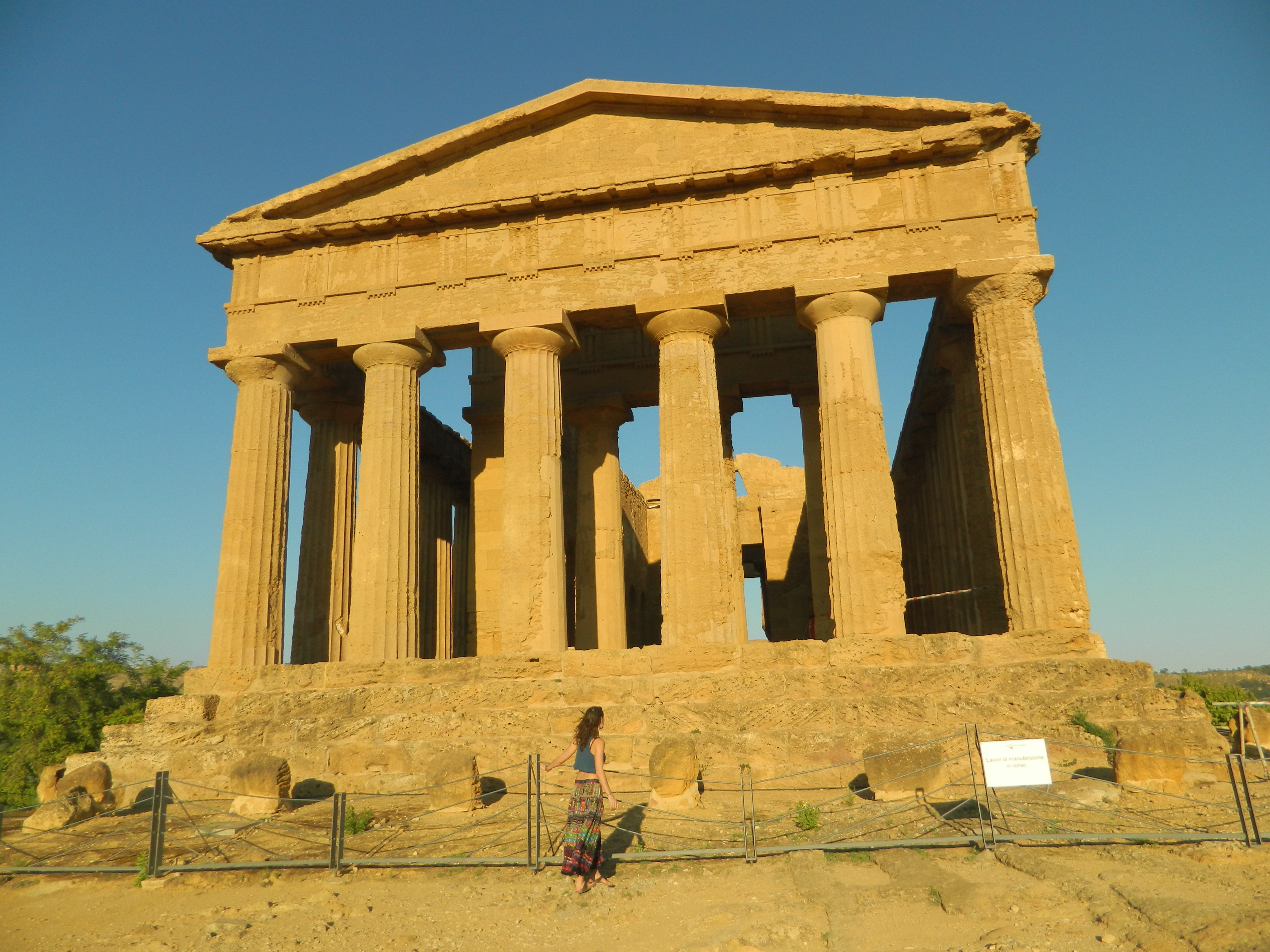
    Italy, first and most enduring love of my life… after horses. That first visit I only remember in glimpses: The heat (there was a record-breaking heatwave that summer). An old woman in a bead shop, and a strand of irregular, aquamarine beads (I would finally turn them into a necklace some fifteen years later). Crisp, white slices of coconut beneath a cascade of water glittering in the sun. Venice canals and dreams of carnevale (I have yet to visit at the right time). Cappuccinos for breakfast, and several subsequent bathroom breaks over the course of the morning. Fairytale mountain villages, and cities shimmering under summer sun.

    I have since been back to visit nearly a dozen times, learned the language, and made numerous friends across the country. I have bungee jumped in Piedmonte and reignited a passion for adventure in Sicily. I’ve indulged in pizza in Napoli, anchovies in Genoa, and fiori di zucca in Rome.

    Just thinking of it makes my mouth water and my palms tingle.

    Italy.

    But the dreamlike beauty of these childhood memories is about so much more than one country. It marks a beginning.

    I could trace my enthusiasm for the wonder of discovery to many moments—many trips:

    Dancing in a circle of women in rural Senegal at age sixteen.

    Wandering the streets of Spanish cities at Christmas-time with my peers, age fifteen.

    Age seventeen, arriving in Paris alone, and growing into a sense of adventure once too big for me.

    I could pick any of those or countless other journeys, but I choose to locate my travel awakening in that sweltering Italian summer many years prior. A seed already planted. A map already drawn across my future—big, swirling letters spelling, WANDER.

    And so I have. And so I do.

    The first time we meet ourselves is extraordinary indeed. Even if we’re too young to realize it. Even if we repeat the experience countless times thence. Even if we’re full of shit, and it wasn’t like that at all, and that dreamlike beauty is just the result of fifteen years’ obfuscation.

    So, I’m curious: what was your first time traveling like?

  • Next Up, Cape Town: Meeting the Voice of Intuition

    Chapman’s Peak, near one of my possible next homes.
    The flights are booked.
    Philadelphia —> NYC —> Amsterdam —> Helsinki. Short pause. Helsinki —> London —> Cape Town.
    Don’t ask. Flights, once booked, are very difficult to reroute.
    Why Cape Town?
    Summer.

    Why else? Well then, summer, right time zone for work schedule, visa on arrival, not Europe (I’m at the end of my 90-day limit for Schengen Zone), ocean, low cost of living, mountains, city…
    But actually, none of that really, truly answers your question: Why Cape Town?
    Yes, those are all reasons why it’s a good choice, yet my choice did not stem from them. Rather, Cape Town felt right, and the rational reasons followed.
    Too “woo woo” for you? Consider this: Whenever we have a decision to make, there is a part of us (call it intuition, gut instinct, whatever you will) that knows the “right” answer before we do. We can arrive at it by logic, or we can skip the winding road and hop straight to our destination—what feels right is right.
    You argue, but this is how drug addicts, hedonists and psychiatric patients are made—acting on impulse. I counter, impulse is not the same as intuition. I sat with my decision to head to Cape Town for nearly two weeks before buying tickets. I reconsidered all my other options, gave logic its chance to sort through the possibilities. But my intuition didn’t waver:
    Warm air, ocean tides—a chance to learn to surf, finally!—and hiking trails, even horses, and then all the things a city can offer: a blank slab of the unknown where you can inscribe the next months of this adventure word by novel word.
    It should come as no surprise that the unknown and my intuition are particularly enmeshed. What feels “right,” more often than not, is what appears shrouded in mystery—the yet-to-be-revealed of a new culture, new community, new dance, new sport, new path, new chance. 
    Of course, that is my “what feels right,” and I neither suggest nor expect it should be the same for another.
    It is only interesting, and instructive, to note where our intuition points us, time after time.
    When we hold a question in our mind’s hands, turning it this way and that, asking where, who, what, when and, most of all, why—what is the first voice to answer, and what does it say?
    Hello, intuition, nice to meet you!

    Cape Town, you say? I trust you.

    Trust. Jump. Fly. Photo Credit: Toni Toreno, Cambodia.
    ***

  • Reflections on a Birthday: Wandering, Searching, & Answering the Call

    Yesterday, I turned 24.

    The past year has been anything but boring as vagabonded my way from Europe to Africa to the U.S. and back, teaching yoga, doing marketing, starting work at elephant journal and publishing over 100 pieces of writing along the way.

    Some of it I’ve written about here; much of it I haven’t. I’m committed to keeping this a travel blog only, and so today, that’s what I’d like to focus my birthday reflections on: this journey.

    A little over a year ago, I decided to go on a vision quest—four hungry days and nights alone in the Vermont wilderness.

    I was looking for something… I didn’t find it.

    I found nothing, in fact, save for a few lovely dragonflies, ducks, and one very long, very cold night stranded beneath the stars.

    Traveling—maybe—is a little bit like that.

    First, we answer the call. Second, we set out into the unknown. And third… third maybe we bring back nothing from our journey. What then?

    As I’ve written before, I’m not searching for [fill in the blank], and so it’s very unlikely that I’ll find “it” anytime soon. And sometimes I find myself stranded beneath those metaphorical stars—cold, hungry or lost… or all three!—and I wonder how the hell I ended up there. What crazy, impulsive, excellent decision got me there?

    But it’s always the right place.

    The stars never wonder why I’m there; they know, and at least that’s one of us.

    You see, I have a philosophy I love about journeys, choices and life, and it basically goes like this:

    Each of our lives is like a forest, or a valley, a mountain a desert, etc—it doesn’t matter—absolutely covered in paths.

    When we look around, we see all of those paths—infinite options, possibilities—choices to be made.

    But when we look behind us, we see only one path—our footsteps in the sand, tracks through the woods, etc—our path.

    That path—our path—is the only path we could have walked, because it is the one we have walked. And each choice we make—once it is made—is the only choice we could have made, because there it is behind us—another footprint, another step on our path—past.

    We answer the call; we make our choices. 


    I find this outlook deceptively simple, quite practical and deeply compelling. Maybe you will too.
    When I look at the year behind me, I see each step that has brought me to this place (a cozy couch in London, England at this particular moment). I regard that winding journey without regret and with no small measure of appreciation, for without it I would not be here—the only place I could possibly be.

    When I look at the year ahead, well, I do so with butterflies in my stomach and wings on my heels, because the forest is so vast—the paths so numerous—that I can take in but a fraction of it at a time.

    And that is every life—not only mine. Every year, every birthday, every moment and every step.

    I believe that, and the stars agree.

    Thank you for being a part of this journey—as a reader, a friend, a star, or all three!

    ***
  • Time to Move

    Once upon a time, nomads—largely hunter gatherers or pastoralists—knew it was time to move when the game animals moved on, or the fields became depleted. They followed the tides of nature.
    Some traveled in caravans of camels or on horseback. They were self-sufficient. They carried their homes with them—bundled tents, cookware and provisions.
    I will be the first to admit I have nothing in common with those nomads.
    I travel by bus, train, or car. Boat if I’m lucky. I do not gather my food—though the markets in Mbita are hardly a walk in the park. If you dropped me in the middle of the desert, I would not have the requisite resources for survival…
    I carry no tent; no cookware; few provisions.
    But maybe I still share something with those wanderers of old who have always captured my imagination.
    I, too, follow a kind of tide.
    An initial wave of excitement carries me to a new place. The promise of a work exchange. The open door to a friend’s home. A spark catching in my belly and igniting my anticipation.
    That first surge crests, and the tide begins to ebb—weeks later, or maybe months. The work is monotonous. The place too isolated or too busy. The enthusiasm never dies, but it smolders more faintly.
    Then a new opportunity calls. This time on the coast, or in the mountains, or across the border. Another surge gathers momentum and I follow.
    I can usually feel when it is time to move.
    No matter how many times I follow this cycle, that initial burst of excitement never seems to lessen. The making of plans, the preparation to move, transition, journey, holds a special kind of magic for me.
    In three days, it will be time again. The ocean is calling. The sand, waves, salt and always, always the

    unknown beckon. From tides of intuition to tides of water.

    There is a backpackers on Diani Beach (30 km south of Mombasa) with room for volunteers. I still have 2 months left on my Kenyan visa, so I think I may stay there a month if it fits.
    Time to say goodbye to Rusinga Island and the rock paintings I may never find. Time to pack up and head east to meet the sun.
    Time to move.

    ~
  • Zanzibar!

    Have you ever written a sonnet?*

    A sonnet’s beauty and difficulty both lie in the restraints placed around its form. Fourteen lines, iambic pentameter, and a rhyme scheme of a-b-a-b;c-d-c-d;e-f-e-f;g-g, the sonnet is no quick jaunt on a summer day. It is hard work to fit depth of thought and poetic sentiment within its narrow frame. But when it works, it’s magic: the sonnet emerges as just reward for the poet’s pains.

    This trip I have just begun (arriving in Paris on November 17th, and checking in now from Barcelona) is a bit like writing a sonnet.

    Why?

    Have I mentioned that I am traveling with my partner? And have I mentioned that said partner is traveling on a Ghanaian passport– a document that grants today’s international traveler few privileges?

    Well, I am, and he is.

    We arrived in Europe knowing that we would have to leave within 30 days– the length of his visa. Yesterday, we returned from the Moroccan Consulate in Barcelona giddy with disbelief. We would not continue on to Morocco by ferry as we had expected.

    Why?

    Because one week prior the Consulate had received instruction to grant Moroccan visas only to residents of the Barcelona area. We would have to return to the U.S. or Ghana now to apply.

    And so we are back to square one. The fourteen lines, iambic pentameter and strict rhyme scheme of travel sonnets and bureaucratic poetry close in ever tighter.

    The following two maps represent our respective “green zones” for international travel. Green and yellow mean we can obtain visas on arrival or do not need them. Gray typically entails a lengthy visa application process, and often the necessity of returning to the U.S. to undertake it.

    Were you to lay one map on top of the other, the world would be mostly gray.

    Add to that the places we do not wish to travel, for various safety concerns, and the gray spreads farther still.

    Yet even as borders tighten and possibilities shrink before my eyes, I feel an odd sense of freedom then, faced by our obstacles. When our plans shatter and we are forced to return with all haste to the drawing board, we have to opportunity to create a sonnet of exceptional spontaneity.

    Where will we go now?

    To Zanzibar! (You may have guessed it.) City of rare consonants that beckons my imagination to wander. To East Africa. Nairobi, Kenya first, in fact– though its lack of Z’s renders it a less tempting contender for title line– then on to Botswana and Tanzania and maybe South Africa.

    I hope the sonnet that emerges is worth all the trouble.

    ~

    *[The credit for this analogy goes to a friend– he managed to express perfectly the nature of this trip.]