Category: Europe

  • An Incomplete Guide to Sicily in Quotes & Pictures

    Valle dei Templi (Valley of the Temples), Agrigento, Sicily

    “The climate’s delicate; the air most sweet.
    Fertile the isle, the temple much surpassing
    The common praise it bears.”
    — Shakespeare

    I could write—and, indeed, have written—many pages about Sicily. However, I’m hardly the first person to be taken with the island’s complex history, natural beauty and unique charms, so for a change I would like to share the words of other writers, whose perspectives, combined with pictures from my recent visit, make for a woefully incomplete (but very poetic) look at the place. I hope it may whet your appetite for more, as I never tire of convincing people to visit!

    Scala dei Turchi (Stair of the Turks), Realmonte, Sicily.  
    “Ho capito che la Sicilia è molto più complessa di quello che si può pensare: la paragonerei ad una cipolla dai molti strati.” — Paco Ignacio Taibo II
    (“I have understood that Sicily is much more complex than one might think: I would compare it to an onion of many layers.”)
    Cattedrale di San Givanni Battista, Ragusa.
    “Sicily has suffered 13 foreign dominations from which she has taken both the best and the worst. The sequence of different cultures has made Sicily a fascinating place, quite unlike any other.” — Andrea Camilleri
    Valle dei Templi.

    “This is the homeland of the Gods of Greek mythology. Near these places, Pluto abducted Persephone from her mother. In this wood we just walked through, Ceres ceased her swift running and tired of her fruitless search, sat on a rock, and despite being a goddess, she wept, the Greeks say, since she was a mother. In these valleys, Apollo pastured his flocks; these groves, stretching down to the seashore, have echoed with Pan’s flute; the nymphs got lost under their shade and breathed their scent. Galatea fled from Polyphemus and Acis, close to succumbing to the blows of his rival, enthralled these shores leaving his name here … In the distance you can see the lake of Hercules and the rocks of the Cyclops. Land of gods and heroes!” — Alexis De Tocqueville

    Valle dei Templi.

    “Sicily is more beautiful than any woman.”
    Truman Capote

    Valle dei Templi.
    “Il siciliano è il prodotto di un territorio che non è un pezzo staccato d’Italia, che non ha mai fatto parte di alcuna parte del mondo in epoca storica, che è stato occupato da nord, sud, est, ma mai è stato assimilato, l’isola in cui niente è stabile se non il movimento, il non-stabile, dove un giorno distrugge quanto l’altro giorno ha costruito, dove vulcanismo e nettunismo sono continuamente all’opera, dove un giorno trasforma la storia di secoli.” — Paul Yorck von Wartenburg

    (“The Sicilian is the product of a territory that is separate from Italy, that has never been part of any part of the world in any period of history, that has been occupied by the North, South, East, but never assimilated, the island in which nothing is stable except movement, non-stability, where one day destroys that which another the other day built, where volcanic and marine forces are always at work, where one day transforms the history of centuries.”)

    “Sicilians build things like they will live forever and eat like they will die tomorrow.” — Plato

    Valle dei Templi.

    “For over twenty-five centuries we’ve been bearing the weight of superb and heterogeneous civilizations, all from outside, none made by ourselves, none that we could call our own.”

    This violence of landscape, this cruelty of climate, this continual tension in everything, and even these monuments of the past, magnificent yet incomprehensible because not built by us and yet standing round us like lovely mute ghosts; all those rulers who landed by main force from every direction who were at once obeyed, soon detested, and always misunderstood, their only expressions works of art we couldn’t understand and taxes which we understood only too well and which they spent elsewhere: all these things have formed our character, which is thus conditioned by events outside our control as well as by a terrifying insularity of mind.”

    ― Giuseppe Tomasi di Lampedusa

    Sunset from a lighthouse.
    “I was enchanted… the limpidity of the sky, the restless splendor of the sun, the beauty of the countryside, a certain excitement of the fantasy…which brought to mind the time when in the fields one encountered the divine.” — Jean Houel

    Ragusa Ibla, Sicily

    “In Sicilia abbiamo tutto. Ci manca il resto.” — Pino Caruso
    (“In Sicily we have everything. We’re just missing the rest.”)


    Valle dei Templi.
    “Noi fummo i Gattopardi, i Leoni; quelli che ci sostituiranno saranno gli sciacalletti, le iene; e tutti quanti gattopardi, sciacalli e pecore, continueremo a crederci il sale della terra.”

    (“We were the Leopards, the Lions; those who will replace us will be little jackals, hyenas; and all of us Leopards, jackals and sheep, we’ll go on thinking ourselves the salt of the earth.”)
    ― Giuseppe Tomasi di Lampedusa

    Macalube, Aragona, Sicily.

    “Per me la Sicilia ha una luce particolare, qualcosa di primordiale. Io non sono nato in Sicilia anche se mia madre è di Palermo. È come se con questa terra ci fosse un richiamo anche più lontano della mia esistenza, che appartenga alla mia memoria. Scrivo volentieri qui, c’è un’aria speciale, istintiva. Non mi va neanche di dargli un nome sennò darei dei confini che non ha.” — Emanuele Crialese

    (“For me, Sicily has a particular light, something of the primordial. I wasn’t born in Sicily even though my mother is from Palermo. It’s as if with this land were a recollection even further back in my existence, which belongs to my memory. I write often here, there’s a special atmosphere, instinctive. I do not even give it a name, as to do so would give it boundaries which it does not have.”)
    Scala dei Turchi.

    “There it was again: the sweeping verbal gesture magnified in the prism of Sicily, the pronouncement so poetic it nullified any arguments before they could take their first breath. The vines, the amphorae, the thousands of years of history, the palmenti, the volcano, the beauty, the power of it all. In Italy, of course, beauty is next to holiness. Sicily was long the most treasured daughter of the Mediterranean. So who can teach Sicily anything about beauty?” — Robert Camuto

    Fountain, Ragusa, Sicily.

    “All of Sicily is a dimension of the imagination.” — Leonardo Sciascia

    “Raccontano, infatti, che secondo il mito la Sicilia è sacra a Core poiché qui avvenne il suo rapimento e perché l’isola fu offerta alla dea come dono di nozze.” — Plutarco
    (“They say, in fact, that according to legend Sicily is sacred to Persephone since her abduction took place here and because the island was offered to the goddess as a wedding gift.”)

    Train tracks at the edge of the Valle dei Templi.

    “And anyone who has once known this land can never be quite free from the nostalgia for it.” — D. H. Lawrence

    *** 
    [All translations mine. :)]
  • What is this Feeling? …Nostalgia??

    Stunning views from my seat flying Catania, Sicily to Istanbul (on my way to Stockholm…
    I should not have opted to fly that way, and now I have no luggage… ah, well… collateral.)

    Lately, I’ve been experiencing a sentiment I’ve never known before.

    A strange tightening in my chest when it’s time to pack.

    An odd sensation as I watch the ground shrink below me during take-off.

    An unfamiliar twinge as I lift my hand to wave goodbye.

    I feel excited to be continuing on to the next place—of course, that goes without saying, and, I suspect, will never change.

    And yet… and yet…

    I think I would call it nostalgia, this new feeling.

    First it was Zanzibar, and now Sicily.

    Maybe I’m growing sentimental in my old age. (Just kidding—my old age is a long, long way away!) Maybe I’m allowing the places (or these people… or these lives, discretely wrapped packages of time, space and possibility) I briefly inhabit to reach a little bit deeper than I used to—sending out just the finest roots beneath my skin.

    Or maybe it’s an inevitable side-effect, which has simply run unrecognized along the sidelines up until now.

    Wherever it comes from, this nostalgia weaves a duskier hue at the edges of my leave-takings. A slight reluctance (never stronger than the bolder urge to continue on, but there nonetheless). A bittersweet recognition that I may in fact miss this place (these people… this time… this particular configuration of life)—that I was happy here.

    It’s the taste of the last sip of hot chocolate, and the color of the faded corner of a photograph. Savoring. It’s the feeling of lingering before standing up to leave a cafe… and it adds, I think, a lovely dimension to each journey onward—a depth, a balance to anticipation.

    While this feeling—this nostalgia—is unfamiliar to me, I welcome it. I acknowledge it (for it undoubtedly deserves its place in the scheme of things), and then I leave it beside the photographs, memories and written pages—where it belongs.

    So. Nolstalgia… welcome to the adventure!

    ***
    Greetings from Stockholm, Sweden, where I am visiting my oldest friend for the week. My luggage is dwelling in Istanbul at the moment, but I will be sharing some amazing shots from Sicily as soon as it finds it’s way over here!
    ***
  • Being versus Seeing


    So, what are you doing here?

    They say it kindly—with honest curiosity—and they say it in Italian, but that is the question.

    The woman at the cheese shop who patiently helps me taste 10 local varieties before wrapping up my selections. The barista at the cafe on the large piazza near my apartment. The elderly gentleman who insists on guiding me through the steep valley from Ragusa (the newer city where I stay) to Ragusa Ibla (the old medieval part of town).

    They want to place me, and I want to help them.

    Entering the valley.

    I explain, in as few words as possible, my work-travel creation. That is, more working than traveling; more living than exploring.

    And, sheepishly, I recall inwardly how disappointing a tourist I have been…

    I managed to climb the bell tower of the main cathedral. I spent an hour in Modica, one of the next towns over, tasting chocolate made the traditional (unbelievably delicious) way and eating granita. I’ve visited a few beautifully restored churches (a huge earthquake in 1693 destroyed most of the older architecture, and I’ve wandered many of the small, hilly streets, eating gelato, canoli or any other treats I stumble upon. I have the good fortune to be staying with two teachers, and have attended a few dinners, lectures and expositions with them, too.

    Cattedrale di San Giovanni Battista (and the piazza)

    It’s not nothing, but it’s not much, considering I’ve been here 10 days already. Compared to past trips, when I managed to cover as many countries in a month and spent entire days on an expedition to see a city from top to bottom, it’s not much at all.

    What’s changed? Quite a bit…

    These days, I don’t have so much free time.

    Between trying to regain a daily yoga practice after injuring my hip, working six to seven hours, chatting with my hosts (my Italian gets better by the minute!), cooking all my meals and trying to write besides, I watch my days fill up fast.

    Most days, I’m happy to get a walk in, a visit to the market and maybe an hour at a cafe.

    In the valley: gate to nowhere.

    So when I feel “guilty” for not doing or seeing as much as I can while I’m in this new town—this place I’ve never been before—I gently remind myself that actually, I’m not here to visit, to tour, or to see.

    I am here to be.

    Not, I am in Ragusa to ____.

    Rather, I am in Ragusa.

    That’s all.

    Ragusa Ibla.

    It’s a subtle shift, but it relieves some of that odd pressure of being a tourist or traveler—here to see, absorb and record as much as possible.

    And I find I am only capable of this shift because I have “an excuse.” I’m working, I’m not on vacation, I’m girando (moving around), but I’m not a tourist… blah, blah blah. Excuse or no excuse, maybe this is the way to do it—for me. (You can do it however is the right way for you, of course.)

    Seeing what I see and doing what I manage to do, but moving my focus away from quantity of recordable events, I can experience my existence here without expectations. The same way I would anywhere, without the badge of “travel” tacked onto the box where I store and process those stories.

    What does it mean to focus on “being” in a place, rather than “seeing” a place?

    Well, that’s what I’m figuring out right now… I’ll let you know.

    Ragusa Ibla.

    ***

  • Snapshot: Bar Willy

    8:30a.m., Trastevere, Roma — 24 August 2015

    I begin the day with that most Italian of concoctions… il bar.

    Bar Willy sits at one corner of a busy plaza in Trastevere—at the edge of Rome.

    Its staff are a typically diverse mix, representing Asia, Africa and “the Continent” too. (Rome is a massive epicenter for immigrants to the country.) They joke about regional linguistic variations, for which Italy is famous.

    At 8:30 on a Sunday, the bar (anywhere else it would be a “cafe”) is buzzing with activity. The tables outside, however, are mostly empty, for—in typical Italian fashion—most of the patrons prefer to take their morning coffee and cornetto (croissants, but, sorry, not as good) standing up.

    And so the bar pulses with the ins and outs of customers on their way to the Sunday market just outside.

    They order a caffe’ (espresso), cappuccino or latte macchiato (hot milk with a touch of coffee), and the sounds of their orders rebound from barista to cashier to my ears and back. The clatter of tiny spoons on plate, plate on bar, cup on plate; the rustle of pastry on napkin and hands on newspaper; the din of shouts, greetings and laughter—all combines to a decibel of energy to which I am unaccustomed so early in the morning, but which, for some strange reason, pleases me.

    It is good-natured—all of it. It is pleasant, honest cheer—a thing the Italians (I find) do better than any others. It is the thing that pulls me back to this country again and again. It is the lushness of fresh pressed olive oil on green figs (speaking of which, the food I’m eating will have to wait for another day…).

    It is magnetic, for me—and clearly I’m not the only one.

    ***
  • Why Am I Here?

    2:00 a.m. Rome, Italy. Fiumicino Airport.

    I arrive haggard, disoriented and ready to drop after a red-eye from Detroit, a 12-hour layover in Amsterdam, and a much delayed flight to Rome.

    Naturally, my pack is last to appear at the baggage claim.

    Even so, I fall into a taxi (my only option at this hour) reluctantly—unaccustomed to paying so much for so little. I direct the driver to Trastevere—my favorite Roman neighborhood, where I will spend the next five days. My Italian, which received a surprising amount of use in Africa, rises quickly to my tongue.

    I sit back, desperately wishing, but unable, to sleep.

    As the damp night speeds past my window, I watch it in a daze. Thanks to some alchemical blend of exhaustion and disorientation, I feel none of my usual enthusiasm.

    And for what may be the first time in my entire life, I find myself wondering, “Why am I here?”

    The answer is simple to a fault. I chose to come to Italy (rather than return to Zanzibar) because 1. I love Italy, 2. I speak Italian, and 3. It was easy to get here from Amsterdam, where I had an un-cancelable flight to anyway.

    I have many times answered the question, “Why travel?” for my own benefit and others’. I have many times defended wandering as a path and destination unto itself. So why ask, why am I here? Why now, when finally I have a great job that I love and the first green shoots of a writing career to show for my efforts over the last year and a half?

    Perhaps it is the openness of it all—my life, that is. The lack of timeline, the total freedom of movement, the sheer vastness of being, which, when made reality, frankly baffles me.

    If you asked me right now why I am here, what I am going to do or where I am going—in the metaphysical, not the practical sense of the words—I would answer you honestly: I don’t know.

    Right now, though, a few crumbs remain scattered from my meal over the red and white checkered tablecloth. A nearly-empty glass of red wine sits before me, and across the lane, a mesmerizing wall of quivering paper butterflies. Beside that, a pile of selfie sticks.
    Tourists wander by in their summer dresses and Sophia Loren style hats, carrying cones of gelato or holding hands. The cobblestones are worn and smooth here, and high yellow walls rise up into the night. The streets are lined with tiramisu kisses, echoes of tambourine music, and spiralling jewelry I would like to buy. The air breathes slowly, wafting the scent of basil, garlic and bread through the scene.
    In this moment, then, I do not ask, “Why am I here?” 
    I am simply here.
    That–so simple and yet so profoundly complete–is the point. I am here. Tomorrow I will be here, and the day after that, and every day, hour, moment following.
    A hundred voices clatter against the wall–Italian, French, English, Spanish and others I can’t understand–and I am here, listening.
    The tang of red wine (della casa, of course) lingers on my tongue, and I am here, tasting.
    A yellow glow bathes the faces of visitors walking their dream across the butterfly wall, and I am here, watching. I am grateful to call this my reality.
    The particularities of the scene around me confront my senses–the man selling lighters shaped like toilet seats; the couple beside me who have returned to this same restaurant after visiting two years ago; the tap tap of gold heels on cobblestones; the clutter of languages in my ear; the fatigue of lingering jet-lag–and I am here, living in it.
    Why am I here?
    That I don’t know, but I am.
    ***
  • Hostels: Beyond the Horror Movie Story

    Picture it: A group of Portuguese boys play ping pong and try not to spill beer. Behind them, Spanish girls converse– loudly– with strangers via a smartphone translation app. Upstairs, Karaoke. Someone knocks over a stool with a bang. Ten bunk beds crowd into a room about 5m2; the room is rarely quiet. Dirty dishes accumulate in the sink, and most people cook pasta.
    No, it’s not an international frat house. It’s a hostel.
    If it sounds rowdy, messy and overwhelming, well, it often is. If it also sounds like a one-stop-shop for meeting other travelers and making friends from other places, well, it’s that too.
    Once upon a time, I loved to stay in hostels. At 18, I found the chaotic collision of cultures exhilarating. Likewise the endless procession of potential friends. The noise, the mess and the banality of bar-stool banter? It was new to me.
    Over the last five years, however, something has shifted. I prefer noise in moderation. Though I still enjoy meeting new friends—and I hope I always will—I am no longer awestruck by the air of international cool that hostels exude.
    Last week, I spent six days in a Barcelona hostel after all better options fell through. For seven euros a night, I didn’t mind that one of the two stoves didn’t work, or that I had to share space with twenty people smellier than me.
    My second evening I overheard a conversation that brought home the change in my relationship to hostels. What once would have seemed a thrilling exchange of travelers’ stories and philosophy now felt decidedly, disappointingly… trite, I suppose.
    What’s changed?
    Certainly not the people, the stories, or the philosophy. So it must be me. Hostels are the same everywhere, anytime, and maybe that’s the problem. I have started to see what is the same rather than what stands out and enchants. My god, I have never felt so cynical!
    As I look at hostels now, I see less the excitement, more the noise. I see lecherous older men rather than good stories. I see travelers who never leave their rooms and parties that I could just as easily find at home.
    This is no longer where I want to be.
    ~
    Picture it: “Dragon’s breath” fog rolls in between purple mountains in the twilight. Terraces of fruit trees reach out above it. The nearest town, where square white houses cling to the mountainside, measures an altitude of 4,000ft. Nobody speaks English. Home is a small caravan with one outlet and the most spectacular view of sunrises and sunsets. Farmers load bags of almonds onto mules to carry them up the slopes.
    For the next two weeks I will be “wwoofing” (working on an organic farm) in the south of Spain. I still like parties and socializing and noise, but lately this environment feels much more my speed. There is nothing wrong with hostels, per se—my criticism may be heavy-handed—but I think I am done with them.

    I feel good here—in the heavy quiet of fog and deep space I can breathe. I can write, too, and that is more than I could say in Barcelona.
    ~
  • Three, Two, One, BUNGEE


    (Sorry, Mom—I know I promised I wouldn’t, but I really think you should be proud of me.)
    “Do one thing a day that scares you.”  The words run repeatedly along the length of my teal blue yoga strap, which, wrapped around my yoga mat, has accompanied me throughout my journey.  Each morning when I unroll my mat they greet me boldly, all capitals—a challenge, maybe.  But usually I smile and take them as an affirmation because, well, I’m trying my best.
    I try, but it’s not always easy.  I hate talking on the phone, but it doesn’t scare me.  I dislike ants and spiders, but we’ve come to an understanding and coexist quite peacefully; they don’t scare me either.  As I travel I seek out situations that challenge me—accepting an invitation to a dinner party in Biella, Italy full of Italian speakers I had never met, for example—to test my mutability, adaptability and flexibility.  I repeatedly throw myself at the universe and marvel at the endless variety of ways in which she catches me.  I am rarely scared.
    On Sunday, July 7, the straps of my safety harness wrapped around my billowing teal pants (Toby Pants, of course) as I stood at the center of the Colossus bridge, 152 meters above the ground at Veglio, Northern Italy.  A spectacular scenery of forested green mountains surrounded the small group of spectators.  The three o’clock sun heated my shoulders.  I watched as one after another the people ahead of me jumped, arms out “like Superman.”  When my turn came and I climbed the metal steps to the edge of the bridge, nothing but an elastic cord attached to a carabiner at my ankles, I was scared.
    “Sei pronta?” Gianluca asked me, grinning casually after ten years of facilitating this bizarre and exhilarating activity.  “Si,” I responded, though I was hardly convinced.  I had closed my eyes and imagined leaping out into the air at least twenty times since calling the bungee center several days prior, but I was nonetheless terrified—terrified of jumping, and even more terrified of not jumping.
    “Alza le braccia.”  I lifted my arms.  “THREE,”  I think my heart stopped beating.  “TWO,” I bent my knees. If I don’t go now, I never will– the thought jumped spontaneously into my consciousness and before I could think further I leapt on “ONE.” At “BUNGEE,” where one usually jumps, I was already in free-fall, accelerating towards a speed of 28 meters per second.
    The scream that wrenched from my throat could probably be described as blood-curdling; it was certainly as close to primordial as I have ever come.  I had thought jumping would be the scariest part.  Wrong.  The first two seconds of my fall, as I felt the uninhibited force of gravity act on my body, I think adrenaline blocked all other brain functions.  Then, the following few seconds, I managed to process the sight of treetops rushing toward me at blinding speed, the sound of air whooshing past my ears, the pressure of wind against my cheeks.  My scream morphed into a whoop of elation.  Next, as I reached the full length of the cord, the elastic caught me, pulled me to a stop, and flung me upwards.  Twice I rebounded high, my body hung suspended for a moment in mid-air, my heart in my mouth, and I flew…
    I pulled myself upright, a feat which proved more physically challenging than jumping, and the woman at the landing platform pulled me back to solid ground.  As I walked (and skipped) along the trail back to the road I felt exhilarated, jubilant, and, especially, satisfied.  Satisfied because I couldn’t think of anything more terrifying than jumping of a 150 meter bridge, and I had done it.  I had taken a fear and alchemized it into a thrilling experience.  I had physically embodied my policy of leaping at the universe.  The elastic cord, like optimism and openness, had turned a free-fall into flight.
    To clarify: bungee jumping is not scary because it is dangerous.  In over 60 thousand jumps and 20 years of experience, the Bungee Center at Veglio has never had an accident.  As extreme sports go, bungee jumping is extremely safe.  Our instincts are not so rational, however, and to voluntarily jump one must override a very basic fear and instinctual reluctance.  I am not really a thrill seeker—I don’t like cliff jumping, skiing on ice, driving fast, or otherwise putting my body in danger.  This probably won’t become a regular activity for me; however, I might choose to repeat the experience, or something similar, just to remind myself that I can.  Because even after the fact I can barely believe that I really jumped.  I had trouble falling asleep that night as the memory of treetops speeding towards me replayed in my mind.  I no longer felt scared though- only elated.  I had done something that truly scared me, and it rocked.
    If you want to see it, the lovely people at Veglio were kind enough to film my jump for me, and it’s posted here: https://www.facebook.com/photo.php?v=10200301434598511.
    Do one thing a day that scares you- try it! 🙂
    ~
  • Story Time!


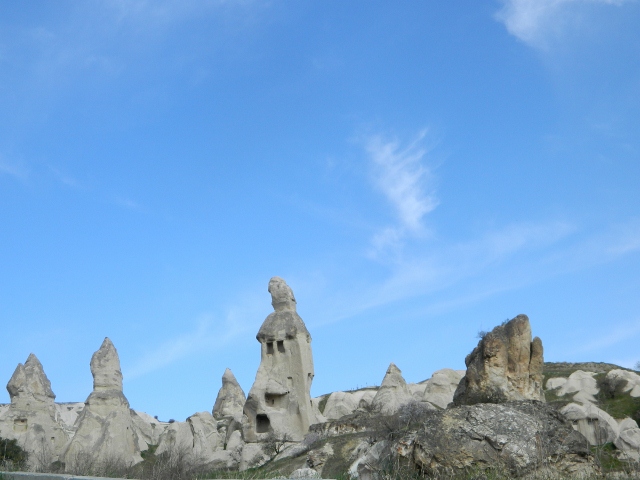
    The fairy chimneys, as it turns out, were the name that the genius, or over-romantic imagination, of someone in Cappadocia’s tourism department assigned to the giant, fanciful (and often very phallic) rock formations that cover the landscape.
    Rather than go through the last two weeks I spent in Turkey, Bulgaria, Serbia and Bosnia, I would like to tell you a story for a change in pace. Or rather, I would like to retell a traditional Bulgarian folktale that I read while visiting my friend’s family in Plovdiv. In recent months I have been rediscovering my love of stories, and having some fun with the art of storytelling whenever it occurs to me. I hope you enjoy this one; it is called “Glavcho.”
    ~
    Once upon a time,a third son was born to a peasant family.  He had an ugly, misshapen body and a large, ugly head, so everyone called him Glavcho (big head, in Bulgarian).  His older brothers teased him mercilessly, and the other village children always picked on him, but rather than fight back, as Glavcho grew bigger and stronger he stuck more and more to himself. He gave to his animals all the tenderness and care that was not shown to him.  Sitting in the pasture, watching the smoke cult into the sky above the slate roofs of his village, Glavcho would sing to his horses and speak to them of his hopes and dreams.
    Now, some animal had been breaking into Glavcho’s family’s fields at night and eating their crops, so his father instructed his sons to keep watch and find out who was causing the trouble.  The first night, the eldest son set himself up at the edge of the field with a lantern and a length of rope, certain he would catch the animal and win his father’s approval.  Dawn, however, found him fast asleep; when his family awoke, he said, “I kept watch all night long, but I saw nothing!”
    The second night, the middle son kept watch.  He too awoke to the rising sun and insisted he had seen nothing.  And so the third night Glavcho had his turn.  He took the lantern and the rope and sat watch.  Though his eyelids drooped and his head grew heavy, he did not fall asleep.  Around midnight, a beautiful white stallion appeared at the edge of the field, glowing in the moonlight, and began to munch on the carrots.  Silently, Glavcho tied his rope into a loop, crept up behind the horse, and slipped the noose over its head!
    “Please,” said the horse, “let me go and I promise I will never eat your family’s crops again!”
    Glavcho looked at him dubiously. “I’m supposed to catch you and bring you to my father…”
    “Glavcho, you are all the horses’ favorite. They all say how kind and gentle you are. You must help me and let me go!”
    “Really? I didn’t know they talked about me.” Glavcho glowed at the rare compliment, and after a moment’s thought, released the white horse.
    “Because you have done me this favor, I will always help you in times of need,” said the horse, lowering his head in thanks.  “All you must do is go into the forest, clap three times and call, ‘horse, come to my aid!’ and I will be there.”  And with that, he disappeared into the night.
    In the morning, Glavcho told his father and brothers about the extraordinary thing that had happened to him, but they laughted at him and scolded him for falling asleep and dreaming instead of keeping watch.  Elated by his discovery, Glavcho did not care, and he went off to take a nap.
    Later that day, a royal herald arrived in the village to announce a competition.  There would be three days of horse races, and the victor would win the princess’ hand in marriage.  The King invited every able man in the kingdom to compete.  Glavcho’s brothers heard the proclamation and they were talking about the upcoming festivities excitedly when Glavcho awoke.
    “Brothers, may I come too?” He asked bashfully.
    “You?” The said, incredulous. “Why, you would only scare the young princess and embarrass us.  Why don’t you stay with your horses.”
    Desperately wanting to see the races (to compete was beyond the scope of his imagination), Glavcho wandered into the forest after supper.  The tall trees cast a murky gloom around him in the gathering night.  He clapped his hands three times and called, “horse, come to my aid!” and like that the beautiful white horse came trotting into the clearing, glowing as always.
    The horse knew already what was Glavcho’s problem.  He said, “Return to this spot tomorrow after your father and brother have left for the races. Bring your sack for collecting mushrooms. I will meet you.”
    And so, the next morning Glavcho took his sack and returned to the clearing.  The white horse was waiting. “Look in the sack,” he said.  Glavcho reached into the sack and brought out the most beautiful set of clothing he had ever seen.  The fabric was softer than silk, and trimmed with gold.  When he put it on, Glavcho became a tall, handsome young man, broad shouldered and strong.  He leapt upon the white horse and they galloped to the castle.
    All heads turned to watch as they entered the field.  Both horse and rider shone brilliantly, and no one could look away.  “Come now,” said Glavcho, “let any man who wishes to compete against me come and race!” No other riders stepped forward.  The white horse galloped around the track with unparalleled speed, and did not stop running until he had reached the clearing in the forest.
    Glavcho took off his beautiful clothes, filled the sack with mushrooms, and returned home.  His father and brothers followed shortly.  Throughout dinner, they talked of nothing but the mysterious rider at the races.
    The next morning, Glavcho again set out for the forest with his sack to meet the horse.  Again everyone turned to watch them with wonder when they arrived at the castle.  Again they raced around the track, unrivaled.  Again, Glavcho’s father and brothers spoke of nothing else at dinner, their voices thick with awe.
    The third day of the races, when Glavcho called out “let any man who wishes to compete against me come and race!” several of the strongest young men in the kingdom stepped forward.  The white horse sped forward, leaving the other riders far, far behind.  Glavcho stood went before the princess and bowed deeply.  Taking the ring that she offered to him, the winner, he said, “tomorrow I shall return for the wedding!” And with that he leapt back onto the white horse and they ran home.
    When Glavcho’s father and brothers returned, talking of the upcoming wedding, Glavcho asked humbly, “do you think we will be invited?”
    His brothers laughed. “Why would the King invite the likes of us?”
    Glavcho took from his pocket the ring that the Princess had given him.  Recognizing it at once, his family exclaimed joyfully and the entire village rejoiced at his good fortune.  And Glavcho, we assume, lived happily ever after.
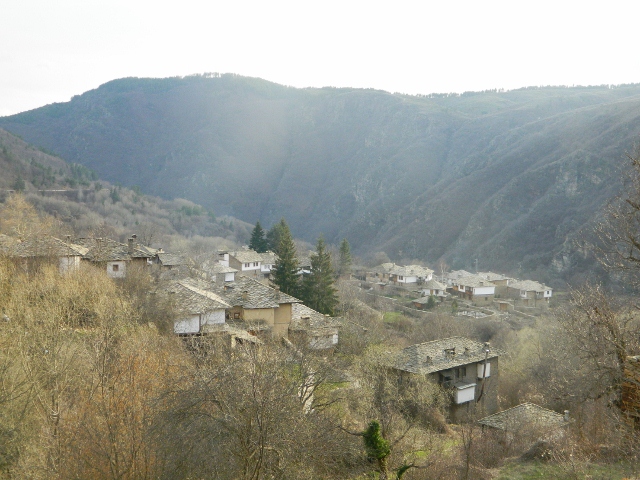
    A traditional Bulgarian village.
    ~
    Fables are nice, with their ready morals at the end (don’t steal, don’t lie, etc., etc.), but I really love these folk stories, with their more oblique messages and meanings.  What are we meant to take from this story? That less attractive men should dress nicely to get the girl? That our families will love us more if we make money? That we should be nice to horses?  The lesson here is actually a bit questionable when we consider that Glavcho only succeeds in life by changing his appearance.  
    For me, though, it doesn’t matter.  However we might interpret them, folktales are stories first and foremost, meant to entertain, and it is for this underlying simplicity of purpose that I love them.
    ~
    Location update: After flying through Bulgaria, Serbia, Bosnia and Montenegro, I am off to Croatia tomorrow—the Balkan adventure continues!
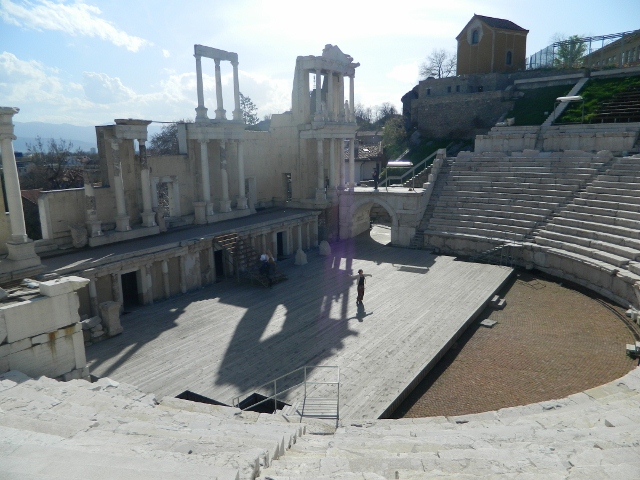
    Roman ruins in Plovdiv, Bulgaria.
  • Toby and Alyssa Take on Istanbul

    For the last six days I had the great pleasure of traveling with the beautiful, brilliant, best of friends, Alyssa Raven Thomas.  What a welcome change from the repetitive (though largely enjoyable) pattern of spending my time with people who don’t know me.

    Just the highlights, then. We met up Sunday at our hotel in Sultanahmet, one of several historic districts of Istanbul. Reunion joy. Our hotel room was called the Grand Bazaar. The next day we visited the real Grand Bazaar, an enclosed warren of alleys and shops that housed a frenzy of action, color, light and exchange.  There, Alyssa purchased  enough evil eye bracelets to protect a Sultan’s entire army.  We spent the afternoon at Hamam Cagaloglu, Istanbul’s oldest and grandest Turkish bath, sweating and scrubbing out at least a week’s worth of grime (on my part, anyways). We scooped water from marble basins and lounged on heated marble slabs as gray light and a few drops of rain filtered through small holes in the domed marble ceiling.  The Blue Mosque, Haiga Sofia (pronounced and spelled Ayasofia, it would seem), and Topkapi Palace of course had their places of honor, and despite the aggressive masses of anxious cattle pushing to the feeding troughs (over-zealous tourists), these sites were spectacular.  Huge Turkish breakfasts, nearly unlimited cups of free tea (thank you, Turkish hospitality!), and squares of flaky baklava dripping with honey formed the delicious brackets between which our sightseeing took place.  We cruised the Bosphorous, took a ferry from Europe to Asia and back, criss-crossed nearly every inch of the city by foot, and braved wind rain and cold to take on Istanbul.  I’d say we emerged victorious.

    ~
    The Blue Mosque (Sultanahmet Cami) as seen from the Bosphorous.

    Stunning Byzantine mural inside the Ayasofia.

    Alyssa and I enjoy one of the best views of the Ayasofia from a rooftop bar in Sultanahmet.
    ~

    Alyssa is now heading home and I am about to set out for Cappadocia, land of the fairy chimneys. I will find out what that means and report back.