Tag: facing fear

  • Zen & the Motorcycle Passenger

    Sorrento Coast,  Italy

    (Mom, you’ll want to skip this one.)
    The headlights of oncoming cars are a blur as we race down the center line of the autostrada (highway) from Sorrento to Napoli. I settle into the peculiar flow of this navigating traffic as we weave in and out.
    Yellow lines, black sky, breathe in, breathe out.
    Yellow lights, black tires, breathe in, breathe out.
    Accelerate, brake. In. Out.
    It’s just me (passenger-monkey) and my friend (driver-pilot). Fear hopped off this train hours ago, and I’ll tell you why.
    ***
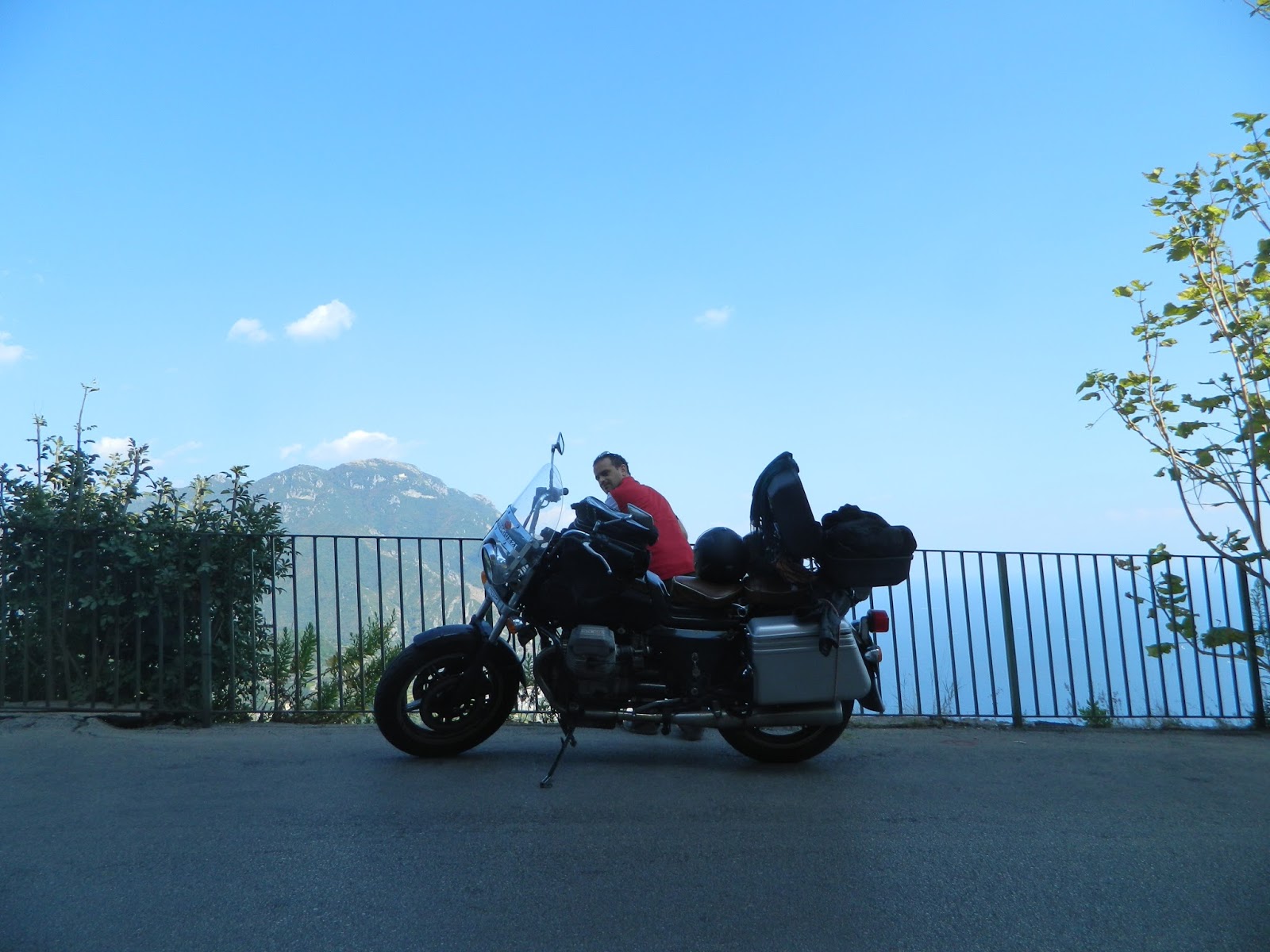
    È stata una giornata bellissima. It was a gorgeous day. Perfect. My friend met me with his vintage motorcycle at the Salerno train station (a half-hour train ride from Napoli), and we (along with seemingly every Italian ever on this last weekend of summer) set off for the Amalfi Coast.
    The fresh wind in my face balanced the hot sun as we followed hairpin turns opening onto one dazzlingly beautiful vista after another. The hum (or, more accurately, roar) of the engine blended with the waves and the wind, and conversation was sparse. The sky turned to dusty rose, orange, teal as we rounded past Amalfi and up the Sorrentino coast at sunset.
    I must have contemplated my death a hundred times that day.
    I usually do when I travel as a motorcycle passenger, and I don’t think it’s morbid. There is a quality of zen to this process of that renders it uniquely compelling for me.
    There’s the, “oh shit, this is dangerous” moment, followed by the, “there’s nothing I can do to change my vulnerability in this situation” realization, culminating in (temporary) total surrender to the inalterable fact of my own mortality.
    Then a sudden acceleration and, “oh shit,” and we begin again. As the minutes or hours blur on, I slowly stop picturing the many gruesome ways in which this could end badly, my pulse slows, and my shoulders relax. Once that last ripple of fear smooths out, I ender a space of zen acceptance—it’s pretty blissful there.
    If you’re thinking I sound nuts, allow me to ask you a question:
    How often, in your day-to-day life, do you contemplate your own mortality?
    If you’re a healthy, well-enough-off human, I’m guessing it’s not all that often. And yet, we are all mortal; we are all helplessly vulnerable to myriad risks. We all walk a fine line between life and death all the time.
    We are all on a precipice.
    ***
    That yellow double line of a Napoletano highway, framed by black sky and black asphalt, is only a metaphor, no more and no less terrifying than the reality we all face. Every day.
    The magic of this motorcycle zen is not the “added risk.” Rather, it (and surely a thousand other activities) forces me to reckon with the transience always enveloping me—always enveloping us—and to breathe in, breathe out, and enjoy the view.
    ***

    I took a video so you could catch a view, too!

     
  • The Intoxicating Unknown, and Solitude

    The Intoxicating Unknown, and Solitude

    The plane lands with a jolt. Rolls to the gate. Shuts off the engines.

    You and the other passengers file off the aircraft. Through the terminal. Past immigration. Baggage Claim. Customs.

    You step outside into a country where you know no one.

    Perhaps you don’t speak the language. The air is different. Heavy and humid. Or maybe cold and sharp. Your nose catches new smells and catalogues them as memories—later, this will be a remembered place.

    Welcome. You have just crossed into a vast field of unknowns.

    Is it terrifying—or exhilarating?

    Someone asked me recently if it ever gets lonely, this solo traveling.

    There are many answers to that question. I’m having a bit of deja vu, because I think I’ve offered some of them before (maybe in this, or this), but I have something new to say about it today.

    Basically, no, I don’t.

    I have experienced dozens of iterations of the above scenario—arriving by air, land or sea—and for me it is always exhilarating. That is, in part, why I will fly from Rome to Agadir, Morocco at the end of September—to spend six or seven weeks in a place where I know nobody.

    While I love traveling with or visiting friends (and do so often), I crave the spaciousness that only comes with solitude. Maybe you do too.

    Nothing can replicate it. It arrives the moment we leave every known thing behind us. Hug our loved ones goodbye outside the airport. See our traveling companion to the train station, then turn back to a foreign city alone. Click “complete payment” on a one-way ticket for one.

    Solitary spaciousness arrives when face the forest, the mountains, the desert—whatever our alluring yet frightening place may be—with a pack on our shoulders and uncertainty in our chest, knowing that no one is coming with us this time.

    Does that scare you? It probably should. There are monsters in the forests, the mountains and most of all the cities. But more than that—more than that there are monsters in our hearts and minds.

    I believe that is what people fear most of all when they fear setting out to travel alone. There is the external risk, of course, but I suspect loneliness—ourself facing ourself—instills greater terror.

    Why don’t I ever get lonely, then? I’m not actually sure, not entirely. Maybe I do, but it no longer scares me, and so I call it solitude instead of loneliness. I do know this:

    Our comfort zone expands every time we step outside of it and thrive there. There is nothing more intoxicating, full of life and purpose, than entering the unknown territory alone.

    So go.

    “The cave you fear to enter holds the treasure you seek.”

  • Minibus Freedom: On Risk and Reward

    Stand-Up Paddleboarding (well, kneel-up paddleboarding) in Smitswinkel Bay.

    “Better the devil you know than the devil you don’t…”
    The sun beats down on my left arm, and the wind blows strong from the sea. I watch waves break and sparkle offshore as my minibus taxi races down the coastal road from Hout Bay to Cape Town.
    The views are magnificent. Breathtaking. Spectacular.
    Although, my fellow passengers seem desensitized to the sight, for which we pay 12 rand ($0.75) each.
    South African music blasts from the speakers, a mix of African polyrhythmic beats, electronic pulse and gospel-like vocals. The driver skips tracks on the mix CD—yup, mix CD—as he holds a cell phone in the other hand, seemingly impervious to the perils of this endeavor.
    These minibus taxis—cheaper and faster than a regular bus, and far cheaper than a cab—evoke a sense of freedom that their more staid (and safer) counterparts do not. Diverse rhythms, accents and languages swirling in my ear, unfettered ocean wind in my hair, shimmer of merciless heat in the air, my senses tingle, come alive to welcome the spectrum of experience on offer.
    It is more than physical freedom, though that is part of it. (By now I know the fastest, car-less route to just about anywhere I want to go in Cape Town.) It is more than the speed and ease of movement, more than the volume of wind and music, and more than the independence of needing to rely on no one to go wherever I please.
    No, if I am honest with myself—and you—there is another kind of freedom epitomized by these minibus journeys, which eclipses all the others.
    It is the freedom of choosing my own risks.

    Cape Town has huge populations of great white sharks in its waters, but that doesn’t
    stop dozens of surfers, paddleboarders and swimmers from getting out there every day.
    I’m not talking about risk-seeking behavior here. Rather, I believe most of us take most of our risks unconsciously. We drive our cars, smoke our cigarettes, drink our six packs of beer, eat our pesticide-laden food—that is, dance with our proverbial devils—all the while pretending, or perhaps believing, that our existence is safe. Secure. Unthreatened.
    I have written about this before, but maybe never so explicitly.
    I believe it is because we tend to ignore risk (or rather, complacently engage in it) where it is an accepted norm, that consciously, actively choosing our risks can inspire such a deep sense of freedom.
    People ask me, how can you hitchhike, take the minibus taxis, travel alone, go out alone, [fill-in-the-blank] as a woman, a foreigner, a young person, a small person? Aren’t you scared?
    Aren’t you scared when you cross the street, go to the mall, eat your food, send your children anywhere alone, smoke your cigarette, drive your car? How can you be a human being in this world—frail, feeble, mortal, vulnerable—day after day after day?
    That is, essentially, the question you are asking me.
    Better the devil we know. Better the risk we acknowledge.
    There is risk everywhere. We are never safe. We are weak, mortal, vulnerable to the vagaries of the world every day of our lives.
    Yet, we cross the street. We live anyway.
    I know the risks I take, and I choose them willingly, because the benefits (ah, the benefits, story for another time) far outweight them.
    The other side of the street; the end of the dance; the other side of risk?
    It’s worth it.
    On one level, my choices bring me joy, full-bodied experience, and inspiration

    But if you wanted to get philosophical about it, each time I choose my own risks, I also acknowledge and make peace with my own mortality—and that is a powerful freedom, indeed.

    Smitswinkel Bay.

    ***


  • High Security

    The view from my patio, Hout Bay, Cape Town.

    Hout Bay, Cape Town, South Africa
    “You need to watch that the gate closes to make sure no intruders get in,” says my neighbor.
    To enter the compound where I live, I click the green button on the remote attached to my set of keys, then press it again to close the gate behind me. To enter the cottage where I’m living, I must unlock a metal grate outer door, then the regular house door. I live in one of the calmest areas of Cape Town—it is like this everywhere (but this is nothing, so I’m told, compared to Joburg).
    From my back patio (which includes a garden and pool), you can just make out the township that lies a couple kilometers away.
    The bus I took from the City to Hout Bay a few days ago drove through the township, and the corrugated iron building materials, open front barbershops and markets, cows, snaking roads and general vibrancy marked a stark contrast with the carefully gated houses on my street.
    The juxtaposition is not lost on me.
    I have been in Cape Town for seven days now, and it seems necessary to get this out of the way before I begin to write anything else about my life here.
    The high security is the first thing I noticed when I arrived (truly unlike anywhere I have ever traveled), and all that it implicitly reveals about this place underlies everything else—or such is my impression. I could hardly boast any depth of understanding of these complex social, political and racial tensions, so for now, suffice it for me to say that they are there, and to share these few observations and facts:
    • The current unemployment rate in South Africa is between 25 and 45%, depending on whom you ask.
    • When I walk the three kilometers from my house to the supermarket, I am typically the only white person on foot.
    • When I take the minibuses (similar to matatus in Kenya), I am the only white person on the bus, too.
    • There is a massive wealth gap.

    • Racial tension is very real, and politically fueled.
    • Theft, break-ins and other crimes are extremely common (the high security isn’t just paranoia).
    • Apartheid ended in 1994; that’s nearly 22 years ago. (Although, coming from the U.S., I’d call that quick progress!)
    • When I asked my Uber driver about the social climate in Cape Town, he continued to call me “ma’am” as he proceeded to heatedly discuss the circumstances that he and his community and family face. (“Ma’am, I was black enough to fight in the riots against apartheid, but I was not black enough to get a job in the new government after the elections.” “Ma’am, the people in my community, when they vote now, they don’t see boxes; they see color.”)
    Right, so what does it all mean?

    That is probably something I will spend the next few months investigating in depth. However, I feel it is necessary to offer these initial comments and observations as prelude to future posts on Cape Town—whether it seems relevant to those topics or not, everything is always connected.

    ***
  • Strangers on a Train

    “We’re on our way to bible study,” says my friend. (He likes to make up stories, but let’s get real, who doesn’t?)

    It’s 10:00 pm, and we’re on the Circle Line, retracing our steps into Central London after hopping the wrong train. Across from us sits a young couple—friendly, talkative, and maybe a touch too willing to believe his absurd stories. They are sipping from a water bottle of vodka and fanta, on their way to a night out “raving.”
    Thus begins my Saturday night this past weekend. My friend alights at King’s Cross Station to head home, and I follow these strangers (soon to be friends) to Fabric, one of London’s most famous House clubs.
    We will meet another stranger on our way out of the Tube, and together walk to the venue. We will spend the next four or five hours dancing to some of the best House music I’ve heard in a year, adding new strangers (new friends) to our group as we went, and they will become, over the course of the night, no longer strangers.
    And all because we had all looked up across the aisle of a Circle Line train and said hello.
    A week prior, I went to meet my coworker in Oxford for the first time. On the trip home, the train was rush-hour packed—standing room only. Series of unexpected events, I found myself squished next to a fellow American; as foreigners are wont to do, we struck up a conversation, found it fascinating, and continued it over a particularly delicious dinner in Notting Hill.

    And all because I had asked (in my unmistakably American accent), “Is this the train to London?”
    When did we grow afraid of strangers? When did the popular wisdom for travelers shift from, trust the road and the good Samaritans who walk it, to, trust no one? When did two strangers—or four strangers—talking on the train become the exception, rather than the rule?
    I have an advantage, in that nothing about my thin five foot five frame and wide smile inspires fear or mistrust. There are fewer barriers for me to cross to arrive at the human beings inside their protective circles.
    Some of my most entertaining nights out, fascinating conversations and closest connections have occurred simply because I looked up and said hello. Though I occasionally forget and succumb to the comfortable bubble of my own world, I try to make a rule of talking to strangers—I have yet to regret it.
    And then, when you think about it, aren’t we all just strangers on a train?
    Busy watching for our station, looking out the window, or within, or anywhere but around us, we don’t realize that the train is it. There are no stations, no stops, and for all we know no destination.
    Our fellow passengers? We’re stuck with them—better hope they don’t smell—and we can make of that a party or a burden. The Buddhists will tell you the train is an illusion; the Jews will tell you it’s the only thing that’s real. One thing I know for certain: It’s what we make of the ride that counts.
    So we can either look up and say hello, and make the journey worthwhile, or we can keep staring at our shoes, waiting for the conductor to call our stop.

    Try saying hello to a stranger today and see what happens. Maybe they’ll tell you their life story. Maybe they won’t respond. Maybe that stranger will change your life—or your day, or your next ten minutes. But no matter what, isn’t it more interesting than your toes?

    ***
  • Lamu, Kiwayu and the Danger of Playing it Safe

    For those of you who have been following recent events in Garissa, Kenya, and who were aware of the proximity of Lamu and Kiwayu Island (my location this past week) to the Somali border, you will be happy to know that I am back safe in Kilifi, several hundred kilometers away.
    As events progressed and the news of Al Shabab’s brutal attack on Garissa University broke, sitting on a bus for eight hours while following updates on Twitter, stopping at multiple police checkpoints and traveling with a police escort could have been a nerve-wracking experience, but with the company of my three travel mates and the shaky consolation that lightening rarely strikes twice, we managed to comfortably ride out the journey.
    I don’t want to write about Garissa today, though. (I’ve done that already here.) I want to share a little about the gorgeous regions in the north of Kenya devastated not just by attacks, but also by foreign travel advisories. 
    At 7:30am on Friday, March 27th, three friends and I boarded a bus bound for Lamu, a Unesco World Heritage Site on the north coast of Kenya accessible only by boat.
    Well, to be exact, we waited at the bus stop for three hours first, bags baking in the sun, and then boarded…
    ***
    Day 1: Friday
    At 3:00pm, we pull off the road and wait a couple hours more for an armed convoy to escort us and the other buses of the afternoon through the more forested area north of Garsen. The roads become increasingly rough as the buses continually race past one another for no apparent reason.
    We arrive at Mokoi Port around 7:30pm and crowd into an already packed ferry. The stars grin overhead as we move towards Lamu Island, and I trail my fingers in the dark water.
    After a quick meal of the best nyama choma (grilled kebabs) I have yet tasted in Kenya, I sleep heavily.
    Day 2: Saturday
    I rise at dawn in order to wander the alleys of Lamu before the town and the sun are fully awake. 
    Winding stone pathways tinted with just the slightest bit of tension (or perhaps desperation would be more precise) speak eloquently of Lamu’s prosperous past as a key Swahili port. The sunlight glows on the waterfront, casting in shadow the men who accumulate around boats and food stalls, hoping for better business. 
    We are the only tourists in sight so far. Gorgeous old houses filled with guest rooms stand empty.
    At 6pm, we learn that the dhow (boat) that should have carried us on to Kiwayu Island (originally at noon, then at 7pm) will not leave until the next day. We make a split-second decision to take a speed boat instead, and are spirited away in the night to an even more remote location. We hurriedly load water, produce and other supplies for 5 days and head out into open water.
    The stars are bright bright and curved around the sky like a snow globe.
    Around 9pm, we arrive at Champali (a luxury camp made available to us four grateful travelers through family connections). My room is quintessential island paradise in one room-sized package: big bed, balcony overlooking the ocean, woven mats and open windows on all sides.
    Day 3: Sunday
    I wake again at dawn in a pool of light, the soft sounds of birds and water lapping at the shore welcoming me into the day. I move slowly, from morning yoga to a brief walk away from the camp, to cooking breakfast.
    We play cards and lounge for a while, then make the fifteen-minute “trek” to the other side of the island and eight kilometers of wild, empty beach. Strewn with seaweed, backed by sand dunes and with an unobstructed view of the Indian Ocean, this beach is the definition of remote. My definition, anyways. You would never guess, to stand there, that several hundred people inhabit the island, residing largely in two villages.
    The cicadas in the trees here are terrifyingly loud at times, their buzzing so pervasive it seems to be coming from inside my own head. A noise like that could drive you crazy if you were stuck in a tree with it for long enough.
    Day 4: Monday
    This time we bring boogey boards to the other beach, and for the first time I really understand why people find this activity fun. The waves are just big enough to carry me all the way to shore when I catch them right. I stand up dripping seaweed and sand, and feel decidedly like a six-year-old mermaid version of myself.
    A walk into the village later in the afternoon reveals the hub of human activity that the exterior of the island obscures. The women are beautiful, dressed in a style that looks almost Indian to me, and the children are utterly enthralled by our appearance, trailing behind our small group as we wander a web of thatch-roofed homes and dirt paths speckled with shells—remnants of an aquatic time long past.
    As the sun begins to set we start for Champali, stopping at a beach along the way to watch the color show.
    Day 5: Tuesday
    We all wake up before dawn to race to the top of “Conical Hill,” the tallest point on the island, in time for sunrise.
    Afterwards, we visit Mike and his camp a long walk further down the beach. He, like Kenya’s tourist economy, is struggling. Since two English tourists were kidnapped in 2011, Kiwayu has hardly been a popular destination. All of Lamu region, really, has suffered.
    Gorgeous island getaways stare out at a magnificent ocean view, empty and waiting to be filled again.
    That afternoon, I return to the village and a local woman covers my left arm—from fingers to shoulder—with bold henna designs.
    Day 6: Wednesday
    I wake up slowly, recovering from the long day on Tuesday, luxuriating in the comfort of my big bed. We savor our last hours on Kiwayu, knowing that we will leave at 4am the next day.
    We sit on my balcony to watch one more sunset, the day fading from yellow to orange to dark.
    Day 7: Thursday
    Our boat is late bringing us back to Lamu. We leave at 5:30 instead of 4:30. When we sit down at La Banda, a reasonably priced restaurant overlooking the water, for breakfast, the first news on the Garissa attacks plays on a television at the back of the room.
    The bus ride back to Kilifi is as long and dusty as the first. I feel refreshed and content, though—despite the danger, despite the unrest, I feel secure…

     ***

    I describe my trip in such detail not to brag, but rather to make a point.

    I almost didn’t go.
    When Earl backed out days before our planned departure, I considered doing the same and making the trip another time. Finally though, despite increased travel advisories, Kiwayu’s proximity to Somalia, and the general tone of fear set by foreign governments, international media and even some locals, I decided to go.
    I do not believe I put myself in any serious danger, but I certainly did not “play it safe” according to the conventional wisdom of travel. As more and more tourists opt to visit Tanzania rather than Kenya (playing it safe), unemployment rates here continue to rise (48% for Kenyan youth). These are not conditions for recovery, stability or growth. There is a serious danger there.
    The region of Kenya I just returned from is among the most beautiful areas I have ever visited… the whole coast of Kenya is, in fact. Following yesterday’s events, this hardly seems the moment to encourage anyone to visit, and yet, I want to remind you that there is more here than what you see on the news. That is true everywhere—everything is more than what you hear secondhand.

    Everything you see is certainly true, but it is only one piece of a 1,000-piece puzzle.

    ***
  • The Dhow

    [The following is an adaptation of a piece I recently published at elephant journal, “Facing Fear in Handstand.” Or maybe the piece in elephant is an adaptation of this, as this is a near exact excerpt from my travel journal. Either way, enjoy!]

    ***

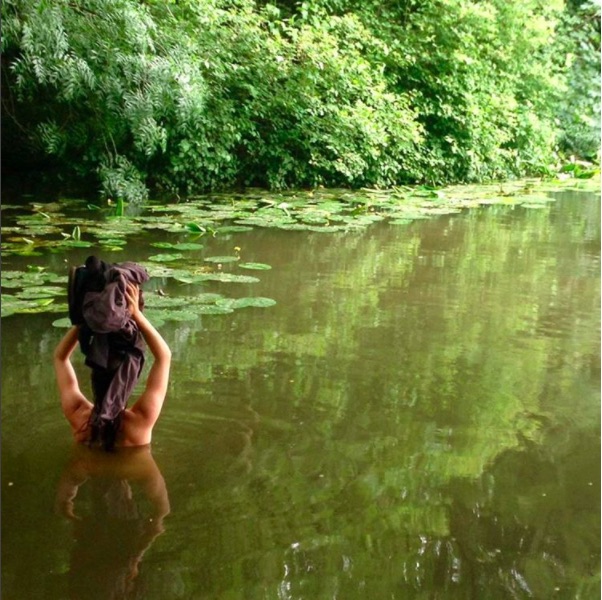
    I swim to the Dhow—a traditional Arab/East African (/originally Chinese?!) sailing vessel—anchored in Kilifi Creek. I alternate between front and back crawl, and though it only takes a couple minutes, it feels much longer, as is always the case with swimming.

    The Dhow (named musafir, Arabic for traveller) is unfinished. Three years in the making, the boat has a bit of work remaining. The deck boards wobble and gape in places.

    The ship’s builder, a Frenchman with a feather in his dreads, is leaving when I arrive. I hoist myself up the rope ladder that dangles into the water, then he lets himself down into a waiting dingy.

    Alone now, save for a snoozing workman at the bow, I make my way to a single plank of wood jutting out at the back of the boat and sit down. The four o’clock sun is still hot on my skin; it dries the seawater on my arms, leaving a salty film.

    I think about jumping into the water, but delay a while yet. I watch, fascinated, the journey of a single fish. He looks like a seahorse stretched out flat: long, pointy snout, eyes on the side of his equestrian head, mint green and brown body, undersized blue tail fin. He plies the water two meters below my feet.

    A dog barks from shore and reminds me I have something to do.

    I probably stand on that wooden plank a full five minutes thinking. Thinking how I could just climb back down the rope ladder, but I won’t. Because I have something to prove. Not to anyone else—the small beach is deserted—but to myself. Thinking how I feel the need to jump off boats and bridges precisely because it scares me so.

    Some people will always turn back to the rope ladder, but I am no longer one of them, I think. I have decided to be “fearless.” A better word, however, might be “fear-defying.” I refuse to abide by my fears.

    I am thinking how fearlessness, or courage, rather, is not the absence of fear. It is doing things anyway. I hope I always will.

    And I jump, of course. The water is warm-cool after the heat of the sun, and it rearranges itself effortlessly around my body.

    And of course, the jump is a non-event. Nothing of note has happened, and yet I am pleased enough to write all about it. I swim back to shore with a smile on my face. It’s the little things, after all…

    ***
  • How to Take the Bus Everywhere

    Jesus travels… and so can you!
    Don’t let anyone tell you otherwise… there is always another way to get there.
    In October, I visited my parents in Shanghai (their home base at the moment). Day two of my trip, I took an afternoon to explore on my own, wandering the tiny alleys of Tianze Feng, in and out of stores selling tins of tea and other adorably packaged goods.
    I have a “taxi card” to return—a business card with the name and address of my parents’ residence written in Mandarin and English. Taxis are cheap. Simple.
    But then, naturally, there’s a catch: I cannot, for the life of me, catch a cab. I stand first on one street corner of the main road by Tianze Feng, then on the divider between lanes, next on another corner. 
    Most of the passing cars already carry passengers, while other drivers seem to be intentionally avoiding my gaze. The afternoon shadows grow longer as I watch one Chinese shopper after another run to intercept an incoming car. There are people crowded on all sides; traffic moves at around 60 km/hour; I am never fast enough.
    Finally, someone does stop, but when he looks at my card he shakes his head and drives off. Does he not feel like going there, or can he not read the card? I will never know.
    Meanwhile, I have seen at least 20 public buses pass me by. I know I need to go *that way.* New plan…
    I think it really is possible to take the bus nearly anywhere and everywhere—if you want to. Here’s how:
    Step 1: Learn the word for “bus” and/or the proper pronunciation of the place you wish to go.
    In Shanghai, it took showing my taxi card to several people to learn to say the name of my parents’ road: Nanjing Shu-Lu.
    In Kenya, buses are “matatus,” and knowing that makes them a lot easier to ask for.

    Sometimes there might be a boat involved… even better!!
    Step 2: Find the bus stop.
    In many places, there will be a physical structure, replete with maps, schedules and names. In many others, there will be nothing but a small sign bearing the image of a bus—or nothing but a crowd of people standing at the side of the road.
    Ask people for the *bus* to [fill in the blank] until you find your stop. In my experience, other bus drivers and shop keepers are the best people to ask, and most likely to know the buses in the area, while taxi drivers are the worst, since they have ulterior motives.
    In Shanghai, I was lucky enough to find an old woman who understood my question, and knew that the 42 bus would take me to the right place.

    Or you can do this.

    Step 3: Catch your bus.
    It might stop automatically, or it might barrel past if you don’t flag it down. A sign bearing a name or number may tell you it is the right bus, or it might be a skinny man hanging from the window, calling out the destination.
    I usually like to confirm at least a couple times that it is indeed the right bus, as I have ended up on the wrong bus far too often.
    Step 4: Revel, and ignore the funny looks.
    Depending on where you are, you might well be the only obvious foreigner on the bus. People will stare. It will get old. Just do your thing and try not to do anything egregious—appropriate dress and conduct is always a good call.
    Revel in being on your way to where you’re trying to go! There is truly no better feeling than the surprise of success after a stressful search!

    If your bus looks like this, wait for the next one.

    Step 5: Pay.
    Often, fare will be collected at some point along your journey—or upfront, or upon arrival. Try to pay attention to how much other passengers are paying to avoid a high “tourist tax.” But if you do end up paying a few cents—or dollars—more, well, the tourist tax is real. I’m sorry.
    Step 6: Arrive.
    Chaos, confusion and disorientation may accompany your arrival… sweat, frustration and elation, too. One thing I can almost guarantee: you will arrive having spent less money. A second thing: it gets easier with practice.
    I love taking the bus. Despite the dust. Despite the confusion, often frustrating and hectic. Despite everything. Because the bus is always an adventure. Always. And that’s kind of the point.
    Need to make a connection? Repeat steps 1-5. Chances are, someone on your first bus will be able to point you to your next one, or even lead you there.
    “Trunk-seat” heading out of Mbita, Kenya a few days ago.

    Enjoy the adventure!
  • Where Do You Go When Nowhere Is Safe?

    Naturally, after our disappointment at the Moroccan embassy and finally, finally finding a place we could both visit without visas (Kenya), new obstacles have arisen. Al Shabab has been targeting non-Muslim Kenyans in the North, Mombassa and Nairobi in retaliation for Kenya’s recent military action in Somalia. Is nowhere safe? I find myself wondering.
    To turn on the news of late is to open the floodgates to a barrage of ill-tidings. Terrorist attacks, Ebola, protests, and political turmoil. That is not to write off the gravity of these situations, for they are undeniably serious. But still, I can’t help wondering where is left to visit. Where do you go when nowhere is safe?
    My musings inspired the creation of this folk tale:
    ~
    Once upon a time, there was a girl. She loved to explore and go on adventures. The spray of light on the horizon played a lilting melody on the back of her eyelids.
    One day, the girl announced that she wished to go into the woods at the edge of town.
    “Don’t go into the woods!” Cried the townspeople. “Don’t go; don’t go,” they pleaded. “The woods are not safe,” they admonished. “There are wolves and witches and monsters and men. Nowhere is safe. Nowhere is safe,” they said.
    And so she stayed, safe in the town, and gazed at the woods, imagination aglow. “Oh how I wish to go into the woods,” thought the girl. “Oh how I wish to go!”
    Months passed, and the girl’s gaze shifted. “I will go to sea,” she announced one day, “to see what lies beyond it.” The townspeople shuddered and shivered and quivered with fear:
    “Don’t go out to sea,” they cried. “Don’t go; don’t go! The sea is not safe,” they admonished. “There are sharks and storms and sirens and surges. Nowhere is safe, my girl. Nowhere is safe; stay here,” they said.
    So the girl sighed and laid aside her plans, and she did not go. But she sat upon the shore and watched the waves, and her thoughts crashed against her skull in time: “Oh how I wish to go out to sea. Oh, how I wish to go!”
    In only a few weeks, she had yet another design: “Surely the mountains are safe enough… that is where I will go,” said the girl, jaw set.
    “Oh!” Cried the townspeople. “Don’t go to the mountains!” They pleaded with her. “Don’t go; don’t go! The mountains are not safe,” they admonished. “There are winds and ghosts and bandits and banshees. Nowhere is safe, you see. Nowhere is safe; stay here,” they said.
    The girl craned her neck to look up at the rocky crags that broke up the sunsets and cast long evening shadows across the town. And she did not go. She sat and she glowered  and her mind raced on. “Oh how I wish to go to the mountains,” thought she. “Oh how I wish to go!”
    Again and again she presented new ideas, and again and again the townspeople shuddered and shivered and shook their fingers sternly:
    “Nowhere is safe, my girl. Nowhere is safe,” they said. “Don’t go there; no you mustn’t go there. There is war and sickness and there are demons and dragons; you see, the world is not safe, my girl. Best to stay here—oh yes, best to stay here,” they repeated. “Don’t go! Don’t go!”
    Months passed in this way, or perhaps they were years, and the girl began to sit longer, to stare farther, to think deeper. Finally, this is what she thought: “If the woods and the sea and the mountains are not safe, then surely neither is this town,” she said to herself. “And indeed if nowhere is safe, then it is “nowhere” where I must go!”
    And with that, she packed her bag with books and bread and blankets and bottles and she set out along the road. The townspeople, when they caught sight of the girl, ran after her, calling frantically, “Where are you going? Where are you going?”
    “Nowhere!” The girl shouted over her shoulder. “I am going nowhere. You needn’t worry—it is safe there!” And she laughed and walked on.
    And she crossed the woods and the sea and the mountains, “nowhere” always just ahead. She encountered dragons and dangers, monsters and men, but fairies and angels and vagabonds, too, and these last guided her way.
    “Nowhere is safe. Nowhere is safe. Oh how I wish to go,” her thoughts chanted through her head in time with her feet, and never did they tire. On the girl walked. Up and out and onward she looked.
    “Go,” whispered the sun. “Go! Go!”
    ~
    Much to my regret, we don’t live in the world of fairy tales and fables. The troubles reported nightly are very real—though occasionally exaggerated by those on the outside. We can’t totally ignore them like the girl in my story. And so, though we still plan to fly to Kenya next week, we will do so cautiously, avoiding population centers like Nairobi and Mombassa and staying in the Lake Victoria region, which appears to remain out of danger.
    Where do you go when nowhere is safe? That is the question facing the 21stcentury nomad, isn’t it.

    ~
  • Links to Latest Article and the TV Interview That Followed

    I’ve had an exciting publication recently on Salon-
    http://www.salon.com/2013/10/07/tales_of_a_female_hitchhiker/

    …which led to a TV interview this morning with WGN:
    http://morningnews.wgntv.com/2013/10/25/woman-describes-challenges-excitement-while-hitchhiking-across-europe/

    Getting my foot in the door, one toe at a time!

    This will continue to be my personal travel blog, just as soon as I get traveling again. Stay posted!

  • Three, Two, One, BUNGEE


    (Sorry, Mom—I know I promised I wouldn’t, but I really think you should be proud of me.)
    “Do one thing a day that scares you.”  The words run repeatedly along the length of my teal blue yoga strap, which, wrapped around my yoga mat, has accompanied me throughout my journey.  Each morning when I unroll my mat they greet me boldly, all capitals—a challenge, maybe.  But usually I smile and take them as an affirmation because, well, I’m trying my best.
    I try, but it’s not always easy.  I hate talking on the phone, but it doesn’t scare me.  I dislike ants and spiders, but we’ve come to an understanding and coexist quite peacefully; they don’t scare me either.  As I travel I seek out situations that challenge me—accepting an invitation to a dinner party in Biella, Italy full of Italian speakers I had never met, for example—to test my mutability, adaptability and flexibility.  I repeatedly throw myself at the universe and marvel at the endless variety of ways in which she catches me.  I am rarely scared.
    On Sunday, July 7, the straps of my safety harness wrapped around my billowing teal pants (Toby Pants, of course) as I stood at the center of the Colossus bridge, 152 meters above the ground at Veglio, Northern Italy.  A spectacular scenery of forested green mountains surrounded the small group of spectators.  The three o’clock sun heated my shoulders.  I watched as one after another the people ahead of me jumped, arms out “like Superman.”  When my turn came and I climbed the metal steps to the edge of the bridge, nothing but an elastic cord attached to a carabiner at my ankles, I was scared.
    “Sei pronta?” Gianluca asked me, grinning casually after ten years of facilitating this bizarre and exhilarating activity.  “Si,” I responded, though I was hardly convinced.  I had closed my eyes and imagined leaping out into the air at least twenty times since calling the bungee center several days prior, but I was nonetheless terrified—terrified of jumping, and even more terrified of not jumping.
    “Alza le braccia.”  I lifted my arms.  “THREE,”  I think my heart stopped beating.  “TWO,” I bent my knees. If I don’t go now, I never will– the thought jumped spontaneously into my consciousness and before I could think further I leapt on “ONE.” At “BUNGEE,” where one usually jumps, I was already in free-fall, accelerating towards a speed of 28 meters per second.
    The scream that wrenched from my throat could probably be described as blood-curdling; it was certainly as close to primordial as I have ever come.  I had thought jumping would be the scariest part.  Wrong.  The first two seconds of my fall, as I felt the uninhibited force of gravity act on my body, I think adrenaline blocked all other brain functions.  Then, the following few seconds, I managed to process the sight of treetops rushing toward me at blinding speed, the sound of air whooshing past my ears, the pressure of wind against my cheeks.  My scream morphed into a whoop of elation.  Next, as I reached the full length of the cord, the elastic caught me, pulled me to a stop, and flung me upwards.  Twice I rebounded high, my body hung suspended for a moment in mid-air, my heart in my mouth, and I flew…
    I pulled myself upright, a feat which proved more physically challenging than jumping, and the woman at the landing platform pulled me back to solid ground.  As I walked (and skipped) along the trail back to the road I felt exhilarated, jubilant, and, especially, satisfied.  Satisfied because I couldn’t think of anything more terrifying than jumping of a 150 meter bridge, and I had done it.  I had taken a fear and alchemized it into a thrilling experience.  I had physically embodied my policy of leaping at the universe.  The elastic cord, like optimism and openness, had turned a free-fall into flight.
    To clarify: bungee jumping is not scary because it is dangerous.  In over 60 thousand jumps and 20 years of experience, the Bungee Center at Veglio has never had an accident.  As extreme sports go, bungee jumping is extremely safe.  Our instincts are not so rational, however, and to voluntarily jump one must override a very basic fear and instinctual reluctance.  I am not really a thrill seeker—I don’t like cliff jumping, skiing on ice, driving fast, or otherwise putting my body in danger.  This probably won’t become a regular activity for me; however, I might choose to repeat the experience, or something similar, just to remind myself that I can.  Because even after the fact I can barely believe that I really jumped.  I had trouble falling asleep that night as the memory of treetops speeding towards me replayed in my mind.  I no longer felt scared though- only elated.  I had done something that truly scared me, and it rocked.
    If you want to see it, the lovely people at Veglio were kind enough to film my jump for me, and it’s posted here: https://www.facebook.com/photo.php?v=10200301434598511.
    Do one thing a day that scares you- try it! 🙂
    ~
  • I Drank Yak Blood


     I drank yak blood. Really. Yesterday, after eight years of not eating red meat. The flavor had a quality surprisingly similar to raw milk, a bit salty and, of course, metallic.  It was still warm. I won’t go into details about the chewy bit that I couldn’t finish. 
    I stood at the top of a stone wall with two other Americans and a small crowd of children to watch the slaughter of three yaks from above.  The kids, none older than eight or nine, passed around fruit candies, shouted at us in shrill voices (the general belief being that if they spoke louder we would understand) and clambered onto rooftops and ledges to acquire prime seats for the show.  A woman sat behind us scraping creamy cheese off a flat stone, occasionally whacking me with a stick for blocking her sun.
    I had decided that watching this event, commonplace to life in Mustang but wholly absent from my prior experience, was something I should do.  The longer I sat above the courtyard, watching the men turn bodies into carcasses, their hands turning from brown to deep red, the more comfortable I became.  Maybe desensitized is a better word.  I have long rejected the part of my own nature that is programmed to hunt, kill and eat meat.  Now, as before, I have no desire to order a steak, but I found it valuable to acknowledge that side of myself, and humanity at large, in such a manner.
    When Tenzin, the owner of the Red House Lodge, beckoned to me, I made my way down the stairs on autopilot, having already committed myself several nights ago to trying yak blood.  “It will make you strong,” he had insisted, just as raksi(local alcohol), buckwheat, and nearly every other local product are said to do.  “You will try it, I think so.” And in the bravado of a moment I agreed.  I wasn’t about to back out later, and besides, what better way to go back to eating meat? 
    I passed through the doorway into the arena.  Tenzin’s mother and another woman were already at work in the corner turning intestines and other innards into sausages.  Someone handed me a mug with rivulets of brilliant red liquid running down the sides. I drank, but could not finish.  On my way down to the river to wash out the remainder, I slipped on the muddy steps and almost fell.  The men in the courtyard laughed and joked that I was drunk from the blood.  I don’t know if it was the adrenaline or the shot of nutrients, but I did feel jittery for quite some time after.
    That night before dinner, over cups of raksi, Tenzin and his friend lamented that they had not taken any pictures (sorry to disappoint) of me with blood smeared on my nose and teased me about falling down.  I felt I had proved my mettle to them and joined some secret boys’ club, at least temporarily.  There is nothing savage or bizarre about the process I witnessed.  Animals are butchered every day, everywhere; that is a part of life.  There is nothing disgusting or barbaric about the tradition I took part in; it made sense in its place, surrounded by others doing the same thing, with gusto.  Still, having proved myself to both the locals and to myself, it is unlikely I will choose to repeat the experience.  I am, however, glad that I did it.
    ~