Tag: tourism

  • The Gift

    Several days ago, I sat in a matatu (bus) plying the main road of Diani, Kenya. On my way to Diani Beach Hospital for a precautionary Malaria test (I don’t have malaria, Mom, you can exhale).
    A muzungu (a sight far more common on the coast than it had been upcountry) boarded several stops after. Hale and tan in the way that Northern Europeans tan—russet, rather than gold—he must have been around 70. His thick white hair and beard shone starkly amongst the rows of shaved Kenyan skulls.
    He sat by the door, and when we stopped to let off passengers, he held out a coin (50 kesh—50 cents—, I think) to a small boy a few yards away.
    A man carried the boy over to accept the gift. As the matatu began to roll away, the white-bearded man said in a thick (Dutch?) accent, “It’s for him [the boy]! Not you—him!” Thus ensuring that his gift would not fall into other hands, he sat back, satisfied.
    This foreigner bestowed his gift with the ease of frequent practice. His manner brought to mind other tourists I have seen in other places, of a similar ilk.
    Simply put, something about the gift—or rather, its giving—bothered me.
    Two years ago, far up in the Himalayan foothills, very small children would emerge from nowhere, holding out phantom hands and pleading eyes, and ask me and my trekking companions for “candy! candy!” or, even more baffling, “ball-oon. ball-oon.”
    From whence had come this peculiar fixation with candy and balloons? Well, from other trekkers, of course. Foreign hikers toting bags of candy—and balloons—to give to children along their path.
    There is something presumptuous—maybe—about giving unsolicited gifts to strangers. An assumption that we as outsiders know what is needed, and by whom. That we have a right to give when and to whom we wish, without asking anyone’s opinion. A whiff of a lingering imperialism, perhaps. (Of course, now these children do ask, having learned from experience to expect bounty of visitors.)
    I am reminded of a class I took on Jewish Ethics 10 years ago, about which I have not once thought in the interim… According to Maimonedes, there are eight levels of charity. The greatest, you may or may not have guessed, is to support another Jew (this merits another conversation entirely). The lowest, naturally, is to give unwillingly.
    Ringing in at number five: giving before one is asked.
    This may all be a bit off point, but Western altruism in Africa has a long and problematic history of unsolicited giving, unscrupulous giving, and giving without once thinking to ask what is desired or needed by the recipients.
    These sorts of giving smack of colonial condescension. Translated into 18th century garb, the image of the foreign man handing money to a Kenyan child becomes that of the beneficent overlord deigning to notice a black child, reaching down magnanimously from his carriage with the gift.
    I do not think I exaggerate so greatly in this leap of imagination.
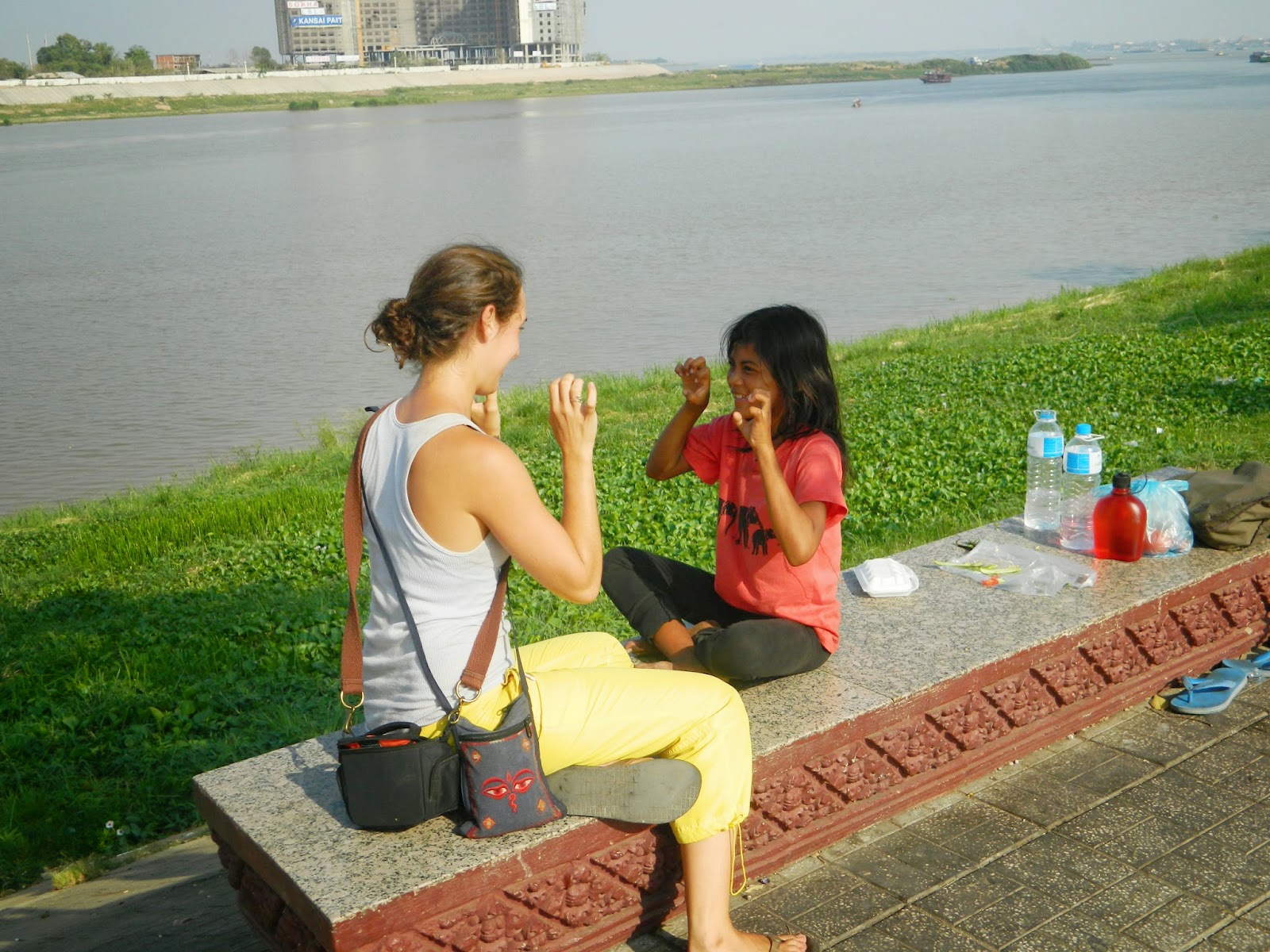
    Sharing food and games in Phnom Penh.
    Surely, you might say, I don’t need to ask to know that a starving child needs food, or that a village with no well needs potable water. Yes, there are certain basic needs, but no, you can’t assume that you know best what they are and may thus dictate another’s priorities.
    In some touristic destinations, poverty is rampant, and in advising visitors to these places, study abroad or travel guides will usually take one of three tracks:
    1. Don’t give anything to anyone. Not to beggars, not to children, not even to new friends. Just don’t, because one friendly gesture of generosity will call upon your head a veritable surge of unanticipated requests.
    2. Bring gifts that are useful—flashlights, notebooks, clothing, etc.—to give to hosts or friends. You will be offering something worthwhile, not a symbolic gesture doomed to sit on a shelf beside its untouched kin.
    3. If you are going to give a stranger something, give them food. Children, especially, almost certainly need it, and your gift will not be misused or appropriated, as money so often is.
    Other responses include: giving to a reputable non-profit, thus ensuring (in theory) that your money will be well spent; sponsoring an individual’s schooling; or offering skills or instruction, which has no (or greater) monetary value.
    I don’t have a set position on the question. All of these suggestions have merit. Personally, I am disillusioned by the distribution of spending in corporation-sized non-profits, and I much prefer the work of grassroots organizations that work in tandem with local communities. I love the option of sharing food; I think it is the most human of acts, and almost universally understood and appreciated. Sharing skills—if you have them—equally so. Material gifts are tricky. I lived with a home-stay family in Kathmandu who had an entire shelf of unused gifts from other guests like me—picture books, snow globes, and salt-water taffy, all untouched and unopened. I don’t know about the worth of gifts that serve no function beyond expressing gratitude for hospitality.
    And then, even if you do ask a community what it is they want, you will not receive a unified answer. Children may indeed want bicycles and candy—and balloons. Male elders will not seek the same help as women; each may have different priorities.

    But if you want to help the “poor, starving children of Africa” (a platitude which, to my absolute shock, some tourists have actually employed), don’t throw up your hands in despair. I think doing good begins with good intentions. Do, however, leave your presumption, your condescension and your self-importance at home. Be mindful of these complexities in your giving.
    ~
  • That Sand in your Toes Feeling

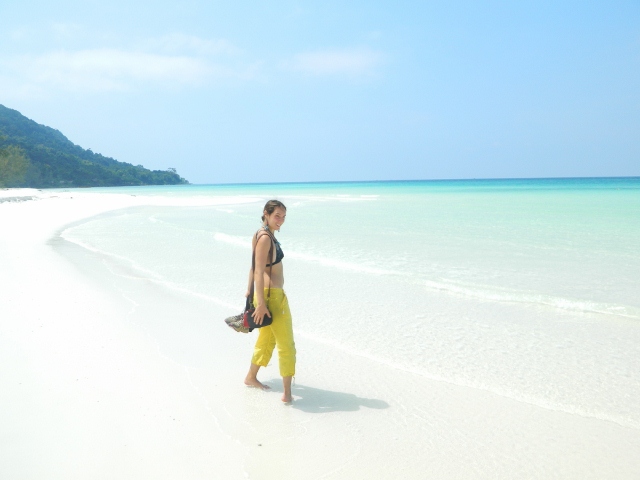
    Today was a gorgeous day at Diani Beach. For the first time in a long time, I felt poetry pushing at my fingertips. I hope it will transport you to where I am, if just for a moment…

    ~


    You know that feeling
    of sand slipping between
    your toes
    like silk ribbons,
    so soft and yielding
    you could almost
    sink your heels to the center
    of the earth?
    Take my hand,
    and follow me there.
    Kick off your shoes here—
    Yes, here at the edge—
    you won’t need them.
    Squint a little
    against the glare—
    white white sand too bright
    to look at.
    There.
    Where the sand forms
    miniature dunes
    in the shifting wind.
    Before the damp, packed
    floor of high tide.
    Just there—
    Try on a pair of sand slippers
    for size.
    Material so fine
    it will hug every millimeter
    of your toenails
    and soothe your soles
    like nothing before.
    Dig deeper,
    and feel the cool gasp
    of another layer,
    untouched by the sun.
    Drink the salt breeze
    in your hair.
    Stay as long as you like.
    Watch the waves carry
    blown glass jellyfish
    and green sea tangle
    In and away.
    When you’re ready,
    brush off your feet with
    sandpaper fingers,
    and put your shoes back on.
    Shade your eyes
    for one last look
    at that sand between your toes feeling.
    ~
  • How to Take the Bus Everywhere

    Jesus travels… and so can you!
    Don’t let anyone tell you otherwise… there is always another way to get there.
    In October, I visited my parents in Shanghai (their home base at the moment). Day two of my trip, I took an afternoon to explore on my own, wandering the tiny alleys of Tianze Feng, in and out of stores selling tins of tea and other adorably packaged goods.
    I have a “taxi card” to return—a business card with the name and address of my parents’ residence written in Mandarin and English. Taxis are cheap. Simple.
    But then, naturally, there’s a catch: I cannot, for the life of me, catch a cab. I stand first on one street corner of the main road by Tianze Feng, then on the divider between lanes, next on another corner. 
    Most of the passing cars already carry passengers, while other drivers seem to be intentionally avoiding my gaze. The afternoon shadows grow longer as I watch one Chinese shopper after another run to intercept an incoming car. There are people crowded on all sides; traffic moves at around 60 km/hour; I am never fast enough.
    Finally, someone does stop, but when he looks at my card he shakes his head and drives off. Does he not feel like going there, or can he not read the card? I will never know.
    Meanwhile, I have seen at least 20 public buses pass me by. I know I need to go *that way.* New plan…
    I think it really is possible to take the bus nearly anywhere and everywhere—if you want to. Here’s how:
    Step 1: Learn the word for “bus” and/or the proper pronunciation of the place you wish to go.
    In Shanghai, it took showing my taxi card to several people to learn to say the name of my parents’ road: Nanjing Shu-Lu.
    In Kenya, buses are “matatus,” and knowing that makes them a lot easier to ask for.

    Sometimes there might be a boat involved… even better!!
    Step 2: Find the bus stop.
    In many places, there will be a physical structure, replete with maps, schedules and names. In many others, there will be nothing but a small sign bearing the image of a bus—or nothing but a crowd of people standing at the side of the road.
    Ask people for the *bus* to [fill in the blank] until you find your stop. In my experience, other bus drivers and shop keepers are the best people to ask, and most likely to know the buses in the area, while taxi drivers are the worst, since they have ulterior motives.
    In Shanghai, I was lucky enough to find an old woman who understood my question, and knew that the 42 bus would take me to the right place.

    Or you can do this.

    Step 3: Catch your bus.
    It might stop automatically, or it might barrel past if you don’t flag it down. A sign bearing a name or number may tell you it is the right bus, or it might be a skinny man hanging from the window, calling out the destination.
    I usually like to confirm at least a couple times that it is indeed the right bus, as I have ended up on the wrong bus far too often.
    Step 4: Revel, and ignore the funny looks.
    Depending on where you are, you might well be the only obvious foreigner on the bus. People will stare. It will get old. Just do your thing and try not to do anything egregious—appropriate dress and conduct is always a good call.
    Revel in being on your way to where you’re trying to go! There is truly no better feeling than the surprise of success after a stressful search!

    If your bus looks like this, wait for the next one.

    Step 5: Pay.
    Often, fare will be collected at some point along your journey—or upfront, or upon arrival. Try to pay attention to how much other passengers are paying to avoid a high “tourist tax.” But if you do end up paying a few cents—or dollars—more, well, the tourist tax is real. I’m sorry.
    Step 6: Arrive.
    Chaos, confusion and disorientation may accompany your arrival… sweat, frustration and elation, too. One thing I can almost guarantee: you will arrive having spent less money. A second thing: it gets easier with practice.
    I love taking the bus. Despite the dust. Despite the confusion, often frustrating and hectic. Despite everything. Because the bus is always an adventure. Always. And that’s kind of the point.
    Need to make a connection? Repeat steps 1-5. Chances are, someone on your first bus will be able to point you to your next one, or even lead you there.
    “Trunk-seat” heading out of Mbita, Kenya a few days ago.

    Enjoy the adventure!
  • Rusinga Island, Lake Victoria, Kenya

    Here, I am Muzungu: foreign, white, outsider. Kids yell after us as we pass on foot (or, after realizing the walk from Mbita is at least an hour, on pika pika, moto-taxi). It hasn’t gotten old quite yet.
    There is something… there is something about the impossibility of fitting in that has always challenged me in the best of ways. In Nepal and India, no matter the effort I made to wear the right clothing, to learn the language, to immerse, I was always patently, immutably other. Here too—I can already tell.
    In Europe, not so much. I have a face that can appear French, Italian, Slavic or even Turkish according to context. Without my backpack, I can walk through a city unmolested, my status as tourist unknown, and blend into the crowd of a subway car. The chameleon has many merits, and I have certainly enjoyed exploring new places in the guise of a local.
    And on the other hand, I do not like the constant attention, stares of curiosity, shouts, deference and, conversely, hostility I receive when I travel as an obvious tourist. I certainly do not like being singled out by the Nairobi police as an easy source of a bribe, and I do not like the behavior of those men who seem to believe that as a foreigner I do not warrant the same respect as women of their own race.
    But still, there is something.
    There is something about the impossibility of fitting in that I do like. Standing out, not because of a voluntarily articulated identifier like religion, sexuality, or dress, but because of an immediately evident, insuppressible feature like skin color—like eye color, height, even language, too.
    That experience was very rare growing up in Boston, or going to school at Middlebury College. And I think most people, of all backgrounds, shy away from it because it is uncomfortable. It is inescapable. It can be exhausting and challenging. It is also, I think, important.
    There is something about the impossibility of fitting in that forces us to confront the reality of our otherness—no greater or lesser than anyone else’s. Amongst so many other reasons, perhaps that is why I travel. It is too easy to fall into the comfortable trap of sameness. Surrounded by people who look— and maybe more significantly behave speak dress and think—like us, we relax not into multiplicity, but into uniformity.
    I would rather learn how to be equally at home in my otherness as I am in my belonging.
    ~
    Home for the moment.
    Here at the western edge of Kenya, the roads are dirt and dust. An energy center in town offers drinking water, internet and computer use, solar energy and more to residents. Wifi is scattered at best.
    At the Wayando Beach Eco-Lodge, our neighbors appear to be hippos to one side and nonstop music to the other. I will teach yoga at 7:30 in the morning… if anyone shows up. I serve Tusker Pilsner to guests and fry Tilapia fresh from the lake for dinner. I have seen three different jewel-colored birds—ruby, emerald, sapphire—since writing that sentence.
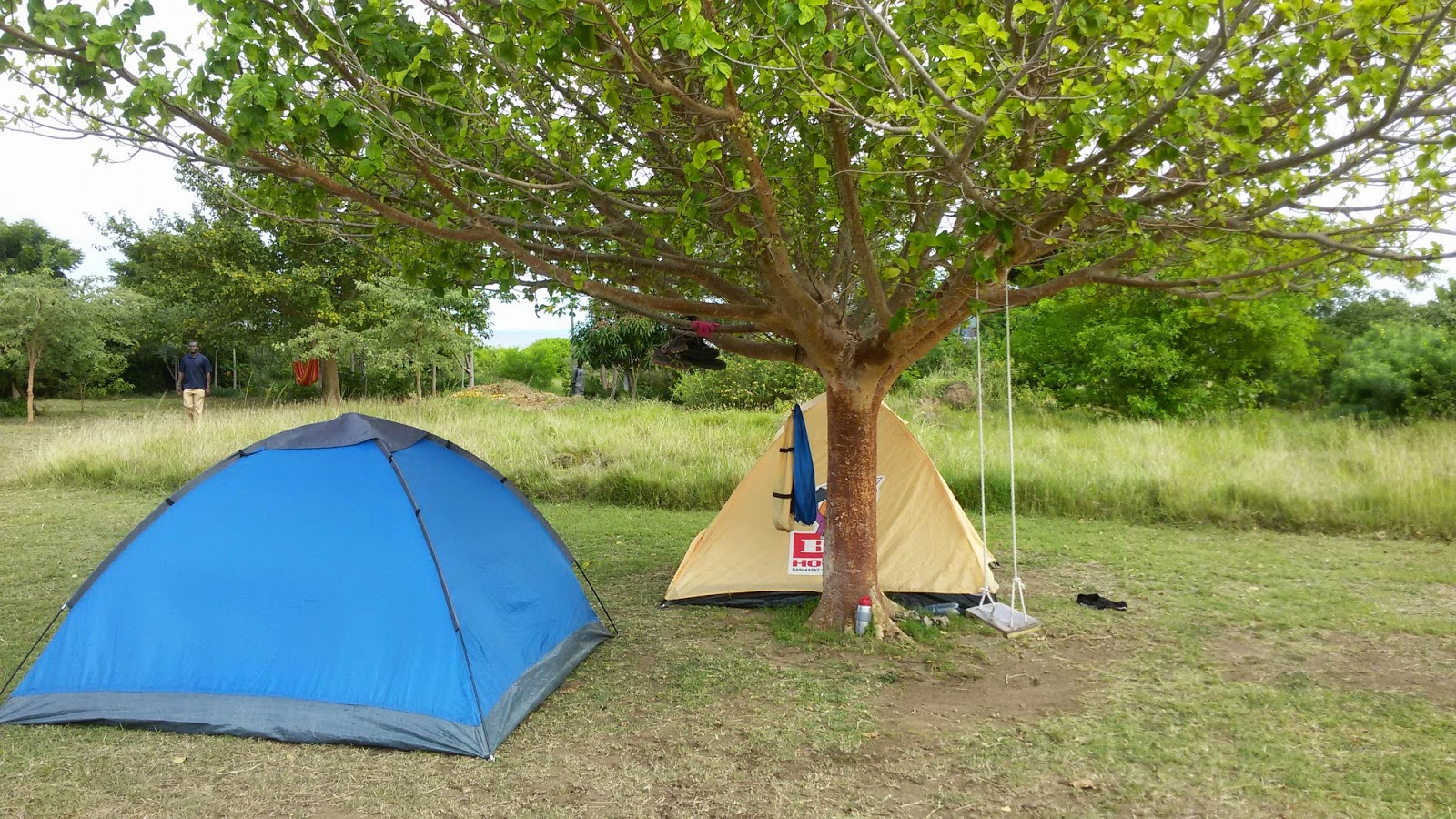
    The sun burns hot at midday, but the nights bring light rain and heavy wind, and I am happy for the warm blanket in my tent.
    Eco-lodge means sawdust-composting latrines, round, self-contained huts for guests, and lake water showers (don’t worry— it’s treated for parasites). It also means fresh papaya, mango, bananas, ginger, arugula, peppers, passion fruit and sweet potato from the garden.
    We will spend two weeks here, or hopefully longer…
    To Be Continued.

    ~
  • Hostels: Beyond the Horror Movie Story

    Picture it: A group of Portuguese boys play ping pong and try not to spill beer. Behind them, Spanish girls converse– loudly– with strangers via a smartphone translation app. Upstairs, Karaoke. Someone knocks over a stool with a bang. Ten bunk beds crowd into a room about 5m2; the room is rarely quiet. Dirty dishes accumulate in the sink, and most people cook pasta.
    No, it’s not an international frat house. It’s a hostel.
    If it sounds rowdy, messy and overwhelming, well, it often is. If it also sounds like a one-stop-shop for meeting other travelers and making friends from other places, well, it’s that too.
    Once upon a time, I loved to stay in hostels. At 18, I found the chaotic collision of cultures exhilarating. Likewise the endless procession of potential friends. The noise, the mess and the banality of bar-stool banter? It was new to me.
    Over the last five years, however, something has shifted. I prefer noise in moderation. Though I still enjoy meeting new friends—and I hope I always will—I am no longer awestruck by the air of international cool that hostels exude.
    Last week, I spent six days in a Barcelona hostel after all better options fell through. For seven euros a night, I didn’t mind that one of the two stoves didn’t work, or that I had to share space with twenty people smellier than me.
    My second evening I overheard a conversation that brought home the change in my relationship to hostels. What once would have seemed a thrilling exchange of travelers’ stories and philosophy now felt decidedly, disappointingly… trite, I suppose.
    What’s changed?
    Certainly not the people, the stories, or the philosophy. So it must be me. Hostels are the same everywhere, anytime, and maybe that’s the problem. I have started to see what is the same rather than what stands out and enchants. My god, I have never felt so cynical!
    As I look at hostels now, I see less the excitement, more the noise. I see lecherous older men rather than good stories. I see travelers who never leave their rooms and parties that I could just as easily find at home.
    This is no longer where I want to be.
    ~
    Picture it: “Dragon’s breath” fog rolls in between purple mountains in the twilight. Terraces of fruit trees reach out above it. The nearest town, where square white houses cling to the mountainside, measures an altitude of 4,000ft. Nobody speaks English. Home is a small caravan with one outlet and the most spectacular view of sunrises and sunsets. Farmers load bags of almonds onto mules to carry them up the slopes.
    For the next two weeks I will be “wwoofing” (working on an organic farm) in the south of Spain. I still like parties and socializing and noise, but lately this environment feels much more my speed. There is nothing wrong with hostels, per se—my criticism may be heavy-handed—but I think I am done with them.

    I feel good here—in the heavy quiet of fog and deep space I can breathe. I can write, too, and that is more than I could say in Barcelona.
    ~
  • What is Cultural Immersion? I Don’t Think It’s This…

    “When I’m in a new place, I don’t want to go to the tourist places; I don’t want to go to museums. I want to see real things.”
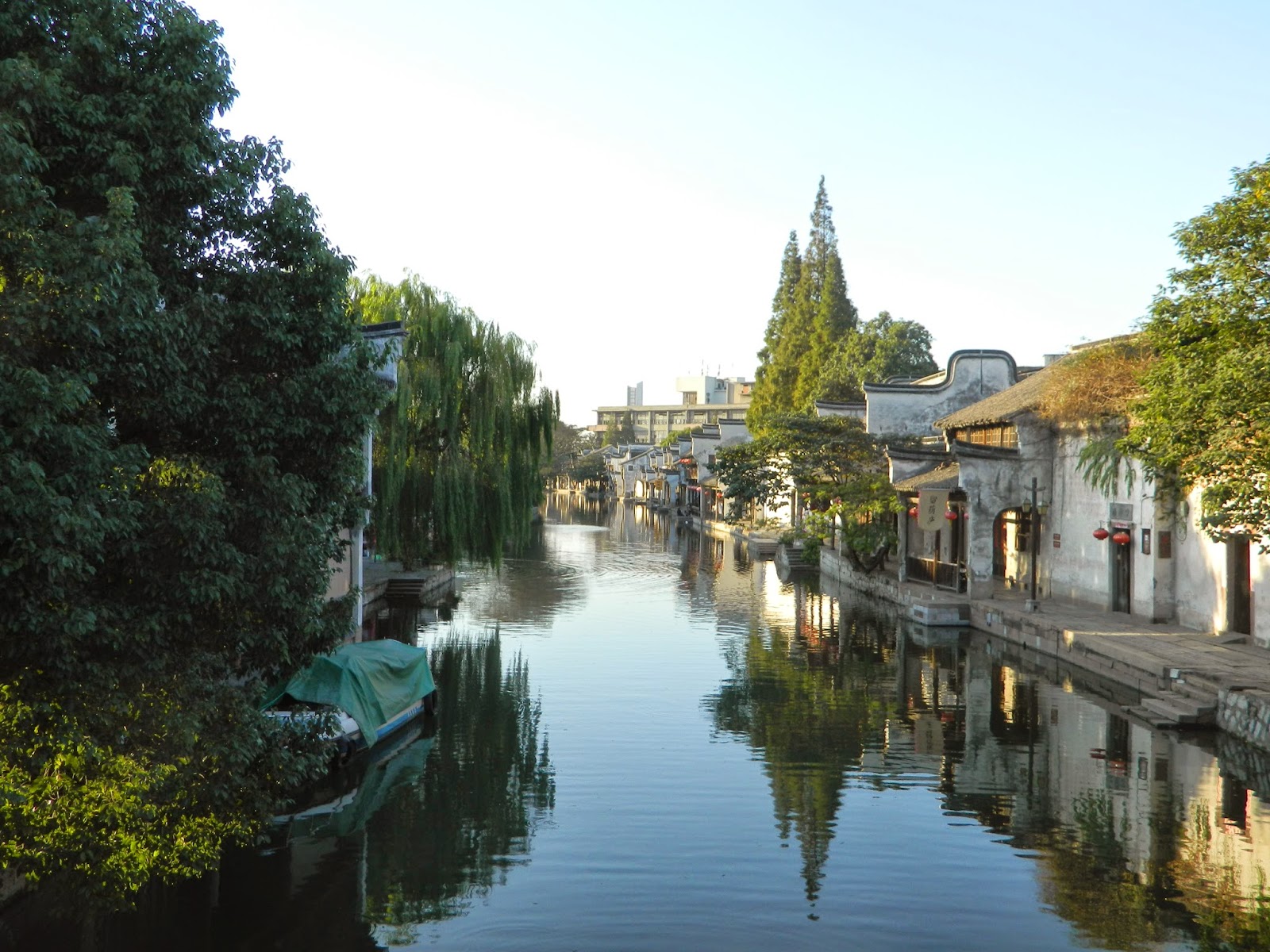
    Thus began my tour of Nanxun, a water village 1.5 hours outside Shanghai. Our guide, Stacy, began her introduction loudly, Midwestern inflection un-dampened by seven years in China.
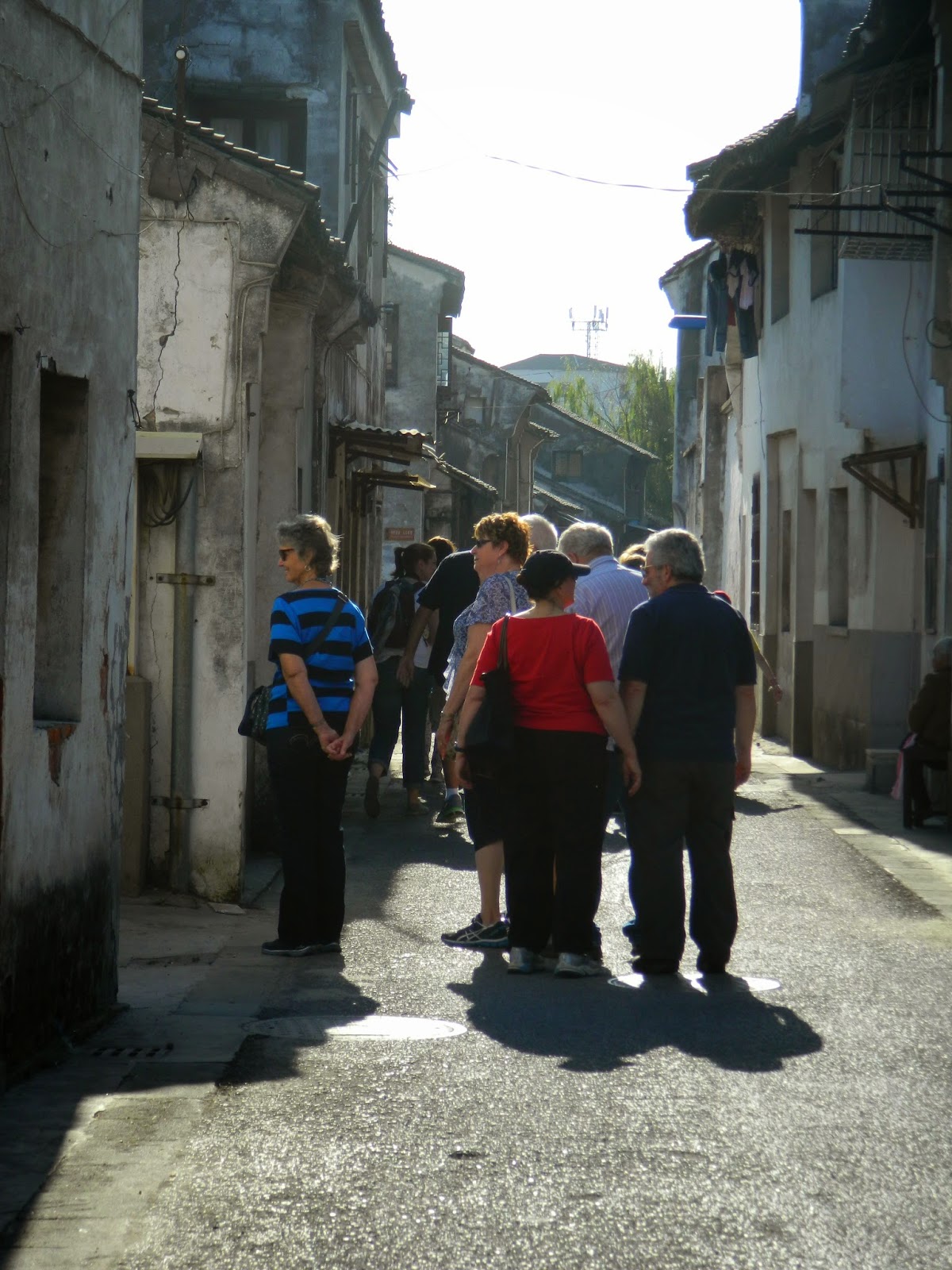
    Here we go, I thought. I would not be sleeping as I had hoped, for all 18 participants would be introducing themselves next. I’m not sure I had ever been on a real group tour like this before, but that weekend I had the distinct pleasure two days in a row.
    Will I do it again? Quite unlikely. Am I glad I went, if only for the wealth of new writing material to come of it? Oh yes.
    As our bus hiccupped out of Shanghai, the platitudes rolled on. Introducing her partner, Mike, Stacy continued, “Of course, because Mike is Chinese, he’s good with numbers and dates and things.” 
    Chinese towns, people and art, on this tour, were only authentic if over 80 years old.
    Those who know me are aware of my crusade against terms like “real” and “authentic.” Last year, after months around tourists bemoaning the loss of “real” Tibetan-Nepali-Indian-etc culture, criticizing restaurants, cafes and people who were not “authentic” and congratulating those who were, I lost my taste for such judgments. After reading a large amount of literature on these discourses, I am convinced that “is it real?” “is it traditional?” and “is it authentic?” are the wrong questions to ask.
    Our first stop in Nanxun, naturally, was for toilets. We pulled up outside a large, nondescript hotel where around 40 staff reluctantly moved through their “morning exercises”—something resembling the bastard son of the Macarena and the electric slide. They looked especially mortified to have an American, camera-laden audience, and I couldn’t find the spirit to take any pictures. After all, we all know the miserable feeling of dragging through forced routines.
    Indeed, much of the day felt disturbingly reminiscent of an elementary school field trip I and my two aunts didn’t want to be on. We were the disruptive kids at the back of the bus.

    As we marched single file through the house of a certain Mr. Wang (a retired blacksmith well over 80 years) to see his traditional Chinese oven, all I could think was, “What is the point of this?” 
    I, like Stacy, enjoy seeing into people’s lives and homes. I tend to be nosy and curious and have few boundaries when I travel. I have participated in many home-stays and exchanges. But I hope I would never be so entitled as to walk into a stranger’s home, practically without conversation, take a few pictures, and leave.
    What did we all learn that day in Mr. Weng’s home? I, for one, have no idea.
    Stacy has branded her tours as off-the-beaten-track cultural immersion experiences. Certainly, I saw parts of Nanxun and Shanghai that I may not have stumbled on alone, but is it even possible to immerse ourselves in another culture in any meaningful way in just 8 hours? 
    I wonder.
    We spent a hefty chunk of the afternoon in a retirement home with three charming Chinese women. Why? Because, “these old folks have so much wisdom to share.” Our interview, however, proved far too short to extract much of any depth. And though I did learn that I should not dry my face immediately after washing it and that “There is more food now” than in the Mao years, that was about it.
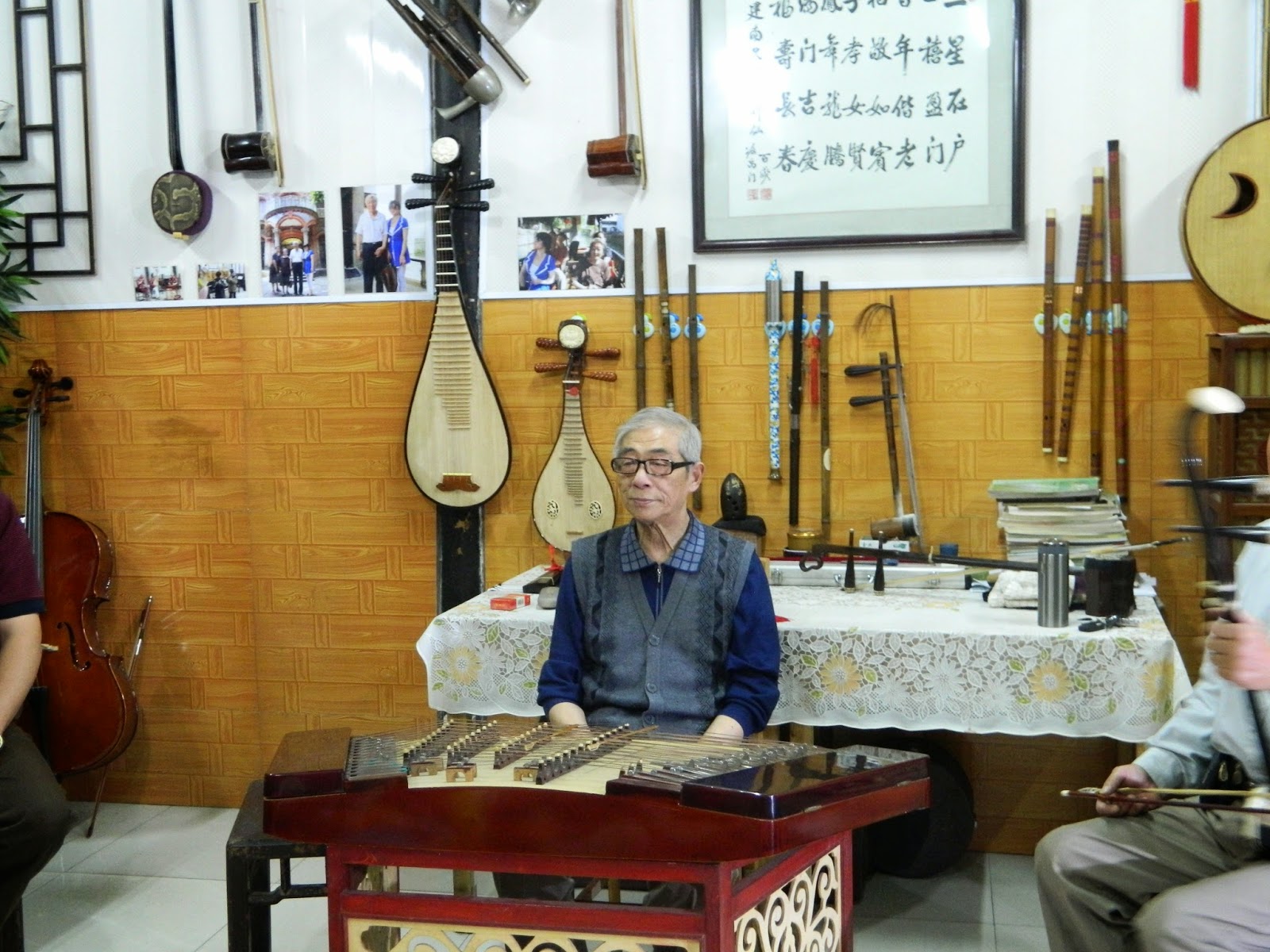
    One spry and flexible 90-something retiree led us through her morning Qi Gong routine. Later, I had the dubious honor of hearing “Jingle Bells” played on traditional Chinese instruments. Still, each stop on our itinerary, our “conversations” with local people, and our glossy overviews of entire schools of religious thought struck me as more shallow than anything else.

    Museums and retirees are equally “real.” Back alleys are not intrinsically superior to touristy main ways. Cultural immersion does not emerge automatically with the right combination of orchestrated meetings and exposure to dirt. Cultural immersion does not literally mean walking in and out of a local person’s kitchen. It is far more elusive. It requires more depth.

    That is not to say we should give up hope of having meaningful, culturally immersive experiences when we are short on time. 
    But let’s not place the things we see into two categories: real and unreal.
    When we have the opportunity to engage with another culture, let’s really engage. Ask questions. Look and see and taste and listen.
    Let’s decide for ourselves what is real.
    What is cultural immersion? That is a big question to answer, and maybe later I will try to go into it (though I’m not sure I have a satisfactory answer to give), but I am fairly certain it is not this.
    ~

  • Shanghai Snippets

    In Shanghai, everything is new. Or it wants to be new. Or it will be new just as soon as the old is knocked down and rebuilt. Retirees participate in state-sponsored activities in the park: old men manipulate Chinese yo-yo’s with surprising prowess, women join enthusiastically in chaotic dance fitness classes, and a single lane fills with the discordant cacophony of 20 different sound systems. I like it. More than I had expected. I take a stupid number of pictures of funny signs and storefronts, animal parts that no one wants to see, and gates and doors. My aunts take charge of photographing the family, and other things people will want to look at. Nonetheless, I want to share a few of those photos I took. These are the snippets and bits that caught my eye. I hope you will enjoy…
    Dancing in the park with maracas, what else?

    Fish heads– for sale or to discard? I’m not certain.

    Fresh pomegranate juice just outside the metro station.

    The Bund at night.

    Street food (pre cooking). For all of the street food fun, check out
    http://twohungryvagabonds.com/2014/10/25/cheap-eats-in-shanghai/

    “Open Lock. Make Key. Fix Lock.”
    An apt description of services offered.

    “Alley Curd,” purveyor of (the apparently
    very trendy) juice served in IV drips.
    Gates and doors.

     ~
  • Servers Love When You Do These Things (Just Kidding. Never Do Any Of It!)

    After a few years working as a server, sometimes part-time, sometimes full-time, always questioning my sanity, I think it is time to let you all in on a few trade secrets. Servers really hate when you do these things:
    Hide your credit inside the checkbook.
    We don’t have x-ray vision, and it is impossible to know if there is a card in there or not. On a busy day, your server will only have time to glance over, and will assume you haven’t looked at your check yet if there is nothing poking out of or sitting on top of it.
    Split checks.
    Okay, sure, it’s convenient for you. But really, how hard is it to figure out what your lunch cost and put in that much money, or to split the check evenly between a few cards? Does that dollar difference between your meal and your friend’s really matter that much? And anyways, you probably eat with these people every week. Why not go in rounds—you know, I’ll pay this week, you pay next week? It will probably work out.
    Be impatient when you ask to split the check six ways.
    So no one has cash and you have to split the check. It happens. No worries. But realize it takes a lot of time to run 6 cards through the credit card machine. No magic wands here. Sorry.
    Hold the check hostage when it is brought to your table.
    You want to sit a while. That’s okay! (Unless it’s busy and there’s a long wait for tables, in which case it’s not really okay. But we’ll say it is.) Just pay for your food so we can close your table and forget about you. There’s no implicit contract saying that once you pay you must leave immediately, so calm down and hand over the checkbook.
    Stand right in the line of traffic while waiting for your table.
    Everyone will dislike you for doing this. When things get busy, we are running, and getting in the way is hazardous for all parties. Fifteen minute wait? Go away, sit in a corner, or stand off to the side. Be anywhere but that spot. Please.
    Ask for extra dressing. Wait for your server to bring it. Ask for more bread. Wait until they return. Ask for another beer. Repeat ad infinitum.
    Oh, your table is low on bread, beer, and dressing? Why not save us three trips back and forth and ask for it all at once? Waiting until your server brings one thing to ask for the next is one of the most inconvenient things you can do.
    Tip poorly.
    There is no excuse for tipping less than 15 percent. I tip 15 for bad service. Good service gets 18 at least, but anyone who realizes that minimum wage is $4/hour and isn’t a miser generally tips at least 20. Regulars who never tip over 15 might be the worst; clearly you like the place. For an extremely comprehensive guide to tipping, check this out: https://www.tobyisrael.me/wp-content/uploads/2014/09/TABLE-final-3.png.
    Say you are ready to order, then take 5 minutes to make up your mind.
    Every minute spent at your table is a minute a server can’t be doing any of the 50 other things they need to do, like running food, bussing a table, making drinks, or going to the bathroom. Have pity, and don’t ask to place your order until you are actually ready.
    Complain when you receive the food you ordered.
    We want you to be happy and enjoy your food. However, that statement has limitations. If a mistake has legitimately been made, by all means say something. But if you’re unhappy that the garlic potato soup you ordered has too much garlic in it, or that the salad you asked for is too salad-y, sleep in the bed you made.
    Wait to complain until it’s too late to do anything.
    If you are unhappy and there is a way to fix it, don’t say everything is fine when your server checks in on you (unless you are actually fine with it). Once you finish eating, your complaints no longer count.
    Complain, and then insist on doing nothing about it.
    Don’t complain unless you want something changed. Letting your server know the burger is under-cooked, “just to tell them,” is utterly pointless. Don’t take advantage of the free-dessert-to-unhappy-customers-policy, either.
    Be the last people sitting when it’s closing time.
    At this point, you are the only thing stopping your servers from breaking down, sweeping up, and going home. Don’t be those a**holes. When you realize the restaurant is suddenly empty and the servers are sneaking glances at you every minute or so, it’s time to leave.
    Play music loudly on your phone, sit with your chair way out blocking the path, or otherwise disrupt the meals of other diners.
    A restaurant is not your private dining room. Please remember to be a respectful human being while there.
    Invent your own menu options to order.
    Most restaurants will be flexible around modifications and substitutions. Within limits. Yes there is a chicken sandwich, pesto, and asiago chese on the menu. No, it does not say “build your own sandwich” anywhere. All of you no cheese, no gluten faddists are also getting old. The researchers who discovered non-celiac gluten intolerance now think it may not be a real thing (http://www.alternet.org/food/new-study-claims-gluten-intolerance-may-not-exist-separate-celiac-disease), so why not enjoy the bread?
    As always, I present these comments to you with love and appreciation for all those kind, considerate, easy-going diners that find their way to my tables as well. And ultimately, if you must do any of these things, it’s okay. Just realize that they are inconvenient, time-consuming or disruptive and remember to say thank you!

    Did I miss anything? Feel free share your addition in the comments!
    ~
  • Toby and Alyssa Take on Istanbul

    For the last six days I had the great pleasure of traveling with the beautiful, brilliant, best of friends, Alyssa Raven Thomas.  What a welcome change from the repetitive (though largely enjoyable) pattern of spending my time with people who don’t know me.

    Just the highlights, then. We met up Sunday at our hotel in Sultanahmet, one of several historic districts of Istanbul. Reunion joy. Our hotel room was called the Grand Bazaar. The next day we visited the real Grand Bazaar, an enclosed warren of alleys and shops that housed a frenzy of action, color, light and exchange.  There, Alyssa purchased  enough evil eye bracelets to protect a Sultan’s entire army.  We spent the afternoon at Hamam Cagaloglu, Istanbul’s oldest and grandest Turkish bath, sweating and scrubbing out at least a week’s worth of grime (on my part, anyways). We scooped water from marble basins and lounged on heated marble slabs as gray light and a few drops of rain filtered through small holes in the domed marble ceiling.  The Blue Mosque, Haiga Sofia (pronounced and spelled Ayasofia, it would seem), and Topkapi Palace of course had their places of honor, and despite the aggressive masses of anxious cattle pushing to the feeding troughs (over-zealous tourists), these sites were spectacular.  Huge Turkish breakfasts, nearly unlimited cups of free tea (thank you, Turkish hospitality!), and squares of flaky baklava dripping with honey formed the delicious brackets between which our sightseeing took place.  We cruised the Bosphorous, took a ferry from Europe to Asia and back, criss-crossed nearly every inch of the city by foot, and braved wind rain and cold to take on Istanbul.  I’d say we emerged victorious.

    ~
    The Blue Mosque (Sultanahmet Cami) as seen from the Bosphorous.

    Stunning Byzantine mural inside the Ayasofia.

    Alyssa and I enjoy one of the best views of the Ayasofia from a rooftop bar in Sultanahmet.
    ~

    Alyssa is now heading home and I am about to set out for Cappadocia, land of the fairy chimneys. I will find out what that means and report back.

  • Paradise in Pictures

    A typical day on Koh Rong:

    Wake up to this.
    Run through the jungle…
    To this, the “other side” of the island, also known as Long Beach.
    Run back to this and paint these:


    Spend the night bar-tending or enjoying an open no-mic night.

    And a few shots from Angkor Wat…

  • Everything is Possible; Nothing is Free


    The hub of my front tire was bent at a worrisome angle. The brakes screeched so loudly they forgot to perform their intended function.  The bell did not ring and my feet did not reach the ground, but paying 10,000 kp, or $1.25 per day, I couldn’t complain about my rented bicycle.  It carried from the northwestern tip of Don Dep four kilometers along a wide dusty path to the southern side of the island, across a bridge to Don Khone, around, and back—about 25 kilometers in total—and never once muttered about the heat of the midday sun, which is more than I could say.  Don Det and Don Khone are two of the largest of the four thousand[i]islands that break up the Mekong River at the south of Laos.  I stayed on Don Det for four nights instead of my expected two, lolled into oblivion by the heady lotuses of palm trees, green water, good company and late-night bonfires.
    Both Don Det and Don Khone are incredibly flat, and my bicycle and I managed to navigate them easily enough. I stopped to see the Phapheng Falls—the massive series of cascades and rapids that thwarted 19thcentury French efforts to chart a water route from Vietnam to China.  I still haven’t seen the Phapheng Falls because when asked to pay a 25,000 kip entrance fee (approximately $3 and by all accords an inconsequential sum) I had a minor breakdown and went on my way instead.  Let me explain… I am more than happy to give my money to fledgling tourism industries, support the countries I am visiting within my means, and in normal circumstances I would never forgo a stunning natural sight over three measly dollars.  However, at that particular moment, something inside me snapped, perhaps triggered by the cold and offhanded attitude of the ticket taker: I wanted my humanity back! I was tired of being a wallet on legs, and I could not bear, at that moment, to pay for one more thing.
    A few hours later, repenting somewhat and feeling rather silly, I thought about doubling back, but the distance left to travel and the thought of the ticket taker’s face deterred me and I continued on without another thought for the waterfall.  I am not the only foreigner to lose patience with the aggressive profiteering in Southeast Asia, and I think I conducted myself relatively well.  In my two weeks in Laos, I witnessed shameful shouting matches between backpackers and tuk tuk drivers over a couple of dollars’ misunderstanding; I watched haggling turn ugly over the last quarter, and I saw smiles turn to anger in countless market interactions.
    In most of Asia, where haggling is accepted and even expected, the problem lies not in the bargaining itself, but in its tenor.  Backpackers especially complain that the locals try to cheat them and see in them only potential profit; locals complain that backpackers, who measure their poverty by a different scale, are stingy, want everything “cheap cheap” and ask rudely.  Both sides give reasonable cause for the other’s accusations.
    Everyone wants to be treated like a person. No one wants to feel like a tray of samosas or a wallet on legs, or a scheming villain.  In my opinion, for tourism to truly succeed someplace, a country’s motivation for drawing visitors cannot be solely monetary.  Obviously tourism is an industry and its purpose is to generate income, but when the desire exists to share one’s culture with outsiders, welcome them into it and benefit from their presence not only in a financial sense, transaction takes the leap to interaction.  In this best case scenario, we break the too-common boom-bust cycle of the tourism industry and see the birth of a new sustainable development model, with tourists returning regularly to places that are welcoming— neither “untouched” nor “ruined,” but real, warm, and human.


    [i]An approximate measure which I suspect was chosen for its poetic appeal in collusion with the ministry of tourism.
    ~
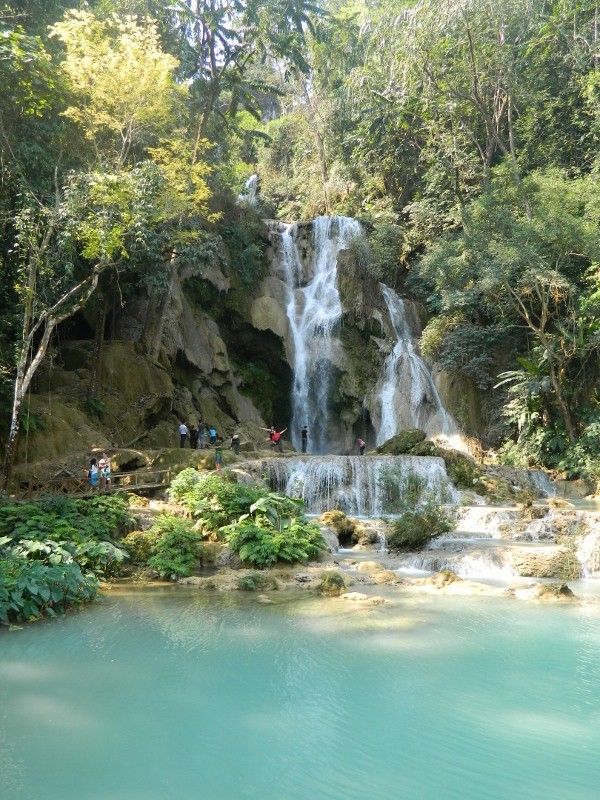
    Another beautiful waterfall in Laos, which I did pay to see. 🙂
  • 11 Things I Won’t Miss About Nepal

    On the (almost) eve of my departure, I have prepared this short rant, lest you mistakenly believe that I liked everything about my home of the last 3.5 months. The things I will not miss about Nepal are:

    1. The spitting. I don’t care if it’s culturally acceptable, hacking and spitting is still gross.
    2. The dogs. I have never before felt absolute hatred for any dog, but when gangs are barking outside my window at four in the morning, I am far too sleep-deprived to feel anything else.
    3. Specifically Lucky, SIT’s dog.
    4. Being talked about in my presence. Yes, I mean you, homestay family. I might not understand everything you say, but I know when you’re talking about me!
    5. The staring. It may be a cross-cultural phenomenon, doesn’t mean I have to like it. Besides, this is Nepal, I know I’m not that much of a novelty.
    6. Load-shedding. Twice-daily power cuts on a rotating schedule. It certainly made me appreciate the luxury of constant electricity, but I won’t miss it.
    7. Rice and potatoes. All the time.
    8. The honking. Unneccessary.
    9. The baby ladies (“please, my baby is hungry”) who borrow babies and will sell the milk you buy them back to the store and split the profits.
    10. The pollution. Carbon emissions control?
    11. Kathmandu’s Indian Embassy. Horrendous.

    Next stop India!

  • Existential Apple Juice

    A section from my soon-to-be-turned-in research paper. A little slice of life in Kagbeni and some more thoughts on authenticity.  Next post will be on a new theme, I promise.


                In academic discourse on tourism and authenticity, we often mistakenly assume that either tourists or local peoples can authoritatively define what is authentic.  In reality, authenticity, of experience as much as objects, is a transient and ever-changing concept, different for everyone.  True authenticity depends on one’s state of mind and openness to experience.  It can be contained in a single apple, a single moment, or a single-minded willingness to engage authentically.
                Less than a week into my stay at the Red House Lodge, I already had a Nepali name (Kalpana), a host of familiar faces in town, and essentially a Nepali family.  One morning, upon returning “home” from a walk, Tenzin’s daughter and employees called to me from the picnic table on the flat roof where they were shredding apples to make juice.  Kalpana! Bosnus, Kalpana.” They made space for me and I sat down on the edge of the table, trying to avoid the sticky bits of apple scattered about.  I insisted on helping, as by then they must have expected, picking up a hand-held metal grater (the kind I had only used to grate cheese), and joined my effort to theirs. 
    For more than an hour we worked in semi-silence, speaking to ask for more apples (apple, dinnus) or pass a bowl of browning mush to Ammis, who would squeeze it in handfuls to separate liquid from solid.  The only other sounds came from the rasping of small, green apples against metal, the occasional cry of hawks circling the crumbling medieval fort across the alley, and the drip drip drip of fresh-squeezed apple juice trickling into a plastic bucket.  It being an unusually still morning, the prayer flags adorning nearly every rooftop remained quiet and the strong Mustangi sun heated the air.  I changed into a T-shirt, the first and last time that my arms would see the sun in Mustang.  We paused sometimes to sample from the abundance of produce spilling from the deep wicker basket next to us, punctuating the music of shredding apples with the crunch of teeth on fruit.
    Apples of every variety grow well in the region around Kagbeni.  Marpha (elevation 2670 meters), a four hour walk south of Kagbeni, boasts the moniker “apple capital of Mustang,” but I preferred the tart crispness of the apples heaped around the picnic table that morning, harvested from Tenzin’s orchard in Pangling, just across the Kali Gandaki River less than an hour from the Red House Lodge.  Though the climate and altitude of Lower Mustang are ideal for the cultivation of apples, it is only in the last few decades that an apple economy has developed there.  Landowners have converted much of their farmland or unused property into orchards, and nearly every restaurant and guest house carries out its own small-scale apple juice-, cider-, and brandy-making operations.  Small bags of dried apples and bottles of apple brandy satisfy the demand of Nepali and foreign tourists alike for edible souvenirs.
    My skin warm and my hands coated with sticky brown apple remains, I smiled contentedly at the easy companionship of that moment, which transcended linguistic and cultural barriers.  Shoulder-to-shoulder with my Nepali didi (sister), I grated apple after apple, as quickly and as diligently as the rest, working towards the simple common goal of juice.  Moments like these cannot be manufactured, I remember thinking.  In their beauty, simplicity and spontaneity, such instances of connection and, yes, authenticity, are precious in their inimitability.  Isn’t that the conundrum of the tourism industry, which makes its millions by selling “real” experiences. 
    Some research on tourism today is employing the Heideggerian concept of existential authenticity to solve that riddle.  According to Heidegger’s philosophy, inherent meaning and connection exist, and it is these qualities that make experience possible.  In terms of tourism, when one approaches the world with “existential authenticity […], a state of Being in which one is true to oneself,” a unique experience of the world, understood from an individual perspective, becomes possible, and the tourist may experience that inherent meaning.  In these terms, authenticity is not a fixed, objective quality, but rather a state of mind, rendering it nearly impossible to package and market.  Taking the Maori’s staged cultural demonstrations as an example (which emerged as a response to non-Maoris producing cultural shows for tourists), “staging pseudo-events for tourists can, in fact, be expressions of host authenticity in deciding how to present themselves to others.”[1]  Whether a tourist witnessing this show finds it authentic is not the question here; the tourist who is attuned to his or her “existential self” will experience it authentically regardless.
    At six o’clock, the night before apple juice-making day, I ate dinner with the group of Ukranian trekkers in the rooftop dining room.  Candlelight cast faces and food into a dynamic interplay of shadow and warm glow, and we lingered over glasses of Tenzin’s mother’s homemade cider.  My dinner companions struck me at first as naïve and impressionable— every monastery, every person they met, and every interaction with local people awed or inspired them, it seemed.  They attempted to quiz their Nepali guide about himself through several layers of translation (from Russian to English to Nepali and back), saying, “we have been in Nepal trekking two weeks, but we don’t know any real Nepalis.”  Predictably, the attempt at conversation faltered, yet the more I reflect on this group of trekkers, the more I appreciate their unusual and sustained efforts at making connections.  Revisiting that evening through a Heideggerian lens, I wonder if their willingness to engage with everyone and everything they encountered and the sincerity of their desire to experience Nepal, uninformed and naïve though it may have been, might not have resulted in a truly authentic experience.
    The philosophy behind existential authenticity may appear hopelessly complex, but its implications for tourism study and marketing are straightforward yet rich in possibility.  If we admit that there is no objective authentic culture, that neither outsiders nor locals can make such a judgment, and we focus instead on individual authentic experience, existing mainstays of tourism marketing may prove misguided.  The shopkeeper who insists that, “this bracelet is really Tibetan. Really” might realize that her neighbor who converses and connects with customers does more business.  The tour guide offering to show his group the “real Mustang,” and its most meaningful cultural treasures, might lose out to the one who allows visitors to determine for themselves what is meaningful and seek for themselves authentic engagement with a foreign culture.
    Apple juice perhaps can be bottled, mass-marketed, and sold at a profit (though I believe it tastes best in small batches), but the existential authenticity contained in a moment of shredding apples at a warm picnic table cannot.  Experiences like those are invaluable, fleeting and individual; at best, a guide or tour might provide support for those tourists who wish to attain them.


    [1]Steiner, Carol J. and Reisinger, Yvette. “Understanding Existential Authenticity.” Annals of Tourism Research, Vol. 33, No. 2. Pp. 299-318.
  • Shit Buses Say

    They crowd the streets of Kathmandu, barreling down the (undefined) center line at breakneck speed… it feels fast at least.  Painted in a fiesta palette of pinks, turquoises, greens and yellows, these buses sound their cartoon-like horns as they roam the twisting motorways of Nepal.  Many also bear some of the most entertaining, impossibly random English slogans you will ever read:

    “You Hold A Special Palace in My Heart”

    “Jesus Death 4 You”

    “London Dreams”

    “Seeking a New Girlfriend”

    “See You–
    No Time to Love”

    “If You *Heart* Seafood You Will Be Popular”

    “Speed Control”

    “Sexy Boys”

    “Jesus Travels”

    “When I’m Rich You’ll Be My Bitch”

    ~
  • Through the Bazaar: My First Nepali Journey

    Tashi Delek (“Auspicious Greetings” Tib.) from Nepal, officially!
    It would be difficult to exaggerate the toll that being sick took on my first week’s experience of Nepal.  Having gotten some kind of food poisoning day three, I spent the following five days deluding myself that I was recovering, when really, sleep-deprived and on an involuntary starvation diet, I could barely function.  The daily 8am-6pm classes and meetings didn’t help either.  Finally admitting defeat, I went to the doctor Thursday afternoon, and a day of antibiotics later (yesterday) I had enough energy for our first free afternoon in Kathmandu.
    Danny, one of our teachers, led our group of 21 SIT students through a series of streets, intersections and ‘rotaries’ from the Garden of Dreams (more to come on this another time) to the Bazaar in Old Kathmandu.  Passing through Tamel, the tourist district, very quickly, I noticed not one, not two, but ten or fifteen stores selling nothing but Toby Pants.  Toby Pants, for those who don’t know, are technically harem pants, but can also refer to a range of styles of colorful cotton pants, which, no matter what milieu I find myself in, always seem to be unique to me.  So imagine my excitement to find so many on one street! Striped Toby Pants, billowing Toby Pants, wide-legged, trimmed with woven ribbon, Toby Pants in every variety.  Toby Pants I hadn’t even known existed.  I had to return.
    Racing to follow Danny down crowded alleyways, I didn’t quite keep track of our route, but I vowed to find my way back to the pants street.  At the center of the Old City, I learned that our “drop-off” assignment was to find our way back to our homestays in Boudha (pronounced Bodha), located at the Northeastern edge of Kathmandu, after exploring the city as much as we liked.  Thus released, I immediately set off first to wander the Bazaar, and then to locate my pants.
    I wandered through the Nepali bead market where ropes of bright green, red, and yellow glass beads glittered in the sun.  Women in equally bright saris sat on the ground in some of the stalls to examine certain strands.  The space between stalls proved too narrow for the volume of people wishing to visit them, and I had to shove my way out, or be shoved.  I quickly walked through seemingly endless alleys piled with T-shirts, sneakers, underwear, and other clothing of little interest.  A few stalls stacked with fabric and shawls I sketched into my mental map.
    Slightly lost, I found my way back to the open square where I had started, at the center of which stood an enormous table covered by towers of scarves.  I set out in the opposite direction, towards Tamel.  I knew I had taken the right street by smell.  At the first intersection, fruit: rickshaws loaded with baskets of bananas, pyramids of fist-sized pomegranates, neat piles of red and green chilies, juice carts with pre-cut pineapple.  At the next intersection, the distinct smell of fish emanating from a hidden location; at the next, cumin and coriander wafting from sacks of spices.  When I took a wrong turn, I retraced my steps and sought out the right scent—there’s the cumin; I’ve been here before.
    At every intersection stood small stone stupas, shrines, some with metal carvings of Buddhist and Hindi deities.  Red powder for puja, too.  The spaces around these stupas served well enough as traffic circles, and every narrow street and alley accommodated two-way traffic.  Motorcycles asserted their supremacy, honking loudly, while pedestrians, bicycles carrying 10-foot ladders or bamboo poles, and rickshaws ambled on indifferently.
    Toby Pants Street, when I found it several wrong turns later, was everything I had hoped it would be. 
    Satisfied, but tired and ready to return to Bodhanath, I made my way to New Road, where, theoretically, I could find a bus.  Considering the size of Bodha’s stupa (more to come later), I was surprised at how many people had never heard of it when I asked directions—I don’t think my pronunciation could have been that bad!  Those who understood me continually directed me farther down the street to the correct spot to wait for my bus.  The minibus to Bodha did arrive, and the stick-thin fare collector directed me to a seat that had not existed a moment before.   The fourth to squeeze onto a three-person bench, I at least had a seat, which is more than could be said for the next ten passengers to press on.  We lurched through traffic at maybe ten miles per hour, and since I could not move my arms, I took the opportunity to count passengers.  At its fullest, this minibus (offering perhaps twenty seats on a good day) held thirty-five!  An appropriately crowded conclusion to my bustling introduction to Nepal.