Tag: africa

  • How to Pack One Bag for Life (What’s in my Backpack)

    It’s been two years that I’ve lived out of one bag.

    In two weeks I will take a second (small) suitcase with me to Cape Town, so I might as well write this while it’s still true.

    One of you lovely readers asked me what’s in my bag, and I’m glad you did, because packing lists are one of my favorite things to write. I’m serious. Growing up, I would start making my list weeks before family vacations; I started packing pretty far in advance, too. I’ve stopped making lists (but kept the habit of packing way too early), so this is a fun throwback.

    A few caveats:

    I chase the sun. If you expect your life to include winter, you’ll need more warm things.

    I have my hobbies, you have yours. Your “extras” will likely be completely different from mine.

    I leave things, give things away and pick things up near-continuously. It is useful to have friends and family, in whose basements, attics and closets you can leave things you don’t want to let go of but don’t want to carry with you (especially books). It is also useful to get used to giving away something old to make room for something new.

    I carry many extraneous items. I suggest it to you, too, even if it’s impractical. It’s the difference between going on vacation and carrying “home” with you.

    I will write this packing list like I write recipes—Italian style, not-too-specific, and with room for creative interpretation.

    I’ve split the following list into (I think) logical sections. I hope it may help someone pack for a nomadic existence, a long backpacking trip or an extended stint abroad. At the very least, I hope it will give you a glimpse into the very practical side of long-term vagabonding, and make you smile.

    One Bag for Life

    For when it gets chilly:

    • Bright blue wool socks for which your friends will mercilessly mock you
    • A shower-resistant outer shell (when it rains, you will wish it were rain-resistant too)
    • Bright blue fleece, because there’s no such thing as too much turquoise
    • Sturdy boots/shoes (right now I have trail shoes, but sometimes I opt for boots)
    • A sweater, preferably stolen from a friend

    For all the time:

    • 1 pair hiking pants
    • 1 pair yoga pants
    • 1 pair “Toby pants” (also known as harem pants by those who don’t know me)
    • 1 pair jeans/passably normal pants
    • X pairs socks and underwear (how many? it depends how often you want to do laundry…)
    • 5-6 shirts (some for hiking, some for exercise, and some for normal person-ing)
    • 1 bathing suit
    • Toiletries (pure argan, coconut or almond oil, natural bar soap, toothpaste, toothbrush, tea tree oil, natural deodorant, comb, nail clippers, lip balm, sunblock—yes, that’s it!)
    • First aid kit (which you will never use but carry around forever “just in case”)
    • Sunglasses and glasses
    • Passport, expired driver’s license, bank card, and other assorted bits of paper that sometimes come in handy
    • Birkenstock sandals
    • Reusable bags (for food-shopping, beach day-ing, or hanging on doorknobs to look at and wonder why you’re carrying so many extra bags)
    • Sarong, which serves equally well as scarf, towel and pillow cover

    Because I’m a woman who likes dresses:

    • 1 long skirt.
    • 2 dresses, neither of which are as practical as they should be, and one bright red

    Me-specific things (yours will be different):

    • Yoga mat (I’ve gone with Manduka’s travel mat—it doesn’t get any lighter, it also doesn’t get any less cushioned)
    • Climbing shoes
    • Dance shoes (the super lightweight practice kind—heels are heavy!)
    • Books (rotating; right now The Prophet by Kahlil Gibran, a book of Italian fairy tales by Carlo Collodi, and Bushido’s Way of the Warrior)
    • Notebooks and many, many pens (you will lend them to people and not get them back, so it’s good to have 5-10 on hand at any given time)
    • Laptop (for work; if you don’t work online, maybe skip the laptop—it’s a hassle)
    • Sleeping bag (and sometimes, but not right now, tent or camping hammock)

    Unnecessary but still important things:

    • A large quartz crystal
    • A large quantity of jewelry
    • A large camera
    • Smartphone (for staying up-to-date with loved ones and total strangers)
    • Gifts (for people in the next place you’re heading)
    • Oversized purple headphones
    • Smaller-sized purple headphones
    • Pretty scarves to put on top of ugly tables

    And just like every time I pack my bag, I feel like I’m forgetting something really, really important, but I haven’t left anything out, so that must be everything!

    The moral of this story? We actually can fit everything we need into one bag—for life, or at least for a few years. It’s probably going to be too heavy, and we’ll probably find ourselves missing variety (of shoes especially), but not nearly as often as we’d expect. We’ll get accustomed to accumulating more belongings when we pause for a while, and equally accustomed to shedding them when it’s time to move once again.

    The other moral: Good food is always money well spent. So are experiences. Our stomachs are like endlessly refillable backpacks, and our brains are like slightly leaky, endlessly expandable suitcases. Fill them.

    ***

  • It’s. A. Trap! (Fair Doesn’t Always Mean Equal)

    It’s. A. Trap! (Fair Doesn’t Always Mean Equal)

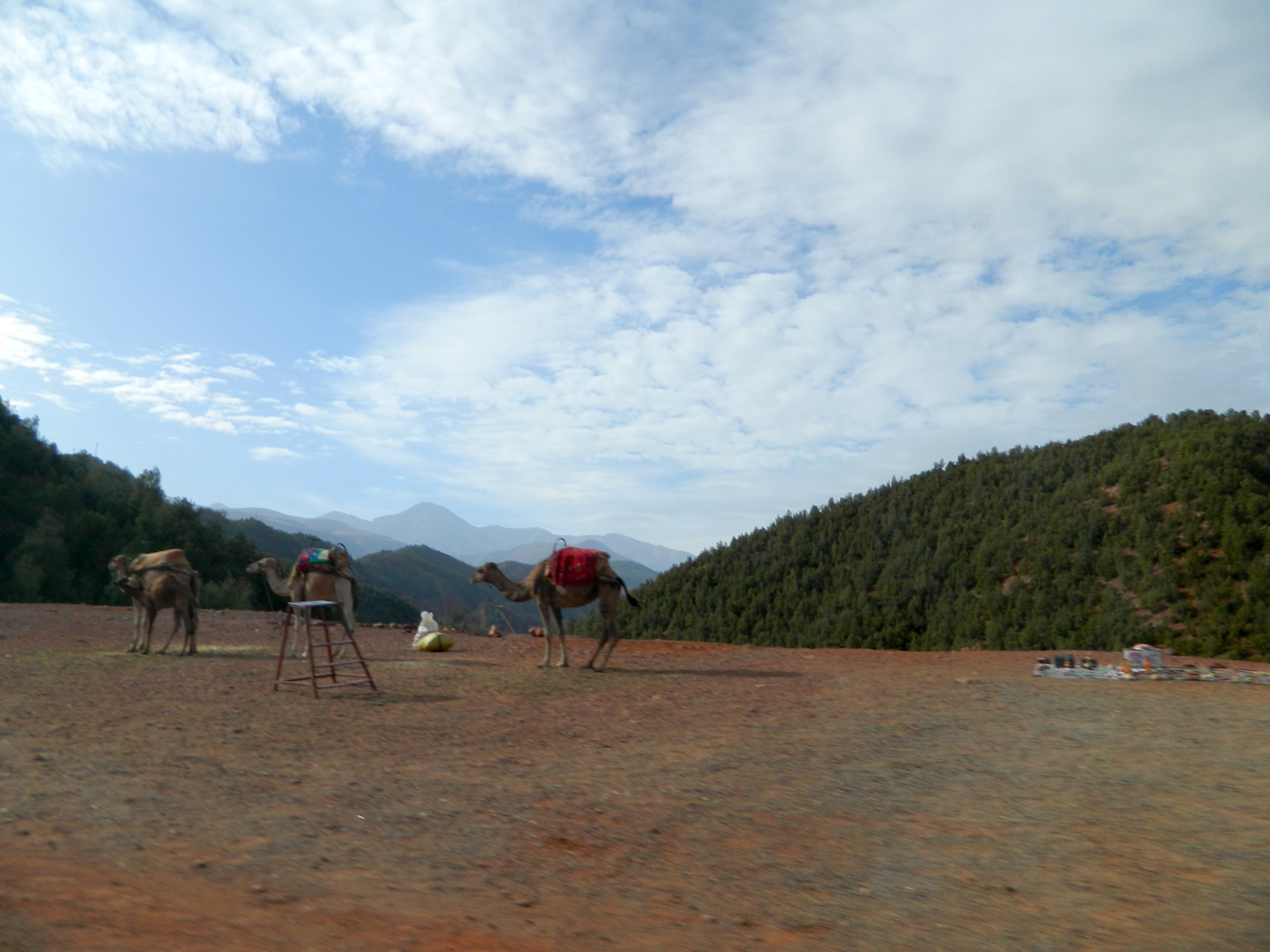
    Ourika Valley, near Marrakech, Morocco

    “Very good price. Very low. Better than free.”

    We’re standing outside the van on the road to Ourika Valley, a verdant, majority-Berber region about two hours from Marrakech, popular with tourists for its many waterfalls.

    A half-dozen camels on short tethers wait for curious tourists to approach. It’s well past 11 o’clock, but the sun is just making it over the mountains to warm the deep valley.

    The man speaking proffers a tangle of necklaces. Plastic. The artisanal products are waiting in well-planned shops, with tougher hagglers behind the counter. My companions for the day, a French couple from outside of Paris, laugh and tell him that’s a good marketing plan.

    In a way it is, but then…maybe not.

    You see, I don’t want anything for free (unless it’s a sincere gift). I don’t want the cheapest price (anymore). I want a fair price.

    And that’s a very different thing.

    Ostensibly we’ve stopped for photos, but the view was around the last bend, and we’re really here to have time to spend money. We’ll stop at three more tourist establishments (some would call them traps, but I won’t today and I’ll explain why soon) before actually reaching our intended destination.

    > The Argan Oil Cooperative. Smiling women sit outside the building grinding argan nuts into a paste, which will later be separated into cosmetic oil and the base ingredient for savon noir (black soap). They beckon us to sit beside them. Ashkid, ashkid. (Come, come.) You can take pictures, we’re told. No problem. There’s a dish in front of the women with a few dirham notes in it. We can leave money there.

    > The Berber House. A traditional Berber house, which I might have found more exciting had I not spent a great deal of the last five weeks visiting my Berber friends in their (yes) Berber Houses. We’re shown the kitchen, the store room, the family room, the hamam (bath) and the backyard. You can take pictures. No problem. On the way out, there’s a well-placed souvenir shop and a donation box for the welcoming Berber House family.

    > The Guide. We stop in the village near the waterfalls to pick up the guide. We haven’t asked for the guide, but the guide is going to come with us. He accompanies our small group halfway up the trail, to the first set of falls, and then tells us it’s time to turn back. When we insist on continuing, and he insists on not going back without us, I convince him to wait at the halfway-up cafe while we finish the hike.

    Now, I don’t like being forced to pay for things I didn’t ask for or want in the first place. I also don’t like not paying someone for work completed or services rendered. I don’t like feeling cheated out of my money. And I don’t like feeling I’ve cheated someone out of their fairly-earned money.

    Most people in the world would probably agree with those sentiments.

    I think all of these scenarios and concerns come down to the same fundamental issue: fairness. Fairness to local people working in the tourism sector, and fairness to tourists seeking to spend their money well (ethically, reasonably and in a way that feels good to them).

    So, what’s fair?

    I’m going to seriously oversimplify for a moment. The tourist-local marketplace dynamic—as I see it—breaks down like this:

    Tourists don’t want to feel ripped off or trapped. (That’s a low bar.) These things are traps: Telling someone to take a picture (no problem, pictures are free!), and then asking them to pay for it. Insisting someone take a bracelet as a gift—and then insisting they pay for it. Following someone through the souk, though they have clearly stated they do not want a guide—and then asking them to pay for it. (These are all common experiences for unsuspecting foreigners in Morocco.)

    Tourists do want to feel like they’re getting a good deal. Sure, some are pinching pennies, but most just want fair. Many, like me, will feel frustrated when they know an item’s market price, and then are asked to pay four times that because said item has been handily transported into a souvenir shop. They don’t want to pay “tourist prices.”

    Local people want to make a decent living. They see foreign tourists and assume (reasonably) that if they had enough money to pay for a plane ticket to Morocco, they also have enough money to pay a few dollars above market price for a bottle of oil, silver necklace, taxi ride, and everything else. They might also encourage (or push) said tourists to spread their money evenly—a few gifts at the Argan Cooperative, a dollar to the Berber House, a tip to the guide. From this perspective, those tourist establishments mentioned above are not traps, but simply an integral component of the day’s adventure.

    Some believe that tourists should pay tourist prices, because they can. And hey, I get where they’re coming from.

    Naturally, I also get where tourists are coming from. I’ve been pondering this a lot lately, and I think the fair solution is neither “equal” (tourists often do earn significantly more than the locals they’re buying from, so why shouldn’t they pay more too?), nor excessive (no one likes traps and cheating). Rather, it’s somewhere in the middle, where everyone is happy—or at least not pissed off.

    So, when buying abroad, keep three questions in mind:

    1. How much is this worth to me? (How much do I want to spend on it? Keep in mind, for perspective, what you would spend at home.)

    2. What is the “market price”? (What would this cost a local?)

    3. What can I afford? (What’s my budget for this day? Week? Holiday? Will this meal/souvenir/excursion put me over?)

    The “fair” price exists somewhere at the nexus of those three answers.

    Happy shopping!

    *** 

    And to justify this blog title:

    Youtube video
     

  • 6 Awesome-Sauce Pictures of Morocco (or, Why you Should Follow Me on Instagram)


    I haven’t been writing much the last couple weeks. I think sometimes, when it comes to writing about our experiences, there have to be periods of writing—and then periods of experiencing. So, let’s just say it’s been the latter, and I’ll get to the writing part again soon.

    In the meantime, did you know I’m on Instagram these days? I share snippets of writing or travelogue with nearly every post. Here are five reasons to follow me:

    *

    *

    *

    *

    ***

  • How to Pour Tea, It’s Out of our Hands, and Other Lessons from the Moroccan Coast

    View of Taghazout from one of my favorite cafes.

    We watch the waves crash against the cliffs beneath our table, the spray catching the sunlight over and over again.

    Our tea arrives—the classic combination of Moroccan mint and strong green that everyone drinks, but without the usual pound of sugar, per my request. A simple silver teapot with a long spout. Two small glasses (not mugs, but glasses).

    I lift the teapot and pour, starting low, then lifting higher, and higher, and a bit higher, steam rising up from the cascade of tea and a slight froth forming at the top of each glass.

    (If I wanted to mix in sugar, I would pour out glasses of tea and dump them back in the pot several times to avoid using a spoon—bad luck, I learned later. But I don’t, so I only pour once.)

    I can’t remember where I first learned to pour tea—properly. I think it was in a Senegalese village when I was 16. Everyone laughed at my first attempts, of course. Even today I spill more than any veteran tea pourer ever would. But I know the technique, and I can make a few bubbles.

    It’s a small thing, arguably, pouring tea well, and yet drinking tea proves such a fundamental aspect of so many cultures that I think it’s important, too. Worth learning. Worth sharing.

    ***

    Let’s drink tea together tomorrow!

    Inshallah.

    You should open a cafe there—you would get so much business!

    It’s a good idea. Inshallah.

    Are you moving this week?Inshallah.

    When does the high season start?

    Things will get busy next week—inshallah.

    Inshallah (also written insha’Allah). If God wills it. God willing. Used throughout the Arabic-speaking and Muslim world—and often. At times my plan-making mind gets irritated by the ceaseless string of Inshallahs spoken and exchanged each day.

    Is nothing certain?

    Well, no, it’s not—is it? To visitors from outside cultures, I think this nonstop Inshallah business can seem like a cop out. Noncommittal. But I suspect (I don’t know nearly enough to say for certain) that it stems more from a different perspective.

    Everything—everything—is out of our hands. Maybe. It’s probably a good brain exercise to consider the possibility, even if you disagree. Living here, then, is like a daily mind workout.

    ***

    Every day I learn here.

    I learned that until the 1950s there was a small Jewish settlement alongside the Berber ones in the mountains behind Taghazout. I visited a new friend’s home in those mountains, and I could feel the history in the ground under my feet.

    I learned that Friday is couscous day and that soup is a summer food.

    I learned that no length of fabric will cover my foreignness here—no matter how Mediterranean I like to think I look.

    I’ve learned that if you sit long enough in one spot it is really possible to see every person you know in this town, and that if you start walking you can spend a whole day just stopping in for chats with old and new friends.

    I’ve learned how to roll under a wave with my surfboard, and that lip sunburn is real.

    I’ve learned to count to ten (though I’ve forgotten at the moment), and how to greet.

    There’s no other message today. There are lessons everywhere, every day and in every culture; I hope you’ll go find some!

    ***

  • Taghazout, Morocco: 10 First Impressions in 10 lines

    First impressions aren’t everything, but they are something. After nine days in the small town of Taghazout, Morocco, I’d like to offer a (first) glimpse into my experience.

    When people greet, they touch their their heart after shaking hands. For some reason, it reminds me of my brother. I like it.
    The air is cool—cold even—after dark. Fog rolls in at dusk and wraps up the boys playing soccer on the beach, the tourists strolling to dinner, the shouts and drumbeats floating in the air.
    Blue tiles everywhere—in bits of mosaic, in staircases. Blue paint, too—on houses, on boats laid out in dozens on the shore.
    A population explosion of cats and dogs. The dogs follow me on my morning run, a pack at my heels—I just hope I’m the alpha. The cats seem determined to ruin my clothes—and my laptop.
    Narrow streets, all leading to the sea, all quite clean, except for that one path that smells like sewage.
    Where are the women?? I wonder. The cafes are full of men. The streets, too. And the beaches. The few women I do see don’t seem like they want to be my friends. The little girls, yes. (That’s true everywhere.)
    Tagine every day. Layers of chicken or fish, potatoes, carrots, spices, olives, citrus—slow-cooked until soft in a clay pot with a conical lid. Fragrant.
    I’m going to get good at surfing; I’m determined. For now, though, I’m focusing on wiping out. The water is muddied with sand most days. Photographs come out in gradations of blue-brown.

    There is no atm in this town. No bar (welcome to Morocco). Surf hotels, corner shops and small cafes abound, though. Everyone knows everyone, too—and that’s not just an impression, I think it’s really true!

    Every house has a terrace. Every terrace a view of the ocean. Every view meets the sound of waves crashing on shore, and I am content to sit and listen.

    ***


  • “Don’t go to Morocco Alone.” And other Fear-mongering you should Ignore.

    A rooftop terrace in Taghazout, Morocco.

    Me: “I’m thinking of going to Morocco.”

    Everyone: “Awesome! Just don’t go alone.”

    As you may have guessed, I didn’t listen to everyone, and here I am: in Morocco, very much solo, and so far quite pleased about it.

    (For the next month, I’ll be living in Taghazout, a small town on the Atlantic coast, teaching some yoga, learning the fine art of surf bummery, and generally winding down after an overly hectic few months. And I’ll have time to visit a few Moroccan cities afterward, not to worry!)

    There is a saying here, which a new friend taught me:

    One rotten fish can make the whole bucket stink.

    For those who work in the tourism industry, that rotten fish (in the form of robberies, political unrest or an isolated attack) is the proverbial boogeyman. Just a whiff of danger and foreigners will cancel their flights. An act of terror (as occurred while I was living in Kenya)? Total disaster for the industry—and, by extension, a great many people’s livelihoods.

    I digress somewhat. I don’t to tell you what happens to the tourism industry when the fear-mongers win. I want to tell you why you shouldn’t listen to them in the first place.

    Every country- or city-shaped bucket has a rotten fish—often many.

    In my opinion, those rotten fish are the reason why people will tell women not to travel solo to India, Zanzibar, Turkey, fill-in-the-blank-with-your-country-of-choice. “It’s not safe.” “Men don’t respect women there.” “It won’t be pleasant.” Et cetera, et cetera, et cetera.

    And sure, there’s a good chance I will encounter an asshole or two before I leave Morocco in six months’ time. I’ve spent time alone in all of the aforementioned countries, and I’ve had occasional negative experiences in all of them (though always far outweighed by the positive). But do you know where I’ve encountered the most assholes? On college campuses in the U.S. In Parisian metro stations. Walking down the street in Boston.

    So what can we learn here?

    ***

    Well, for starters, check your assumptions. Are you giving more credence to warnings of danger or disrespect because the destination in question is “over there”? Keep in mind that nowhere is perfect, and nowhere is particularly “safe.” I have yet to investigate, but I’ve heard Morocco may be one of the statistically safest countries in the world. Chew on that.

    Second, ask yourself if you’re discounting cultural differences. If so, you may be falling victim to the understandable yet problematic epidemic of Western ethnocentrism. That is, judging another culture purely by your own values. Quick tips for women wishing to avoid harassment while traveling alone: cover your hair, cover your shoulders, and cover your legs (generally, follow cultural codes for modesty and behavior). Oh yes, that’s problematic in its own way, and I take issue with it sometimes, but we don’t get to make the rules when we visit someone else’s home.

    Lastly, choose your devil, because there is nowhere—nowhere–you will be utterly and inalterably at ease.

    ***

    I (and just about every woman ever) learned since birth to fear. Fear attack. Fear violence. Fear bad men. Fear everything, right? Society teaches us that.

    And it’s true. Of course it’s true! The world is a scary place. Especially for women. We’re working on it, but we have a very, very long way to go. Change, however, has never happened when we stick to the status quo. Fear-mongering doesn’t keep us safe; it keeps us the same. So if you want something different, you have to ignore the fear-mongers.

    There’s a lot of space between reckless risk-taking and bubble-girl-style caution. Here’s what you may find there:

    > Deserted tropical islands where you can run naked across miles of sand, because you are totally, beautifully alone.

    > Kind shop owners who will invite you inside for tea, show you pictures of their wife and children, and invite you to stay with their family if ever you return to their country.

    > Fascinating strangers on trains, buses and trails, in hostels, campsites and smoke-filled restaurants, whom you never would have met if you hadn’t been traveling solo.

    > The best meal of your month, discovered only by following your nose and your intuition (yours alone) through a labyrinthine bazaar.

    > And last, but unavoidably, rotten fish. It’s part of the travel bucket. But hey, it’s part of every bucket, and you can’t avoid them all.

    I hope, if nothing else, this will make you think—maybe reconsider. Please share your thoughts in the comments if so inclined!

    ***

  • De-Nile, and other Ugandan States

    Last week, I visited friends in Jinja “Source of the Nile” Uganda and stayed with them at the lodge they manage.
    Between playing sharks and mermaids with their two beautiful children, drinking excessive amounts of African tea laced with ginger, feasting on their restaurant’s famous ribs (had to be a bad Jew for a day before heading to Israel for Passover!), practicing yoga poolside and working full time, there wasn’t much time for sightseeing.
    So, for my last day in town, all of us—plus a few extra kids and friends—hopped on a boat to check out Lake Victoria, some wildlife, and the infamous source of the Nile.

    Jinja lay claim to an impressive 5-meter column of water springing from the river’s start at the edge of Lake Victoria. The world class rapids along this following stretch attracted droves of adventure seeking tourists, fueling an industry of rafting and whitewater kayaking.
    On August 3rd, 1858, an avidly adventurous Englishman named John Hanning Speke “discovered” the source of the Nile, although it wasn’t until after his death that his claims were finally verified. Our guide, however, pointed out the exact spot from which Speke first spotted it.
    A few minuscule drops of rain excepted, it was a perfect afternoon for a boat ride. We observed vibrant-hued kingfishers and bee-eaters, ungainly pelicans and a particularly ugly vulture-type bird whose name I’ve forgotten, monitor lizards, otters and more.
    When we neared the source of the Nile and our gaze followed our guide’s finger between two small Islands, I already knew what to expect:

    The construction of two hydroelectric dams downriver in 2012 quickly turned the wild origins into the Nile into the still lovely—but rather more staid—river that meandered past my tent:

    The full ecological (and economic) implications of this shift remain to be seen.
    In classic irony, we had to run generators at the lodge for nearly two days when the power cut out. (Rumor has it Uganda is selling all that juicy new electricity from the dams to neighboring Kenya.)
    The car ride home hosted a 45-minute game of “I Spy,” in which I participated as a laughing spectator to the shenanigans of three rowdy kids (two small, and one grown up). Back in Entebbe airport in Kampala the following day, I studied a bevy of glossy banners promoting the #PearlOfAfrica’s lush green landscapes, diverse wildlife and smiling inhabitants.

    Juxtaposing those lustrous landscapes and straightforward hashtags, I am struck now—as I so often am—by the depth of the gray space between simple facades and complex realities. Fraught with tensions, ironies, vibrancy and intensity as they are, I’ll always choose the latter.

    ***


  • 10 Hours in Nairobi (Airport!)

    Final Destination: Jinja, Uganda—the mouth of the Nile

    Tuesday, 12 April, 2016—Nairobi, Kenya

    The New York Times may have all the tips for how to spend your 36-hour weekend in Nairobi, but you only need 10 hours to enjoy all the delights of the Jomo Kenyatta International Airport!

    It’s going to be a long day, so wear comfortable shoes. The following is only a sample itinerary—feel free to craft your own.
    5:50 a.m. Early bird gets the worm and all that. Arrive at Nairobi airport from whatever your previous port of embarkment may be. Drink in the fresh morning air (but please, not the water) and stumble toward your connecting flight. 
    (Note: This is best enjoyed on minimal rest, so try not to sleep too much on your red eye.)
    7:15 a.m. Pole pole (slowly), friends. Delays are normal, especially with Kenya Airways. The Avanti Cafe on the ground floor has reasonably priced tea and friendly and sympathetic staff. (They’ve heard your story before; don’t bother.)
    Savor your mediocre latte and partake of the only free wifi in NBO. Don’t miss the sights: Watching disgruntled tourists aimlessly milling about in growing impatience is one of the unique pleasures of the airport experience.
    8:15 a.m. Board your flight and prepare for take-off. Don’t worry, your day’s not over that quickly—we’re just going for a quick aerial tour of the beautiful city of Nairobi.
    Sit back, relax, and enjoy the view on your 10-minute cruise above Kenya. “Technical issues” are just an official way of saying, “please don’t leave yet, Nairobi airport has so much more to offer.” 
    9:35 a.m. Make good use of an hour on the ground before deplaning, and get to know your fellow adventurers. Enjoy a stale, rubbery apology croissant, courtesy of the airline, too. You’ll need your fuel; we still have 6 hours to go! You may also like to observe the unloading of your luggage, which was heading toward your final destination just minutes before.
    10:50 a.m. Experience extreme disorganization first-hand. Join the pack, and wander confusedly from gate to gate, really getting to know the twists and turns of the Nairobi airport. Intimate knowledge like this is rare for the average tourist; you may even have time to peruse the least authentic curio shops in all of Kenya.
    11:25 a.m. Head to Table 49 for a classic airport dining experience. As you sample your chocolate-cardboard muffin and piping hot tea, you may appreciate the opportunity to practice your Italian, French, Swahili or German language skills with some of the other diners—this is an international airport, after all.
    12:10 p.m. Wave goodbye to some of your new friends as they head to the next (now fully booked) flight, then get to know some of the airline staff as they place you on the next one—5 hours later.

    12:45 p.m. Why not head back to the unsurpassed Avanti Cafe for another visit? After all, no one has given you any free water, and you’re probably thirsty. Browse through Facebook, and daydream about arriving at your destination before dark.

    1:25 p.m. Stroll upstairs to Table 49 for another complimentary meal. Totally edible chicken, rice and spinach, and a bottle of water to boot! Enjoy getting to know the remaining stranded passengers from the morning, and observe the effect that sleep deprivation may have on your conversational skills (hint: they improve).
    2:55 p.m. Meander down those gray, expressionless airport terminal hallways one last time before you have to leave. Join the desperate crowd at gate 15, and since you’re early, why not finish up your conversations with your new friends.
    3:50 p.m. Get on that plane, friends, it’s time to fly. Cross your fingers that your checked baggage makes it on with you, and settle in for a nap—you’ll need it. Safari njema (safe travels)!

    ***
    In complete seriousness, as desperately long and painfully disorganized as my unplanned, extended layover in Nairobi was, I don’t think I’ve ever had as many conversations, in as many languages, with as many strangers, in one day. We were all looking out for each other, united in common misfortune and misery—which, miserable as it was, was also pretty cool.
    And, it’s always better to laugh. Running on 3 hours of sleep and very disappointed to be spending my day off in an airport—instead of with friends in Uganda—I quickly found the entire situation completely absurd, and I had to laugh.
    You have to laugh.
    Frustration is useless, especially in airports, and a bit of humor can make a bleak day far more bearable.

    So, enjoy your next visit to the Nairobi Airport, and let me know if you want any more tips—I’m probably an expert now.

    ***

    Update: In Jinja, Uganda now, visiting some friends I haven’t seen since a year ago in Kenya, and enjoying some much-needed R and R. My checked luggage, if you were wondering, miraculously made it here, too!

    ***

  • Journeys All The Way Down

    Goes into the post office to mail home some books… 30 minutes and 90 stamps later ^^

    Once, a great guru came to a small village. 

    He gave a long speech and held forth on many subjects, and he claimed that the world rested on the back of four elephants. These, in turn, stood on the back of a turtle.

    After the wise man had finished talking, an old woman came to ask him a question.

    “Guru-ji,” she said, “You say the world is held by four elephants, which in turn are standing on the back of a turtle. But I want to know, what is the turtle standing on?”

    The man’s eyes sparkled as he answered, “Why, it’s standing on the back of another turtle.”

    “But what is that turtle standing on?” asked the old woman. 

    He smiled and said, “Madam, it’s turtles all the way down.”

    The above is an amalgamation of a dozen versions of one of my favorite philosophical tales (variously attributed to Eastern and Western lore). It comes to mind today as I slowly, dare I say reluctantly, pack my things and prepare to leave Cape Town.
    Why, I’m not exactly sure, but I think its suggestion of infinite yet symmetrical unknowns appeals to me in this moment of transition.
    As I clear out the fridge, eating my last grapefruit, savor my last coffee at my favorite cafe, enjoy a last (unseasonably hot) afternoon at Clifton Beach and write a “last blog post” before shipping off to my next destination, I seek a clever way to avoid the “lasts” altogether.
    An enigmatic symmetry and circularity have entered into my travels lately. Returns and revisits abound, and endings, more often than not, prove to be intermissions.
    And so as I peer into the infinite unknowns ahead, I suspect there is more circularity in my future. Journeys bending and spiraling in on themselves in unexpected ways.
    After my last coffee, I go to the post office to mail home a few notebooks’ worth of extra weight. Thirty minutes later, I leave behind a medium-sized envelope impressively plastered with 90 stamps.
    The scenario is comical and exaggerated; together, the post office teller and I systematically paste rows of stamps onto the package.
    I’m reminded of other boxes and envelopes I have shipped from other locations—usually filled with items whose monetary value falls far short of the cost of shipping. (Of course, you can’t put a price on memories.) Often accompanied by absurd postage situations.
    Circularity and symmetry.
    No “lasts” in sight.
    If I were to ask a wise man to surmise my future, I think I could guess at the conversation:

    “What comes after today?” 

    “It’s another journey ahead for you, of course.”

    “And what comes after that journey?”

    “Why Madam, it’s journeys all the way down.”


    Journeys all the way down…

    ***
  • Coffee Culture, Slow Food, and Why Cape Town Has Both

    Coffee Culture, Slow Food, and Why Cape Town Has Both

    cape town coffee culture slow food

    A side alley off Buitenkant Street, Gardens, City Center, Cape Town

    The first sip is bitter, sour, almost acrid, before my palette adjusts and the taste mellows into a more complex configuration of nutty, earthy, sweet and rich.

    This is good coffee.

    I’m sitting at my favorite Cape Town cafe, Deluxe Coffee (also called YARD, the Dog’s Bollocks and the Bitch’s Tits), where motorcycle parts, vintage bicycles and canvas sacks of wholesale coffee beans make for original decor.

    I’ve occupied this stool at the counter for well over an hour now, and nobody cares. Par for the course.

    Cape Town has an exceptional coffee culture. (The reason I’ve consumed more coffee in the past three months than probably the last three years prior—well, that, and the fact that a cappuccino costs a bit more than a dollar.)

    What is “coffee culture”?

    Well, to answer in negatives, the U.S. does not have a coffee culture—or a cafe culture, to be more precise. A coffee culture does not “run” on coffee (like Americans run on Dunkins), but rather stops. Sits. Stays. Connects.

    And when you stop to taste your “cup of joe,” quality matters. Deluxe Coffee may be my favorite spot, but easily half a dozen others tie for second. There is a lot of good coffee in this city.

    To-go cups are more rare, too, and at least among my friends, “going for coffee” is an hour(s)-long undertaking—not a five-minute quick fix.

    Cape Town generally moves more slowly. Less rush, less stress, none of the high-powered, shiny, corporate velocity of New York, London or Hong Kong. None of the humorless, chain-brand cafes, either.

    Starbucks hasn’t made it to Cape Town, yet, but I hear it’s coming. When it gets here, I hope Cape Townians will put it out of business.

    In a cafe culture, independent roasters, brewers and purveyors of coffee thrive. Character and personality matter—or maybe that’s just me.

    And I think there’s a common denominator between coffee cultures and Slow Food. Shared values. An appreciation of quality, and a willingness to wait for it.

    Many of the cafes where I go to do work have some of the worst service I have seen anywhere in the world. Friendly, but extraordinarily slow.

    But, good food. Good coffee.

    See the connection? I do.

    I am more than a little bit enamored of the Slow Food movement—and of Cape Town’s coffee culture.

    I like the pace, the time for detail, the space for real connection. This is what a cafe should be, in my opinion.

    This is how coffee should taste. This is how life should move.

  • Vagabonding vs Bonding: On Staying in Touch

    Reunited in Cape Town: Hiking Table Mountain
    Is it hard to form deep, enduring friendships when you’re always moving around?
    I get that question a lot.
    The answer, as you could probably guess, is no and yes.
    My close friends and family span the globe, but I know I could call any one of them today—or, better yet, show up at their doorstep—and they would offer me all the love and support I could need. Of course, it goes both ways… minus the doorstep, which I don’t always have.
    And then, I typically find it easy to connect with the people around me, wherever I find myself.
    My neighbor? New friend and dance buddy.
    My housemate? New friend and hiking buddy.
    Strangers on a train? You get the idea.
    Answer one: Depth is easy. So no, it’s not difficult to connect deeply—be it for an hour, a week or a month. The more layers of artifice I burn, the more easily, and more deeply, I find connection—everywhere.
    But then there’s that other, more elusive quality: endurance. 
    Does it last? How? And if it doesn’t, how meaningful is a friendship formed in Thailand and set to rest in Laos? How deep does connection really run if it can’t follow me across borders and years?
    Answer two is longer…
    Recently, a close friend from university paid me an impromptu visit in Cape Town. Keeping the spontaneity flowing, we rented a car, picked it up the next day, and drove nearly 1,000 kilometers east, toward the Garden Route (a popular region for tourists) and a particularly beautiful place called Nature’s Valley (though we didn’t know yet that we were going there).
    As we drove on the wrong side of the road through endless stretches of caramel-colored hillsides, we caught up on the milestones of the last year of our lives. As we hiked through fynbos (vegetation unique to the Western Cape) and down to wild, windswept beaches, we discussed philosophy and travel, mistakes and purpose. As we pitched our tiny camping tent amidst rows of elaborate palatial campsites in a dilapidated caravan park, we laughed like no time at all had passed.
    Time had passed. Clear from the very new lines around my eyes and the shifting sands of love, death and discovery that shaped the contours of the interim months—or was it years?—of our lives.
    And yet, connection had endured.

    Roadside picnic on the Garden Route, and a very rare selfie.
    I could list a dozen more examples off the top of my head. Old friends joining me for segments of my travels; new friends opening their homes to me when I arrive in their city; strangers offering me a place to sleep, and becoming friends through that inimitable alchemy of giving and gratitude.
    And then there are the other friendships, the ones that take root in the rich soil of new experiences shared, yet wither when transplanted to the barren realms of social media and virtual communication—or perhaps they refuse to leave in the first place.
    Still, these, too, endure in their own way.
    A note out of the blue from a passing acquaintance met several years prior.
    A supportive comment on an article from a familiar face whose name I had forgotten.
    An unexpected coffee with a high school friend with whom correspondence had been sporadic and stunted.
    Silence doesn’t always mean disinterest.
    I should know, since I rarely hear from many I consider my closest friends.
    Distance doesn’t mean detachment.
    I should know, since I repeatedly choose to be continents, miles and time zones away from my loved ones.
    Staying in touch is remarkably difficult for an era of unprecedented “connectedness.” I have nothing to brag about—those who know me will be sure to tell you—but I am constantly working to do better.
    I’ll repeat: distance doesn’t mean detachment. 
    Connection is there. Depth is there. Consistency? We’re all working on it. 

    Forced to choose between travel and connection (that is, vagabonding and bonding), I’ll choose “C” every time. No and yes. Both. I think it’s possible.

    ***
  • Playing Tourist—Because, Penguins

    More tourist-ing on the way to the Garden Route.

    Sometimes, it’s fun to play tourist in your own town—or, you know, any town.

    Funny, coming from me, the anti-tourist. I know.

    And sure, I believe the following to be true:

    1) There are no “have to’s” in travel. (No must-see’s, no can’t misses. Things are only as meaningful as the value we ascribe to them.) 

    2) Tourist traps are just that—traps. (You want me to pay how much to play with a tiger? Which, by the way, I’m pretty sure has been drugged.)

    3) There’s nothing better than simply being wherever we are. (Sitting at my “local” cafe all day reading? Check. Wandering aimlessly through a new city? All the time.)

    Still, once in a while, the tourist things call.

    Because, well, penguins.

    Need I say more?

    Tuesday before last found me and a friend driving south out of Cape Town, bound for Boulders Beach and Simon’s Town.

    Boulders Beach, if you didn’t know, is home to the largest colony of African penguins in town. They come for the slightly-warmer-than-icy water, and stay for the spectacular turquoise water and blinding white beaches.

    Oh wait, that’s us. The penguins just come for the warm water. Thousands of them.

    Flop.

    And yup, they are adorable.

    So there we were, one local and one wannabe-local standing on the viewing platforms along with dozens of other camera’d, sunblock’d and visor’d observers, utterly entertained.

    Funny, because the penguins seem committed to accomplishing as little as possible during their stay at Boulders Beach (the ultimate beachgoers). I watched one duo (African penguins mate for life) for a solid ten minutes, and neither moved a muscle.

    “Do you wanna do something else?” “No.” “Good, me neither.”

    They are also brilliant waddlers and unrivaled loafers.

    Afterward, we ate fish and chips, wandered through beachside shops oddly reminiscent of New England charm, and reviewed our pictures.

    These are our happy penguin faces.

    Sometimes, it’s fun to play tourist.

    You get to see penguins, climb spectacular mountains or window shop on streets overflowing with “custom designed African culture.”

    Shop on Long Street—my favorite street for tourist-ing.

    Fun. Nothing more, maybe, but nothing less, either.

    Many penguin acquaintances were indeed made.

    ***
  • Cape Town Snapshots

    Street art near Assembly, Cape Town.

    Are these snapshots I share so often an exercise in lassitude or creativity?

    I’ll admit I write them when I can’t think of a full article I want to lay out. At the same time, I think they might capture more of life in fewer words than any other format. I hope they serve to inspire your imaginations and whet your appetite to form your own snapshot memories of these places.

    Cape Town Snapshots:

    ***

    Two long-legged, long-necked birds cross the road near the Civic Center. One, then the other. Each looks both ways, takes a few steps, stops, looks, and steps again. Traffic flows around them. Their mother must have taught them about looking both ways.

    ***

    The wet sand along Long Beach, Kommetjie reflects the mountains in the early morning light. My friend’s golden retriever, a streak of ocher against shads of blue, plays in the surf.

    ***

    Saucer-eyed children materialize around the outdoor table off Long Street where my friend and I have just begun to eat our vegan lasagna and salad. Plant, the restaurant is called. The danger of sitting outside to eat in Cape Town: the reality of the city is on the same side of the window as you.

    ***

    The white-haired sales clerk at the Simon’s Town boutique is more interested in conversation than sales. “Nobody really needs any of this,” she confesses, “but sometimes you just have to buy something nice for yourself!” She laughs. When she hears my friend speaking in Afrikaans on the phone she says excitedly in her high, soft voice, “You have an Afrikaans friend! She’ll be your friend for life.” We all smile.

    ***

    Heaps of fresh fruit in every supermarket. Most (or all) of it grown here. Mangos, avocados and pomegranates, oranges, peaches and nectarines, papaya, apples, plums and grapes. I am spoiled for choice, wish I could buy some of everything, but know I couldn’t possibly eat it all fast enough. Choose just one or two each time I buy my groceries.

    ***
    We teach the students, all in their last years of high school, how to copy and paste, type in urls on a browser and do basic formatting in Word. I am helping my friend with the class he volunteer teaches on Monday afternoons in Masiphumelele, a township near Kommetjie. I never thought I had any computer skills to speak of—I realize I was wrong.
    ***

    The train to the coastal area south of Cape Town emits a banshee screech each time it heaves to a stop. Pick a compartment with lots of people, and don’t carry valuables, I was advised. The train is full of everyday commuters and seems mundane and secure, but I’ve heard the stories and I know looks can be deceiving.

    ***

    A cross between a motorcycle bar and a hipster cafe (my friend’s words, not mine) of my favorite cafes in Cape Town serves the best coffee and a morning’s worth of decorations to occupy the unhurried observer. No mirrors. In the bathroom, only a bare, framed cement square with black painted letters spelling, “You Are Fucking Amazing.”

    ***
    Thick fog rolls down over Table Mountain as the sun drops and the air chills. The “tablecloth,” this misty white blanket is called. It covers and reveals, slowly, silently. The city hides and reveals, slowly, silently. Every day a new facet. Every day a new mystery.

    View of False Bay from the southbound train.
    [Penguins and beaches—lots of pictures on the way, just as soon as I get them onto my computer!]
  • One Reason I Am in Love with Cape Town

    South Africa—Cape Town included—is a complicated place. 

    It is complex, fraught with tension and not particularly safe. It is fascinating, for this half-anthropologist, half-writer (and 100% curious human being), and it is sad. Cape Town, specifically, is diverse, vibrant, disjointed, anachronistic, cosmopolitan, wild, chilled, cohesive and embattled, all at once.
    It is the kind of city you fall in love with.
    But you could take all that away, and I would still love Cape Town for the simple fact that this natural beauty
    is everywhere.

    Mountains. Lakes. Oceans. Rivers.
    Sparkling cobalt water,
    An ecosystem like nowhere else in the world, and more hikes than I could possibly cover in 3 months of weekends,
    All literally within the city.
    No adjectives could do these mountains justice, but they are enough to steal your heart.
    ***

  • My 9 Favorite South African Words & Phrases (so far)

    This guy knows what I’m talking about.

    Just a short one for today, as I want to spend the remainder of my day off out there in the sunshine!

    South African English has proven to be full of delightful expressions that are just too good not to pick up. If you hear me using these in everyday speech, now you’ll know what the heck I’m talking about. Spend enough time here, and I bet you’ll find yourself using these words too!
    Without further ado…

    My 9 Favorite South African Words & Phrases (so far):


    1. Lekker
        (Nice, great, good. Can be used to describe just about anything. From the Dutch word.)

    2. Robots
        (Traffic Lights. I have no clue why they’re called robots.)

    3. Isit? 
        (Is that so? Really? Oh yeah? Response to just about anything. Hard not to use once you start.)

    4. Braai
        (Barbecue, both the verb and the noun. But somehow way more fun to talk about.)

    5. Boet (5b. Bru)
        (A bro, “bru” then being the term boets would use to address one another… as I understand it.)

    6. Yoh!
        (An exclamation of surprise, like “wow!” Pronounced with an aspiration on the “Y.”)

    7. Aswell 
        (Me too. Emphasis on the “as.”)

    8. Now now
        (Expresses immediate action—kind of. This should be #1, as it’s my new favorite expression.)*

    9. Shebeen 
        (An illegal shop/drinking establishment. I haven’t been yet, but I can’t wait to go so I can use this word more frequently.)**

    Well, there you have it. Come visit me in Cape Town—and you won’t be entirely lost in the verbaiage.

    South African friends? Feel free to correct me if I got something wrong. Or share your favorite words, and I’ll add them to the list!

    ***

    *The precise meanings of “now now” and its close counterpart, “just now” are quite nuanced and difficult to describe succinctly. Suffice it to say that neither of these actually promise imminent action.
    **Update: Shebeens are no longer illegal, it would seem, and now hold licenses like any other store/restaurant in Cape Town… though it seems likely that illegal shebeens still exist!