Author: Toby

  • “Paying the Rent”

    It seemed about time to talk about what I am currently doing for money “to pay the rent.” As previously mentioned, I have five jobs at the moment. Only one, however, really pays the rent. It struck me recently that this one job may actually be pretty unhealthy for me.

    That job is waitressing.

    I identify myself as many things. As a writer, a yogini, a dancer and a wanderer. As a Jew, an artist, a woman and a traveler. Fairy, unicorn, and bird sometimes slip into that list as well. But never that I can recall have I identified with my current occupation. Waitressing, or “serving,” is something that I do to earn money, wholly separate and distinct from my essence or self.

    Now, before any servers start raising their hackles, I am not offering judgment on the value of food service professions.  I have a coworker who has payed her mortgage and supports herself through waitressing. This can only be viewed as impressive, and I respect her and anyone else who chooses to make a living as a server. I only wish to observe that I do not identify as such, probably because of the negative qualities that this profession has begun to hold for me. The longer I spend in it, the more conscious I am of its advantages, and its shortcomings. Most importantly, I am realizing that these are really two sides of the same coin. In writing this, I hope to explain why I am doing this work to begin with, and why, ultimately, I do not like it.

    While I do not intend to pass judgment, I am fairly certain that it also steals a little bit of your soul. Make of that what you will.

    So here they are, The Advantages of Waitressing… and Why They are not so Advantageous for me:

    Pro: There is no contract.
    That’s right. You can leave whenever you want (though it’s courteous to offer at least two weeks’ notice, especially if you hope to be welcomed back), and, if you find a good place, it is very likely you can come back whenever you want. It is also fairly easy to get shifts covered or traded. This makes being a server the ideal job for travelers, musicians, mothers, or anyone else looking for a flexible work schedule. For example, I am taking a week off in the middle of the busy season to go to a festival. What other kind of work would allow that?
    The Flip Side: There is no contract.
    Slow night? You might get cut (sent home). Over-staffed? You might get cut. Chef doesn’t like you? You might get cut. Really. There can’t possibly be a workplace more subject to the vagaries of individual whim. No contract means no promises, and that cuts two ways. I was recently cut from the schedule for several weeks at my second restaurant job due to over-staffing (as far as I know, no personal dislike was involved), and that’s fairly normal.

    Pro: You work for tips.
    Many times customers have tipped me 30 or 40 percent, or handed me an extra twenty for no apparent reason. (Maybe they liked my face?) There are a lot of generous people out there. Plus, in the U.S. it is convention to tip 18 percent on average.
    The Flip Side: You work for tips.
    Your hourly pay is about four dollars. If it’s slow, you make $4/hour. Plus, there are a lot of obnoxiously stingy people out there, and there are no actual laws on tipping. That means, outside of automatic gratuity, nothing is guaranteed. You depend entirely on the generosity of others for your wages.

    Pro: You work on your feet.
    You are constantly moving (running) around, with barely any time to drink water! Out of a six-hour shift, you spend six hours on your feet. There is very little need to add any additional exercise if you do this full time.
    The Flip Side: You work on your feet.
    You are constantly running around, with barely any time to drink water. It’s kind of exciting, but mostly it’s dehydrating and exhausting. Sure, I’d hate to be at a desk all day, but that doesn’t mean I love the unadulterated chaos.

    Pro: You get to work with people.
    New faces every day. Cool regulars that you get to know as the months go by.* I can’t think of a more effective way to hone communications skills.
    The Flip Side: You have to work with people.
    Horrible, self-important regulars who never tip well. Screaming children who insist they hate pasta as soon as the pasta they ordered arrives at the table. Every person who stubbornly refuses to notice you are waiting for them to leave so that you can go home. A lot of humanity passes through a restaurant’s doors… you end up wishing half of them would learn to cook and leave you alone.

    Pro: You make other people happy.
    I truly like this part of the job. I love giving people food, and I enjoy seeing them enjoy it. If it were that simple, I don’t think I would have so much to say.
    The Flip Side: Making other people happy can be a pain in the ass.
    Some people do not want to be happy. They want to be grumpy and discontented. They are demanding and unreasonable, and they can turn a day bad.

    Pro: You make a lot of money.
    The Flip Side: You make a lot of money.
    Enough that it seems illogical to switch to something else. But these days, I kind of think it’s a trap. You do make a lot of money waitressing. That is why a lot of people choose to do it. That is why I chose to stick with it while I save money to travel. But the longer I stay, the clearer the flip sides become. The more painful certain customers’ arrogance, self-centeredness and smallness feels. The more the lack of any consistent real human connection begins to wear on me.

    That is why I do not identify with this job. I am good at it (I forgot to mention that), but I can’t love work that yields negativity and spite in tandem with flexibility and profit. So I am scaling back, spending more time working for less money, and more time on writing, which pays nothing at present, but brings me joy.**

    *I think I will do a follow-up piece soon to describe some of these characters in more detail!
    **Stay tuned for the consequences of this ‘more writing’.

    Sorry, no pictures to go with this post. I promise I will include a lot of pictures next time to make up for it!

  • A Picnic Revolution

    I’m starting a picnic revolution! Here’s how it came about:

    Yesterday, my friends invited me to an outdoor concert at Lincoln Peak Vineyard (about 3 miles north of Middlebury, VT). After a busy day at work, this seemed like the perfect way to spend my evening.

    Sunlight dripped like honey into the Adirondacks on the horizon, and its warmth melted away the constant action of the past few days of work. Vibrations lifted from violin strings. Blades of grass sprouted between my toes while Bluegrass music washed over my nose. For the first time in some days, I felt totally at peace. (I’m realizing that I need to step back from work, ‘other work’ and other ‘other work’ far more often.)

    Due to my new-found engagement with social media, I snapped photos of my friends, lively grape vines, and, of course, our new picnic innovation and the subject of this post…

    Naturally, Lincoln Peak Vineyard offers glasses of wine for sale during their outdoor summer concerts. Now, my parents, and probably many others, own special wine stakes meant to hold your wineglass in place while you use your hands for other things, like eating your beautiful picnic food. These stakes are somewhat unruly, however, and regardless, I don’t have any.

    Feet, I discovered yesterday evening, are equally, if not more, effective, and you never run the risk of leaving them at home! How had it taken me so long to stumble upon such a simple solution? In no time, all four of us were holding our glasses up with our toes while we feasted on tomato basil and feta salad, millet bread muffins, chicken, cherries, and chocolate.

    I suggested that this idea could revolutionize picnics, and I was only sort of kidding. Rise up with me against the tyranny of wineglasses over our picnic fun! Join my picnic revolution and take back your two-handed freedom! But seriously, give this a try and you may never picnic the same way again!

    ~

  • Snapshots of Living

    Snapshots in words and pictures of the last three weeks of life in Middlebury– plant, animal, and human.

    (Disclaimer: All photos were taken yesterday, when I couldn’t resist the sunshine and the realization that things were changing every day out in the garden, and I had better hurry up if I wanted to capture some of the journey. And so, as I am wont to do, I went on a photo-shooting spree after a month without touching my lovely Nikon. Really, it would be more accurate to call these “Snapshots of a Day at 56 High Street, and an Unconnected Assortment of Words.”)

    Green tomato today… what will tomorrow bring?

    New bean stalks rear dinosaur heads out of the cracked earth.

    Love spills out of my ears.

    Green tomato. Yellow flower.

    Rabbits and foxes and hedgehogs, oh my! They eat everything except the chives…

    One lost, baby-size sneaker sits on a windowsill outside a Main Street shop.

    An abundance of thyme. No pun here. 

    My neighbor, Mr. Cardinal, sits on his perch in royal ruby splendor, presiding over my morning commute along High Street.

    Snow pea spirals to get lost in.

    A vine explodes along the back deck. Green exuberance.

    Dreaming already of fiori di zucca!

    I notice two red glitter hearts stick to the pavement as I walk to work. They leave a smile in my thoughts that lasts the day.

    A teenage boy on a bicycle shouts at me as he zips by. His words are unexpected: “Have a good day!”

    So much green. An abundance of green. A superabundance of green! Green green green.

    Watermelon in Vermont? You bet! Gifted to me today at the Middlebury co-op, and planted by my neighbor’s granddaughter in a sunny patch of ground.

    Welcome summer.

         Vibrant

              Fresh.

                  Green.

                      Joyful.

                     Abundant.

    ~~~
  • The Internets: A Story of Love and Hate

    I may be the last person you would expect to see managing communications and social media outreach for a small business. Doggedly resistant to Twitter. Irrationally dedicated to my Samsung flip phone and equally irrationally opposed to Smartphones. Lover of ink and paper. Paper and ink. The “Internets,” as I have been known to call that massive and barely comprehensible matrix of invisible threads (and a troll or two), are no place for a flower-child-smartphone-hipster-bookstore-nerd-in-denial-of-modern-technology-hippie. Right?

    What do you mean? This phone is top of the line!

    Wrong. You must be wrong, because here I am, suddenly Communications Manager for an amazing little holistic wellness center in Vergennes, Vermont called 2 Wolves. (And Events Coordinator, too. I’m sorry, I have to brag a little– it’s my first job with a title other than, “Our Intern,” “Toby Over There” or “Excuse Me Miss”) And here I am, starting a Twitter account on behalf of the center, learning a bit about website building, and gearing up for Instagram next. To a certain extent, I am probably wired for it, being a child of the Information Age. Computer keys feel like home and I can find my way around a website whether I want to or not.

    So there’s the catch. I am, whether or not I resist it, predisposed to excel in this swamp of technology we call communication. Up until now, I have by and large resisted it (with the exception, of course, of blogging… and email… and, well, yes, Facebook. But compare me to the average “twenty-something” and it starts to look a lot more like resistance). I have long resisted the omnipresence of the Internet. Now, however, I plan to bend it to my will.

    Below is a segment of the email I sent to the instructors and practitioners at the 2 Wolves Center before enumerating a long list of ways in which they could help me grow our online presence. I write:

    The internet is an extraordinary and a terrifying thing. It can be an impersonal, vast network of virtual connections, but it can also be very local in its scope. First and foremost, it is a tool that we can use in any way we choose, and I intend to use it to build conscious, cocreative community right here in Vermont. I know many of our students are not plugged in on Facebook, Twitter, etc, but many of them are, and many potential students and participants are as well, and these tools can be an amazingly effective way of building our individual classes and our collective community.

    There it is. The Internets (that’s “the Internet” to you) are a tool. Neither good nor evil in of themselves, but simply a vast, swampy, troll-ridden universe of as-yet-unfulfilled possibilities. Some beautiful. Some terrifying.

    So here I am. Trying to create something beautiful and meaningful with that troll-swamp of invisible roads.

    ~
  • Waiting for the Invisible

    I expect this garden will teach me many things this summer. Though garden is perhaps too tame a word to describe it– too civilized. No tidy rows or neat squares here. On all sides of my house the land extends outward and upward in near vertical lines, and the eye loses track of the boundaries between the cultivated and the wild. Pockets of arable soil dot the landscape, reclaimed from the hill by sheer determination. Vines tangle with maples and violets fraternize with garlic chives and clover. Beans that were planted in one patch willfully assert themselves in the neighboring one– “volunteers,” as my friend Rae calls them.

    Nine days now have passed since I planted what remained of these plots. (The owner had already planted beans and peas, chives and thyme some weeks prior.) I contributed squash and zucchini, cucumbers and collard greens, turnips, parsley and arugula. Nine days later and I begin to lose patience. Where are they?

    The herbs and tomatoes I bought as starters stand strong in their pots by the driveway. Turnip shoots emerge from the earth in droves; the zucchini begin to display a few shy leaves; and the rest… the rest remain hidden, continuing along a mysterious, underground journey that I can only guess at. Well, thanks to high school Biology I can do more than guess, but even so, where are all the rest? I ask, exasperated. I don’t even like turnips!

    Calm down, I remind myself. Breath. In and out. These are seeds, not magic beans, and they don’t in fact grow overnight. When I ‘woofed’ (worked on an organic farm) in Sicily, I arrived in June, at the start of a lengthy harvest season. Zucchini already a foot long and figs falling off the trees. There was no waiting; I enjoyed an instant gratification of food production matched only by… supermarkets. And fairy tales.

    But in the real world of dirt and seeds and seasons and cycles, there is a germination period: 4-12 days for cucumbers, 7-14 for squash. That’s a lot of days. Nine days in, and I have to remind myself to have patience; to quiet the pessimistic, doubtful voice in my head whispering, they’re never coming.

    Where are those darn plants? They’re coming. Are we there yet? No, but we’re on our way.

  • Next Stop World, First Stop Vermont

    Dear readers, friends, internet… I’m back in Blogland.

    I think I have for some time now unconsciously defined The World as “that which is not here.” There is The World, and then there is Brookline, MA (my hometown). There is The World, and then there is Vermont (my current home). The title of this blog, begun as a travel blog in autumn of 2012, reflects this mindset. I was Here, and I was going There.

    Always reaching waiting longing for There, I think I have sometimes inadvertently obstructed my experience of Here. Of Vermont. I only kept a journal when I traveled; only blogged; only wrote poetry. As if only that stimulation– of the new and the changing Elsewhere– only those inspirations, merited contemplation. Here was the place I settled for when I could not be There. Here, the mountains were Green, but There, they were Emerald.

    But from where I sit presently– dappled sunlight prickling the deck of my new house (I moved this past weekend) and wrapping me in its warmth; birds singing about today, only today; wind chimes punctuating my thoughts– Here seems Emerald-bright. Last I wrote in this blog, my focus was on movement, wandering, physical musings through space. And never fear: the wanderlust burns steadily and I will travel again soon. But for the next few months, I hope to focus on finding stillness in stillness, as well as in movement. I will tend my garden, practice yoga, work my five jobs, and I will write. About the food I grow, prepare and eat, about the woods I explore, the mountains that pulse beneath, the people I meet. About the abundance of adventure, inspiration and daily wonder to be found Everywhere– Here included.

    I don’t know how often, but let’s try for every week or two. And please, hold me to that. Remind me if I forget. Welcome to Here. Fasten your seat belts, and enjoy the ramble.

  • The Wind in my Armpit Hair and Other Uncoventional Pleasures

    “It’s like you’re doing the seventies, but in 2013,” my friend said, laughing as I posed in our Istanbul bedroom to display the luxurious dark hair flowing from my underarms.

    I twirled a strand thoughtfully. “They had a good thing going there.”
    I decided to stop shaving while studying abroad in Nepal in the fall of 2012. My reasoning? Standards of modesty demanded that I cover my arms at all times, so no one would have to confront the increasingly impressive tufts of hair beneath them, including me.
    I assumed I would begin shaving again as soon as I arrived at the beaches of southern India.
    And then, I changed my mind.
    I tossed my razor and let it grow for the remainder of my yearlong journey through Asia and Europe.
    Why?
    Let’s begin with why not?
    I’m still writing- thanks for still reading!!
  • Links to Latest Article and the TV Interview That Followed

    I’ve had an exciting publication recently on Salon-
    http://www.salon.com/2013/10/07/tales_of_a_female_hitchhiker/

    …which led to a TV interview this morning with WGN:
    http://morningnews.wgntv.com/2013/10/25/woman-describes-challenges-excitement-while-hitchhiking-across-europe/

    Getting my foot in the door, one toe at a time!

    This will continue to be my personal travel blog, just as soon as I get traveling again. Stay posted!

  • On Going Home


    Here I am. London Heathrow International Airport. 1:11pm. Twenty-three degrees Celsius. Gray skies.  Eleven months, 21 countries, one visa problem and one stomach bug ago I set out for my “year”-long journey. My goals? To explore. To learn. To play.  I didn’t want to change the world. And more importantly, I didn’t want to change.  I wasn’t seeking enlightenment, wisdom or self-improvement.  I didn’t go abroad “to find myself” in the Himalayas, and I didn’t travel to discover the secret of life in that elusive elsewhere.
    Nonetheless, I did search. And in the clear blue skies of the Himalayas, in the phosphorescent seas of Cambodia, in the jagged black rocks of Sicily and in the cosmopolitan bustle of Berlin, Bangkok and Belgrade I found answers.  Truth, beauty and joy. In the winding, tangential, abstract manner beloved of Buddhist scriptures and Beat poetry, the world answered me. Like a garrulous friend who prattles on without encouragement, the faces and places I encountered over the last 11 months have taught me so much more than I could or would have asked of them.
    I will return in much the same condition I left.  Zero piercings, tattoos, or drastic hairstyle changes. A few barely-visible scars. I don’t know if I look or sound like someone who has spent the last year traveling.  I don’t know what such a person is supposed to look like.  I don’t have any brilliant conclusions to offer.  I am less certain of what I want to be doing than I was before starting this trip—whatever I found, it wasn’t direction.  At this moment I mostly feel bewildered. Where am I going now?
    I’m going home. I guess. I’m flying to Boston, where I grew up. But since my parents moved to London while I was away, one could argue that I’ve actually just spent the last two weeks “home” here in London. Since I’ve lived and studied in Vermont, and spent a good portion of my summers there, I generally call it home now. And yet it doesn’t feel quite complete.
    Home is wherever there are people who love and care about you, and those people are spread out across the globe for me. Home is where you feel welcome and comfortable, and I have felt at home after one day at a Rainbow Gathering in the mountains of Sicily, after one evening with an old friend in Hamburg, after two days with like-minded people in India. When it came time for my parents to sell the house I grew up in, I was somewhere in Southeast Asia and I felt… indifferent. As much as I had loved that house, it was only that: a house. Walls and a floor, paint colors I had helped choose and rooms upon rooms of memories, yes, but just wood and paint after all.  I realized that I had begun to carry “home” with me.  Home was my body. Home was the network of friends, family and strangers that stretched out in a shimmering web to catch me where and if I needed them. Home was laughter, handmade bread, and warmth—home was everywhere and anywhere I wanted it to be.
    You could say I’m going back, then, I suppose.  But back to what? To “normal” life? As if this year were somehow removed from the rest of my life, a collection of adventures on which I will look back with longing and nostalgia, which will sustain me as I spend the next several decades sitting behind a cubicle desk speaking with belligerent self-importance of my year abroad. Hate to break it to you, but this is my reality. Truth, beauty, and joy are not temporary ideals, applicable only to some fantasy alternate life with an expiration date; they are a worldview, an optimism and a set of values by which I will, hopefully, continue to live, be it traveling abroad, studying, working, at “home” and “away.”
    So no, I am not going back.  I am continuing a journey that is not defined by national boundaries, a search that is not defined by questions, and an adventure that is not circumstantial, but inherent.  This life is an adventure and a journey, full of the potential for truth, beauty and joy. That is neither a secret nor an answer; it is my own personal conviction.
    I am going back to the United State with a broken backpack full of dirty clothes and not much else.  I am going back to one of the many places I choose to call home. The answers and the secrets can wait; I have never felt more content—full of joy and gratitude—and that is enough for me.
    “Home”-made pizza in Sicily.
    Home on my mat.
    Feeling at home in my hammock, Don Det, Laos.
  • Three, Two, One, BUNGEE


    (Sorry, Mom—I know I promised I wouldn’t, but I really think you should be proud of me.)
    “Do one thing a day that scares you.”  The words run repeatedly along the length of my teal blue yoga strap, which, wrapped around my yoga mat, has accompanied me throughout my journey.  Each morning when I unroll my mat they greet me boldly, all capitals—a challenge, maybe.  But usually I smile and take them as an affirmation because, well, I’m trying my best.
    I try, but it’s not always easy.  I hate talking on the phone, but it doesn’t scare me.  I dislike ants and spiders, but we’ve come to an understanding and coexist quite peacefully; they don’t scare me either.  As I travel I seek out situations that challenge me—accepting an invitation to a dinner party in Biella, Italy full of Italian speakers I had never met, for example—to test my mutability, adaptability and flexibility.  I repeatedly throw myself at the universe and marvel at the endless variety of ways in which she catches me.  I am rarely scared.
    On Sunday, July 7, the straps of my safety harness wrapped around my billowing teal pants (Toby Pants, of course) as I stood at the center of the Colossus bridge, 152 meters above the ground at Veglio, Northern Italy.  A spectacular scenery of forested green mountains surrounded the small group of spectators.  The three o’clock sun heated my shoulders.  I watched as one after another the people ahead of me jumped, arms out “like Superman.”  When my turn came and I climbed the metal steps to the edge of the bridge, nothing but an elastic cord attached to a carabiner at my ankles, I was scared.
    “Sei pronta?” Gianluca asked me, grinning casually after ten years of facilitating this bizarre and exhilarating activity.  “Si,” I responded, though I was hardly convinced.  I had closed my eyes and imagined leaping out into the air at least twenty times since calling the bungee center several days prior, but I was nonetheless terrified—terrified of jumping, and even more terrified of not jumping.
    “Alza le braccia.”  I lifted my arms.  “THREE,”  I think my heart stopped beating.  “TWO,” I bent my knees. If I don’t go now, I never will– the thought jumped spontaneously into my consciousness and before I could think further I leapt on “ONE.” At “BUNGEE,” where one usually jumps, I was already in free-fall, accelerating towards a speed of 28 meters per second.
    The scream that wrenched from my throat could probably be described as blood-curdling; it was certainly as close to primordial as I have ever come.  I had thought jumping would be the scariest part.  Wrong.  The first two seconds of my fall, as I felt the uninhibited force of gravity act on my body, I think adrenaline blocked all other brain functions.  Then, the following few seconds, I managed to process the sight of treetops rushing toward me at blinding speed, the sound of air whooshing past my ears, the pressure of wind against my cheeks.  My scream morphed into a whoop of elation.  Next, as I reached the full length of the cord, the elastic caught me, pulled me to a stop, and flung me upwards.  Twice I rebounded high, my body hung suspended for a moment in mid-air, my heart in my mouth, and I flew…
    I pulled myself upright, a feat which proved more physically challenging than jumping, and the woman at the landing platform pulled me back to solid ground.  As I walked (and skipped) along the trail back to the road I felt exhilarated, jubilant, and, especially, satisfied.  Satisfied because I couldn’t think of anything more terrifying than jumping of a 150 meter bridge, and I had done it.  I had taken a fear and alchemized it into a thrilling experience.  I had physically embodied my policy of leaping at the universe.  The elastic cord, like optimism and openness, had turned a free-fall into flight.
    To clarify: bungee jumping is not scary because it is dangerous.  In over 60 thousand jumps and 20 years of experience, the Bungee Center at Veglio has never had an accident.  As extreme sports go, bungee jumping is extremely safe.  Our instincts are not so rational, however, and to voluntarily jump one must override a very basic fear and instinctual reluctance.  I am not really a thrill seeker—I don’t like cliff jumping, skiing on ice, driving fast, or otherwise putting my body in danger.  This probably won’t become a regular activity for me; however, I might choose to repeat the experience, or something similar, just to remind myself that I can.  Because even after the fact I can barely believe that I really jumped.  I had trouble falling asleep that night as the memory of treetops speeding towards me replayed in my mind.  I no longer felt scared though- only elated.  I had done something that truly scared me, and it rocked.
    If you want to see it, the lovely people at Veglio were kind enough to film my jump for me, and it’s posted here: https://www.facebook.com/photo.php?v=10200301434598511.
    Do one thing a day that scares you- try it! 🙂
    ~
  • Story Time!


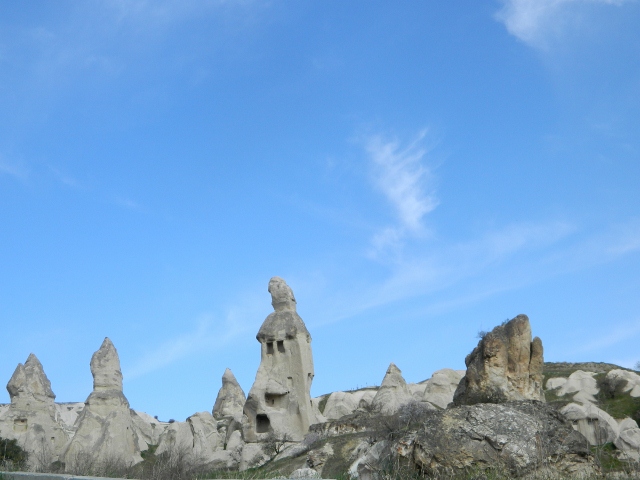
    The fairy chimneys, as it turns out, were the name that the genius, or over-romantic imagination, of someone in Cappadocia’s tourism department assigned to the giant, fanciful (and often very phallic) rock formations that cover the landscape.
    Rather than go through the last two weeks I spent in Turkey, Bulgaria, Serbia and Bosnia, I would like to tell you a story for a change in pace. Or rather, I would like to retell a traditional Bulgarian folktale that I read while visiting my friend’s family in Plovdiv. In recent months I have been rediscovering my love of stories, and having some fun with the art of storytelling whenever it occurs to me. I hope you enjoy this one; it is called “Glavcho.”
    ~
    Once upon a time,a third son was born to a peasant family.  He had an ugly, misshapen body and a large, ugly head, so everyone called him Glavcho (big head, in Bulgarian).  His older brothers teased him mercilessly, and the other village children always picked on him, but rather than fight back, as Glavcho grew bigger and stronger he stuck more and more to himself. He gave to his animals all the tenderness and care that was not shown to him.  Sitting in the pasture, watching the smoke cult into the sky above the slate roofs of his village, Glavcho would sing to his horses and speak to them of his hopes and dreams.
    Now, some animal had been breaking into Glavcho’s family’s fields at night and eating their crops, so his father instructed his sons to keep watch and find out who was causing the trouble.  The first night, the eldest son set himself up at the edge of the field with a lantern and a length of rope, certain he would catch the animal and win his father’s approval.  Dawn, however, found him fast asleep; when his family awoke, he said, “I kept watch all night long, but I saw nothing!”
    The second night, the middle son kept watch.  He too awoke to the rising sun and insisted he had seen nothing.  And so the third night Glavcho had his turn.  He took the lantern and the rope and sat watch.  Though his eyelids drooped and his head grew heavy, he did not fall asleep.  Around midnight, a beautiful white stallion appeared at the edge of the field, glowing in the moonlight, and began to munch on the carrots.  Silently, Glavcho tied his rope into a loop, crept up behind the horse, and slipped the noose over its head!
    “Please,” said the horse, “let me go and I promise I will never eat your family’s crops again!”
    Glavcho looked at him dubiously. “I’m supposed to catch you and bring you to my father…”
    “Glavcho, you are all the horses’ favorite. They all say how kind and gentle you are. You must help me and let me go!”
    “Really? I didn’t know they talked about me.” Glavcho glowed at the rare compliment, and after a moment’s thought, released the white horse.
    “Because you have done me this favor, I will always help you in times of need,” said the horse, lowering his head in thanks.  “All you must do is go into the forest, clap three times and call, ‘horse, come to my aid!’ and I will be there.”  And with that, he disappeared into the night.
    In the morning, Glavcho told his father and brothers about the extraordinary thing that had happened to him, but they laughted at him and scolded him for falling asleep and dreaming instead of keeping watch.  Elated by his discovery, Glavcho did not care, and he went off to take a nap.
    Later that day, a royal herald arrived in the village to announce a competition.  There would be three days of horse races, and the victor would win the princess’ hand in marriage.  The King invited every able man in the kingdom to compete.  Glavcho’s brothers heard the proclamation and they were talking about the upcoming festivities excitedly when Glavcho awoke.
    “Brothers, may I come too?” He asked bashfully.
    “You?” The said, incredulous. “Why, you would only scare the young princess and embarrass us.  Why don’t you stay with your horses.”
    Desperately wanting to see the races (to compete was beyond the scope of his imagination), Glavcho wandered into the forest after supper.  The tall trees cast a murky gloom around him in the gathering night.  He clapped his hands three times and called, “horse, come to my aid!” and like that the beautiful white horse came trotting into the clearing, glowing as always.
    The horse knew already what was Glavcho’s problem.  He said, “Return to this spot tomorrow after your father and brother have left for the races. Bring your sack for collecting mushrooms. I will meet you.”
    And so, the next morning Glavcho took his sack and returned to the clearing.  The white horse was waiting. “Look in the sack,” he said.  Glavcho reached into the sack and brought out the most beautiful set of clothing he had ever seen.  The fabric was softer than silk, and trimmed with gold.  When he put it on, Glavcho became a tall, handsome young man, broad shouldered and strong.  He leapt upon the white horse and they galloped to the castle.
    All heads turned to watch as they entered the field.  Both horse and rider shone brilliantly, and no one could look away.  “Come now,” said Glavcho, “let any man who wishes to compete against me come and race!” No other riders stepped forward.  The white horse galloped around the track with unparalleled speed, and did not stop running until he had reached the clearing in the forest.
    Glavcho took off his beautiful clothes, filled the sack with mushrooms, and returned home.  His father and brothers followed shortly.  Throughout dinner, they talked of nothing but the mysterious rider at the races.
    The next morning, Glavcho again set out for the forest with his sack to meet the horse.  Again everyone turned to watch them with wonder when they arrived at the castle.  Again they raced around the track, unrivaled.  Again, Glavcho’s father and brothers spoke of nothing else at dinner, their voices thick with awe.
    The third day of the races, when Glavcho called out “let any man who wishes to compete against me come and race!” several of the strongest young men in the kingdom stepped forward.  The white horse sped forward, leaving the other riders far, far behind.  Glavcho stood went before the princess and bowed deeply.  Taking the ring that she offered to him, the winner, he said, “tomorrow I shall return for the wedding!” And with that he leapt back onto the white horse and they ran home.
    When Glavcho’s father and brothers returned, talking of the upcoming wedding, Glavcho asked humbly, “do you think we will be invited?”
    His brothers laughed. “Why would the King invite the likes of us?”
    Glavcho took from his pocket the ring that the Princess had given him.  Recognizing it at once, his family exclaimed joyfully and the entire village rejoiced at his good fortune.  And Glavcho, we assume, lived happily ever after.
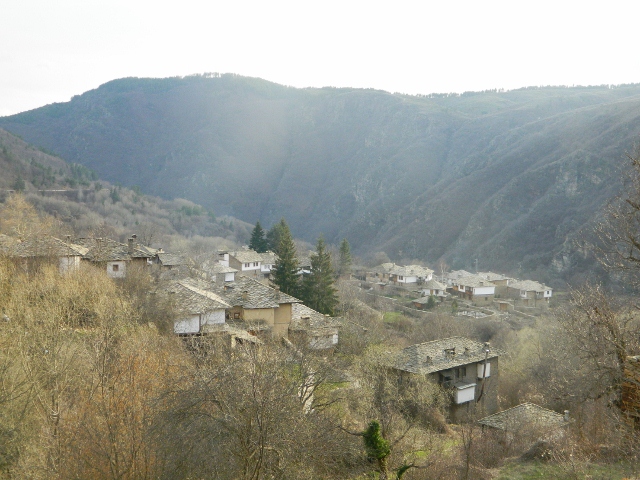
    A traditional Bulgarian village.
    ~
    Fables are nice, with their ready morals at the end (don’t steal, don’t lie, etc., etc.), but I really love these folk stories, with their more oblique messages and meanings.  What are we meant to take from this story? That less attractive men should dress nicely to get the girl? That our families will love us more if we make money? That we should be nice to horses?  The lesson here is actually a bit questionable when we consider that Glavcho only succeeds in life by changing his appearance.  
    For me, though, it doesn’t matter.  However we might interpret them, folktales are stories first and foremost, meant to entertain, and it is for this underlying simplicity of purpose that I love them.
    ~
    Location update: After flying through Bulgaria, Serbia, Bosnia and Montenegro, I am off to Croatia tomorrow—the Balkan adventure continues!
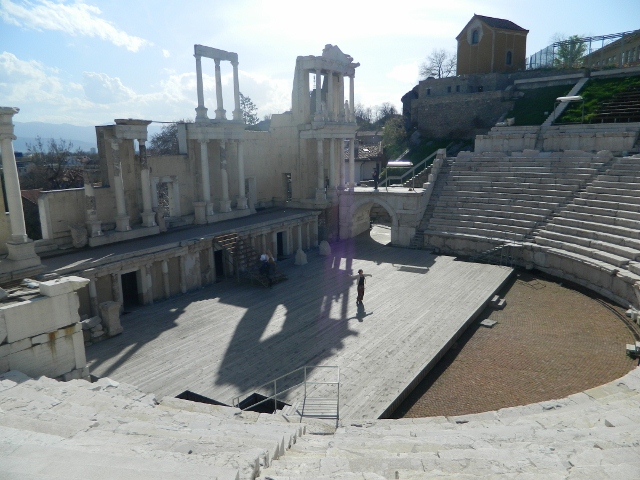
    Roman ruins in Plovdiv, Bulgaria.
  • Toby and Alyssa Take on Istanbul

    For the last six days I had the great pleasure of traveling with the beautiful, brilliant, best of friends, Alyssa Raven Thomas.  What a welcome change from the repetitive (though largely enjoyable) pattern of spending my time with people who don’t know me.

    Just the highlights, then. We met up Sunday at our hotel in Sultanahmet, one of several historic districts of Istanbul. Reunion joy. Our hotel room was called the Grand Bazaar. The next day we visited the real Grand Bazaar, an enclosed warren of alleys and shops that housed a frenzy of action, color, light and exchange.  There, Alyssa purchased  enough evil eye bracelets to protect a Sultan’s entire army.  We spent the afternoon at Hamam Cagaloglu, Istanbul’s oldest and grandest Turkish bath, sweating and scrubbing out at least a week’s worth of grime (on my part, anyways). We scooped water from marble basins and lounged on heated marble slabs as gray light and a few drops of rain filtered through small holes in the domed marble ceiling.  The Blue Mosque, Haiga Sofia (pronounced and spelled Ayasofia, it would seem), and Topkapi Palace of course had their places of honor, and despite the aggressive masses of anxious cattle pushing to the feeding troughs (over-zealous tourists), these sites were spectacular.  Huge Turkish breakfasts, nearly unlimited cups of free tea (thank you, Turkish hospitality!), and squares of flaky baklava dripping with honey formed the delicious brackets between which our sightseeing took place.  We cruised the Bosphorous, took a ferry from Europe to Asia and back, criss-crossed nearly every inch of the city by foot, and braved wind rain and cold to take on Istanbul.  I’d say we emerged victorious.

    ~
    The Blue Mosque (Sultanahmet Cami) as seen from the Bosphorous.

    Stunning Byzantine mural inside the Ayasofia.

    Alyssa and I enjoy one of the best views of the Ayasofia from a rooftop bar in Sultanahmet.
    ~

    Alyssa is now heading home and I am about to set out for Cappadocia, land of the fairy chimneys. I will find out what that means and report back.

  • Paradise in Pictures

    A typical day on Koh Rong:

    Wake up to this.
    Run through the jungle…
    To this, the “other side” of the island, also known as Long Beach.
    Run back to this and paint these:


    Spend the night bar-tending or enjoying an open no-mic night.

    And a few shots from Angkor Wat…

  • Escape to Paradise


    The universe provides. Yes, she really does, and I will explain the recent series of events that have bolstered my belief in that statement.  Three days ago I woke up at the Golden Fisth Guesthouse in Siem Reap, the developing Cambodian town twelve kilometers from Angkor Wat.  The temple ruins were as spectacular as I had hoped, with the murmurs of history humming beneath every stone, and I had spent two days biking back and forth to visit them.  I had also spent an enjoyable couple of evenings at the Angkor What? Bar with some new friends. In short, now I was ready to leave.
    I packed my bag (a process that has shortened from thirty minutes to ten), checked out, and spent a while deciding where I wanted to go next.  The boat to Battambang, a pretty colonial town a few hours downriver and one of my potential stops, had already left. Not wanting to waste a day, I bought a ticket to Sihanoukville instead and spent a decently comfortable night’s sleep on the ten hour bus to the coast.  In the interim, I began to hear rumors that Sihanoukville—praised for its pristine beaches and calm atmosphere—had been ruined by an excess of parties, neon paint, construction, loud music and loud tourists… exactly what I was not looking for.
    I arrived at 7am and set out on foot for town, as per usual, stubbornly ignoring the tuk tuk drivers’ warnings that it was eight kilometers away. Eight means four, generally, which is manageable.  I must have taken a wrong turn somewhere along the way, because after well over an hour I arrived not at the beach, but at the port.  It is a large, dirty collection of warehouses, smog, street food I don’t want any part in, construction, and minimal signage.  Frustrated and unwilling to retrace my steps, I formed a plan B.  Maybe I shouldn’t be stopping in Sihanoukville at all, I thought.  Maybe this means I should be continuing straight to the islands, said to be some of Southeast Asia’s finest.
    I found my way to the passenger ferry area where a few tourists from the Czech Republic were waiting.
                “Where are you guys going?” I asked.
                “Koh Rong.”
                “Is it a nice place?
                “We hope so!” They laughed.
                “Alright, works for me!”  Tickets were twenty dollars and the boat left four hours later.  I bought my ticket, found breakfast (hunted down breakfast, really), and played cards and chatted until 2pm—departure time.  In the interim, I flipped through my friends’ Lonely Planet and realized the island was a bit beyond my budget.  Oops! Perfect timing for Dave to step on the scene. The dreadlocked Aussie appeared around 1pm wearing angry birds shorts and carrying bags of supplies to the docks.  I guessed that he must work on the island.  He owns two guesthouses, in fact, one about to open, and that is how by the end of the two hour boat ride I had work decorating the soon-to-be Vagabonds Bar in exchange for room and board.  And that is how, less than twenty-four hours after leaving Siem Reap I found myself behind the bar of Island Boys Guesthouse mixing drinks and drinking in my fully affordable  new island life.
    So if you don’t hear from me over the next week, it is because I am temporarily lost in paradise with a lot to get done.  You can call it luck, fate or providence, but I am exactly where I was meant to end up, and I credit the universe.
  • Everything is Possible; Nothing is Free


    The hub of my front tire was bent at a worrisome angle. The brakes screeched so loudly they forgot to perform their intended function.  The bell did not ring and my feet did not reach the ground, but paying 10,000 kp, or $1.25 per day, I couldn’t complain about my rented bicycle.  It carried from the northwestern tip of Don Dep four kilometers along a wide dusty path to the southern side of the island, across a bridge to Don Khone, around, and back—about 25 kilometers in total—and never once muttered about the heat of the midday sun, which is more than I could say.  Don Det and Don Khone are two of the largest of the four thousand[i]islands that break up the Mekong River at the south of Laos.  I stayed on Don Det for four nights instead of my expected two, lolled into oblivion by the heady lotuses of palm trees, green water, good company and late-night bonfires.
    Both Don Det and Don Khone are incredibly flat, and my bicycle and I managed to navigate them easily enough. I stopped to see the Phapheng Falls—the massive series of cascades and rapids that thwarted 19thcentury French efforts to chart a water route from Vietnam to China.  I still haven’t seen the Phapheng Falls because when asked to pay a 25,000 kip entrance fee (approximately $3 and by all accords an inconsequential sum) I had a minor breakdown and went on my way instead.  Let me explain… I am more than happy to give my money to fledgling tourism industries, support the countries I am visiting within my means, and in normal circumstances I would never forgo a stunning natural sight over three measly dollars.  However, at that particular moment, something inside me snapped, perhaps triggered by the cold and offhanded attitude of the ticket taker: I wanted my humanity back! I was tired of being a wallet on legs, and I could not bear, at that moment, to pay for one more thing.
    A few hours later, repenting somewhat and feeling rather silly, I thought about doubling back, but the distance left to travel and the thought of the ticket taker’s face deterred me and I continued on without another thought for the waterfall.  I am not the only foreigner to lose patience with the aggressive profiteering in Southeast Asia, and I think I conducted myself relatively well.  In my two weeks in Laos, I witnessed shameful shouting matches between backpackers and tuk tuk drivers over a couple of dollars’ misunderstanding; I watched haggling turn ugly over the last quarter, and I saw smiles turn to anger in countless market interactions.
    In most of Asia, where haggling is accepted and even expected, the problem lies not in the bargaining itself, but in its tenor.  Backpackers especially complain that the locals try to cheat them and see in them only potential profit; locals complain that backpackers, who measure their poverty by a different scale, are stingy, want everything “cheap cheap” and ask rudely.  Both sides give reasonable cause for the other’s accusations.
    Everyone wants to be treated like a person. No one wants to feel like a tray of samosas or a wallet on legs, or a scheming villain.  In my opinion, for tourism to truly succeed someplace, a country’s motivation for drawing visitors cannot be solely monetary.  Obviously tourism is an industry and its purpose is to generate income, but when the desire exists to share one’s culture with outsiders, welcome them into it and benefit from their presence not only in a financial sense, transaction takes the leap to interaction.  In this best case scenario, we break the too-common boom-bust cycle of the tourism industry and see the birth of a new sustainable development model, with tourists returning regularly to places that are welcoming— neither “untouched” nor “ruined,” but real, warm, and human.


    [i]An approximate measure which I suspect was chosen for its poetic appeal in collusion with the ministry of tourism.
    ~
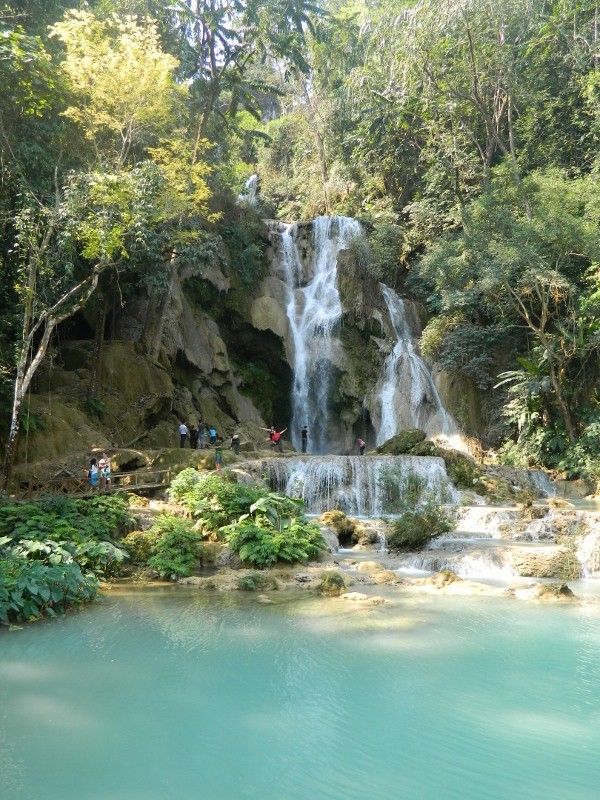
    Another beautiful waterfall in Laos, which I did pay to see. 🙂