Introducing (maybe): a new platform for all the podcast lovers in here!
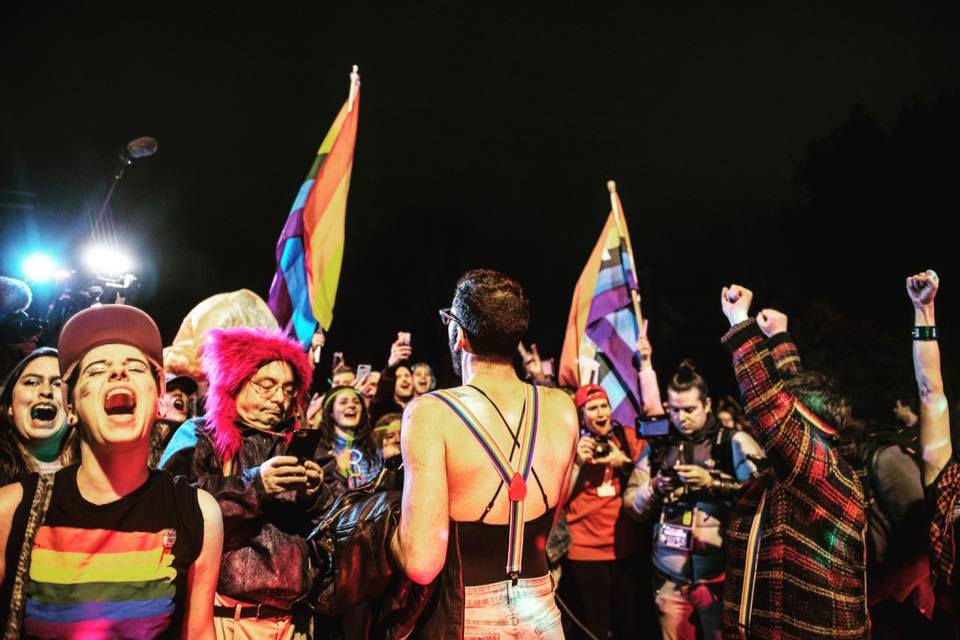
Last week I had the honor of speaking with WERK for Peace founding organizer (and my good friend) Firas Nasr about peaceful protesting.
Since the movement started, I’ve been inspired by how WERK for Peace harnesses the power of dance to shift narratives, send a rainbow-hued message and empower the LGBTQ community in Washington DC and beyond. While the interview was ostensibly part of a University for Peace project on nonviolent resistance, Firas’ message is simply too good to share with only a few people.
“With the Mike Pence event, lots of people assume that our primary goal was to send Mike Pence a message. And lots of people ask me, you know, do you think Mike Pence heard you? Do you think you were effective? But for me, the goals are really centering the queer and trans community, and allowing us to celebrate our bodies, to celebrate our community, and to come together for a shared cause. And that’s I think why our events are so effective. I measure efficacy on whether or not the queer/trans community had fun, was safe, showed up… our protests are really about centering our bodies and our voices, our experiences, the marginalized individuals within our community, uplifting those voices and creating community through our events.” — Firas Nasr
WERK for Peace is a queer-based grassroots organization that uses dance to promote peace. It was founded in response to the Orlando Pulse Nightclub shooting in early 2016. Listen here:
“There’s a very clear underpinning as to why we use dance. Our bodies are ascribed political and social narratives, and so by moving our bodies we are actively shifting those political and social narratives. We’re redefining them, we’re reclaiming them, and we’re reclaiming our bodies in the process too. That is to me such a powerful means of both personal and social change happening at the same time. That encapsulates why dance is so powerful as a means for social change.” — Firas Nasr
Will podcasts become a regular menu item here? I’m not sure yet, but with this WERK for Peace spotlight I think I’m off to a good start! Watch my new Soundcloud page to see what’s next.
Everything you wanted to know about my new work with NuMundo and studies in Media and Peacebuilding… and then some.
What will the internet age look like?
Will it result in a “pax technologica” independent of hegemonic power and military force? Or will it only deepen existing divides between different nationalities, ethnicities, and cultural groups, perpetuating conflicts and impeding understanding?
It is an exciting time to be thinking about these questions.
The choices we make now—as users, thought-leaders, entrepreneurs, policy-makers, and consumers—could well direct the course of our technological future.
That is why I am passionate about the vision of NuMundo, a tech-forward company leading the way in “land-based online networks,” regenerative economies, and decentralized global tribalization. If those sound like a lot of strange terms, they are. But emerging organizations and businesses like NuMundo have the power to create and define the terms that will drive the future of technology and the social structures surrounding it.
NuMundo is a global, online network of “impact centers” with a focus on eco-restoration, education, empowerment, community living, and sustainable travel. It serves to link interested travelers, vacationers, and full-time escapees from The System with ecological, educational, and physical locations for stays, workshops, work-trades, and retreats.
I will argue that NuMundo (and other online-offline communities like it) solves the paradox of the “global tribe”—or at least has the potential to do so.
Rather than sacrificing individual and group identities for the dubious ideal of peace driven by homogeneity, it celebrates pluralism and cultivates close-knit, on-the-ground “tribal” communities. Rather than foregoing a global outlook in favor of insular “villages,” it encourages an inclusive and open-minded perspective through online resources, dialogue, and exchange across all borders.
NuMundo answers what I will call a “noble impulse” for connection, meaning, and peace; in so doing, it offers an alternative vision of “full spectrum media” that is earth-centered and regenerative, rather than transhumanist and exploitative. Defining media in as broad a manner as possible, I place this organization at the forefront of a promising trend toward “glocalization” bolstered (rather than hindered) by communications technologies.
“Minimalism: Just another thing rich people can buy?”
Packing light. Helsinki, 2015.
Using media to promote anti-consumerism and counterculture lifestyles may seem incongruous, but networks like NuMundo are attempting to do just that. Leading propagandist Edward Bernays wrote, “This general principle, that men are very largely actuated by motives which they conceal from themselves, is as true of mass as of individual psychology.” While he and Freud believed these “repressed impulses” to be wholly negative—aggression, sexual deviance, violence—one could make a case for the existence of neutral or even noble human impulses, equally repressed, and equally driving consumer choices.
What of wildness? Intuition? Connection (to nature, self, and fellow humans)?
These impulses, too, are present in modern humans, and repressed as much as, if not more than violence by mainstream culture and conditioning. Some of the emerging media technologies of today could indeed satisfy our hidden impulses—just not in the way Freud or Bernays might have imagined.
Looking at a pattern of consumption, or more broadly a cultural habit, “The modern propagandist therefore sets to work to create circumstances which will modify that custom” to suit his ends (Bernays 55). That is, the processes of propaganda (and marketing) run deep beneath the surface. The elusive goal of altering cultural desires and values through media can create docile consumers, obedient citizens… or something else.
Taking propaganda as a neutral term, this could also describe the process of guiding a reluctant public to first recognize their disconnectedness from community and nature and then seek to reclaim such a connection.
Of course, at times the “selling of peace” is itself part of a broader trend of commodifying meaning that, for example, appropriates ancient practices and strips them of context. The Westernization of yoga, Madonna-ization of Kabbalah, and corporate “greenwashing” should well serve as cautionary tales. Nonetheless, if mainstream marketing can tap into consumers’ darkest repressed desires, then alternative models can play to their noblest ones. Success in this endeavor would undoubtedly have a net positive effect on global peacebuilding efforts.
We Have the Medium. Still Waiting on the Message.
We could next consider what role these alternative media might play in building a new kind of peace.
The equation of Internet + Access = Peace is, most would agree, vastly oversimplified. It’s not only access to technology, but also how that technology is used that impacts social evolution. While that statement may seem self-evident, many appear tempted to label this new technological force as “good” or “evil.”
However, “It was not the machine, but what one did with the machine, that was its meaning or message” (McLuhan 7).
Communications technologies are the medium; how we use them will determine what meaning they ultimately have for human development.
Networks such as NuMundo seek to utilize new technologies in a focused and intentional manner, promoting ecological lifestyles, cross-cultural understanding and appreciation, and community-oriented systems. They do so by facilitating access to workshops on permaculture, natural building, indigenous wisdom, and traditional healing modalities. Furthermore, they enable “regular people” to discover “transformational experiences”—in the form of vacations, retreats, gatherings, or work trades—capable of permanently altering their worldview.
When we use “the machine” to promote sustainable travel, community empowerment, and ecological lifestyle, then the machine is…green.
If communications technologies ultimately serve to create a greener, more grounded, and more connected world, then we are a far cry from both the doomsday predictions and the transhumanist fantasies of many scholars and thinkers. “The “message” of any medium or technology is the change of scale or pace or pattern that it introduces into human affairs” (McLuhan 8). We are currently embedded in the change being wrought by the introduction of the internet and associated technologies. Thus it follows that we cannot know yet what the characteristics of that “change of scale” will be. However, it appears likely that the participation of users will prove a strong determining factor.
Convergence & A Full-Spectrum World
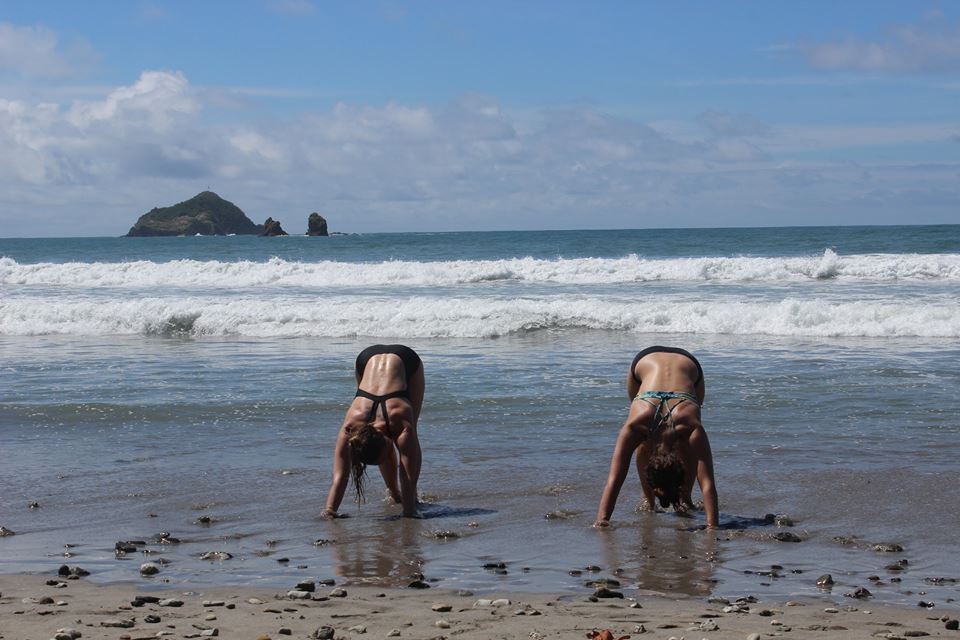
Full-spectrum experience in Manuel Antonio, Costa Rica
Convergence theory describes not only the convergence of media companies, but also consumers’ participation in and influence over media technologies. It is this “grassroots convergence” that applies to an analysis of NuMundo and similar digital communities.
Herein, “consumers are learning to use these different media technologies to bring the flow of media more fully under their control and to interact with other consumers” (Jenkins 18). Active and participatory internet users affect the form and function of media through their involvement.
What will they choose to do with the control of new media in their own hands?
Many are building tribes—some purely virtual, others avatars of more local groups. We will return to the topic of tribalization shortly. Other users, however, are building sophisticated digital networks of communication, growth, and resilience akin to those of the mycelium that run beneath the earth.
To follow the idea of convergence a step further, the concept of a “full spectrum world” takes on yet greater nuance when we extend our definition of “media” to concrete, physical experiences. If media, or communications technologies, are extensions of our own eyes, ears, mouths, hands, then the reverse could also be true.
By such a definition, NuMundo’s unique blend of physical, grounded “impact centers” and the tech-savvy “digital nomads” visiting them are actually part of the media they use. In this instance, “media” does not only refer to the website, blog, search directory, photos, videos, and Facebook, Twitter, and Instagram accounts that constitute NuMundo’s online presence.
It also encompasses the physical locations, the food forests, the dirty hands, the organic farm-to-table meals and the face-to-face interactions that characterize users’ lived experience.
At the risk of following the concept too far, we are the message. And the message is one of peaceful community and regenerative practices.
Networks like NuMundo promote peace at multiple levels. Permaculture principles engender food security, community empowerment, and nature connection. Respect for indigenous wisdom cultivates cultural exchange, learning, and awareness. A culture of travel and “transformational experience” de-commodifies the modern lifestyle and reinstates human interaction at the fore of our value system.
Many people, when picturing the future of technology, may imagine a dystopia (or utopia, depending on who’s imagining) of chips implanted in brains and credit cards embedded in forearms. However, there are alternative models.
NuMundo is one of them.
And this vision centers on the fusion of the global village and the local tribe.
Tribalization: The Good, The Bad, and the Nu
Finca Morpho, one of NuMundo’s impact centers.
The word “tribe” has many connotations—some negative, as in the conflict that often arises from “us versus them” dynamics and identity politics, but others positive.
Alternative communities across the globe are reclaiming the term, taking it to mean something quite different from the conventional usage. NuMundo, for example, often refers to their community as “tribe.”
In recent discourse, the idea of the global village frequently appears in opposition to the local tribe. And looking at the echo chambers of social media, the proliferation of online hate groups, and the fragmentation of the online world, we are likely to wonder which it will be: tribal or global.
The NuMundo model, on the other hand, synthesizes these two dynamics in a manner only possible because of modern technologies. Few species have achieved such a feat; mycelium are one of them. Underground mycelium networks can stretch for thousands of miles, cropping up above the surface at intervals, yet remaining interconnected through adept communication systems. Likewise, NuMundo impact centers and community members span the globe, and their virtual ties are invisible to the naked eye. However, through strong networks of communication, they remain intricately bound to one another.
The NuMundo approach to applying advanced technologies to modern society has its roots in natural processes. We would do well to ground our technology use in such a way more often.
Taken in the NuMundo sense of the term, tribalization is an overwhelmingly positive development. Modern “conscious tribes” represent small, closely knit and interdependent groups of people who support one another and their environment. These groups have strong identities, but ones which incorporate a global perspective and a value system centered on non-violence—between humans, and toward the earth.
However, retribalization can undoubtedly become a damaging and even violent process, whereby we we project our negative qualities onto an outside “other,” thus reinforcing an “in group” identity while demonizing an “out group.” Such trends have certainly arisen in many alternative lifestyle movements. Think militant veganism, minimalism, and sustainability. Dogmatic adherents to any value system will often move beyond their own choices to attack those who do not share them.
The inherent dangers of tribalization are not to be overlooked or brushed off.
What’s Ahead?
Can the global village coexist with the local tribe, then?
NuMundo would say yes.
If there is such a thing as pax technologica, I hope it will follow the NuMundo template: Technology-supported empathy and interconnection will lead to a “decentralized peace”—independent of hegemonic or state powers. Retribalization will occur along non-national, non-ethnic lines; rather, global citizens will group into value-aligned, semi-location-independent communities.
Potential for peace notwithstanding, however, we will do well to take cautionary measures against the divisive implications of a retribalization process. As this shift takes place, we must ensure that it is not divisive, with “eco-warriors” hunkering down in one camp, facing off against the status quo and corporate machine in the other.
Most likely, the dynamics of future digital communities will be far more fluid than either of these scenarios, a bit less black and white.
There is no utopian outcome to the global tribe paradox, whereby technology leads to perfect peace amongst mankind and harmony with nature. Not even an army of mission-driven, eco-focused organizations could achieve that. Still, in turning our focus toward globally linked, locally rooted projects, we could learn a lot about building new models of non-violent living.
If technology is going to define the world that future generations inhabit, let’s hope it’s less “Brave New World” and more “NuMundo.”
References Bernays, Edward (1928). Propaganda. Routledge. Chapter 4: The Psychology of Public Relations. pp. 47-61. Blondel, Ylva Isabelle. (2003). Violent Conflict and Roles of the Media. Uppsala University report commissioned by Sida and UNESCO. pp. 1-37. Jenkins, Henry. (2008). Convergence Culture: Where Old and New Media Collide. New York University Press. Introduction: Worship at the Alter of Convergence: A New Paradigm for Understanding Media Change, pp. 1-24. McLuhan, Marshall. (1964). Understanding Media: The Extensions of Man. Chapter 1: “The Medium is the Message” pp. 7-21 and Chapter 32: “Weapons: War of the Icons” pp. 338-345.
Portugal has made it onto just about every top travel list this year, and with good reason.
I loved the month I spent there in every way, and I want to share some of the goodness with you.
If you’re looking for the definitive guide to the country, this is not it. On the other hand, if you want to know about some of the places, food, and other things I really enjoyed, I’m so happy to share my favorite spots with you.
Enjoy this rough and totally incomplete guide to sunny Portugal. And feel free to ask if I didn’t mention something you want to know about—maybe I forgot!
I give to you…some stuff I liked and things I did in Portugal, in no particular order:
Praia da Areia Branca
Just 70 kilometers (1.5 hours by bus) North of Lisbon, Praia da Areia Branca is (one of) the chillest spot(s) I know to surf, yoga, and write songs in Portugal. Granted, I only went to two areas on the beach, but I’d go back, and that’s saying a lot. A week is perfect; I think less than that would be too short.
Gorgeous garden out back, choice of shared or private rooms, super affordable if you go in low or mid season and opt for the surf-yoga-stay package. Comfortable, clean, and graced by the warmest and most welcoming hosts.
Nicest (and, in my roommate’s opinion, cutest) surf instructors around. Great value for money. Packages available for surf/yoga/stay, or just surf/stay. As it turns out, I don’t like surf lessons, but if you’re looking to learn, this is the deal for you.
Yoga:
Yoga lessons with Carla (organized through Ripar/Lemon Tree) are a necessary complement to hours of surfing in the cold Atlantic. She is a gem of a teacher, and I was lucky to wander into her class for a week.
Eat/Drink:
Foz—
Fresh seafood, sunset views…what else is there to say? Go for one of the grill options. I won’t ruin it for you, but the skewers are served beautifully.
Sol Mar—
Catch the sun from the open terrace and relax to the sound of the waves, or sit inside and enjoy some particularly well-chosen beats. Veggie burger isn’t bad, and I hear their beetroot salad is excellent. Lemon-ginger infusion is perfect for post-surf warm-up.
Bar Central (or maybe it’s Cafe Central…you should probably ask) (Lourinha)—
If you have a car, or a friend with a car, this cafe is worth the 10 minute drive from Praia da Areia Branca for some of the tastiest Pasteis de Nata in the area. Buy a box and bring some back to share.
Dance:
Baracca Bar—
I did not go on working-surfing holiday expecting to stay out dancing until two in the morning, but that’s exactly what I did my last night in Praia da Areia Branca. The DJs on a Saturday night were unexpectedly exceptional.
Porto and I are totally going steady. Portugal’s tiled, hilly, artistic northern city won my heart within twenty-four hours. I even forgive it for being uphill in every possible direction. A three-hour train or bus ride from Lisbon, it’s an easily accessible (and, in my humble opinion, unmissable) stop for any itinerary.
I would highly recommend the Airbnb studio apartment I rented just to the north of the city center. Ideal for solo travelers, couples, or really good friends. Hosts were kind, solicitous, and excellent communicators.
Eat:
Ristorante Sai Cão (Rua do Bonjardim)—
Keep walking up past Trindade metro, cross the main road, and look for a blue awning on your left. Great local spot—according to my hosts people come from all over Porto to eat here—and menus for 4-5 euros.
Raiz—
Menu looks great. Comes highly recommended. I didn’t actually get a chance to eat here.
Foz Fish Restaurants—
Follow the Douro River toward the sea (walking). When the ocean comes into view and Foz is just around the corner, you’ll come to a strip of seafood restaurants on the sidewalk. Pick the busiest one, and enjoy some of the freshest, cheapest fish around.
Francesinha—
The famous Porto sandwich—layers of meat and cheese, and covered with a tomato-based sauce—available at just about any restaurant for 5-8 euros. I recommend sharing with a friend to avoid instant heart attack.
Drink:
Bar Candelabro—
Enjoy a coffee or port wine surrounded by old books. This quickly became my favorite spot to read and write in the whole city. Social hub by night, calm cafe haven by day.
Cafe Majestic—
Gorgeous (almost over the top) explosion of mirrors, brass, candelabras, and overdressed waiters. Have high tea for 20 euros…or sit down, take pictures, look at the menu and walk back out and head for Bar Candelabro instead.
Maus Hábitos—
Art gallery with bar/restaurant space, situated above a parking garage (you have to know to look for it). Funky, creative ambiance, perfect for a drink with friends, and supposedly there’s dancing on the weekends.
Dance:
Rua Cândido dos Reis—
Take your pick from a whole street full of standard bars-with-dance-floors. Nothing exceptional, but they serve their purpose if you’re looking for a party on a weeknight. Bar hop to get the full experience—Britney Spears one minute, Kizomba the next, and old school hip hop after that.
Party Boat—
Not sure how to give instructions for this…Walk along the river in the early evening. Look for a cruise boat blasting music and crowds of young people waiting to get on board. Get lucky, and buy the last two tickets to a sunset cruise dance party. Alternately, river sightseeing cruises are available daily (without the party).
Tiny but ultra-chic selection of footwear, bags, and a few clothing items, owned and stocked by a man from Tokyo with a great eye for functional-yet-beautiful style. Boutique prices.
Pop-Up Store—
Good luck finding it, as it comes and goes, but if you do manage to stumble upon it there’s a whole world of local designers and cooking classes inside!
They think of everything, so you don’t have to. Equipped us with helmets, smartphone charger, maps, plans for the day, goggles. All we had to do was hop on and get lost—and we did this spectacularly well. Set your map directions to “bicycle” to avoid highways and get into some interesting wooded situations.
Matosinhos
Don’t go here unless there are waves. Maybe for an afternoon to eat fish (Matosinhos has the best fish in the world, according to their tourism office).
Surf:
If there are waves, Matosinhos is an easy day trip from Porto. Take the A metro or the 501 bus from Porto center, and hop out half an hour later in the dilapidated, possibly haunted, urban surf spot. Many surf schools on the beach where you can rent equipment.
This one’s a splurge. Save it for a special occasion or for traveling with your mom. 😉 Ideal location if you like things quiet at night, walking distance to Bairro Alto and lots of funky bars and restaurants, but situated in a local, not too touristed part of town.
Another splurge, but a day-long adventure complete with visiting a local food market, learning loads about Portuguese cuisine, and cooking a ridiculously tasty multi-course meal, wine included.
Visit Sintra—
Again, I didn’t actually do this, but my friend did, and suggests taking a train to Sintra, renting scooters there, and then motoring out to the Westernmost point in continental Europe, Cabo da Roca. I’d take her word for it.
Walk—
Everywhere. The famous Tram 28 is crowded, to say the least; if I had to do it again, I’d probably just pull on my walking shoes and take a three hour wander from Bairro Alto to Alfama (wonderful twisty little roads) and back.
Go to Belém—
The port of departure for some of the most famous naval expeditions in history, Bélem is an easy (though hot and crowded) bus ride from the center of Lisbon. Wander over to the fort, but by all accounts don’t bother going inside, eat the Original Pastel de Belem at the cafe of the same name, Pasteis de Belem, and pause to soak in the ornate architecture of the Jerónimos Monastery.
Listen:
Fado—
A Tasca do Chico in Bairro Alto came highly recommended for a Fado music experience. Don’t make the same mistake we did; you need a reservation or you will not get a table in this tiny spot. Go for the music, not the food.
I couldn’t resist visiting the farthest southwest town in Europe, and it far exceeded my expectations. This place is definitely magic. According to my airbnb host, it has something to do with the rocks. Whatever it is, this would have to be my top pick for a chilled out beach holiday. Go out of season; I hear the summer gets hectic.
I loved my stay at this laid-back oasis right at the edge of Sagres. Liz is a wonderful host, the garden is as peaceful as peaceful can be, and you could comfortably fit two people in the double room.
Memmo Baleeira Hotel—
If you’re going for upscale, this four-star hotel has some truly beautiful views of Sagres harbor. That’s all I can tell you about it, since I never actually stepped inside.
Do:
Surf—
Watch out for the rocks at Tonel Beach, especially if you’re like me and wipe out more than you ride waves. But the water is beautiful, not as bitingly cold as farther north, and the dramatic cliffs surrounding the beaches make an unbeatable view once you make it past the break point.
This marks the actual farthest southwest point in all of continental Europe. It’s a slightly-hilly-but-enjoyable 6km pedal from Sagres town; if that’s not your windy cup of tea, I believe the regular local bus goes that way several times a day. Leave time to wander the paths along the cliffs
Wander—
The beaches. The cliffs. The harbor. The one sleepy main road that cuts through town. Time slows down here—let it.
We watch the waves crash against the cliffs beneath our table, the spray catching the sunlight over and over again.
Our tea arrives—the classic combination of Moroccan mint and strong green that everyone drinks, but without the usual pound of sugar, per my request. A simple silver teapot with a long spout. Two small glasses (not mugs, but glasses).
I lift the teapot and pour, starting low, then lifting higher, and higher, and a bit higher, steam rising up from the cascade of tea and a slight froth forming at the top of each glass.
(If I wanted to mix in sugar, I would pour out glasses of tea and dump them back in the pot several times to avoid using a spoon—bad luck, I learned later. But I don’t, so I only pour once.)
I can’t remember where I first learned to pour tea—properly. I think it was in a Senegalese village when I was 16. Everyone laughed at my first attempts, of course. Even today I spill more than any veteran tea pourer ever would. But I know the technique, and I can make a few bubbles.
It’s a small thing, arguably, pouring tea well, and yet drinking tea proves such a fundamental aspect of so many cultures that I think it’s important, too. Worth learning. Worth sharing.
***
Let’s drink tea together tomorrow!
Inshallah.
You should open a cafe there—you would get so much business!
It’s a good idea. Inshallah.
Are you moving this week?Inshallah.
When does the high season start?
Things will get busy next week—inshallah.
Inshallah (also written insha’Allah). If God wills it. God willing. Used throughout the Arabic-speaking and Muslim world—and often. At times my plan-making mind gets irritated by the ceaseless string of Inshallahs spoken and exchanged each day.
Is nothing certain?
Well, no, it’s not—is it? To visitors from outside cultures, I think this nonstop Inshallah business can seem like a cop out. Noncommittal. But I suspect (I don’t know nearly enough to say for certain) that it stems more from a different perspective.
Everything—everything—is out of our hands. Maybe. It’s probably a good brain exercise to consider the possibility, even if you disagree. Living here, then, is like a daily mind workout.
***
Every day I learn here.
I learned that until the 1950s there was a small Jewish settlement alongside the Berber ones in the mountains behind Taghazout. I visited a new friend’s home in those mountains, and I could feel the history in the ground under my feet.
I learned that Friday is couscous day and that soup is a summer food.
I learned that no length of fabric will cover my foreignness here—no matter how Mediterranean I like to think I look.
I’ve learned that if you sit long enough in one spot it is really possible to see every person you know in this town, and that if you start walking you can spend a whole day just stopping in for chats with old and new friends.
I’ve learned how to roll under a wave with my surfboard, and that lip sunburn is real.
I’ve learned to count to ten (though I’ve forgotten at the moment), and how to greet.
There’s no other message today. There are lessons everywhere, every day and in every culture; I hope you’ll go find some!
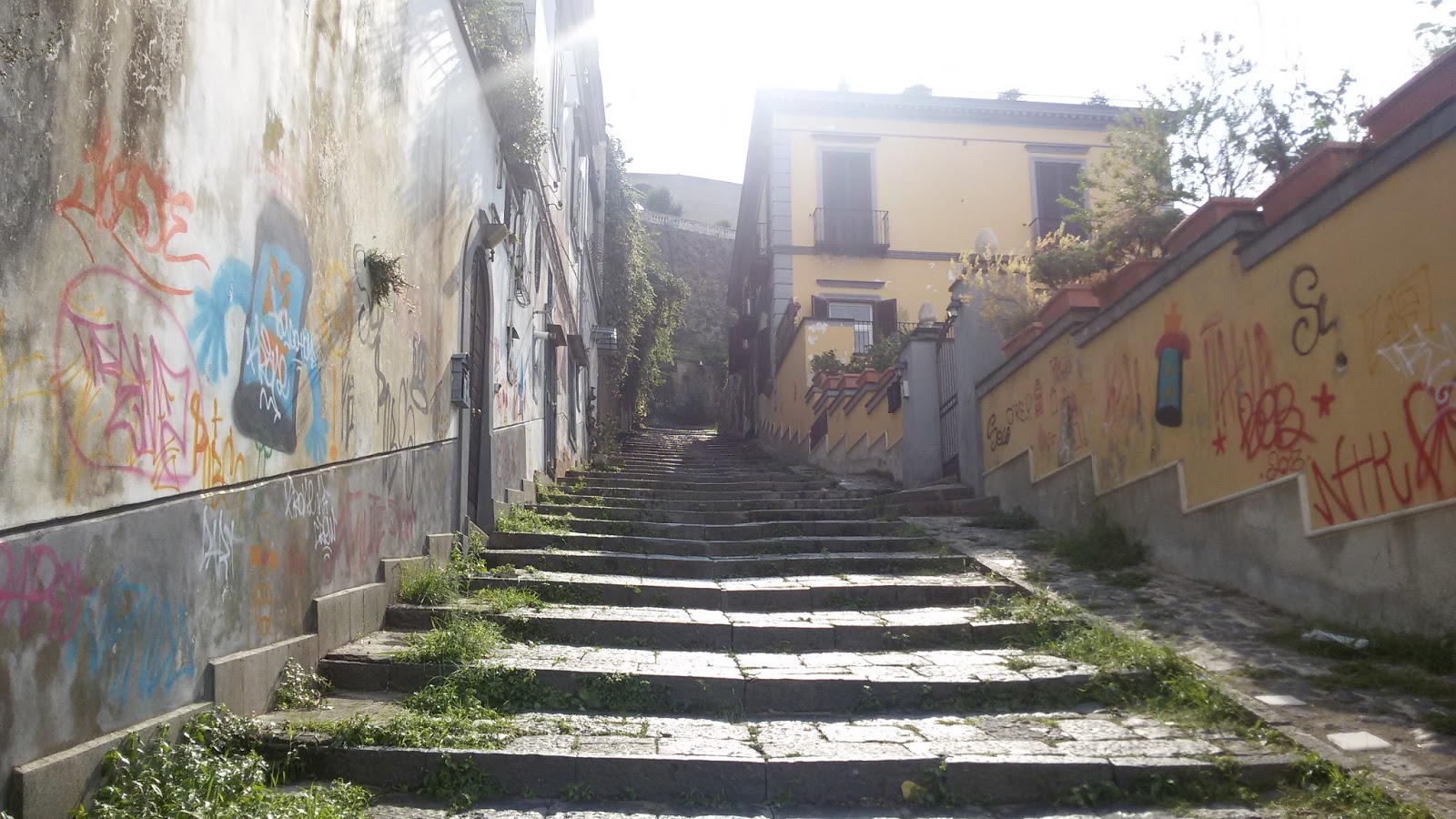
Climbing hundreds of stairs for a good view, as per usual.
Thursday, 1 September, Napoli, Italy
The weather was a bit mercurial, and we took shelter from a sudden downpour in a nearby cafe. As the storm passed and we prepared to continue on our way, my friend (a Napoli native) informed me that we were about to cross an invisible boundary.
The police don’t come to this part of the city. It’s controlled by a powerful family (think mafia). Recently, three young men from a different, neighboring family were shot dead as they walked down the street.
Suffice it to say, this was not a safe neighborhood. At least, unlike most tourists, I was acutely aware of the risk involved as we ambled onward on our quest for the best sfogliatelle in Napoli (and thus, seeing as it’s a Neapolitan specialty, the best sfogliatelle in the world).
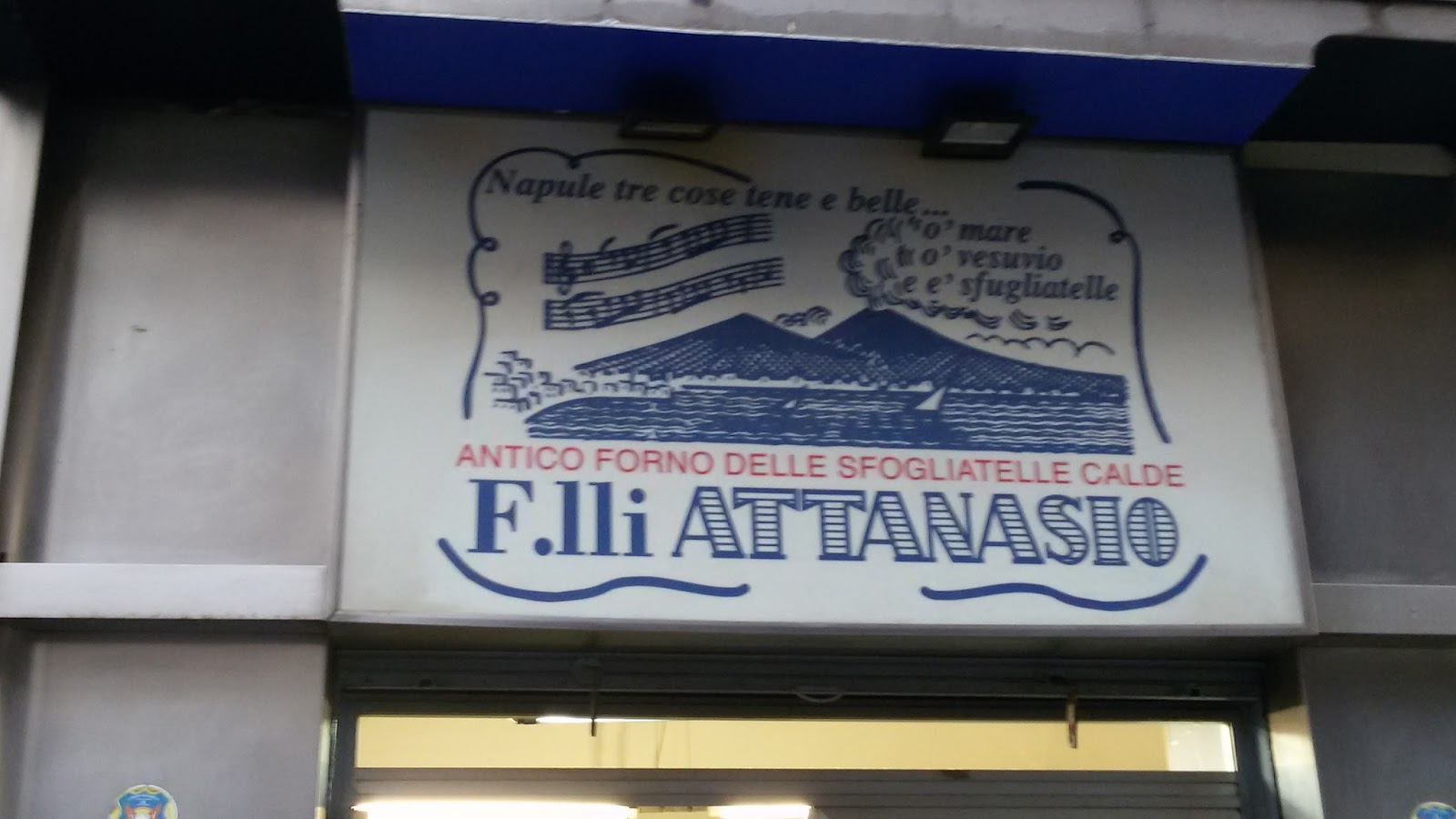
Go fish! Can you find this famous Napolitano bakery? 🙂
Now, if you’re thinking it’s insane to risk your life for a pastry, you’ve never eaten sfogliatella.
Flaky layers of crisp pastry, artfully shaped to resemble a seashell, filled with sweet ricotta cream lightly flavored with local orange, and dusted with powdered sugar—one is already too much, too rich, and yet I bought four just in case.
Napoli has a bit of a reputation as the more dangerous, more sordid Southern cousin of the well-frequented tourist destinations to the North (Rome, Florence, Venice, Milan). And indeed, the crowded warren of twisting streets layered atop a cavernous subterranean void (in turn layered atop the lava fields that fuel Vesuvius) is not the Italy many tourists may imagine.
It may be better.
As we walked from one end of the city to the other on our quixotic pastry mission, my friend, uniquely knowledgeable about Napoli’s architecture, history, language and culture, regaled me with stories—many macabre—that endeared me to this dark gem of a city.
Here are three of them:
Rub a skull for good luck.
The Old Ladies and the Catacomb Skulls
Twenty years ago, the old ladies of Napoli still maintained this tradition, originating in the plague years, or perhaps the war years (regardless, years of extraordinarily high mortality rates). Each would “care for” a particular skull in the catacombs beneath the city, bringing it flowers, offering it prayers, and grieving the death of a stranger who perhaps had no family left to mourn their passing. Sometimes, vicious arguments would break out over a particular skull when more than one woman lay claim to it. Questa è la mia testa! No! È la mia! (This is my head! No! It’s mine!) Talk about macabre.
San Gennaro (Saint Januarius), Patron Saint of Napoli, and the Curious Affair of the Keys to the Church
San Gennaro is not officially a saint, but don’t try telling that to the citizens of Napoli, who are particularly dedicated to their patron. A vial of the saint’s blood purportedly resides in the main church of the city, and twice a year, the miracle of the liquefaction takes place, in which the dried remains turn to liquid once again. Interestingly, the remains of San Gennaro do not belong to the church, but rather to a mysterious ancient sect with a centuries-old history in Napoli. They allow the church to hold the remains in exchange for the keys to the building. If you’re picturing creepy Satanic rituals in the catacombs of the cathedral, yeah, I’m right there with you.
L’Ospedale delle Bambole (Doll Hospital)—a whole different kind of creepy.
The Hospital of the Incurable Ones
In medieval times, when pilgrimage to Jerusalem was a popular undertaking, Napoli occupied an important step along the journey. In plague years, and other times too, pilgrims would frequently fall ill and find themselves unable to complete their pilgrimage. Many of these stopped in Napoli, and the city became their final resting place. The Church built a thriving business around this occurrence, constructing buildings to house the sick and dying—partially out of Christian charity, surely, and partly because dying pilgrims, unable to reach Jerusalem, proved particularly disposed to leave everything to the Church instead. One of these, L’Ospedale deli Incurrabili (Hospital of the Incurables), still operates today, although I believe it is more concerned with saving lives than saving souls.
This dark and fascinating history lays a particular foundation for the vibrant crush of life filling Napoli today. Young people sporting dark 70s-style fashion, 80s-style hair, lots of attitude and even more tattoos loiter outside cafes, nightclubs, pizzerias and bars. Crowds line up outside the best gelateria, stroll along the waterfront and press into the narrow streets of the Old City. The Napoletano language is alive and well, spoken by many if not most locals, changing and adapting as any healthy, living language should. Musicians play tarantela in the streets, and motorcyclists and pedestrians weave past, seemingly unaware of one another, in a seething dance.
There is life here. Tons of it. And maybe that’s the point of all the macabre underpinnings; they tell a story about all the living happening now.
The sound of tambourines fills the air—not just from the stage, where the opening acts are performing, but also from thousands of tambourine-bearing audience members.
Raucous festival-goers pass around three-liter jugs of local red wine. They dance in pairs, sometimes circles, in a style of dance that (to my Jewish eyes) most closely approximates the hora.
It’s an odd blend: mostly Italians, from babies in carriages to elderly observers avoiding the crush in the center of the crowd (here, things more closely resemble a mosh pit), but mostly young people. Most appear to know the songs and sing along; many know the traditional steps, too.
The main concert hasn’t even begun, and it’s already difficult to find a free patch of ground close to the stage. I have come from Rome for five days, pretty much just to witness this unique event. After hearing about the Notte della Taranta and the Pizzica style of dance and music that goes with it, I became fixated on experiencing it for myself.
The History:
In the twenty-first century, La Notte della Taranta (the Night of the Tarantula) is a modern music festival occurring every August throughout the Salento region of Puglia (Apulia) and culminating in a finale event in Melpignano. Its roots, however, stretch much, much farther back. The event centers on the Pizzica, a style of folk music and dance that originated in the Salento region in pre-Christian Italy.
According to tradition, women in this region would become possessed by the spirit of the tarantula after being bitten by a spider during a certain season. They would begin to act out with strange antics and wild dancing. Nights of the Tarantula would break out in various villages as the spirit spread and more and more women succumbed to its grip.
Now, through a modern anthropological lens, this is a clear case of a ritualized upheaval of social order and codes, whereby women living in an oppressive culture could express rage and wildness in a way that would normally be totally unacceptable. Stories of possession by various animal spirits, leading to trance, hysteria or other phenomena, abound across world folk cultures.
La Notte della Taranta Today:
I can’t speak too much to this, having only been to the main concert. Today, at least in Melpignano, the tradition seems to have been somewhat sanitized. 200,000 attendees can do that. The Pizzica has come a long way from the village square, and it looks a lot different with lights and sound production and weeks of rehearsal than (I imagine) it would have even a century ago.
But who cares? I was hypnotized by the twirling white skirts on stage, fascinated by the folk lore surrounding the spirit of the spider, and enchanted by the percussive rhythms rolling on for hours.
Worth the trip? Absolutely.
Some outcomes of this excursion:
I own a tambourine—which i can’t stuff into my backpack and which I will have to figure out how to carry with me everywhere.
I must add another dance style on my to-learn list.
I have a new love for a layer of Italian culture I never even knew existed until a few months ago.
Looking for somewhere to go next August? Maybe check it out—don’t buy a tambourine, though.
Skip to minute 4:00 if ten minutes of Italian folk music isn’t your thing.
Skip to minute 5:00 to see a bit of traditional dancing.
Pilgrimage Museum, Santiago de Compostela, Galicia, Spain
I placed the noise canceling headphones over my ears, and an ancient melody flowed straight to my soul.
It was my foodsteps—hundreds, thousands of them—plucked from a harp. It was the daily rhythm of walking made song.
I stood at that display in the Pilgrimage Museum for a long time, and I listened to some of the recordings of the Resonet Musica Antiga group more than once. Recreated from sheets music in the Cathedral’s archives and reconstructed medieval instruments, the music might have run through my head at a distance.
But somehow it didn’t. Somehow it connected.
I arrived in Santiago on Friday, July 1, 2016. That Friday marked the culmination of a month of walking across Northern Spain (approximately 800 kilometers) begun in the vague interest of “seeking.”
(We can talk about what I “found” once I figure that out—story for another day.)
Pilgrimage is an ancient phenomenon. Historians have found evidence of its occurrence in Mesopotamia, Vedic India and ancient Egypt. Wherever it appears in human history, it follows the same principle: an outward, often arduousjourney serving as an allegory for the spiritual path.
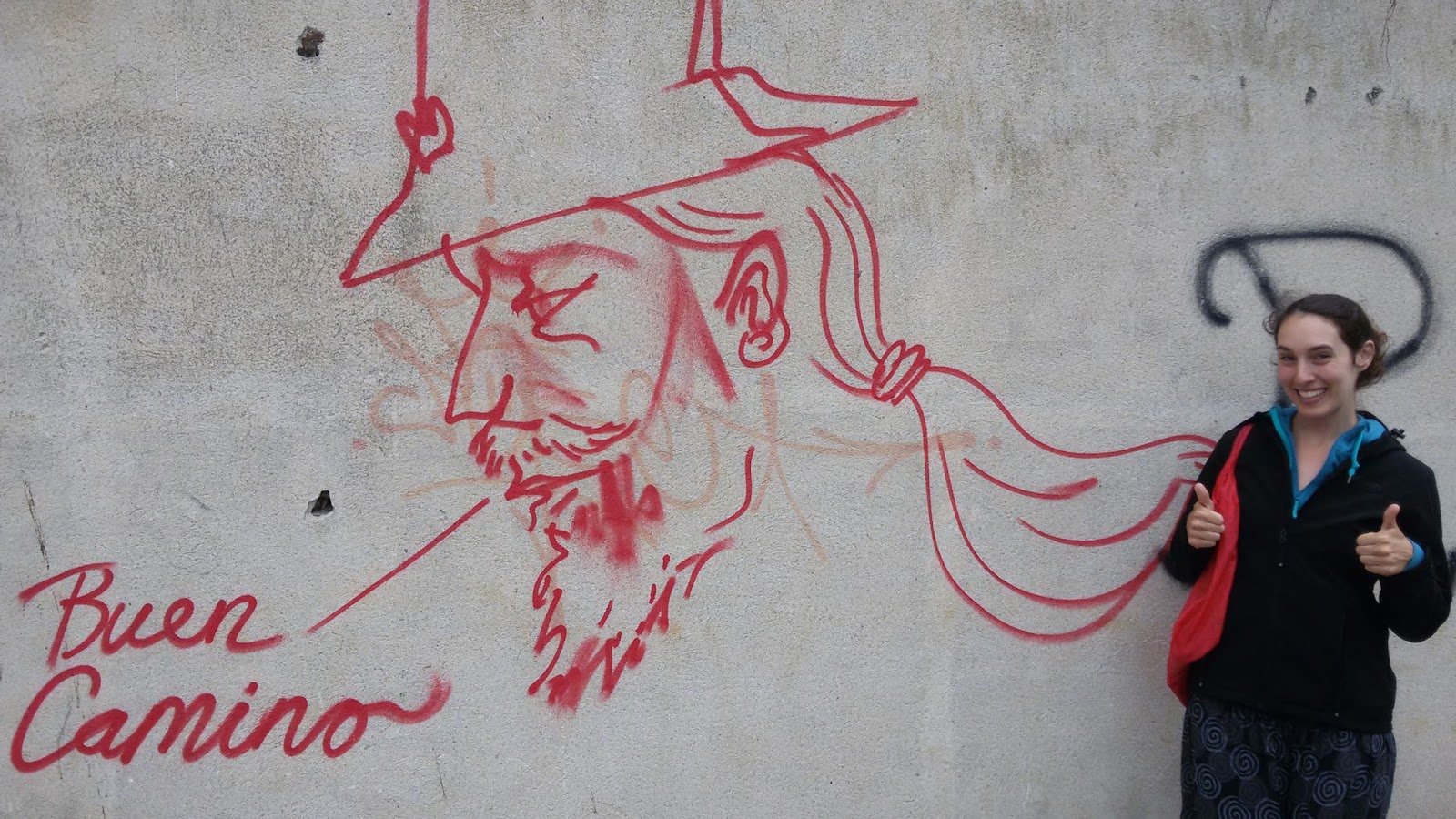
Since the alleged discovery of the remains of Saint James (one of the Twelve Apostles) in the ninth century, Santiago—and its cathedral—has been one of the most important pilgrimage sites in the world. It is said that the Camino de Santiago—the Way to Santiago, and there are many—is a metaphor for the trail marked by the Milky Way across the sky. Again, a physical manifestation of a metaphysical path.
That sounds heady and outmoded, right?
Wrong.
In the last decade, traffic on the Camino Frances (the most popular route) has surged into the thousands. Clearly, the ancient tradition still resonates. And lately, its popularity is growing fast.
Just as ritual will always revive itself and traditions will be reborn, pilgrimage is finding its place in the modern world.
The scallop shell, long worn as an insignia by peregrinos walking to Santiago, now hangs from my backpack, too. Symbol of water, life and healing, it is as timeless, endlessly resonant, as it is timeworn.
These themes are eternal:
WanderingSeekingThe JourneyWalkingLooking to the SkyWalking upon the Earth Questioning
The WarriorThe SeekerThe Scholar [1]
As I listened to those modern recordings of centuries-old music, I heard my experience translated—so precisely—into sound. I walked a path that thousands, perhaps millions, had walked before me, and though the asphalt beneath my feet and electric lights in the distance were new, the the experience had somehow been the same. [2]
That, in short, is why pilgrimage is still deeply relevant today.
***
[1] The Warrior, The Seeker and The Scholar are the three archetypes represented by Saint James.
[2] Sadly I have not been able to find the same recordings anywhere online. This is the closest I could find, but you may have to visit the Pilgrimage Museum in Santiago to hear the music I’ve described:
Sicily, 2013—where I first learned about putting olive oil on everything.
Florence, Tuscany
Gnocchi with fennel, mint and gorgonzola. A generous drizzle of olive oil (the frisky, green, good quality kind) on plain, unsalted bread.
A lake near Rome somewhere
Tiny fried fish, fresh marinated anchovies, mussels, salad with potato and octopus. Gnocchi with clams. Zucchini with mint. A drizzle of olive oil.
Perugia, Umbria
Hands dry from chalk after climbing. Spaghetti with shrimp, zucchini and tomatoes. Olive oil from my host’s grandmother’s home. On the pasta—and on my hands.
It was in Italy that I learned you can truly put olive oil on everything.
This most recent visit was no different.
I mean the good stuff, of course. The fresh, tangy-green and gorgeous kind. The kind with bite and soul that tastes like it came from somebody’s grandmother’s farm (it probably did).
Here is a short list of ways I have seen olive oil used to perfection:
Drizzled (well, poured, really) into tomato sauce after it is cooked and off the heat.
Applied to dry hair, skin and lips—best directly after the shower while skin is damp.
On a plate with sea salt and balsamic vinegar, for dipping (soaking) bread.
Drizzled over pasta, salad, cut vegetables, meat, pizza—everything, I’m serious.
Straight from the jug—just a taste, a drop.
Olive oil is everything. Condiment and cooking base. Start and finish. Salve for the body and soul. I suspect it could heal a broken heart, too, though I haven’t tried yet.
In the North, butter features prominently in many recipes—but in the South, it’s always olive oil.
And that’s really it. I mean, I could keep listing mouthwatering Italian meals. That never gets old for me… but I suspect others might have a shorter attention span.
Olive oil. On everything. My time in Italy, in a nutshell.
Try it. Don’t be moderate. Italian grandmothers never are.
Find the good stuff. Apply liberally. Buon appetito!
Mixed-era apartment buildings. Imposing stone architecture at turns. Cobblestones and pavement following no particular logic. Crush of cars and scooters. Cafes. Hairdressers. Passerby dressed in scales of gray.
So, what makes this different from any other street—any other city?
***
As we made our way along a dry riverbed, through native South African fynbos vegetation, toward a spectacular (but, again, arguably nondescript) stretch of shoreline, my friend put to me a similar question. Not quite verbatim, it was this:
Most mountains are pretty similar. Most cities are pretty similar. There are trees and rocks and wide sky spaces. There are streets and cafes and passerby in scales of gray. So, what makes these mountains different? If we can go hiking at home, why ever go anywhere else? And if we do go, how do we choose?
Why these mountains?
The question was philosophical in nature. My friend is nearly as avid a traveler as I.
I would like to offer three answers to these questions—one of which sounds nice, one of which I believe most strongly, and one of which I feel, irrationally, to be true.
It doesn’t matter which is which.
First, terroir. Terroir is a French term I fell in love with while studying the anthropology of food. Essentially, it claims that taste is deeply rooted in place—territory. The elements unique to a given locale—water, specific bacteria, culture, human traditions, soil, weather, everything—combine to create the particular circumstances in which a given food item is produced. And we can taste it. While terroir is a culinary concept, I believe it can just as easily apply to cities, landscapes and really anything else.
Thus, these mountains are made unique by an intangible yet undeniably meaningful agregate of water, culture, air, bacteria, soil, and human idiosyncrasy.
Why go anywhere? Terroir.
Second, intuition. Some part of our deepest self knows where we need to be. It doesn’t make sense, and it can’t be proven, but those who have experienced will swear that the voice of intuition is real—and that it is always right.
So, how do we know, how do we decide where to go? Instinct.
Or third, the difference isn’t out there at all. It’s us. The mountains are, more or less, all the same. Trees and rocks and wide sky spaces. The cities, too. We, however, change, and we can understand that change by observing its reflection in the places we visit—or rather our experiences of them.
What makes these mountains different from all the rest? We do.
Or, most probably, the answer is some combination of the three.
What makes these mountains different from any others? Nothing, or precious little. Yet, they will be different, because we will change—always.
Why go anywhere else? Terroir.
And if it’s all the same, how do we possibly decide on one mountain, one city, one street over another? Oh yes, intuition.
Maybe this could be any street in any city, but it isn’t. It’s this one—the one I’m in. And it is utterly unique, both for its composition of individuals, elements and other intangibles, and for my experience of it, in this particular moment. No other street in any other moment will ever be this. I don’t know why I’m here—and not in another street, city, mountain—but I trust the voice that called me.
The whirring of the machine as I touch my foot to the pedal brings me back.
To my grandmother’s home and her ancient Singer. To the costume room in the basement of my middle school theater. To my projects on the kitchen table in my childhood home in Brookline, Massachusetts.
I haven’t used a sewing machine in a long time, and the rhythmic pull of needle on fabric is bringing me to a good meditative place.
The air is so dry that drinking water does nothing for my thirst—the liquid seems to evaporate on my tongue—and there’s a super-fine layer of desert dust beneath my bare feet. (Hardly had we swept the floors, cleaning house to usher in Passover, than the relentless winds brought the dust back.)
I’m staying with my brother’s friends and their five beautiful children in the mud house they built for themselves here in Tzukim; we (my brother and I) have been invited for Passover seder. They study and speak openly about Kabbalah, a central tenet of which is the concept of togetherness. And indeed, I feel more than welcomed here on my second stop of my second visit to Israel—I feel involved.
Tonight, I am helping to sew pillowcases to decorate the rounded, light-filled common area of their home. Deep green, vivid red, heavy, rough, intricate, beautiful textiles. I hum tunelessly as I work; it’s a new habit I’ve found myself adopting since the term, “humming tunelessly” caught my eye in a book.
The pillowcases are definitely of the wabi sabi variety—as is everything about the house. Perfectly imperfect. Made by hand with care and natural irregularity. Human. Filled with meaning.
My brother’s friend works beside me, and she smiles when she tells me that each person who has stayed in the house has left a part of themselves in it. The pillowcases will be my part.
***
After my last, particularly heavy post on Israel, I wanted to offer something lighter. A balancing perspective, if you will.
The question came to mind: How would one write about Israel if it were just a place, with no history, no complexities and no enigmas—just sun and desert and sandy beaches and olive groves—a beautiful spot on the map? How would one describe it?
Is such a thing possible? Of course not. Not for anywhere in the world. Total nonsense.
And, what’s more, maybe misguided.
For, like my wabi sabi pillowcases, Israel is not beautiful—cannot be beautiful—in spite of its rough edges (rough edges is putting it mildly), but because of them. The same is true, I believe, for every spot on the map.
***
Somewhere near Modi’in, Israel
A man with one leg and no clothing flashes by, moving faster on crutches than I can usually manage to run.
As we traipse in with our camping gear a little before dusk, a crowd near the entrance shouts, “Welcome home!” as they always do at these gatherings. Participants spread out across the forested space to make camp, collecting in small population centers, or venturing further afield in search of silence and solitude.
The activity centers around the communal cooking area, and a large bonfire where most gather after the shared evening meal for drumming, singing and sometimes dancing. Gauzy dresses, dreadlocks and bare skin are as common here as head scarves and black hats in Jerusalem.
This is Rainbow Israel, and if you aren’t familiar with Rainbow Gatherings and you want to understand what they are (you do), you should go here.
We stay only one night, but I could have happily stayed a week. There’s something special about a community where anything goes, and (usually) nothing bad comes of it.
Tel Aviv, Israel
On my last night in Israel, I sit with an old friend on the steps of the big Synagogue, sipping a beer as we catch up on six or seven years of life.
He describes his experiences with medicines in Peru (yes, others would call them drugs), his work with sound healing and his studies on homeopathy and Kabbalah. I describe my work with elephant journal, a publication focused on mindfulness, my yoga teaching and my nomadic lifestyle. I think the intervening years have brought us both a good deal closer to our life paths.
This last evening, along with other conversations, meetings and interactions like it, balances out my more complicated experiences of Israel, renders me more grounded in my time here. There’s violence and oppression in the Holy Land, but there are hippies too.
So, what do wabi sabi pillowcases, rainbow gatherings and hippies all have in common?
For starters, they’re all positive, forgiving, inclusive and somewhat alternative entities.
And, they all exist in Israel.
It would take many lifetimes to write enough to do justice to a single spot on a map. It would take a million voices, on a thousand days, to tell every facet of every side of every story cradling that spot.
For now, I’ll content myself with having told two facets of one story—my own—and I hope you’ll be wise enough and brave enough not to take my word for it. Make your own stories, wherever you may be called to do so!
A side alley off Buitenkant Street, Gardens, City Center, Cape Town
The first sip is bitter, sour, almost acrid, before my palette adjusts and the taste mellows into a more complex configuration of nutty, earthy, sweet and rich.
This is good coffee.
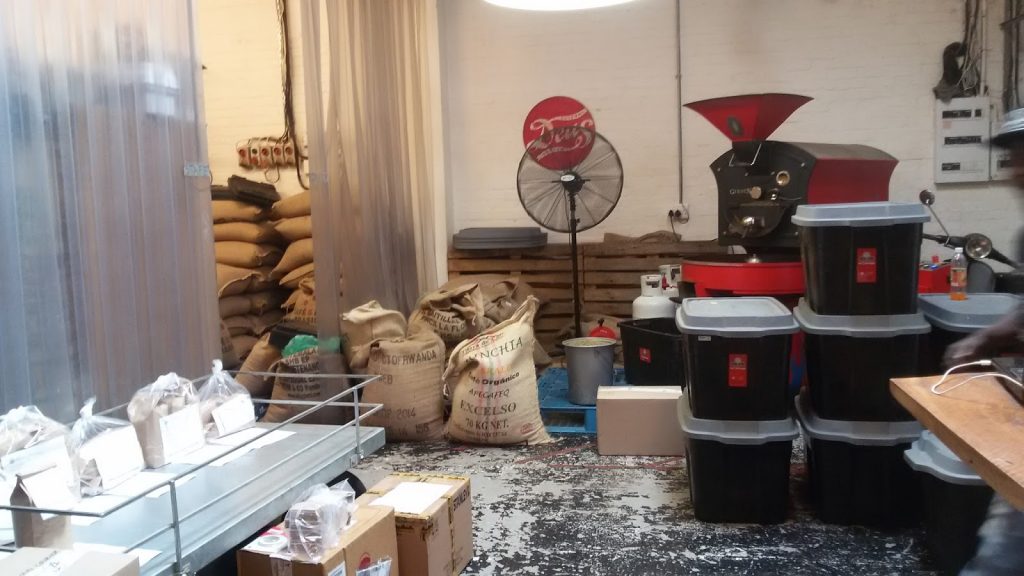
I’m sitting at my favorite Cape Town cafe, Deluxe Coffee (also called YARD, the Dog’s Bollocks and the Bitch’s Tits), where motorcycle parts, vintage bicycles and canvas sacks of wholesale coffee beans make for original decor.
I’ve occupied this stool at the counter for well over an hour now, and nobody cares. Par for the course.
Cape Town has an exceptional coffee culture. (The reason I’ve consumed more coffee in the past three months than probably the last three years prior—well, that, and the fact that a cappuccino costs a bit more than a dollar.)
What is “coffee culture”?
Well, to answer in negatives, the U.S. does not have a coffee culture—or a cafe culture, to be more precise. A coffee culture does not “run” on coffee (like Americans run on Dunkins), but rather stops. Sits. Stays. Connects.
And when you stop to taste your “cup of joe,” quality matters. Deluxe Coffee may be my favorite spot, but easily half a dozen others tie for second. There is a lot of good coffee in this city.
To-go cups are more rare, too, and at least among my friends, “going for coffee” is an hour(s)-long undertaking—not a five-minute quick fix.
Cape Town generally moves more slowly. Less rush, less stress, none of the high-powered, shiny, corporate velocity of New York, London or Hong Kong. None of the humorless, chain-brand cafes, either.
Starbucks hasn’t made it to Cape Town, yet, but I hear it’s coming. When it gets here, I hope Cape Townians will put it out of business.
In a cafe culture, independent roasters, brewers and purveyors of coffee thrive. Character and personality matter—or maybe that’s just me.
And I think there’s a common denominator between coffee cultures and Slow Food. Shared values. An appreciation of quality, and a willingness to wait for it.
Many of the cafes where I go to do work have some of the worst service I have seen anywhere in the world. Friendly, but extraordinarily slow.
But, good food. Good coffee.
See the connection? I do.
I am more than a little bit enamored of the Slow Food movement—and of Cape Town’s coffee culture.
I like the pace, the time for detail, the space for real connection. This is what a cafe should be, in my opinion.
This is how coffee should taste. This is how life should move.
Are these snapshots I share so often an exercise in lassitude or creativity?
I’ll admit I write them when I can’t think of a full article I want to lay out. At the same time, I think they might capture more of life in fewer words than any other format. I hope they serve to inspire your imaginations and whet your appetite to form your own snapshot memories of these places.
Cape Town Snapshots:
***
Two long-legged, long-necked birds cross the road near the Civic Center. One, then the other. Each looks both ways, takes a few steps, stops, looks, and steps again. Traffic flows around them. Their mother must have taught them about looking both ways.
***
The wet sand along Long Beach, Kommetjie reflects the mountains in the early morning light. My friend’s golden retriever, a streak of ocher against shads of blue, plays in the surf.
***
Saucer-eyed children materialize around the outdoor table off Long Street where my friend and I have just begun to eat our vegan lasagna and salad. Plant, the restaurant is called. The danger of sitting outside to eat in Cape Town: the reality of the city is on the same side of the window as you.
***
The white-haired sales clerk at the Simon’s Town boutique is more interested in conversation than sales. “Nobody really needs any of this,” she confesses, “but sometimes you just have to buy something nice for yourself!” She laughs. When she hears my friend speaking in Afrikaans on the phone she says excitedly in her high, soft voice, “You have an Afrikaans friend! She’ll be your friend for life.” We all smile.
***
Heaps of fresh fruit in every supermarket. Most (or all) of it grown here. Mangos, avocados and pomegranates, oranges, peaches and nectarines, papaya, apples, plums and grapes. I am spoiled for choice, wish I could buy some of everything, but know I couldn’t possibly eat it all fast enough. Choose just one or two each time I buy my groceries.
***
We teach the students, all in their last years of high school, how to copy and paste, type in urls on a browser and do basic formatting in Word. I am helping my friend with the class he volunteer teaches on Monday afternoons in Masiphumelele, a township near Kommetjie. I never thought I had any computer skills to speak of—I realize I was wrong.
***
The train to the coastal area south of Cape Town emits a banshee screech each time it heaves to a stop. Pick a compartment with lots of people, and don’t carry valuables, I was advised. The train is full of everyday commuters and seems mundane and secure, but I’ve heard the stories and I know looks can be deceiving.
***
A cross between a motorcycle bar and a hipster cafe (my friend’s words, not mine) of my favorite cafes in Cape Town serves the best coffee and a morning’s worth of decorations to occupy the unhurried observer. No mirrors. In the bathroom, only a bare, framed cement square with black painted letters spelling, “You Are Fucking Amazing.”
***
Thick fog rolls down over Table Mountain as the sun drops and the air chills. The “tablecloth,” this misty white blanket is called. It covers and reveals, slowly, silently. The city hides and reveals, slowly, silently. Every day a new facet. Every day a new mystery.
View of False Bay from the southbound train.
[Penguins and beaches—lots of pictures on the way, just as soon as I get them onto my computer!]
Just a short one for today, as I want to spend the remainder of my day off out there in the sunshine!
South African English has proven to be full of delightful expressions that are just too good not to pick up. If you hear me using these in everyday speech, now you’ll know what the heck I’m talking about. Spend enough time here, and I bet you’ll find yourself using these words too!
Without further ado…
My 9 Favorite South African Words & Phrases (so far):
1. Lekker
(Nice, great, good. Can be used to describe just about anything. From the Dutch word.)
2. Robots
(Traffic Lights. I have no clue why they’re called robots.)
3. Isit?
(Is that so? Really? Oh yeah? Response to just about anything. Hard not to use once you start.)
4. Braai
(Barbecue, both the verb and the noun. But somehow way more fun to talk about.)
5. Boet (5b. Bru)
(A bro, “bru” then being the term boets would use to address one another… as I understand it.)
6. Yoh!
(An exclamation of surprise, like “wow!” Pronounced with an aspiration on the “Y.”)
7. Aswell
(Me too. Emphasis on the “as.”)
8. Now now
(Expresses immediate action—kind of. This should be #1, as it’s my new favorite expression.)*
9. Shebeen
(An illegal shop/drinking establishment. I haven’t been yet, but I can’t wait to go so I can use this word more frequently.)**
Well, there you have it. Come visit me in Cape Town—and you won’t be entirely lost in the verbaiage.
South African friends? Feel free to correct me if I got something wrong. Or share your favorite words, and I’ll add them to the list!
***
*The precise meanings of “now now” and its close counterpart, “just now” are quite nuanced and difficult to describe succinctly. Suffice it to say that neither of these actually promise imminent action.
**Update: Shebeens are no longer illegal, it would seem, and now hold licenses like any other store/restaurant in Cape Town… though it seems likely that illegal shebeens still exist!
A totally irrelevant picture of Clifton Beach at sundown—Camps Bay, sundown.
Yes, there is an analogy to be made here.
Excuse me friends, I’m going to digress from my usual steady word diet of adventure tales and travelogue to get just a little bit political…
I’ve had an unprecedented number of responses to my first (and, I thought, fairly innocuous) post about Cape Town, “High Security,” so much so that I feel the need to write a follow up. What I have to say is in no way a judgement of any individual reader or responder. I don’t know you, and I withhold any opinion about your life, social beliefs or general good-will as a person (in fact, I’m sure you’re all good people—most are).
However, this is a judgement on a system—two systems, in fact—and how we can talk about them.
In July of 2015, one of the best explanations I’ve seen made the internet rounds to clarify why exactly answering #AllLivesMatter to the rallying call of #BlackLivesMatter is, well, missing the point. Below is an excerpt from Reddit user Geek Aesthete’s answer:
“Imagine that you’re sitting down to dinner with your family, and while everyone else gets a serving of the meal, you don’t get any. So you say “I should get my fair share.” And as a direct response to this, your dad corrects you, saying, “everyone should get their fair share.” Now, that’s a wonderful sentiment — indeed, everyone should, and that was kinda your point in the first place: that you should be a part of everyone, and you should get your fair share also. However, dad’s smart-ass comment just dismissed you and didn’t solve the problem that you still haven’t gotten any! The problem is that the statement “I should get my fair share” had an implicit “too” at the end: “I should get my fair share, too, just like everyone else.” But your dad’s response treated your statement as though you meant “only I should get my fair share”, which clearly was not your intention. As a result, his statement that “everyone should get their fair share,” while true, only served to ignore the problem you were trying to point out. […] Just like asking dad for your fair share, the phrase “black lives matter” also has an implicit “too” at the end: it’s saying that black lives should also matter. But responding to this by saying “all lives matter” is willfully going back to ignoring the problem. It’s a way of dismissing the statement by falsely suggesting that it means “only black lives matter,” when that is obviously not the case. And so saying “all lives matter” as a direct response to “black lives matter” is essentially saying that we should just go back to ignoring the problem.” (For great further discussion, check out this article on Fusion or this one in the guardian.)
That implicit “too” exists everywhere in critical discussion of racism—both in the U.S., and in South Africa, which I currently call home. I am hardly more enlightened on the racial, political and social complexities of South Africa than I was a week ago, at the time of writing “High Security,” but I think I still have have something valuable to offer by way of this analogy.
The implicit “too.”
It is there when activists in the U.S. say, “Black Lives Matter,” because up to now these lives have mattered less to our legal (and social and educational and economic) institutions.
When others answer, “but, All Lives Matter,” they, “willfully go back to ignoring the problem.” That is, they ignore all the conditions that have created the need for such a statement in the first place. Furthermore, they in turn implicitly erase centuries of racial violence, injustice, intolerance and bigotry, filing history away into that closed box conveniently labeled, “Not Anymore.”
The implicit “too” is there when I say, “there is a wealth gap in this country, much of which is divided along racial lines,” and a South African white responds, “but there are poor white South Africans, too.”
Indeed, there are, and they have certainly not benefitted from the post-Apartheid systems put in place to (attempt to) correct a long history of colonial oppression. Yet, to address real racial income inequality in South Africa* by saying that white South Africans suffer poverty too is to once again willfully avoid the unavoidable: racism and inequality are still massive problems, here, as in the U.S.
In much the same way, saying, “but there’s so much crime within those communities, too,” when we bring up the issue of police violence toward people of color, is a whole lot like saying, “but there is corruption amongst black South African politicians, too” when someone else decries past actions of Afrikaans leaders in this country. Indeed, it is true, but the former does not invalidate the latter. To answer in this way is, just maybe, to suggest that police violence (or Apartheid violence) is somehow less upsetting, less in need of remedying, less bad because that “black-on-black crime” (or that new corruption) also exists.
Let’s take this one step further.
The spirit of the implicit “too” similarly comes into play when we in the U.S. bring up the issue of institutional racism, that is, racism that exists at the institutional level—which is both greater and more subtle than any individual’s lack-of-racism. When someone says, “racism still exists in America,” those who would answer, “but I’m not a racist,” miss the point. The issue does not lie with them (and, by the by, neither does the fault, though that’s somewhat of a more complex question), but rather with the system to which they are inexorably tied.
Similarly, when the topic of racism in pre- and post-Apartheid South Africa arises, arguing, “but I had/have non-white friends,” or, “but some schools were already mixed,” or even, “but not everyone was racist, bigoted, intolerant, hateful, violent, fill-in-the-blank,” is the same as a white American today saying, “but I have black friends,” (and so there must not be racism), or, “but my neighborhood is so diverse,” (so there is no socioeconomic disparity), or, “but my family didn’t have slaves,” (and so, slavery didn’t exist?).
The individual experience of tolerance and friendship does not change the historical fact of the Apartheid system. The individual history of love does not change a national history of hate. To pretend otherwise is to ignore the reality that the majority of South Africans faced under the Apartheid system.
It is to be complice to an unjust system, past or present.
It is to ignore yesterday and sugar-coat today, in the hopes that tomorrow will be better.
But until we acknowledge yesterday for what it was, and see today as it is, tomorrow isn’t going to look any different.
In the U.S., and in South Africa.
And that, in my humble opinion, is what post-Apartheid South Africa and “post-racism” America have in common.
***
*Interesting tangential reading here, here and here.
“You need to watch that the gate closes to make sure no intruders get in,” says my neighbor.
To enter the compound where I live, I click the green button on the remote attached to my set of keys, then press it again to close the gate behind me. To enter the cottage where I’m living, I must unlock a metal grate outer door, then the regular house door. I live in one of the calmest areas of Cape Town—it is like this everywhere (but this is nothing, so I’m told, compared to Joburg).
From my back patio (which includes a garden and pool), you can just make out the township that lies a couple kilometers away.
The bus I took from the City to Hout Bay a few days ago drove through the township, and the corrugated iron building materials, open front barbershops and markets, cows, snaking roads and general vibrancy marked a stark contrast with the carefully gated houses on my street.
The juxtaposition is not lost on me.
I have been in Cape Town for seven days now, and it seems necessary to get this out of the way before I begin to write anything else about my life here.
The high security is the first thing I noticed when I arrived (truly unlike anywhere I have ever traveled), and all that it implicitly reveals about this place underlies everything else—or such is my impression. I could hardly boast any depth of understanding of these complex social, political and racial tensions, so for now, suffice it for me to say that they are there, and to share these few observations and facts:
The current unemployment rate in South Africa is between 25 and 45%, depending on whom you ask.
When I walk the three kilometers from my house to the supermarket, I am typically the only white person on foot.
When I take the minibuses (similar to matatus in Kenya), I am the only white person on the bus, too.
There is a massive wealth gap.
Racial tension is very real, and politically fueled.
Theft, break-ins and other crimes are extremely common (the high security isn’t just paranoia).
Apartheid ended in 1994; that’s nearly 22 years ago. (Although, coming from the U.S., I’d call that quick progress!)
When I asked my Uber driver about the social climate in Cape Town, he continued to call me “ma’am” as he proceeded to heatedly discuss the circumstances that he and his community and family face. (“Ma’am, I was black enough to fight in the riots against apartheid, but I was not black enough to get a job in the new government after the elections.” “Ma’am, the people in my community, when they vote now, they don’t see boxes; they see color.”)
Right, so what does it all mean?
That is probably something I will spend the next few months investigating in depth. However, I feel it is necessary to offer these initial comments and observations as prelude to future posts on Cape Town—whether it seems relevant to those topics or not, everything is always connected.