Category: Culture

  • How to Pour Tea, It’s Out of our Hands, and Other Lessons from the Moroccan Coast

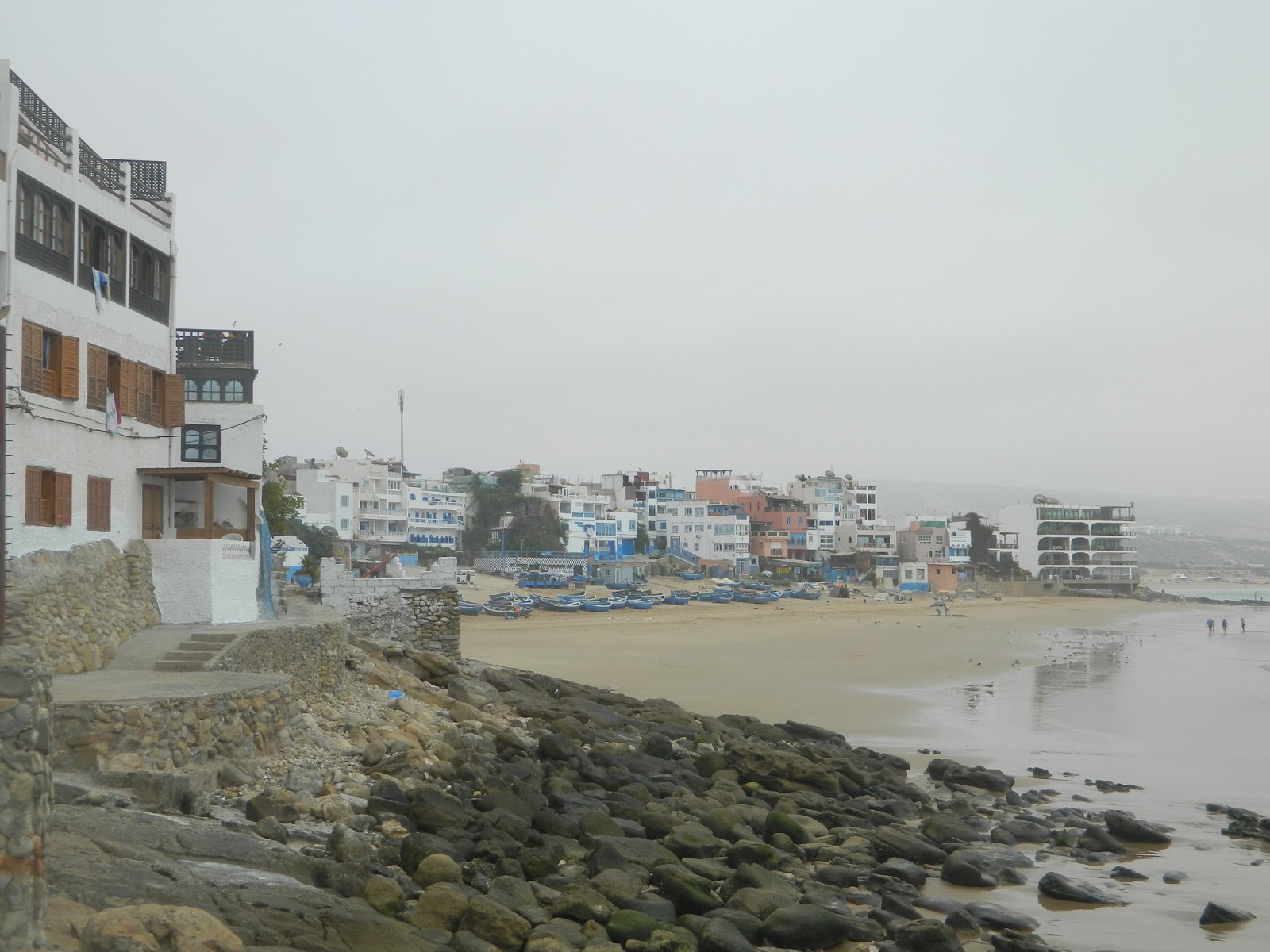
    View of Taghazout from one of my favorite cafes.

    We watch the waves crash against the cliffs beneath our table, the spray catching the sunlight over and over again.

    Our tea arrives—the classic combination of Moroccan mint and strong green that everyone drinks, but without the usual pound of sugar, per my request. A simple silver teapot with a long spout. Two small glasses (not mugs, but glasses).

    I lift the teapot and pour, starting low, then lifting higher, and higher, and a bit higher, steam rising up from the cascade of tea and a slight froth forming at the top of each glass.

    (If I wanted to mix in sugar, I would pour out glasses of tea and dump them back in the pot several times to avoid using a spoon—bad luck, I learned later. But I don’t, so I only pour once.)

    I can’t remember where I first learned to pour tea—properly. I think it was in a Senegalese village when I was 16. Everyone laughed at my first attempts, of course. Even today I spill more than any veteran tea pourer ever would. But I know the technique, and I can make a few bubbles.

    It’s a small thing, arguably, pouring tea well, and yet drinking tea proves such a fundamental aspect of so many cultures that I think it’s important, too. Worth learning. Worth sharing.

    ***

    Let’s drink tea together tomorrow!

    Inshallah.

    You should open a cafe there—you would get so much business!

    It’s a good idea. Inshallah.

    Are you moving this week?Inshallah.

    When does the high season start?

    Things will get busy next week—inshallah.

    Inshallah (also written insha’Allah). If God wills it. God willing. Used throughout the Arabic-speaking and Muslim world—and often. At times my plan-making mind gets irritated by the ceaseless string of Inshallahs spoken and exchanged each day.

    Is nothing certain?

    Well, no, it’s not—is it? To visitors from outside cultures, I think this nonstop Inshallah business can seem like a cop out. Noncommittal. But I suspect (I don’t know nearly enough to say for certain) that it stems more from a different perspective.

    Everything—everything—is out of our hands. Maybe. It’s probably a good brain exercise to consider the possibility, even if you disagree. Living here, then, is like a daily mind workout.

    ***

    Every day I learn here.

    I learned that until the 1950s there was a small Jewish settlement alongside the Berber ones in the mountains behind Taghazout. I visited a new friend’s home in those mountains, and I could feel the history in the ground under my feet.

    I learned that Friday is couscous day and that soup is a summer food.

    I learned that no length of fabric will cover my foreignness here—no matter how Mediterranean I like to think I look.

    I’ve learned that if you sit long enough in one spot it is really possible to see every person you know in this town, and that if you start walking you can spend a whole day just stopping in for chats with old and new friends.

    I’ve learned how to roll under a wave with my surfboard, and that lip sunburn is real.

    I’ve learned to count to ten (though I’ve forgotten at the moment), and how to greet.

    There’s no other message today. There are lessons everywhere, every day and in every culture; I hope you’ll go find some!

    ***

  • 3 Macabre Stories that Capture the Essence of Napoli

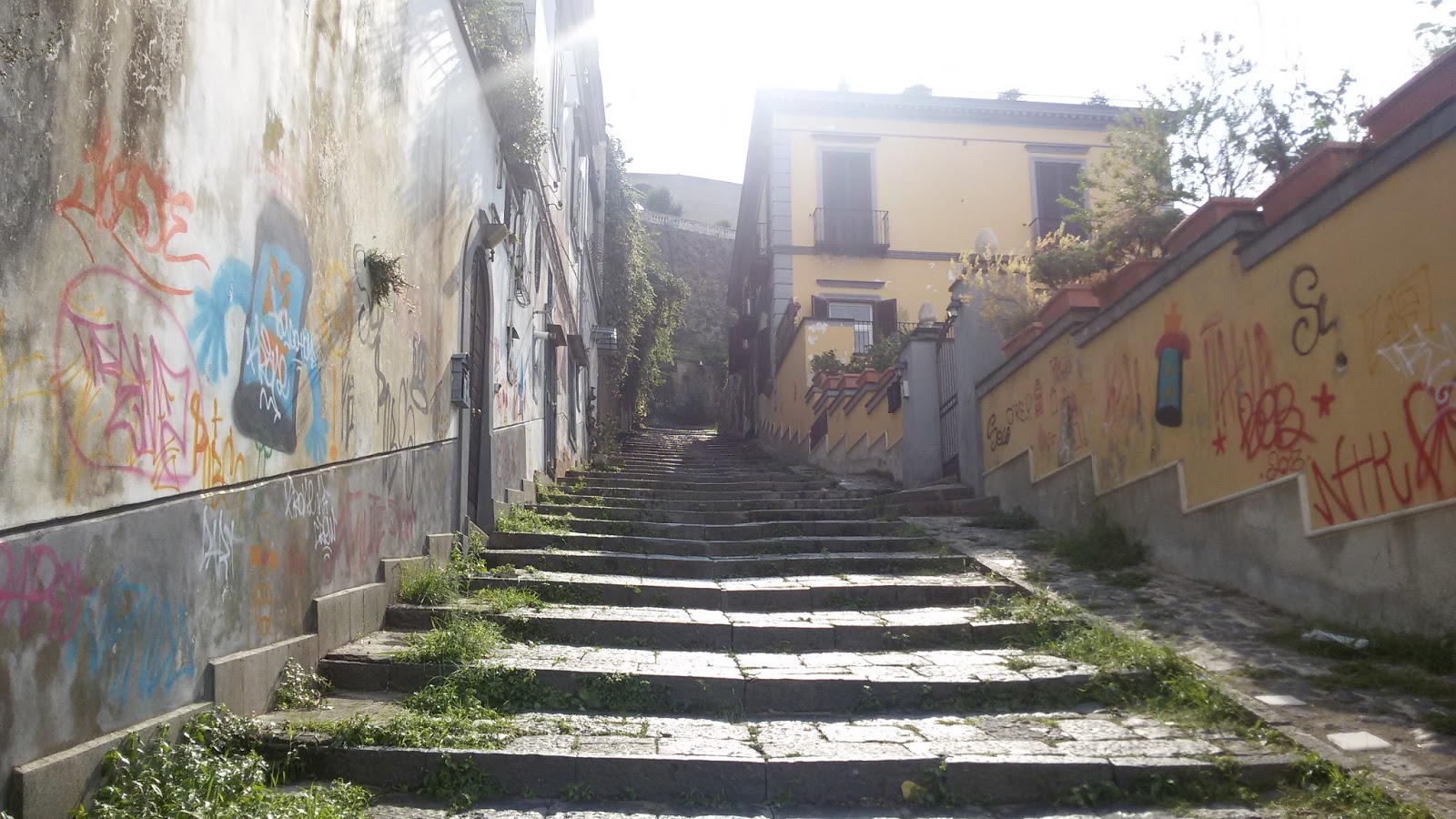
    Climbing hundreds of stairs for a good view, as per usual.
    Thursday, 1 September, Napoli, Italy

    The weather was a bit mercurial, and we took shelter from a sudden downpour in a nearby cafe. As the storm passed and we prepared to continue on our way, my friend (a Napoli native) informed me that we were about to cross an invisible boundary. 
    The police don’t come to this part of the city. It’s controlled by a powerful family (think mafia). Recently, three young men from a different, neighboring family were shot dead as they walked down the street.
    Suffice it to say, this was not a safe neighborhood. At least, unlike most tourists, I was acutely aware of the risk involved as we ambled onward on our quest for the best sfogliatelle in Napoli (and thus, seeing as it’s a Neapolitan specialty, the best sfogliatelle in the world).
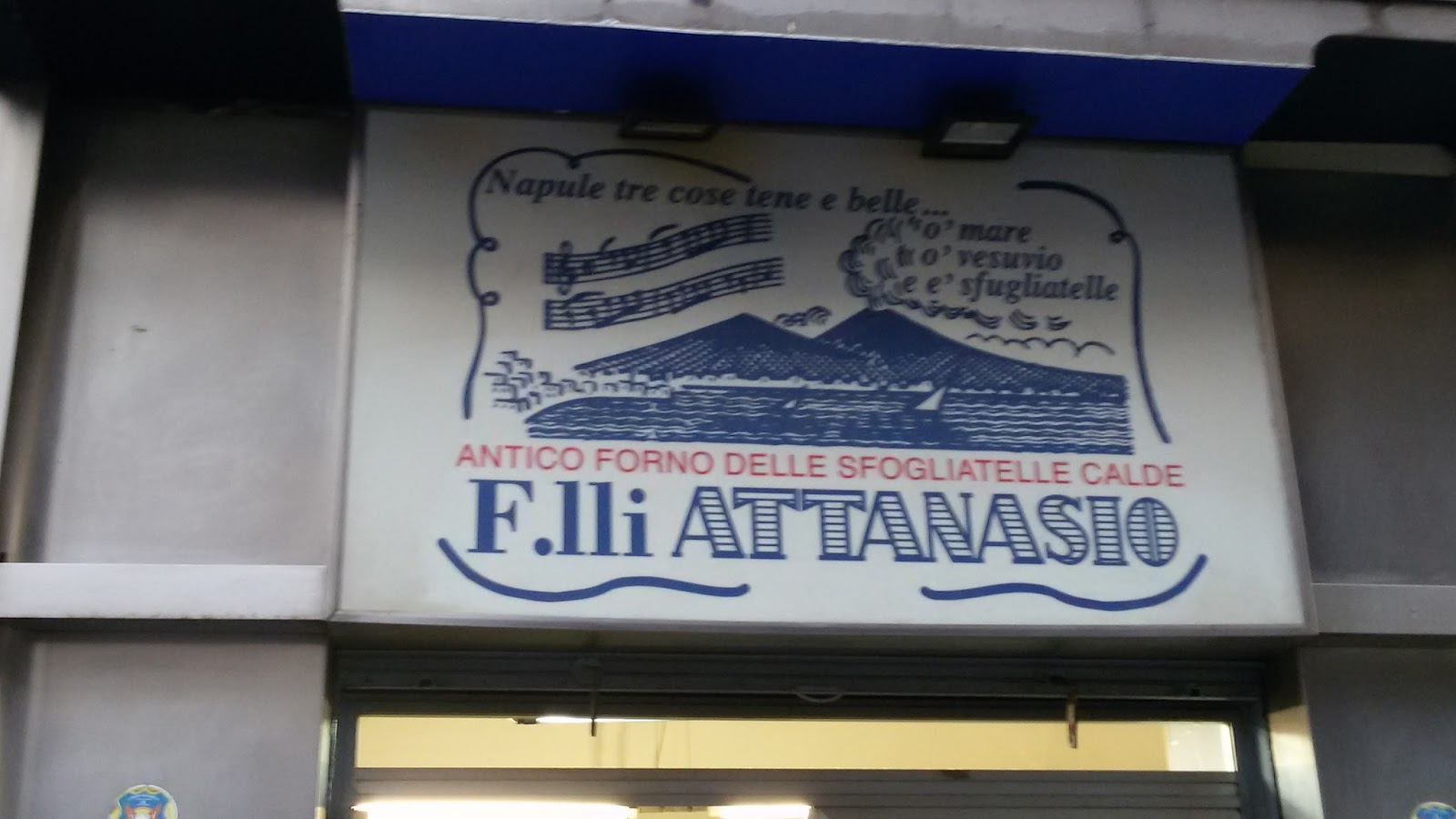
    Go fish! Can you find this famous Napolitano bakery? 🙂
    Now, if you’re thinking it’s insane to risk your life for a pastry, you’ve never eaten sfogliatella.
    Flaky layers of crisp pastry, artfully shaped to resemble a seashell, filled with sweet ricotta cream lightly flavored with local orange, and dusted with powdered sugar—one is already too much, too rich, and yet I bought four just in case.
    Napoli has a bit of a reputation as the more dangerous, more sordid Southern cousin of the well-frequented tourist destinations to the North (Rome, Florence, Venice, Milan). And indeed, the crowded warren of twisting streets layered atop a cavernous subterranean void (in turn layered atop the lava fields that fuel Vesuvius) is not the Italy many tourists may imagine.
    It may be better.
    As we walked from one end of the city to the other on our quixotic pastry mission, my friend, uniquely knowledgeable about Napoli’s architecture, history, language and culture, regaled me with stories—many macabre—that endeared me to this dark gem of a city.
    Here are three of them:

    Rub a skull for good luck.
    The Old Ladies and the Catacomb Skulls
    Twenty years ago, the old ladies of Napoli still maintained this tradition, originating in the plague years, or perhaps the war years (regardless, years of extraordinarily high mortality rates). Each would “care for” a particular skull in the catacombs beneath the city, bringing it flowers, offering it prayers, and grieving the death of a stranger who perhaps had no family left to mourn their passing. Sometimes, vicious arguments would break out over a particular skull when more than one woman lay claim to it. Questa è la mia testa! No! È la mia! (This is my head! No! It’s mine!) Talk about macabre.
    San Gennaro (Saint Januarius), Patron Saint of Napoli, and the Curious Affair of the Keys to the Church
    San Gennaro is not officially a saint, but don’t try telling that to the citizens of Napoli, who are particularly dedicated to their patron. A vial of the saint’s blood purportedly resides in the main church of the city, and twice a year, the miracle of the liquefaction takes place, in which the dried remains turn to liquid once again. Interestingly, the remains of San Gennaro do not belong to the church, but rather to a mysterious ancient sect with a centuries-old history in Napoli. They allow the church to hold the remains in exchange for the keys to the building. If you’re picturing creepy Satanic rituals in the catacombs of the cathedral, yeah, I’m right there with you.

    L’Ospedale delle Bambole (Doll Hospital)—a whole different kind of creepy.
    The Hospital of the Incurable Ones
    In medieval times, when pilgrimage to Jerusalem was a popular undertaking, Napoli occupied an important step along the journey. In plague years, and other times too, pilgrims would frequently fall ill and find themselves unable to complete their pilgrimage. Many of these stopped in Napoli, and the city became their final resting place. The Church built a thriving business around this occurrence, constructing buildings to house the sick and dying—partially out of Christian charity, surely, and partly because dying pilgrims, unable to reach Jerusalem, proved particularly disposed to leave everything to the Church instead. One of these, L’Ospedale deli Incurrabili (Hospital of the Incurables), still operates today, although I believe it is more concerned with saving lives than saving souls.

    This dark and fascinating history lays a particular foundation for the vibrant crush of life filling Napoli today. Young people sporting dark 70s-style fashion, 80s-style hair, lots of attitude and even more tattoos loiter outside cafes, nightclubs, pizzerias and bars. Crowds line up outside the best gelateria, stroll along the waterfront and press into the narrow streets of the Old City. The Napoletano language is alive and well, spoken by many if not most locals, changing and adapting as any healthy, living language should. Musicians play tarantela in the streets, and motorcyclists and pedestrians weave past, seemingly unaware of one another, in a seething dance. 

    There is life here. Tons of it. And maybe that’s the point of all the macabre underpinnings; they tell a story about all the living happening now.

    ***
  • La Notte della Taranta—or, Where I was on Saturday

    A post shared by Toby Israel (@tobyintheworld) on


    On the road to Melpignano

    Melpignano, Puglia, Italy; Saturday, 8:00 p.m.

    The sound of tambourines fills the air—not just from the stage, where the opening acts are performing, but also from thousands of tambourine-bearing audience members.

    Raucous festival-goers pass around three-liter jugs of local red wine. They dance in pairs, sometimes circles, in a style of dance that (to my Jewish eyes) most closely approximates the hora.

    It’s an odd blend: mostly Italians, from babies in carriages to elderly observers avoiding the crush in the center of the crowd (here, things more closely resemble a mosh pit), but mostly young people. Most appear to know the songs and sing along; many know the traditional steps, too.

    The main concert hasn’t even begun, and it’s already difficult to find a free patch of ground close to the stage. I have come from Rome for five days, pretty much just to witness this unique event. After hearing about the Notte della Taranta and the Pizzica style of dance and music that goes with it, I became fixated on experiencing it for myself.

    The History:

    In the twenty-first century, La Notte della Taranta (the Night of the Tarantula) is a modern music festival occurring every August throughout the Salento region of Puglia (Apulia) and culminating in a finale event in Melpignano. Its roots, however, stretch much, much farther back. The event centers on the Pizzica, a style of folk music and dance that originated in the Salento region in pre-Christian Italy.

    According to tradition, women in this region would become possessed by the spirit of the tarantula after being bitten by a spider during a certain season. They would begin to act out with strange antics and wild dancing. Nights of the Tarantula would break out in various villages as the spirit spread and more and more women succumbed to its grip.

    Now, through a modern anthropological lens, this is a clear case of a ritualized upheaval of social order and codes, whereby women living in an oppressive culture could express rage and wildness in a way that would normally be totally unacceptable. Stories of possession by various animal spirits, leading to trance, hysteria or other phenomena, abound across world folk cultures.

    La Notte della Taranta Today:

    I can’t speak too much to this, having only been to the main concert. Today, at least in Melpignano, the tradition seems to have been somewhat sanitized. 200,000 attendees can do that. The Pizzica has come a long way from the village square, and it looks a lot different with lights and sound production and weeks of rehearsal than (I imagine) it would have even a century ago.

    But who cares? I was hypnotized by the twirling white skirts on stage, fascinated by the folk lore surrounding the spirit of the spider, and enchanted by the percussive rhythms rolling on for hours.

    Worth the trip? Absolutely.

    Some outcomes of this excursion:

    1. I own a tambourine—which i can’t stuff into my backpack and which I will have to figure out how to carry with me everywhere.
    2. I must add another dance style on my to-learn list.
    3. I have a new love for a layer of Italian culture I never even knew existed until a few months ago.

    Looking for somewhere to go next August? Maybe check it out—don’t buy a tambourine, though.

    Youtube video

    Skip to minute 4:00 if ten minutes of Italian folk music isn’t your thing.


    Youtube video
    Skip to minute 5:00 to see a bit of traditional dancing.


    ***
     
  • Pilgrimage Today—It’s Still Relevant

    Pilgrimage Museum, Santiago de Compostela, Galicia, Spain

    I placed the noise canceling headphones over my ears, and an ancient melody flowed straight to my soul.
    It was my foodsteps—hundreds, thousands of them—plucked from a harp. It was the daily rhythm of walking made song.
    I stood at that display in the Pilgrimage Museum for a long time, and I listened to some of the recordings of the Resonet Musica Antiga group more than once. Recreated from sheets music in the Cathedral’s archives and reconstructed medieval instruments, the music might have run through my head at a distance.
    But somehow it didn’t. Somehow it connected.
    I arrived in Santiago on Friday, July 1, 2016. That Friday marked the culmination of a month of walking across Northern Spain (approximately 800 kilometers) begun in the vague interest of “seeking.”
    (We can talk about what I “found” once I figure that out—story for another day.)
    Pilgrimage is an ancient phenomenon. Historians have found evidence of its occurrence in Mesopotamia, Vedic India and ancient Egypt. Wherever it appears in human history, it follows the same principle: an outward, often arduous journey serving as an allegory for the spiritual path.
    Since the alleged discovery of the remains of Saint James (one of the Twelve Apostles) in the ninth century, Santiago—and its cathedral—has been one of the most important pilgrimage sites in the world. It is said that the Camino de Santiago—the Way to Santiago, and there are many—is a metaphor for the trail marked by the Milky Way across the sky. Again, a physical manifestation of a metaphysical path.
    That sounds heady and outmoded, right?
    Wrong.
    In the last decade, traffic on the Camino Frances (the most popular route) has surged into the thousands. Clearly, the ancient tradition still resonates. And lately, its popularity is growing fast.
    Just as ritual will always revive itself and traditions will be reborn, pilgrimage is finding its place in the modern world.
    The scallop shell, long worn as an insignia by peregrinos walking to Santiago, now hangs from my backpack, too. Symbol of water, life and healing, it is as timeless, endlessly resonant, as it is timeworn.
    These themes are eternal:

    WanderingSeekingThe JourneyWalkingLooking to the SkyWalking upon the Earth
    Questioning 

    The WarriorThe SeekerThe Scholar [1]

    As I listened to those modern recordings of centuries-old music, I heard my experience translated—so precisely—into sound. I walked a path that thousands, perhaps millions, had walked before me, and though the asphalt beneath my feet and electric lights in the distance were new, the the experience had somehow been the same. [2]

    That, in short, is why pilgrimage is still deeply relevant today.

    ***

    [1] The Warrior, The Seeker and The Scholar are the three archetypes represented by Saint James.
    [2] Sadly I have not been able to find the same recordings anywhere online. This is the closest I could find, but you may have to visit the Pilgrimage Museum in Santiago to hear the music I’ve described:
    Youtube video
    ***

  • Pillowcases in the Desert, Rainbows in the Forest, and Hippies in the Holy Land: Another Perspective on Israel

    Tzukim, Arava, Israel
    The whirring of the machine as I touch my foot to the pedal brings me back.
    To my grandmother’s home and her ancient Singer. To the costume room in the basement of my middle school theater. To my projects on the kitchen table in my childhood home in Brookline, Massachusetts.
    I haven’t used a sewing machine in a long time, and the rhythmic pull of needle on fabric is bringing me to a good meditative place.
    The air is so dry that drinking water does nothing for my thirst—the liquid seems to evaporate on my tongue—and there’s a super-fine layer of desert dust beneath my bare feet. (Hardly had we swept the floors, cleaning house to usher in Passover, than the relentless winds brought the dust back.)
    I’m staying with my brother’s friends and their five beautiful children in the mud house they built for themselves here in Tzukim; we (my brother and I) have been invited for Passover seder. They study and speak openly about Kabbalah, a central tenet of which is the concept of togetherness. And indeed, I feel more than welcomed here on my second stop of my second visit to Israel—I feel involved.
    Tonight, I am helping to sew pillowcases to decorate the rounded, light-filled common area of their home. Deep green, vivid red, heavy, rough, intricate, beautiful textiles. I hum tunelessly as I work; it’s a new habit I’ve found myself adopting since the term, “humming tunelessly” caught my eye in a book.
    The pillowcases are definitely of the wabi sabi variety—as is everything about the house. Perfectly imperfect. Made by hand with care and natural irregularity. Human. Filled with meaning.
    My brother’s friend works beside me, and she smiles when she tells me that each person who has stayed in the house has left a part of themselves in it. The pillowcases will be my part.
    ***
    After my last, particularly heavy post on Israel, I wanted to offer something lighter. A balancing perspective, if you will.
    The question came to mind: How would one write about Israel if it were just a place, with no history, no complexities and no enigmas—just sun and desert and sandy beaches and olive groves—a beautiful spot on the map? How would one describe it?
    Is such a thing possible? Of course not. Not for anywhere in the world. Total nonsense.

    And, what’s more, maybe misguided. 

    For, like my wabi sabi pillowcases, Israel is not beautiful—cannot be beautiful—in spite of its rough edges (rough edges is putting it mildly), but because of them. The same is true, I believe, for every spot on the map.
    ***
    Somewhere near Modi’in, Israel
    A man with one leg and no clothing flashes by, moving faster on crutches than I can usually manage to run.
    As we traipse in with our camping gear a little before dusk, a crowd near the entrance shouts, “Welcome home!” as they always do at these gatherings. Participants spread out across the forested space to make camp, collecting in small population centers, or venturing further afield in search of silence and solitude.
    The activity centers around the communal cooking area, and a large bonfire where most gather after the shared evening meal for drumming, singing and sometimes dancing. Gauzy dresses, dreadlocks and bare skin are as common here as head scarves and black hats in Jerusalem.
    This is Rainbow Israel, and if you aren’t familiar with Rainbow Gatherings and you want to understand what they are (you do), you should go here.
    We stay only one night, but I could have happily stayed a week. There’s something special about a community where anything goes, and (usually) nothing bad comes of it.

    Tel Aviv, Israel
    On my last night in Israel, I sit with an old friend on the steps of the big Synagogue, sipping a beer as we catch up on six or seven years of life. 

    He describes his experiences with medicines in Peru (yes, others would call them drugs), his work with sound healing and his studies on homeopathy and Kabbalah. I describe my work with elephant journal, a publication focused on mindfulness, my yoga teaching and my nomadic lifestyle. I think the intervening years have brought us both a good deal closer to our life paths.

    This last evening, along with other conversations, meetings and interactions like it, balances out my more complicated experiences of Israel, renders me more grounded in my time here. There’s violence and oppression in the Holy Land, but there are hippies too.
    So, what do wabi sabi pillowcases, rainbow gatherings and hippies all have in common?
    For starters, they’re all positive, forgiving, inclusive and somewhat alternative entities.
    And, they all exist in Israel.
    It would take many lifetimes to write enough to do justice to a single spot on a map. It would take a million voices, on a thousand days, to tell every facet of every side of every story cradling that spot.


    For now, I’ll content myself with having told two facets of one story—my own—and I hope you’ll be wise enough and brave enough not to take my word for it. Make your own stories, wherever you may be called to do so!

    ***

  • Okay, Let’s Talk about Israel

    View from Old Jaffa, Tel Aviv
    “If the Arabs didn’t kill me, my wife would.”
    Bloody hell. Did he just say that?
    After the split second necessary for me to process his words and maintain a neutral expression, I answer:
    “Why’s that?”
    “She doesn’t want me walking through the Arab neighborhood.”
    Obviously.
    We are talking, of course, about which gate to use to exit the kotel (the Western Wall, the holiest place for Jews to pray in Jerusalem).
    I think he means it as a joke, but it’s not funny.
    On this visit to Israel, I have been floored multiple times by this kind of abject fear, prejudice and even hatred—veiled and otherwise—toward the vaguely-defined “Arabs.”

    ***
    I don’t want to write about this hatred, but I feel I must. I could not in good faith write at some length on post-apartheid South Africa, yet stay silent on the subject of Israel. I don’t mean to criticize the incredible people who have welcomed me here, but I feel an obligation to present my experiences as they have been—without convenient omissions. I come from a class of American Jews for whom criticism of Israel is practically the equivalent of self-hatred. Yet, to be silent is to be complacent.
    ***
    Imagine my surprise when, fifteen minutes later, I learn that we are to join this man and aforementioned wife for Shabbat dinner.
    As we walk across the large stone plaza by the Western Wall (toward the “safe,” acceptable gate), the call to prayer echoes across the open space. It is, as I always find it to be, hauntingly beautiful.
    Dissonance.
    I steel myself for an… interesting (challenging) evening.
    But nothing ever happens the way we expect.
    Eighteen guests break bread (matzah) around a generously laden table, and before we take turns introducing ourselves, our hostess delivers a brief speech full of lovely sentiments on perspective, understanding and peace. 
    How we should all get along.
    Our hosts turn out to be warm, exuberant, slightly odd, good-hearted and generous humans. They delight in opening their homes to strangers every Friday night.
    The dissonance still has me reeling three days later.
    How can people who live according to laws of loving-kindness, compassion, charity and devotion also spread hate?
    It is the paradox of our times—perhaps of every time.

    ***
    I do not want to write about this ugly, complicated tangle of politics, identity, religion, culture and hate. But to stay silent is to be complacent.
    Growing up in Jewish communities in the U.S., I have seen how stories of persecution and oppression—and survival—perpetuate themselves.
    I know how seductive it is to believe ourselves always the David to another’s Goliath. Such archetypes are practically written into our genetic code. After all, everyone wants to be the hero, the victorious underdog, the resilient victim. To put it in contemporary terms, most of us see our obstacles with clarity—but rarely our privilege.
    All of us have our hands too close to our faces to read our palms.
    And six years ago, when I first visited Israel, I was still too close to the flattering, awe/fear-inspiring story with which most Jews are inoculated. Two years ago, when I wrote my senior thesis in Anthropology on female Jewish identity, I had taken a few steps back.
    Again, I have gained more perspective.
    I am hardly informed enough to offer you a well-shaped, well-researched and well-defended opinion, but neither am I too scared to present my experience and observations as I have found them, with as much accuracy as any individual could hope to achieve.
    I don’t have any answers to offer, but I have questions that are churning in my brain, and I want them to churn in yours, too.
    ***

    Market abundance.
    “Now, some people are saying that Israel is an apartheid state,” he says in a classic Brooklyn accent unaffected by twenty plus years living in Israel.
    The patriarch of the family (another family, in another Jerusalem neighborhood, for another Passover week dinner) sits at the head of the table.
    I certainly wasn’t planning on opening that can of worms, and I hold my peace while he holds forth.
    “That is simply not true.”
    He goes on to explain why point-to-shoot, border walls, checkpoints and other security policies are justified and necessary to the self-preservation of the Jewish people.
    I hold my peace and wait for the subject to pass.

    But it’s so much more complicated.
    While in Cape Town, I, too, heard some people—many people—referring to Israel as an apartheid state.
    Takes one to know one?
    I don’t know. I do know, however, that the arguments are compelling and not insubstantial. It’s not an entirely ludicrous claim, as others would declare.
    This family of religious Jews is, like the other, extraordinarily kind, warm, welcoming, generous and loving.

    They ply us with food, wine, friendly interrogation on every aspect of our lives. There is joy and laughter and exuberance at this table, and we are folded into the melody. Yet, every so often a “joke” slips out at the edge of conversation, and the note falls flat on my ears.
    Dissonance.
    Again, my mind turns over and over the same questions:
    How can people have such open hearts, yet such narrow minds? How can we preach love, but spread hate? How can we celebrate our survival, and at the same time justify—advocate for—the oppression of our fellow man?
    I’m not deaf. I’ve heard this dissonance a hundred times in a hundred places. Contradictions spoken by a hundred mouths in a hundred languages. The pairing of hate and love in a hundred hearts; the conflict of logic and fear in a hundred minds.
    But this, now, in Israel, is different for me.
    It hurts me to see a group of people—to whom I belong; whom I am proud to call my own; whose story of survival is my story of survival—display these confusing contradictions.
    Dissonance.
    The shelves of history are crowded with stories of the oppressed who became the oppressors—the Hutu and the Tutsi; the early pilgrims to America; Britain (if you go far enough back); Burma/Myanmar—a narrative so common as to almost be an historical cliché.
    It is easy—too easy—to live out the patterns of conflict handed down by past generations. In Israel and Palestine, these stories exist now in abundance on both sides of the proverbial—and literal—fence.
    It is far harder to pull our hands away from our eyes and read the map of where we have walked—and where we are walking.
    Is Israel an apartheid state? I’ll leave that to the history books to answer, though we know those will only ever tell part of the story.
    I am far more concerned with the answer to this:
    How can people have such open hearts, yet such narrow minds? How can we contain such love and generosity—and such anxiety and fear—within our individual—or national—bodies?
    I would like to know.
    I don’t.

    I do know, however, that I wish I had not held my peace for the sake of harmony—as I so often do. For to stay silent is to be complacent.
    ***
    I regretted saying nothing at that first dinner, so at the second dinner, when I introduced myself to the 19 other guests and our hosts (the instructions? talk about something—anything), I told a story. It wasn’t a Jewish story; I think I’ve heard it’s Cherokee, and the original version I saw goes like this:

    An old man is teaching his grandson about life. “A fight is going on inside me,” he said to the boy.

    “It is a terrible fight and it is between two wolves. One is evil – he is anger, envy, sorrow, regret, greed, arrogance, self-pity, guilt, resentment, inferiority, lies, false pride, superiority, and ego.” He continued, “The other is good – he is joy, peace, love, hope, serenity, humility, kindness, benevolence, empathy, generosity, truth, compassion, and faith. The same fight is going on inside you – and inside every other person, too.” 

    The grandson thought about it for a minute and then asked his grandfather, “Which wolf will win?” 

    The old Cherokee simply replied, “The one you feed.”

    I don’t know if my message reached anyone, but at least this time I tried. 

    And I’ll keep trying.
  • Coffee Culture, Slow Food, and Why Cape Town Has Both

    Coffee Culture, Slow Food, and Why Cape Town Has Both

    cape town coffee culture slow food

    A side alley off Buitenkant Street, Gardens, City Center, Cape Town

    The first sip is bitter, sour, almost acrid, before my palette adjusts and the taste mellows into a more complex configuration of nutty, earthy, sweet and rich.

    This is good coffee.

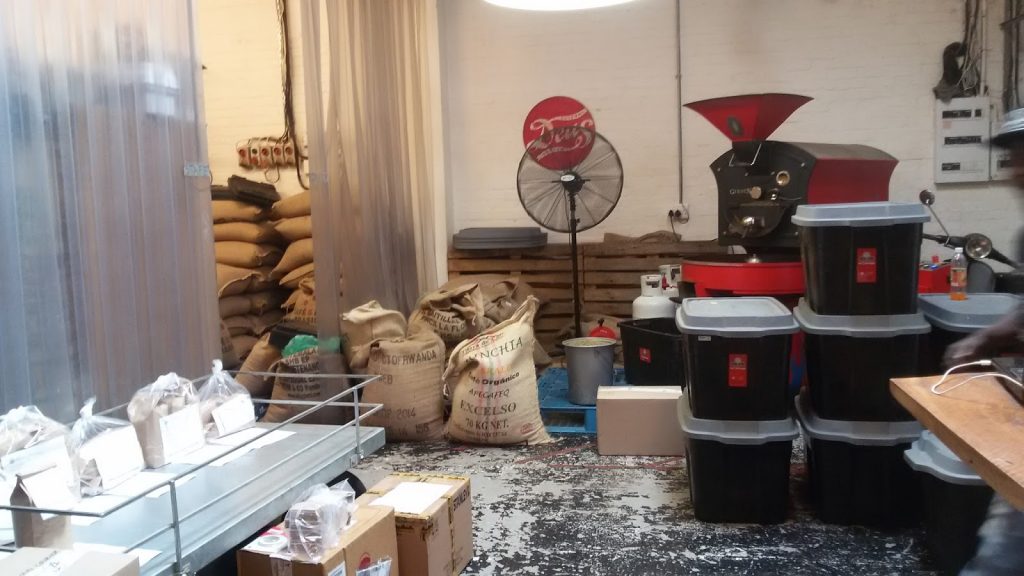
    I’m sitting at my favorite Cape Town cafe, Deluxe Coffee (also called YARD, the Dog’s Bollocks and the Bitch’s Tits), where motorcycle parts, vintage bicycles and canvas sacks of wholesale coffee beans make for original decor.

    I’ve occupied this stool at the counter for well over an hour now, and nobody cares. Par for the course.

    Cape Town has an exceptional coffee culture. (The reason I’ve consumed more coffee in the past three months than probably the last three years prior—well, that, and the fact that a cappuccino costs a bit more than a dollar.)

    What is “coffee culture”?

    Well, to answer in negatives, the U.S. does not have a coffee culture—or a cafe culture, to be more precise. A coffee culture does not “run” on coffee (like Americans run on Dunkins), but rather stops. Sits. Stays. Connects.

    And when you stop to taste your “cup of joe,” quality matters. Deluxe Coffee may be my favorite spot, but easily half a dozen others tie for second. There is a lot of good coffee in this city.

    To-go cups are more rare, too, and at least among my friends, “going for coffee” is an hour(s)-long undertaking—not a five-minute quick fix.

    Cape Town generally moves more slowly. Less rush, less stress, none of the high-powered, shiny, corporate velocity of New York, London or Hong Kong. None of the humorless, chain-brand cafes, either.

    Starbucks hasn’t made it to Cape Town, yet, but I hear it’s coming. When it gets here, I hope Cape Townians will put it out of business.

    In a cafe culture, independent roasters, brewers and purveyors of coffee thrive. Character and personality matter—or maybe that’s just me.

    And I think there’s a common denominator between coffee cultures and Slow Food. Shared values. An appreciation of quality, and a willingness to wait for it.

    Many of the cafes where I go to do work have some of the worst service I have seen anywhere in the world. Friendly, but extraordinarily slow.

    But, good food. Good coffee.

    See the connection? I do.

    I am more than a little bit enamored of the Slow Food movement—and of Cape Town’s coffee culture.

    I like the pace, the time for detail, the space for real connection. This is what a cafe should be, in my opinion.

    This is how coffee should taste. This is how life should move.

  • Cape Town Snapshots

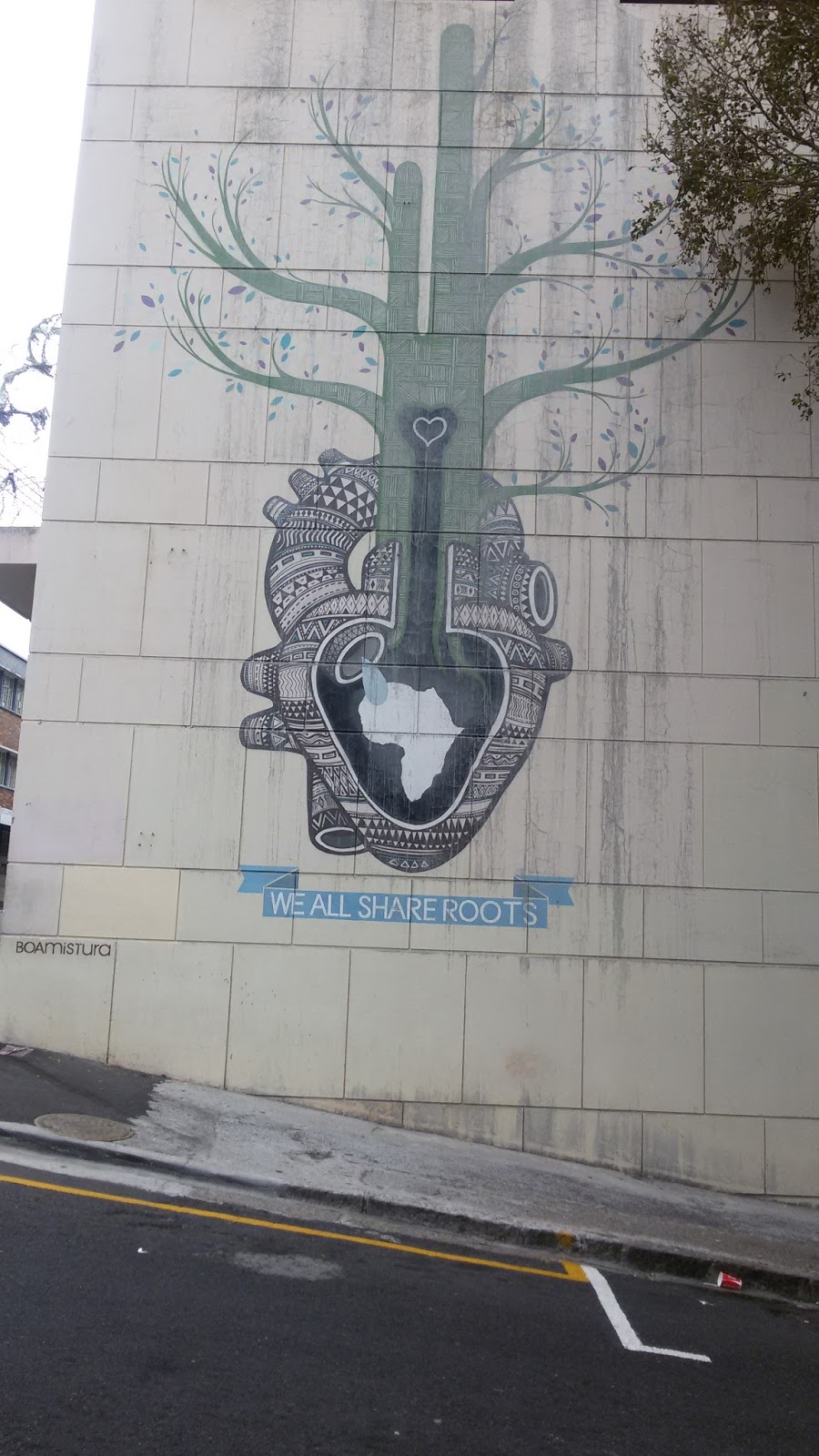
    Street art near Assembly, Cape Town.

    Are these snapshots I share so often an exercise in lassitude or creativity?

    I’ll admit I write them when I can’t think of a full article I want to lay out. At the same time, I think they might capture more of life in fewer words than any other format. I hope they serve to inspire your imaginations and whet your appetite to form your own snapshot memories of these places.

    Cape Town Snapshots:

    ***

    Two long-legged, long-necked birds cross the road near the Civic Center. One, then the other. Each looks both ways, takes a few steps, stops, looks, and steps again. Traffic flows around them. Their mother must have taught them about looking both ways.

    ***

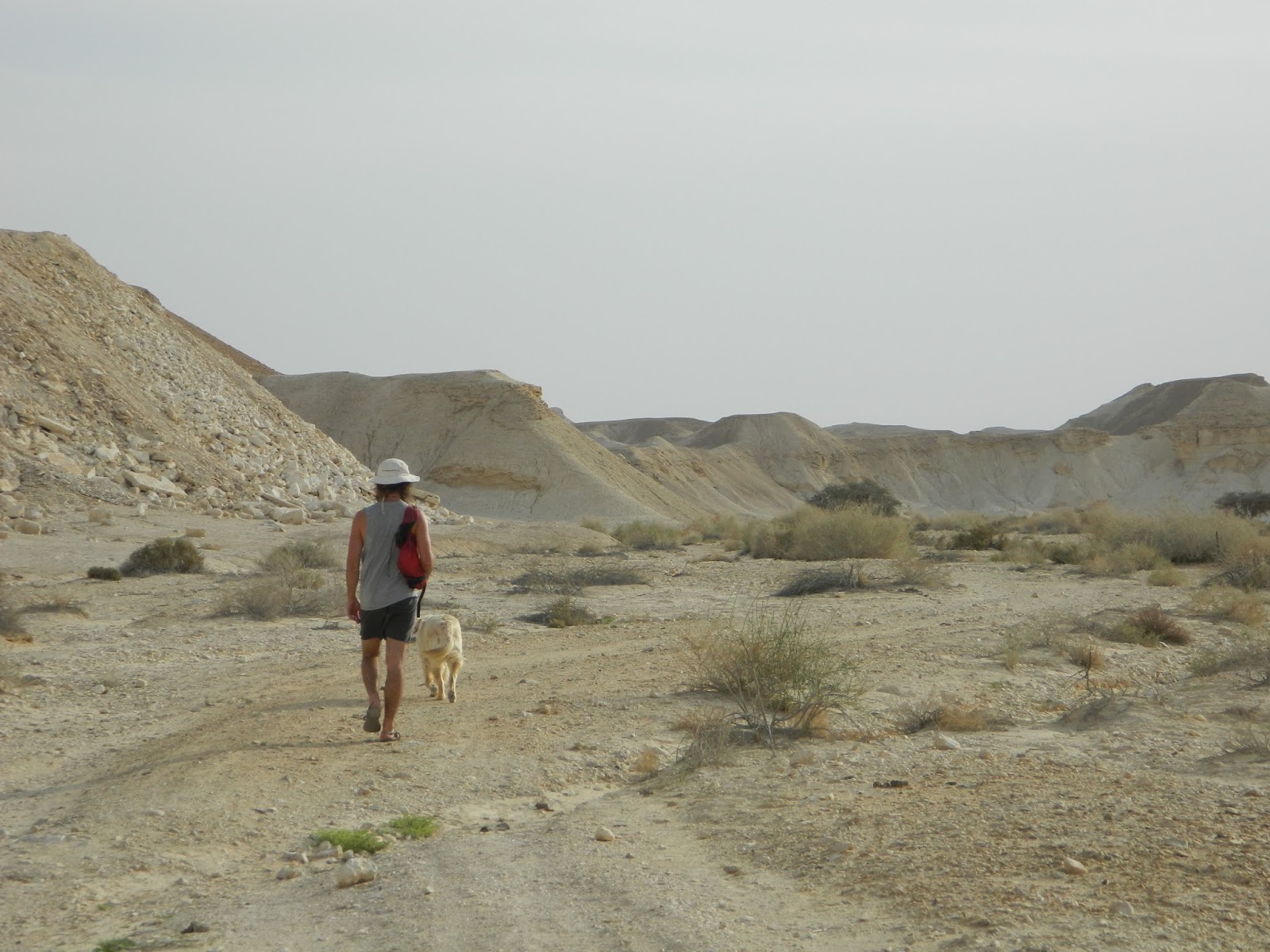
    The wet sand along Long Beach, Kommetjie reflects the mountains in the early morning light. My friend’s golden retriever, a streak of ocher against shads of blue, plays in the surf.

    ***

    Saucer-eyed children materialize around the outdoor table off Long Street where my friend and I have just begun to eat our vegan lasagna and salad. Plant, the restaurant is called. The danger of sitting outside to eat in Cape Town: the reality of the city is on the same side of the window as you.

    ***

    The white-haired sales clerk at the Simon’s Town boutique is more interested in conversation than sales. “Nobody really needs any of this,” she confesses, “but sometimes you just have to buy something nice for yourself!” She laughs. When she hears my friend speaking in Afrikaans on the phone she says excitedly in her high, soft voice, “You have an Afrikaans friend! She’ll be your friend for life.” We all smile.

    ***

    Heaps of fresh fruit in every supermarket. Most (or all) of it grown here. Mangos, avocados and pomegranates, oranges, peaches and nectarines, papaya, apples, plums and grapes. I am spoiled for choice, wish I could buy some of everything, but know I couldn’t possibly eat it all fast enough. Choose just one or two each time I buy my groceries.

    ***
    We teach the students, all in their last years of high school, how to copy and paste, type in urls on a browser and do basic formatting in Word. I am helping my friend with the class he volunteer teaches on Monday afternoons in Masiphumelele, a township near Kommetjie. I never thought I had any computer skills to speak of—I realize I was wrong.
    ***

    The train to the coastal area south of Cape Town emits a banshee screech each time it heaves to a stop. Pick a compartment with lots of people, and don’t carry valuables, I was advised. The train is full of everyday commuters and seems mundane and secure, but I’ve heard the stories and I know looks can be deceiving.

    ***

    A cross between a motorcycle bar and a hipster cafe (my friend’s words, not mine) of my favorite cafes in Cape Town serves the best coffee and a morning’s worth of decorations to occupy the unhurried observer. No mirrors. In the bathroom, only a bare, framed cement square with black painted letters spelling, “You Are Fucking Amazing.”

    ***
    Thick fog rolls down over Table Mountain as the sun drops and the air chills. The “tablecloth,” this misty white blanket is called. It covers and reveals, slowly, silently. The city hides and reveals, slowly, silently. Every day a new facet. Every day a new mystery.

    View of False Bay from the southbound train.
    [Penguins and beaches—lots of pictures on the way, just as soon as I get them onto my computer!]
  • My 9 Favorite South African Words & Phrases (so far)

    This guy knows what I’m talking about.

    Just a short one for today, as I want to spend the remainder of my day off out there in the sunshine!

    South African English has proven to be full of delightful expressions that are just too good not to pick up. If you hear me using these in everyday speech, now you’ll know what the heck I’m talking about. Spend enough time here, and I bet you’ll find yourself using these words too!
    Without further ado…

    My 9 Favorite South African Words & Phrases (so far):


    1. Lekker
        (Nice, great, good. Can be used to describe just about anything. From the Dutch word.)

    2. Robots
        (Traffic Lights. I have no clue why they’re called robots.)

    3. Isit? 
        (Is that so? Really? Oh yeah? Response to just about anything. Hard not to use once you start.)

    4. Braai
        (Barbecue, both the verb and the noun. But somehow way more fun to talk about.)

    5. Boet (5b. Bru)
        (A bro, “bru” then being the term boets would use to address one another… as I understand it.)

    6. Yoh!
        (An exclamation of surprise, like “wow!” Pronounced with an aspiration on the “Y.”)

    7. Aswell 
        (Me too. Emphasis on the “as.”)

    8. Now now
        (Expresses immediate action—kind of. This should be #1, as it’s my new favorite expression.)*

    9. Shebeen 
        (An illegal shop/drinking establishment. I haven’t been yet, but I can’t wait to go so I can use this word more frequently.)**

    Well, there you have it. Come visit me in Cape Town—and you won’t be entirely lost in the verbaiage.

    South African friends? Feel free to correct me if I got something wrong. Or share your favorite words, and I’ll add them to the list!

    ***

    *The precise meanings of “now now” and its close counterpart, “just now” are quite nuanced and difficult to describe succinctly. Suffice it to say that neither of these actually promise imminent action.
    **Update: Shebeens are no longer illegal, it would seem, and now hold licenses like any other store/restaurant in Cape Town… though it seems likely that illegal shebeens still exist!
  • Post-Apartheid South Africa and “Post-Racism” America

    A totally irrelevant picture of Clifton Beach at sundown—Camps Bay, sundown.
    Yes, there is an analogy to be made here.
    Excuse me friends, I’m going to digress from my usual steady word diet of adventure tales and travelogue to get just a little bit political…
    I’ve had an unprecedented number of responses to my first (and, I thought, fairly innocuous) post about Cape Town, “High Security,” so much so that I feel the need to write a follow up. What I have to say is in no way a judgement of any individual reader or responder. I don’t know you, and I withhold any opinion about your life, social beliefs or general good-will as a person (in fact, I’m sure you’re all good people—most are).
    However, this is a judgement on a system—two systems, in fact—and how we can talk about them.
    In July of 2015, one of the best explanations I’ve seen made the internet rounds to clarify why exactly answering #AllLivesMatter to the rallying call of #BlackLivesMatter is, well, missing the point. Below is an excerpt from Reddit user Geek Aesthete’s answer:

    “Imagine that you’re sitting down to dinner with your family, and while everyone else gets a serving of the meal, you don’t get any. So you say “I should get my fair share.” And as a direct response to this, your dad corrects you, saying, “everyone should get their fair share.” Now, that’s a wonderful sentiment — indeed, everyone should, and that was kinda your point in the first place: that you should be a part of everyone, and you should get your fair share also. However, dad’s smart-ass comment just dismissed you and didn’t solve the problem that you still haven’t gotten any!
    The problem is that the statement “I should get my fair share” had an implicit “too” at the end: “I should get my fair share, too, just like everyone else.” But your dad’s response treated your statement as though you meant “only I should get my fair share”, which clearly was not your intention. As a result, his statement that “everyone should get their fair share,” while true, only served to ignore the problem you were trying to point out.
    […]
    Just like asking dad for your fair share, the phrase “black lives matter” also has an implicit “too” at the end: it’s saying that black lives should also matter. But responding to this by saying “all lives matter” is willfully going back to ignoring the problem. It’s a way of dismissing the statement by falsely suggesting that it means “only black lives matter,” when that is obviously not the case. And so saying “all lives matter” as a direct response to “black lives matter” is essentially saying that we should just go back to ignoring the problem.”
    (For great further discussion, check out this article on Fusion or this one in the guardian.)

    That implicit “too” exists everywhere in critical discussion of racism—both in the U.S., and in South Africa, which I currently call home. I am hardly more enlightened on the racial, political and social complexities of South Africa than I was a week ago, at the time of writing “High Security,” but I think I still have have something valuable to offer by way of this analogy.
    The implicit “too.”
    It is there when activists in the U.S. say, “Black Lives Matter,” because up to now these lives have mattered less to our legal (and social and educational and economic) institutions.
    When others answer, “but, All Lives Matter,” they, “willfully go back to ignoring the problem.” That is, they ignore all the conditions that have created the need for such a statement in the first place. Furthermore, they in turn implicitly erase centuries of racial violence, injustice, intolerance and bigotry, filing history away into that closed box conveniently labeled, “Not Anymore.”
    The implicit “too” is there when I say, “there is a wealth gap in this country, much of which is divided along racial lines,” and a South African white responds, “but there are poor white South Africans, too.”
    Indeed, there are, and they have certainly not benefitted from the post-Apartheid systems put in place to (attempt to) correct a long history of colonial oppression. Yet, to address real racial income inequality in South Africa* by saying that white South Africans suffer poverty too is to once again willfully avoid the unavoidable: racism and inequality are still massive problems, here, as in the U.S.
    In much the same way, saying, “but there’s so much crime within those communities, too,” when we bring up the issue of police violence toward people of color, is a whole lot like saying, “but there is corruption amongst black South African politicians, too” when someone else decries past actions of Afrikaans leaders in this country. Indeed, it is true, but the former does not invalidate the latter. To answer in this way is, just maybe, to suggest that police violence (or Apartheid violence) is somehow less upsetting, less in need of remedying, less bad because that “black-on-black crime” (or that new corruption) also exists.
    Let’s take this one step further.
    The spirit of the implicit “too” similarly comes into play when we in the U.S. bring up the issue of institutional racism, that is, racism that exists at the institutional level—which is both greater and more subtle than any individual’s lack-of-racism. When someone says, “racism still exists in America,” those who would answer, “but I’m not a racist,” miss the point. The issue does not lie with them (and, by the by, neither does the fault, though that’s somewhat of a more complex question), but rather with the system to which they are inexorably tied.
    Similarly, when the topic of racism in pre- and post-Apartheid South Africa arises, arguing, “but I had/have non-white friends,” or, “but some schools were already mixed,” or even, “but not everyone was racist, bigoted, intolerant, hateful, violent, fill-in-the-blank,” is the same as a white American today saying, “but I have black friends,” (and so there must not be racism), or, “but my neighborhood is so diverse,” (so there is no socioeconomic disparity), or, “but my family didn’t have slaves,” (and so, slavery didn’t exist?).
    The individual experience of tolerance and friendship does not change the historical fact of the Apartheid system. The individual history of love does not change a national history of hate. To pretend otherwise is to ignore the reality that the majority of South Africans faced under the Apartheid system. 

    It is to be complice to an unjust system, past or present. 
    It is to ignore yesterday and sugar-coat today, in the hopes that tomorrow will be better.
    But until we acknowledge yesterday for what it was, and see today as it is, tomorrow isn’t going to look any different.
    In the U.S., and in South Africa.
    And that, in my humble opinion, is what post-Apartheid South Africa and “post-racism” America have in common.

    ***

    *Interesting tangential reading here, here and here.
  • High Security

    The view from my patio, Hout Bay, Cape Town.

    Hout Bay, Cape Town, South Africa
    “You need to watch that the gate closes to make sure no intruders get in,” says my neighbor.
    To enter the compound where I live, I click the green button on the remote attached to my set of keys, then press it again to close the gate behind me. To enter the cottage where I’m living, I must unlock a metal grate outer door, then the regular house door. I live in one of the calmest areas of Cape Town—it is like this everywhere (but this is nothing, so I’m told, compared to Joburg).
    From my back patio (which includes a garden and pool), you can just make out the township that lies a couple kilometers away.
    The bus I took from the City to Hout Bay a few days ago drove through the township, and the corrugated iron building materials, open front barbershops and markets, cows, snaking roads and general vibrancy marked a stark contrast with the carefully gated houses on my street.
    The juxtaposition is not lost on me.
    I have been in Cape Town for seven days now, and it seems necessary to get this out of the way before I begin to write anything else about my life here.
    The high security is the first thing I noticed when I arrived (truly unlike anywhere I have ever traveled), and all that it implicitly reveals about this place underlies everything else—or such is my impression. I could hardly boast any depth of understanding of these complex social, political and racial tensions, so for now, suffice it for me to say that they are there, and to share these few observations and facts:
    • The current unemployment rate in South Africa is between 25 and 45%, depending on whom you ask.
    • When I walk the three kilometers from my house to the supermarket, I am typically the only white person on foot.
    • When I take the minibuses (similar to matatus in Kenya), I am the only white person on the bus, too.
    • There is a massive wealth gap.

    • Racial tension is very real, and politically fueled.
    • Theft, break-ins and other crimes are extremely common (the high security isn’t just paranoia).
    • Apartheid ended in 1994; that’s nearly 22 years ago. (Although, coming from the U.S., I’d call that quick progress!)
    • When I asked my Uber driver about the social climate in Cape Town, he continued to call me “ma’am” as he proceeded to heatedly discuss the circumstances that he and his community and family face. (“Ma’am, I was black enough to fight in the riots against apartheid, but I was not black enough to get a job in the new government after the elections.” “Ma’am, the people in my community, when they vote now, they don’t see boxes; they see color.”)
    Right, so what does it all mean?

    That is probably something I will spend the next few months investigating in depth. However, I feel it is necessary to offer these initial comments and observations as prelude to future posts on Cape Town—whether it seems relevant to those topics or not, everything is always connected.

    ***
  • Will the Real Santa Claus Please Stand Up?

    “Joulupukki” by Lauri Rantala from Espoo, Finland – Santaclaus at Helsinki Cathedral.

    Consider this my holiday blog post. I could talk about Hanukkah (the holiday I celebrate), or Christmas markets (delightful all around the world), or any number of things. But why would I when scary monsters and mythology are on the menu?

    ***

    It is September, and I am walking through the the Finnish tunturi (mountains in Lapland, way North), the setting sun to my right. Low bushes, a few turned to orange, carpet the ground. The trail is wide and mostly flat, and it carries me and my hiking partner past Pyhäkero (Sacred Mountain), herds of reindeer silent as dusk and rocca (unique shards formed by the freezing of water in crevices of rock and their subsequent explosion).

    As the colors in the sky deepen and a nighttime chill settles over this landscape, I learn the real story of Santa Claus and his Nordic predecessor, Joulupukki (Yule Goat).

    A terrifying creature with a goat’s skull for a head and flaming eyes, Joulupukki—so it is said—appears at homes during the Christmas season, demanding food, occasionally taking away those who have not been good. He dresses in gray furs and sows fear wherever he walks.

    Jolly Saint Nick, is it?

    Eventually, this Joulupukki became more or less synonymous with the Christian Santa we all know today. Funny how we always seem to do that to the less cuddly figures of mythology.

    As I listen to this alternate (and, I must admit, much more interesting) Yuletide legend, I consider the gray, shifting light of this place and conclude it is much better suited to such a dark and mystical creation than a rotund, white-bearded figure in red.

    Near Rovaniemi, where the train from Helsinki leaves us and we begin our journey, there is a place called The North Pole, where tourists seeking a merrier experience can visit Santa Claus’ Village.

    I opt out. Biting wind, icy mountain lakes and ever-so-slightly magical mountains do so much more justice to this fascinating culture.

    As for Joulupukki, the “real” Santa Claus? No, I didn’t run into him. But, it wouldn’t have surprised me if I had…

    ***

    {Update: Family matters brought me back to the U.S. sooner than my planned visit, and I have been quietly and busily staying under the radar in Michigan these past few weeks. I’ll be in the Northeast a few weeks longer, then it’s on to the next adventure. Where is that, you ask? …I’ll let you know when I do!}
  • Tallinn Snapshots

    Greetings from Tallinn!

    On Monday, my friend and I took the 2-hour ferry from Helsinki, Finland to Tallinn, Estonia.

    Our mission? Like nearly every other passenger on board, buying alcohol. Tallinn, evidently, is the everyman’s solution to avoiding Finland’s high taxes and stocking up on liquor for parties and general consumption.

    With a house party coming up this weekend, we had an important task to complete, and an extra seven hours to explore Tallinn… Here’s just a taste:

    The ferry itself is six stories tall, boasting its own liquor store, luxury “trends” store and nightclub—where drinking habits go to breed and a night out consists of a round trip to Tallinn without ever leaving the boat.

    The breakfast buffet offers Karelian tarts (hailing from the Finnish region of Karelia, pastries full of rice, topped with a special “egg butter”), smoked salmon and cold cuts, mysterious meatballs and an assortment of very particular cured fish. We spend the entire trip to Tallinn slowly working our way through it all.

    My favorite poster from the day.

    Tallinn’s Old Town winds away from the harbor, a pleasant mix of cobblestones I’m still feeling in my sore legs, kitsch tourist restaurants loosely modeled after medieval times, posters that seem stuck in another century, souvenir shops and folk art galleries.

    My friend, travel sister and current host, posing with an eye-catching door.

    Outside one of those restaurants, bored waiters crouch down to scatter crumbs to a few pigeons. Next door, a woman in full-on (presumably) traditional Estonian garb acts as a human signboard—brightly colored embroidery, tightly braided pigtails and elaborate headdress demanding the passerby’s attention. We try to covertly get a picture of her… and fail:

    I think she saw us…

    But, we are photo-bombed brilliantly by a passing stranger, which makes up for it:

    Never seen this guy before in my life.

    I spot Captain Jack Sparrow walking down one of the main streets, swagger and all. I get a little bit too excited, fumbling with my camera and missing the photo op. I still wonder what restaurant he was promoting.

    As Jack Sparrow disappears down the street, we follow the sound of a Steel HandPan to a busker, and I meet my soulmate in puppy form:

    More puppy pictures to come.

    As is the case in dedicated tourist towns the world over, we are met with considerable indifference by a considerable portion of Tallinn’s population, with some friendly exceptions. As dusk falls (around 4p.m. in this part of the world), exhausted from some combination of cobblestones and cloudy skies, we settle in for a dinner of Modern Estonian Cuisine before making our way back to the ferry.

    Tallinn at dusk—beautiful.

    It’s a good day.

    ***
  • An Incomplete Guide to Sicily in Quotes & Pictures

    Valle dei Templi (Valley of the Temples), Agrigento, Sicily

    “The climate’s delicate; the air most sweet.
    Fertile the isle, the temple much surpassing
    The common praise it bears.”
    — Shakespeare

    I could write—and, indeed, have written—many pages about Sicily. However, I’m hardly the first person to be taken with the island’s complex history, natural beauty and unique charms, so for a change I would like to share the words of other writers, whose perspectives, combined with pictures from my recent visit, make for a woefully incomplete (but very poetic) look at the place. I hope it may whet your appetite for more, as I never tire of convincing people to visit!

    Scala dei Turchi (Stair of the Turks), Realmonte, Sicily.  
    “Ho capito che la Sicilia è molto più complessa di quello che si può pensare: la paragonerei ad una cipolla dai molti strati.” — Paco Ignacio Taibo II
    (“I have understood that Sicily is much more complex than one might think: I would compare it to an onion of many layers.”)
    Cattedrale di San Givanni Battista, Ragusa.
    “Sicily has suffered 13 foreign dominations from which she has taken both the best and the worst. The sequence of different cultures has made Sicily a fascinating place, quite unlike any other.” — Andrea Camilleri
    Valle dei Templi.

    “This is the homeland of the Gods of Greek mythology. Near these places, Pluto abducted Persephone from her mother. In this wood we just walked through, Ceres ceased her swift running and tired of her fruitless search, sat on a rock, and despite being a goddess, she wept, the Greeks say, since she was a mother. In these valleys, Apollo pastured his flocks; these groves, stretching down to the seashore, have echoed with Pan’s flute; the nymphs got lost under their shade and breathed their scent. Galatea fled from Polyphemus and Acis, close to succumbing to the blows of his rival, enthralled these shores leaving his name here … In the distance you can see the lake of Hercules and the rocks of the Cyclops. Land of gods and heroes!” — Alexis De Tocqueville

    Valle dei Templi.

    “Sicily is more beautiful than any woman.”
    Truman Capote

    Valle dei Templi.
    “Il siciliano è il prodotto di un territorio che non è un pezzo staccato d’Italia, che non ha mai fatto parte di alcuna parte del mondo in epoca storica, che è stato occupato da nord, sud, est, ma mai è stato assimilato, l’isola in cui niente è stabile se non il movimento, il non-stabile, dove un giorno distrugge quanto l’altro giorno ha costruito, dove vulcanismo e nettunismo sono continuamente all’opera, dove un giorno trasforma la storia di secoli.” — Paul Yorck von Wartenburg

    (“The Sicilian is the product of a territory that is separate from Italy, that has never been part of any part of the world in any period of history, that has been occupied by the North, South, East, but never assimilated, the island in which nothing is stable except movement, non-stability, where one day destroys that which another the other day built, where volcanic and marine forces are always at work, where one day transforms the history of centuries.”)

    “Sicilians build things like they will live forever and eat like they will die tomorrow.” — Plato

    Valle dei Templi.

    “For over twenty-five centuries we’ve been bearing the weight of superb and heterogeneous civilizations, all from outside, none made by ourselves, none that we could call our own.”

    This violence of landscape, this cruelty of climate, this continual tension in everything, and even these monuments of the past, magnificent yet incomprehensible because not built by us and yet standing round us like lovely mute ghosts; all those rulers who landed by main force from every direction who were at once obeyed, soon detested, and always misunderstood, their only expressions works of art we couldn’t understand and taxes which we understood only too well and which they spent elsewhere: all these things have formed our character, which is thus conditioned by events outside our control as well as by a terrifying insularity of mind.”

    ― Giuseppe Tomasi di Lampedusa

    Sunset from a lighthouse.
    “I was enchanted… the limpidity of the sky, the restless splendor of the sun, the beauty of the countryside, a certain excitement of the fantasy…which brought to mind the time when in the fields one encountered the divine.” — Jean Houel

    Ragusa Ibla, Sicily

    “In Sicilia abbiamo tutto. Ci manca il resto.” — Pino Caruso
    (“In Sicily we have everything. We’re just missing the rest.”)


    Valle dei Templi.
    “Noi fummo i Gattopardi, i Leoni; quelli che ci sostituiranno saranno gli sciacalletti, le iene; e tutti quanti gattopardi, sciacalli e pecore, continueremo a crederci il sale della terra.”

    (“We were the Leopards, the Lions; those who will replace us will be little jackals, hyenas; and all of us Leopards, jackals and sheep, we’ll go on thinking ourselves the salt of the earth.”)
    ― Giuseppe Tomasi di Lampedusa

    Macalube, Aragona, Sicily.

    “Per me la Sicilia ha una luce particolare, qualcosa di primordiale. Io non sono nato in Sicilia anche se mia madre è di Palermo. È come se con questa terra ci fosse un richiamo anche più lontano della mia esistenza, che appartenga alla mia memoria. Scrivo volentieri qui, c’è un’aria speciale, istintiva. Non mi va neanche di dargli un nome sennò darei dei confini che non ha.” — Emanuele Crialese

    (“For me, Sicily has a particular light, something of the primordial. I wasn’t born in Sicily even though my mother is from Palermo. It’s as if with this land were a recollection even further back in my existence, which belongs to my memory. I write often here, there’s a special atmosphere, instinctive. I do not even give it a name, as to do so would give it boundaries which it does not have.”)
    Scala dei Turchi.

    “There it was again: the sweeping verbal gesture magnified in the prism of Sicily, the pronouncement so poetic it nullified any arguments before they could take their first breath. The vines, the amphorae, the thousands of years of history, the palmenti, the volcano, the beauty, the power of it all. In Italy, of course, beauty is next to holiness. Sicily was long the most treasured daughter of the Mediterranean. So who can teach Sicily anything about beauty?” — Robert Camuto

    Fountain, Ragusa, Sicily.

    “All of Sicily is a dimension of the imagination.” — Leonardo Sciascia

    “Raccontano, infatti, che secondo il mito la Sicilia è sacra a Core poiché qui avvenne il suo rapimento e perché l’isola fu offerta alla dea come dono di nozze.” — Plutarco
    (“They say, in fact, that according to legend Sicily is sacred to Persephone since her abduction took place here and because the island was offered to the goddess as a wedding gift.”)

    Train tracks at the edge of the Valle dei Templi.

    “And anyone who has once known this land can never be quite free from the nostalgia for it.” — D. H. Lawrence

    *** 
    [All translations mine. :)]
  • Snapshot: Bar Willy

    8:30a.m., Trastevere, Roma — 24 August 2015

    I begin the day with that most Italian of concoctions… il bar.

    Bar Willy sits at one corner of a busy plaza in Trastevere—at the edge of Rome.

    Its staff are a typically diverse mix, representing Asia, Africa and “the Continent” too. (Rome is a massive epicenter for immigrants to the country.) They joke about regional linguistic variations, for which Italy is famous.

    At 8:30 on a Sunday, the bar (anywhere else it would be a “cafe”) is buzzing with activity. The tables outside, however, are mostly empty, for—in typical Italian fashion—most of the patrons prefer to take their morning coffee and cornetto (croissants, but, sorry, not as good) standing up.

    And so the bar pulses with the ins and outs of customers on their way to the Sunday market just outside.

    They order a caffe’ (espresso), cappuccino or latte macchiato (hot milk with a touch of coffee), and the sounds of their orders rebound from barista to cashier to my ears and back. The clatter of tiny spoons on plate, plate on bar, cup on plate; the rustle of pastry on napkin and hands on newspaper; the din of shouts, greetings and laughter—all combines to a decibel of energy to which I am unaccustomed so early in the morning, but which, for some strange reason, pleases me.

    It is good-natured—all of it. It is pleasant, honest cheer—a thing the Italians (I find) do better than any others. It is the thing that pulls me back to this country again and again. It is the lushness of fresh pressed olive oil on green figs (speaking of which, the food I’m eating will have to wait for another day…).

    It is magnetic, for me—and clearly I’m not the only one.

    ***