Category: Culture

  • “Hakuna Matata”

    Photo Credit: Flickr


    “Hakuna Matata! It means no worries…”

    I’m sure everyone can finish that sentence–especially those who, like me, grew up on The Lion King and other Disney movies.

    Except, did you know “hakuna matata” actually does mean “no worries” in Ki-Swahili? Maybe I’m the odd one out, but I didn’t!

    Hakuna, “there are no,” matata, “problems” (or worries, colloquially).

    Incidentally, Simba, our favorite main character’s name, means “lion,” Rafiki, our favorite supporting monkey, means “friend,” and Nala means “gift.” The list actually goes on and on, fatally crushing my (totally baseless) childhood assumption that Disney had made it all up. That I can recall, no credit was given. Classic.

    What I find really fascinating is the way the phrase “Hakuna Matata” has come to define tourism along the Swahili Coast in many ways.

    The following are my observations and hypotheses only, and in no way represent a comprehensive study or survey of tourism in the region. With that caveat in mind, I think we have some good old-fashioned Orientalism at play here.

    Very briefly put, “Orientalism” describes a process (first laid out by Edward Said in his 1978 book by the same name) by which Western, largely fictional accounts of an exotic, Eastern “Other” serve to reinforce existing cultural stereotypes. This “knowledge” is then internalized by those “Others” when they observe themselves through Western lenses and reflected back to Western observers as reality. The original sense of Orientalism was limited to academia and a particular corner of the globe; however, the concept can have far-reaching applications.

    When it comes to the phrase “Hakuna Matata,” Disney’s The Lion King effectively fed generations of Americans (and others) a heavily fictionalized and distorted portrait of Swahili culture without our realizing it.

    Now, in the parts of Tanzania and Kenya I have visited, it’s a catchphrase for rastas on the beach, shopkeepers, souvenirs (T-shirts, pottery, paintings, postcards, keychains, sarongs, and every form of kitsch) and tourism.

    Photo Credit: The Hunt

    It has managed to insinuate itself into the most mundane of daily interactions between tourists and locals: “Hi, how are you?” “I’m fine.” “Everything good? Hakuna Matata?” Or: “Coconut oil? Bracelet? Sister, you want something?” “No, thank you brother, I’m okay.” “Okay. Hakuna matata.”

    And even in intrusive non-interactions: “Wei (You)! Where are you going? Just walking? Very good, Hakuna Matata.” Or muttered, half-interactions: “Helloooo.” “Hi.” “Jambooo. Helooo. Hakuna Matata…”

    I don’t know what role those words played pre-Lion King and multi-million dollar tourism industry, but I doubt they were quite so widespread. Now, for the tourist world and the people that cater to it, those words are everything. I’ve started thinking of this as the “Hakuna Matata Complex,” though perhaps that’s undeserved.

    My point is, whatever the initial impetus (did tourists’ expectations start the trend? did an enterprising salesman realize the opportunity for profit? I don’t know.), Hakuna Matata has become more than a catchy phrase to print on souvenirs.

    It’s an identity and a brand. The East African coast seems to be turning into a caricature of itself—or, at least the face it presents to tourists is:

    The carefree, “no worries” attitudes of the young men who roam the beach offering boat rides, bracelets and (sometimes) romantic flings. The escapist, happy-go-lucky language covering hotel brochures and tourism websites. The one-dimensional, highly stereotypical idea of a culture that is packaged, sold and summed up in two words: Hakuna Matata.

    Most interesting are the many manners in which our favorite Swahili-turned-Disney slogan is used. Sometimes there is irony, and a look that I interpret as, “I am making a lot of money off your daft willingness to believe my culture boils down to two silly words, so I’ll follow the script.” Sometimes I read eagerness and sincerity: “Welcome to the land of Hakuna Matata. Really.” And sometimes I perceive something like resentment, which, considering the veritable flood of foreigners, would be understandable.

    Sometimes, when I’ve heard “Hakuna Matata” for the thirtieth time that day, I want to tear someone’s Hakuna Matata T-shirt to shreds. I don’t. I just file it away in the Hakuna Matata compartment in my brain and keep walking… at some point, I will open that box and sort out what I’ve collected there. (This is a first attempt.)

    I wonder: How many tourists go home thinking, “This is East Africa”?

    I don’t know.

    How many of the young men on the beach present this idea of themselves with sincerity, and genuinely identify with the Hakuna Matata Africa of brochures and T-shirts?

    I don’t know. If they do, though, then these old and tired cultural stereotypes have triumphed, and indeed a limiting caricature has been made reality.

    Or. Or maybe the joke is on us. Maybe there is more self-awareness and agency than I can observe from my position as an outsider. Maybe it’s not tourist demand driving Hakuna Matata supply, but a cheeky, ironic or simply pragmatic internal effort to determine how and by whose terms outsiders may experience Swahili culture.

    I draw no conclusions as of yet, and only offer my working theories as food for thought. If anyone has been to this region and has a different perspective to share, I would love to hear it.

    One thing is certain: It’s a wonderful phrase!

    ***
  • The Difference A Word Makes

    [Greetings from Nungwi, Zanzibar, my new home-for-the-moment! It was a tough choice, but I decided to switch tracks and will now be living here and teaching yoga for the summer. Come visit. J]

    ***

    Considering I will be here for so long, and mostly on my own, I decided my favorite method of dealing with unwanted attention and attempted sales—the “ignore and conquer” tactic—may not be my best option here. After all, I don’t really want to be that rude muzungu lady who never talks to anyone for three months (even if, secretly, I would be totally happy to have three reclusive months free of dealing with strangers).
    Instead, I’ve decided, I will engage. Stop to chat with, or at least greet, everyone. Practice my increasingly passable Ki-Swahili.
    And it’s amazing the difference a few words make. Knowing that “poa” is the response to “mambo,” the most common greeting. Even better, greeting with “mambo vipi,” a more colloquial version, rarely used by tourists.
    Five basic words of greeting are all it takes to distance myself from foreigners “fresh off the Zanzibar ferry.” The fact that I can hold an introductory conversation and explain that I am here to live and work, all in (broken) Ki-Swahili? Just icing.
    Being able to decline, politely, in Ki-Swahili when offered goods and services means I usually only need to say “no” once, rather than six or seven times. Already, I think I have probably avoided hours of pointless sales pitches for jet-skiing, fishing trips and spice tours.
    It is truly incredible to observe the difference a word or two makes. Some seem to appreciate my effort, smiling or laughing with good-natured surprise. Others just respond in English, but my language skills are far too rudimentary for me to take offense at that. Overall, the response has convinced me to share my experience here.
    To those traveling or living abroad who are tired of being treated as wallets (or breasts) with legs, try learning a few words of the local language. You’ll still stand out (and women, you’ll still be harassed), but you’ll also stand out from other tourists.
    You don’t have to be fluent—no one expects you to be—even ten words will often make a huge difference.

    Have you ever experienced the difference a word makes? What was it like?
    ***
  • Nuns and Princesses

    I never knew there were so many ways of wearing a head scarf, but after more than a month in Zanzibar–people watching on dala dalas (public buses), at the beach and in Stone Town–I think I may have seen all of them.

    There is nothing birdlike about the women I see walking along the beach, jewel-bright against the stark white sand. Though their scarves flutter prettily in the wind, their arms are strong, supporting baskets on their heads, and their steps are deliberate–heavy, even.

    Some women wrap their heads in lengths of pattered fabric, leaving their faces and necks bare. Others dress in heavy black coverings that melt seamlessly into the fabric of their dresses. Some layer a heavy white and all-concealing cloth beneath a lighter outer piece.  Still others throw on a scarf as an afterthought, tossing one end over their shoulders as they usher their children outside or duck into the dukha (store) on the corner. For those particularly fashionable, and presumably wealthy, women, the scarf is a statement of personal style, wrapped asymmetrically or held with studied carelessness just below the hairline.

    Girls in their school uniforms, heads covered with long, plain pieces of white or gray fabric, walk in flocks of three to ten through the narrow stone alleys of their neighborhoods. Their rounded heads, demurely framed faces and tented apparel appear, to my mind, unmistakably reminiscent of the nuns I have seen in the streets of Rome.

    In Italy, however, those nuns are occasional (and for me, always remarkable) apparitions; whereas here, hundreds of such girls travel to and from school each day. Commonplace they may be, but something about them always strikes a chord in my imagination.

    Then there are the women who drape brightly colored, patterned scarves over hair piled high atop their heads. While sitting on the bus, I often find my attention fixed by a large, jeweled pin holding the entire construction in place for a woman beside me. Some tie a black piece of fabric over these scarves and across their faces, leaving only a narrow opening for their eyes. Tall and slender, jeweled and wrapped in silk, these women sharply remind me of the princesses of old storybooks.

    The impression is hard to shake. There is an old-world glamour made modern–to my eyes, at least. Coming from a place where head scarves are extremely rare (except for in my hardback copy of One Thousand and One Nights) I see shadows of a fabled past.

    In reality, though, I have simply entered a different paradigm–one where my uncovered head is the only anomaly, and where my limited knowledge of foreign fashions is baldly apparent.

    There is a stunning amount of diversity contained in this small, religiously homogeneous island. I hope my record of variety might serve to reveal the gaps in others’ understanding, as it has revealed mine.

    ***
  • The Tropical Beach Paradox

    Walk along Miami Beach in a string bikini, and you’ll fit right in. Opt for boy shorts, and you’ll probably feel overdressed.
    Now, do the same thing in Zanzibar, and unless you are on a truly private beach, chances are you’ll feel very uncomfortably exposed.
    That’s why many large resorts have private beaches. That, and the fact that nothing says luxury like owning your own piece of the ocean.
    Zanzibar is between 95% and 99% Muslim, depending on who you ask, and though local women express their faith in various fashions—some wearing full sleeved dresses and somber-hued veils, others donning brightly colored and fashionably tailored items, and still others wrapping vast kangas (traditional patterned fabric) around their bodies and heads—all of them do so modestly.
    Women don’t show their bodies in public, so men don’t see many bodies. Thus, as my partner once—rather rudely—pointed out, for local men, “seeing exposed skin is like porn.” Harsh, but not inaccurate.
    There’s a paradox here, because Zanzibar’s major industry is tourism.
    This industry packages Zanzibar as a remote, tropical island paradise escape and sells this vision to tourists looking for beach holidays, water sports and romantic adventures—for the most part. The people who populate the island, however, are Muslims, the female half of whom does not swim, does not frolic, lightly clad, in the surf (like the beautiful images on brochures) and seemingly finds it quite entertaining to observe the foreign antics of ever-growing hordes of visitors. (How they really feel about these foreigners, I will not presume to guess.)
    It’s a paradox because we are looking at a massive (and growing) industry built on a beach culture that never before existed and, in context, appears shocking and clumsily out-of-place.
    (A foreign woman visiting Zanzibar is left with three options. She can:
    A. Wear the swimsuits which would feel appropriate or even modest at any American or European beach and feel very uncomfortably exposed.
    B. Not swim. (Not a real option.)
    C. Find a truly deserted beach—as most of the coast is populated by fishing villages or mangrove forests, this last option is unlikely, unless she books her stay at an exclusive, gated resort.
    D. Why is there no D?)
    (It’s not as deserted as it looks.)
    This paradox is hardly unique to Zanzibar. If you follow the equatorial belt around the world, you won’t find many places where short shorts and bikinis seem appropriate. And still, as travelers seek more exotic, more remote, more different destinations, anywhere with a nice beach is liable to become “the next Thailand,” or the next “place you need to visit in the next decade.”
    Why the hurry? I think that’s a story for another day.
    Meanwhile, many of these tropical paradise escapes are rather unlikely and incongruous candidates when you really think about it. I mean, I want to comfortably lie on a beach without offending anyone’s religion, attracting large amounts of attention, arousing anyone’s fantasies of “Western Women,” or shocking anyone with different expectations of modesty… I can’t be the only one!
    Where’s the solution?

    I don’t think there is one… anyone have any better ideas?
    ***
  • Sometimes We Don’t Take Pictures: Camping on the Beach and Other Undocumented Adventures

    Greetings from Tanzania!

    In the week since I returned from the U.S., I have not taken a single photograph.
    In that time, we have spent five days camping on the deserted Tiwi Beach south of Mombasa, two days exploring Mombasa—one of them very soggy–and one day on a very long bus ride to Dar Es Salaam, Tanzania.
    At low tide in Tiwi, a treacherous trail through sea urchin mines and slippery pathways of rock led to two wide, deep tidal pools, called Africa Pool and Australia Pool respectively. Africa Pool had a shape remarkably reminiscent of the African continent… Australia Pool less so.
    The pools receded into the overhanging cliffs, and in these dimly lit recesses I could float on my back staring up at a small patch of blue sky revealed by a hole in the stone ceiling. Roots and vines and glimpses of the greenery overhead trailed from the opening, and bright sun, too, at the right time of day.
    One of these caves echoed with the calls of kingfishers and the steady sound of water dripping from pockets collected at high tide. Magic. With goggles, I could explore the meter-high seaweed at the edges of the pools and try to follow the paths of schools of fish—yellow and black striped, iridescent gray with a black line along the top—and observe the forbidding stillness of sea urchins.
    The journey, though only 10 or 15 minutes from camp, felt like an enormous expedition due to the various perils along the way. The sandy beach by our tents (we had joined two friends already there) felt like home when I returned.
    As I floated in the tidal pools watching the clouds pass and the water ripple, I couldn’t help but wish I had brought my camera with me—though how I would have managed it in the pools (water well above my head in places) is beyond me. What lovely pictures I could have taken and shared with all of you.
    Mombasa, gray and narrow upon our rain-soaked arrival, looked far more appealing the following day in the sun. Old Town proffered windows into other eras: curio shops, mosques, cafes and old architecture nestled into every alleyway, a sea view always just minutes away by foot.
    Again, I left my camera at the guest house—and perhaps even had I brought it could not have taken pictures for fear of theft or unwanted attention—and found myself observing picturesque doors and street-fronts longingly. If only I could capture this fascinating swirl of urban culture and take it home with me.
    Finally, the 12-hour bus ride to Tanzania… I was probably awake for half of it. I alternately dozed and gazed out the window, watching the landscape change. As I daydreamt, the earth grew redder; the trees thicker, and the sea more distant and, finally, out of sight altogether. The women I watched on the side of the road when we stopped wore different styles of clothing—some shoulders bare, more and brighter colored fabrics, and somehow more “African” to my eyes.
    Snacks available at rest stops—offered in baskets held up to the high bus windows—shifted too. Plantain chips appeared, mishkaki (skewers of barbecued meat) became more seasoned, and exchange rates grew by a factor of 20.
    As we rocked and bounced and sped along the road to Dar Es Salaam, I felt the old, familiar feeling of excitement return to my gut. 
    New country. New city. New adventure.
    I would have loved to document this leg of our journey. The doorway to a new chapter. The doorway to Dar Es Salaam, House of Peace.
    I did not, however, photograph any of it.
    Typically, I take pictures on designated days during a long trip, opting to leave my camera at home the rest of the time. This choice results in some odd collections of photos—a hundred pictures of Angkor Wat, and none of Phnom Penh; fifty photos of Kilifi Beach, and none of Tiwi—but I prefer it to constantly watching the world through a viewfinder, which I find hugely alters my experience.
    Sometimes, I don’t take pictures. 
    Sometimes, I just travel. For a travel writer, that’s a hard choice to make. It limits how I can record and share my experiences with others. It limits how I can record my travels for myself, restricting me to journal writing, or worse, the incomplete caprice of memory.
    Still, I think most who travel reach a certain point—once or twice, or on a regular basis—where a camera becomes an unwelcome companion.
    We then can choose to bring it along anyways and bear the burden, or we can leave it behind for a day, a week or a month. We might regret the choice later on, when left with no means for capturing the most amazing view, most engaging face, most extraordinary sunset, or we might thank ourselves for creating this space to simply enjoy, imbibe, and, quite possibly, forget.
    Sometimes we don’t take pictures, and we have “nothing” to show for our journey. No evidence. No documentation. No justification.
    And you know what? It’s okay.
    It’s okay if we forget the view from an epic bus ride, the sunset on a remote island, or the face of the old woman we bought vegetables from every day for a week. It’s okay, and it’s even natural, I’d argue. We don’t have to remember every detail, carefully wrapped and preserved in slideshow form.
    I think experiences are most valuable not for the memories they bestow us, but for the subtle changes they initiate within our minds. These we cannot photograph, anyways.
    And so sometimes I don’t take pictures, and all I have to offer are these words.
    ***
  • Kenya V United States (A Fun Chart)

    This blip of time back in the U.S. has offered me some perspective on both Kenya and my home country, and a chance to reflect on how the two compare. So I had myself some fun and made this chart.

    Granted, some of these are generalizations based only on my own experiences; nonetheless, I think the following juxtaposition could be both entertaining and illuminating. Enjoy!

    ***

    Kenya
    United States
    Airport employees mostly smile.
    The women working security at the Mombasa International Airport are delighted at my attempts to speak Ki-Swahili, try to convince me to find a Kenyan husband, and totally crack up when I joke that I already have seven and I don’t want any more.
    Airport employees rarely smile.
    I try to make a joke with the woman directing the passport control line about the man who seems to be trying to cut in front of me. The look she gives me is closer to shock than anything else.
    Pedestrians are responsible for themselves.
    Crossing the street is on you. Try not to get hit.
    Pedestrians are the drivers’ responsibility.
    There are crosswalks. Cars stop at them.
    Metonyms.
    Salad could be anything made from vegetables, be it mango salsa or tomatoes and onion… or mixed greens!
    Divisions (or the corresponding linguistic term).
    Caeser salad; cobb salad; garden salad; waldorf salad… you get the point. So many kinds of salad out there, and we will name them all!
    Mpesa.
    People have been using digital currency for a while. Not a big deal.
    Apple Pay.
    You can pay for things with your iPhone now. It’s a big deal.
    Music.
    All the time. Everywhere. Buses blast awesome music (sometimes too loudly), as do shops, restaurants and motorcycles. Usually I like it.
    Music.
    The usual suspects (restaurants, bars, retail) play the usual tunes, and then yoga classes, of all places, blast terrible hip hop. I don’t like it.
    Corruption.
    Police take people’s money and call it Christmas. (As in, “So, what did you get me for Christmas?”)
    Corruption.
    Police take people’s money and call it the law.

    (See the excellent John Oliver clip below.)

    Cats…
    Are nuisances so problematic in Lamu that they were loaded onto boats and shipped to a remote island (Kiwayu), where they continue to be nuisances.
    Cats…
    Are beloved pets.
     Obama:

    Love him (from what I can tell). I even bought playing cards with Obama’s face on them a couple weeks ago.
     Obama:

    Apparently at least 50% of citizens do not love him. And I’ve never seen Obama cards, though they might exist here too.
     Local food is the norm.
    The main fruit and veg market in Kilifi features whatever is grown (which is a lot!). Imported foods are exorbitantly marked up.
     Local food is a trend.

    I hope it’s a trend that will stick, but the supermarkets I’ve seen still stock masses of produce from around the country and the world.

    ***

    And there you have it! Kenya V United States… Not so different? Not so similar? Maybe a venn diagram would have been better..
    .

    Youtube video


  • Embracing Syncretism

    When I first encountered the concept of cultural immersion, it sounded something like this:

    To understand—to truly understand—another place and people, you must eat, sleep, dress, breathe and speak like the locals.

    The Anthropological principle of “participant observation” essentially takes the same tact.
    And it’s simple, right? Not easy, but simple:

    When in Nepal, eat dal bhat, sleep on wooden pallets topped by thin thin cushions, wear salwar kameez, learn Nepali—or, in my case, attempt to learn Tibetan—take the bus and wear a mask against air pollution. When in Italy, eat pasta with bread to fare la scarpetta, speak Italian, ride scooters and dress… however it is Italian women dress. When in Kenya… need I go on?

    Except, no. It’s not that simple.
    First of all, unless you’re a linguistic genius, you can’t possibly learn all of the languages, and if you want to travel to many places, your communication skills will suffer in the balance. More than two months in Kenya, and I have yet to muster the energy to tackle Ki-Swahili. (I will though… I will.)
    And then, what is “Italian” in the patchwork of dialects that is Italy? In Nepal, a country of at least fifteen distinct ethnic/cultural/linguistic groups, what language should you learn?
    What is “traditional dress” when every other “modern Indian woman” opts for blue jeans?
    What is local food? Sure, staff meal might be rice and beans, but those who can afford it sup on steak frites or pasta marinara. Valid or non-valid dimension of a “local” experience?
    The answer, of course, is valid. It’s all valid. Local ≠ traditional ≠ authentic. We attach far too many judgments of value, ignorant assumptions and foreign stereotypes to these words (as I have, doubtless, asserted many, many times already…).
    Local, at this moment in Kilifi, Kenya, means teaching yoga and tango at a four-day milonga event. The absolute last thing I expected to find here, and I could not be more pleased.
    At this moment, local means dancing five hours a day and creating lesson plans with my new Italian dance partner, so that we can teach foreigners and Kenyans alike about connecting to their bodies and one another through Tango.
    Local means ordering grilled cheese and butternut squash soup for lunch because it’s f*cking delicious and I have no desire to eat rice and stew every day.

    I no longer wish to limit my experience to what is appropriately immersive. Not, I hope, at the expense of learning (I really need to get it together and study Ki-Swahili), but in the interest of embracing reality in all its syncretic, contradictory beauty.
    ***
  • The Gift

    Several days ago, I sat in a matatu (bus) plying the main road of Diani, Kenya. On my way to Diani Beach Hospital for a precautionary Malaria test (I don’t have malaria, Mom, you can exhale).
    A muzungu (a sight far more common on the coast than it had been upcountry) boarded several stops after. Hale and tan in the way that Northern Europeans tan—russet, rather than gold—he must have been around 70. His thick white hair and beard shone starkly amongst the rows of shaved Kenyan skulls.
    He sat by the door, and when we stopped to let off passengers, he held out a coin (50 kesh—50 cents—, I think) to a small boy a few yards away.
    A man carried the boy over to accept the gift. As the matatu began to roll away, the white-bearded man said in a thick (Dutch?) accent, “It’s for him [the boy]! Not you—him!” Thus ensuring that his gift would not fall into other hands, he sat back, satisfied.
    This foreigner bestowed his gift with the ease of frequent practice. His manner brought to mind other tourists I have seen in other places, of a similar ilk.
    Simply put, something about the gift—or rather, its giving—bothered me.
    Two years ago, far up in the Himalayan foothills, very small children would emerge from nowhere, holding out phantom hands and pleading eyes, and ask me and my trekking companions for “candy! candy!” or, even more baffling, “ball-oon. ball-oon.”
    From whence had come this peculiar fixation with candy and balloons? Well, from other trekkers, of course. Foreign hikers toting bags of candy—and balloons—to give to children along their path.
    There is something presumptuous—maybe—about giving unsolicited gifts to strangers. An assumption that we as outsiders know what is needed, and by whom. That we have a right to give when and to whom we wish, without asking anyone’s opinion. A whiff of a lingering imperialism, perhaps. (Of course, now these children do ask, having learned from experience to expect bounty of visitors.)
    I am reminded of a class I took on Jewish Ethics 10 years ago, about which I have not once thought in the interim… According to Maimonedes, there are eight levels of charity. The greatest, you may or may not have guessed, is to support another Jew (this merits another conversation entirely). The lowest, naturally, is to give unwillingly.
    Ringing in at number five: giving before one is asked.
    This may all be a bit off point, but Western altruism in Africa has a long and problematic history of unsolicited giving, unscrupulous giving, and giving without once thinking to ask what is desired or needed by the recipients.
    These sorts of giving smack of colonial condescension. Translated into 18th century garb, the image of the foreign man handing money to a Kenyan child becomes that of the beneficent overlord deigning to notice a black child, reaching down magnanimously from his carriage with the gift.
    I do not think I exaggerate so greatly in this leap of imagination.
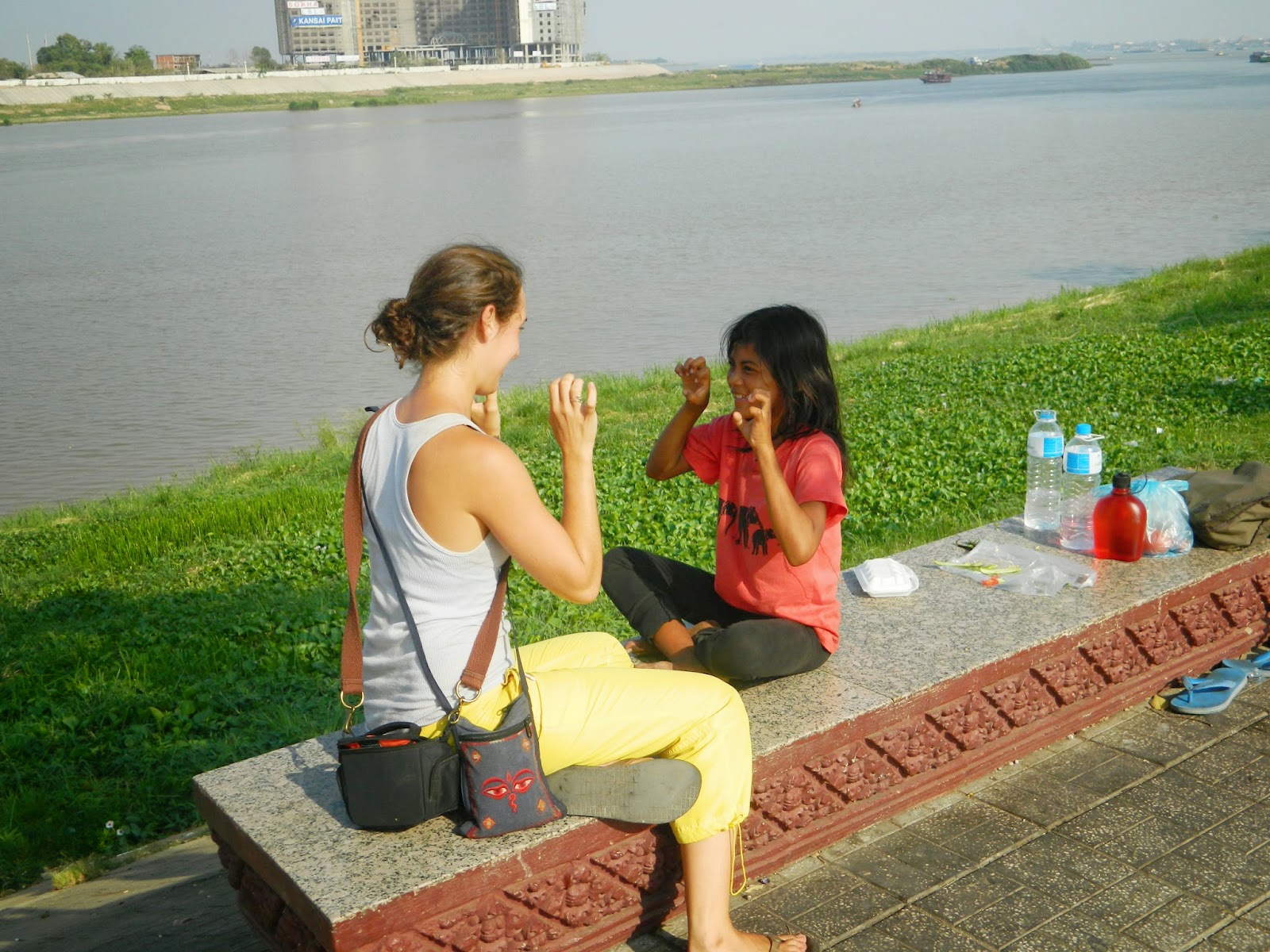
    Sharing food and games in Phnom Penh.
    Surely, you might say, I don’t need to ask to know that a starving child needs food, or that a village with no well needs potable water. Yes, there are certain basic needs, but no, you can’t assume that you know best what they are and may thus dictate another’s priorities.
    In some touristic destinations, poverty is rampant, and in advising visitors to these places, study abroad or travel guides will usually take one of three tracks:
    1. Don’t give anything to anyone. Not to beggars, not to children, not even to new friends. Just don’t, because one friendly gesture of generosity will call upon your head a veritable surge of unanticipated requests.
    2. Bring gifts that are useful—flashlights, notebooks, clothing, etc.—to give to hosts or friends. You will be offering something worthwhile, not a symbolic gesture doomed to sit on a shelf beside its untouched kin.
    3. If you are going to give a stranger something, give them food. Children, especially, almost certainly need it, and your gift will not be misused or appropriated, as money so often is.
    Other responses include: giving to a reputable non-profit, thus ensuring (in theory) that your money will be well spent; sponsoring an individual’s schooling; or offering skills or instruction, which has no (or greater) monetary value.
    I don’t have a set position on the question. All of these suggestions have merit. Personally, I am disillusioned by the distribution of spending in corporation-sized non-profits, and I much prefer the work of grassroots organizations that work in tandem with local communities. I love the option of sharing food; I think it is the most human of acts, and almost universally understood and appreciated. Sharing skills—if you have them—equally so. Material gifts are tricky. I lived with a home-stay family in Kathmandu who had an entire shelf of unused gifts from other guests like me—picture books, snow globes, and salt-water taffy, all untouched and unopened. I don’t know about the worth of gifts that serve no function beyond expressing gratitude for hospitality.
    And then, even if you do ask a community what it is they want, you will not receive a unified answer. Children may indeed want bicycles and candy—and balloons. Male elders will not seek the same help as women; each may have different priorities.

    But if you want to help the “poor, starving children of Africa” (a platitude which, to my absolute shock, some tourists have actually employed), don’t throw up your hands in despair. I think doing good begins with good intentions. Do, however, leave your presumption, your condescension and your self-importance at home. Be mindful of these complexities in your giving.
    ~
  • Rusinga Island, Lake Victoria, Kenya

    Here, I am Muzungu: foreign, white, outsider. Kids yell after us as we pass on foot (or, after realizing the walk from Mbita is at least an hour, on pika pika, moto-taxi). It hasn’t gotten old quite yet.
    There is something… there is something about the impossibility of fitting in that has always challenged me in the best of ways. In Nepal and India, no matter the effort I made to wear the right clothing, to learn the language, to immerse, I was always patently, immutably other. Here too—I can already tell.
    In Europe, not so much. I have a face that can appear French, Italian, Slavic or even Turkish according to context. Without my backpack, I can walk through a city unmolested, my status as tourist unknown, and blend into the crowd of a subway car. The chameleon has many merits, and I have certainly enjoyed exploring new places in the guise of a local.
    And on the other hand, I do not like the constant attention, stares of curiosity, shouts, deference and, conversely, hostility I receive when I travel as an obvious tourist. I certainly do not like being singled out by the Nairobi police as an easy source of a bribe, and I do not like the behavior of those men who seem to believe that as a foreigner I do not warrant the same respect as women of their own race.
    But still, there is something.
    There is something about the impossibility of fitting in that I do like. Standing out, not because of a voluntarily articulated identifier like religion, sexuality, or dress, but because of an immediately evident, insuppressible feature like skin color—like eye color, height, even language, too.
    That experience was very rare growing up in Boston, or going to school at Middlebury College. And I think most people, of all backgrounds, shy away from it because it is uncomfortable. It is inescapable. It can be exhausting and challenging. It is also, I think, important.
    There is something about the impossibility of fitting in that forces us to confront the reality of our otherness—no greater or lesser than anyone else’s. Amongst so many other reasons, perhaps that is why I travel. It is too easy to fall into the comfortable trap of sameness. Surrounded by people who look— and maybe more significantly behave speak dress and think—like us, we relax not into multiplicity, but into uniformity.
    I would rather learn how to be equally at home in my otherness as I am in my belonging.
    ~

    Home for the moment.
    Here at the western edge of Kenya, the roads are dirt and dust. An energy center in town offers drinking water, internet and computer use, solar energy and more to residents. Wifi is scattered at best.
    At the Wayando Beach Eco-Lodge, our neighbors appear to be hippos to one side and nonstop music to the other. I will teach yoga at 7:30 in the morning… if anyone shows up. I serve Tusker Pilsner to guests and fry Tilapia fresh from the lake for dinner. I have seen three different jewel-colored birds—ruby, emerald, sapphire—since writing that sentence.
    The sun burns hot at midday, but the nights bring light rain and heavy wind, and I am happy for the warm blanket in my tent.
    Eco-lodge means sawdust-composting latrines, round, self-contained huts for guests, and lake water showers (don’t worry— it’s treated for parasites). It also means fresh papaya, mango, bananas, ginger, arugula, peppers, passion fruit and sweet potato from the garden.
    We will spend two weeks here, or hopefully longer…
    To Be Continued.

    ~
  • Hostels: Beyond the Horror Movie Story

    Picture it: A group of Portuguese boys play ping pong and try not to spill beer. Behind them, Spanish girls converse– loudly– with strangers via a smartphone translation app. Upstairs, Karaoke. Someone knocks over a stool with a bang. Ten bunk beds crowd into a room about 5m2; the room is rarely quiet. Dirty dishes accumulate in the sink, and most people cook pasta.
    No, it’s not an international frat house. It’s a hostel.
    If it sounds rowdy, messy and overwhelming, well, it often is. If it also sounds like a one-stop-shop for meeting other travelers and making friends from other places, well, it’s that too.
    Once upon a time, I loved to stay in hostels. At 18, I found the chaotic collision of cultures exhilarating. Likewise the endless procession of potential friends. The noise, the mess and the banality of bar-stool banter? It was new to me.
    Over the last five years, however, something has shifted. I prefer noise in moderation. Though I still enjoy meeting new friends—and I hope I always will—I am no longer awestruck by the air of international cool that hostels exude.
    Last week, I spent six days in a Barcelona hostel after all better options fell through. For seven euros a night, I didn’t mind that one of the two stoves didn’t work, or that I had to share space with twenty people smellier than me.
    My second evening I overheard a conversation that brought home the change in my relationship to hostels. What once would have seemed a thrilling exchange of travelers’ stories and philosophy now felt decidedly, disappointingly… trite, I suppose.
    What’s changed?
    Certainly not the people, the stories, or the philosophy. So it must be me. Hostels are the same everywhere, anytime, and maybe that’s the problem. I have started to see what is the same rather than what stands out and enchants. My god, I have never felt so cynical!
    As I look at hostels now, I see less the excitement, more the noise. I see lecherous older men rather than good stories. I see travelers who never leave their rooms and parties that I could just as easily find at home.
    This is no longer where I want to be.
    ~
    Picture it: “Dragon’s breath” fog rolls in between purple mountains in the twilight. Terraces of fruit trees reach out above it. The nearest town, where square white houses cling to the mountainside, measures an altitude of 4,000ft. Nobody speaks English. Home is a small caravan with one outlet and the most spectacular view of sunrises and sunsets. Farmers load bags of almonds onto mules to carry them up the slopes.
    For the next two weeks I will be “wwoofing” (working on an organic farm) in the south of Spain. I still like parties and socializing and noise, but lately this environment feels much more my speed. There is nothing wrong with hostels, per se—my criticism may be heavy-handed—but I think I am done with them.

    I feel good here—in the heavy quiet of fog and deep space I can breathe. I can write, too, and that is more than I could say in Barcelona.
    ~
  • What is Cultural Immersion? I Don’t Think It’s This…

    “When I’m in a new place, I don’t want to go to the tourist places; I don’t want to go to museums. I want to see real things.”
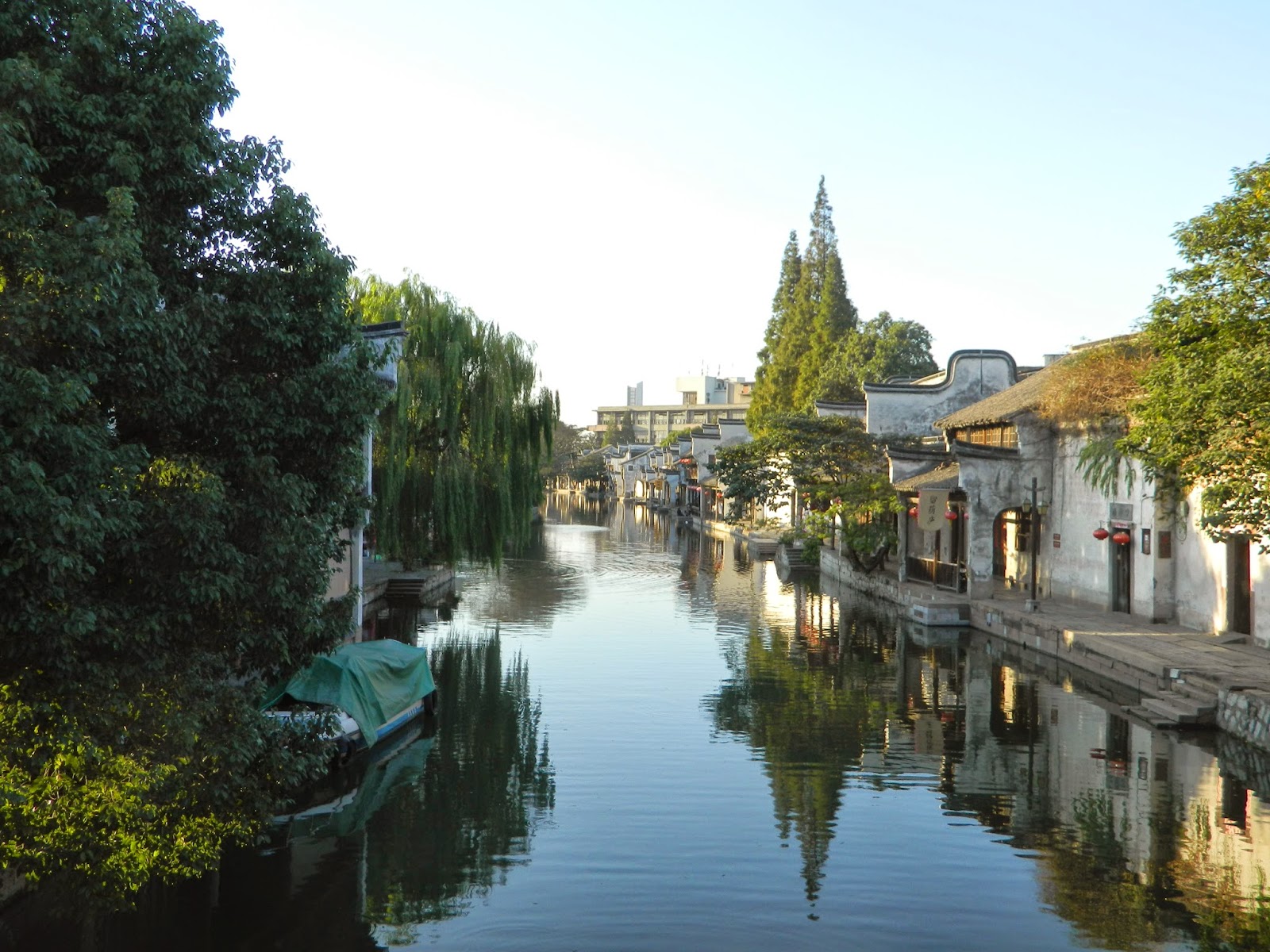
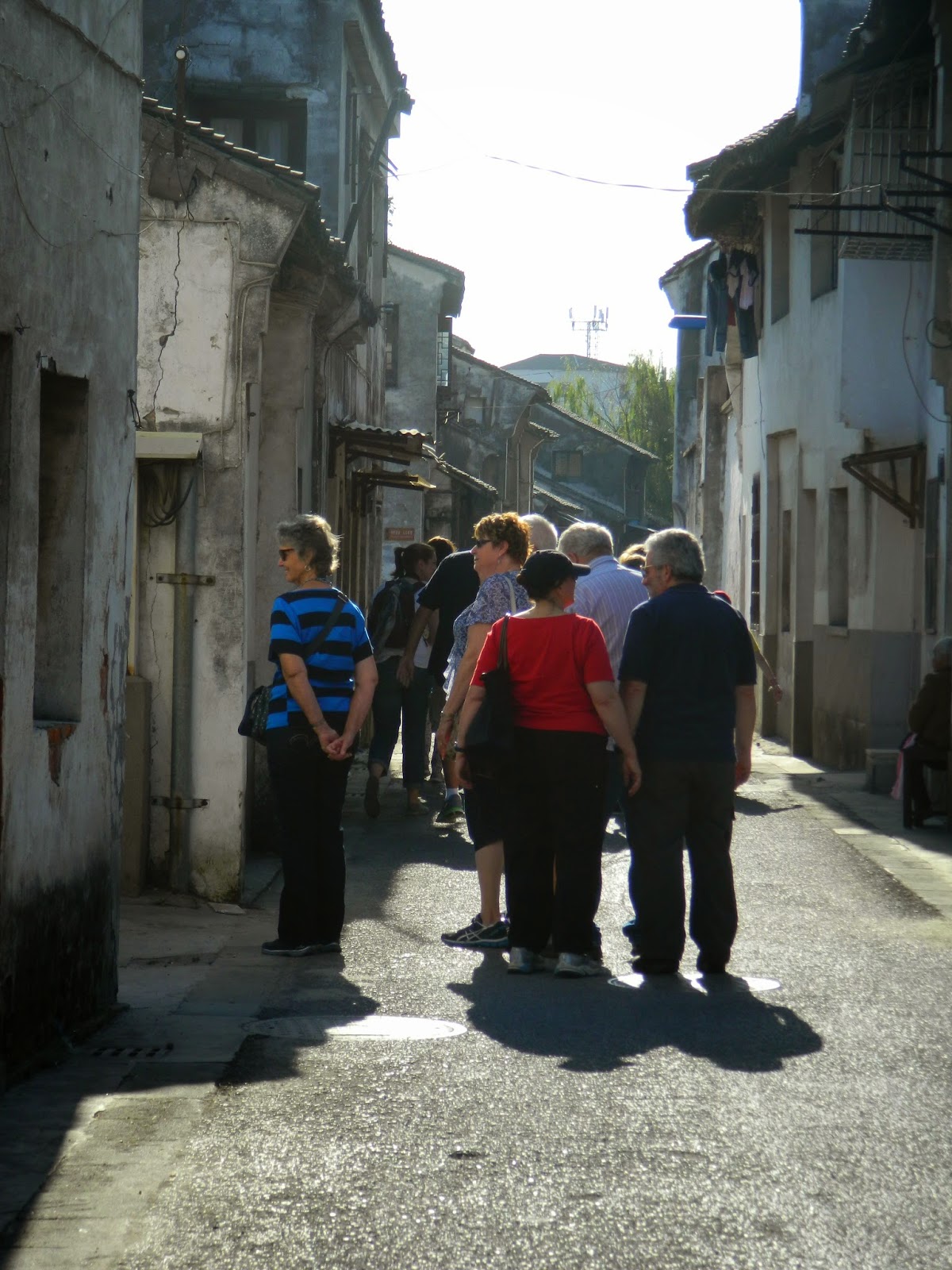
    Thus began my tour of Nanxun, a water village 1.5 hours outside Shanghai. Our guide, Stacy, began her introduction loudly, Midwestern inflection un-dampened by seven years in China.
    Here we go, I thought. I would not be sleeping as I had hoped, for all 18 participants would be introducing themselves next. I’m not sure I had ever been on a real group tour like this before, but that weekend I had the distinct pleasure two days in a row.
    Will I do it again? Quite unlikely. Am I glad I went, if only for the wealth of new writing material to come of it? Oh yes.
    As our bus hiccupped out of Shanghai, the platitudes rolled on. Introducing her partner, Mike, Stacy continued, “Of course, because Mike is Chinese, he’s good with numbers and dates and things.” 
    Chinese towns, people and art, on this tour, were only authentic if over 80 years old.
    Those who know me are aware of my crusade against terms like “real” and “authentic.” Last year, after months around tourists bemoaning the loss of “real” Tibetan-Nepali-Indian-etc culture, criticizing restaurants, cafes and people who were not “authentic” and congratulating those who were, I lost my taste for such judgments. After reading a large amount of literature on these discourses, I am convinced that “is it real?” “is it traditional?” and “is it authentic?” are the wrong questions to ask.
    Our first stop in Nanxun, naturally, was for toilets. We pulled up outside a large, nondescript hotel where around 40 staff reluctantly moved through their “morning exercises”—something resembling the bastard son of the Macarena and the electric slide. They looked especially mortified to have an American, camera-laden audience, and I couldn’t find the spirit to take any pictures. After all, we all know the miserable feeling of dragging through forced routines.
    Indeed, much of the day felt disturbingly reminiscent of an elementary school field trip I and my two aunts didn’t want to be on. We were the disruptive kids at the back of the bus.

    As we marched single file through the house of a certain Mr. Wang (a retired blacksmith well over 80 years) to see his traditional Chinese oven, all I could think was, “What is the point of this?” 
    I, like Stacy, enjoy seeing into people’s lives and homes. I tend to be nosy and curious and have few boundaries when I travel. I have participated in many home-stays and exchanges. But I hope I would never be so entitled as to walk into a stranger’s home, practically without conversation, take a few pictures, and leave.
    What did we all learn that day in Mr. Weng’s home? I, for one, have no idea.
    Stacy has branded her tours as off-the-beaten-track cultural immersion experiences. Certainly, I saw parts of Nanxun and Shanghai that I may not have stumbled on alone, but is it even possible to immerse ourselves in another culture in any meaningful way in just 8 hours? 
    I wonder.
    We spent a hefty chunk of the afternoon in a retirement home with three charming Chinese women. Why? Because, “these old folks have so much wisdom to share.” Our interview, however, proved far too short to extract much of any depth. And though I did learn that I should not dry my face immediately after washing it and that “There is more food now” than in the Mao years, that was about it.
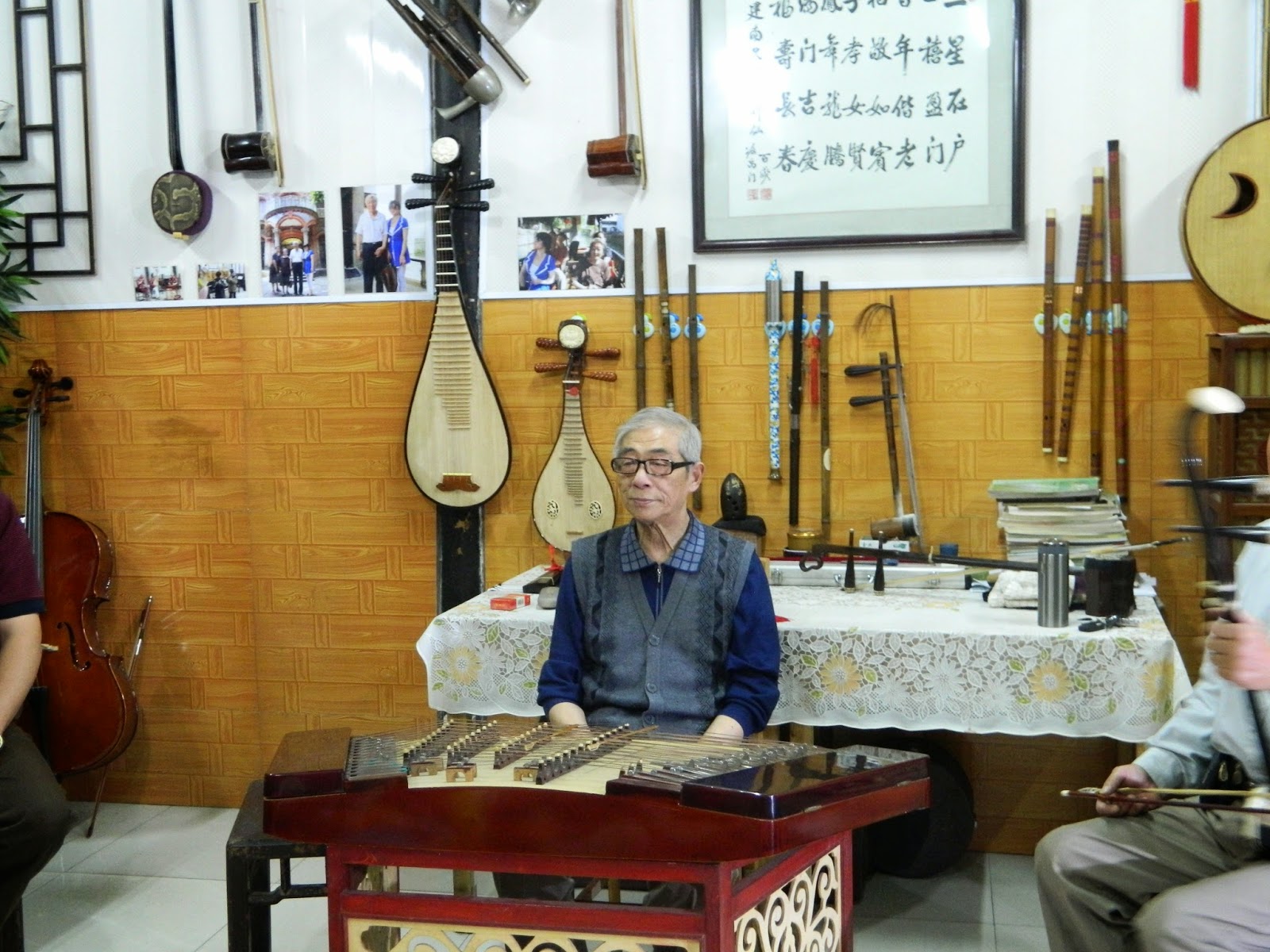
    One spry and flexible 90-something retiree led us through her morning Qi Gong routine. Later, I had the dubious honor of hearing “Jingle Bells” played on traditional Chinese instruments. Still, each stop on our itinerary, our “conversations” with local people, and our glossy overviews of entire schools of religious thought struck me as more shallow than anything else.

    Museums and retirees are equally “real.” Back alleys are not intrinsically superior to touristy main ways. Cultural immersion does not emerge automatically with the right combination of orchestrated meetings and exposure to dirt. Cultural immersion does not literally mean walking in and out of a local person’s kitchen. It is far more elusive. It requires more depth.

    That is not to say we should give up hope of having meaningful, culturally immersive experiences when we are short on time. 
    But let’s not place the things we see into two categories: real and unreal.
    When we have the opportunity to engage with another culture, let’s really engage. Ask questions. Look and see and taste and listen.
    Let’s decide for ourselves what is real.
    What is cultural immersion? That is a big question to answer, and maybe later I will try to go into it (though I’m not sure I have a satisfactory answer to give), but I am fairly certain it is not this.
    ~

  • Shanghai Snippets

    In Shanghai, everything is new. Or it wants to be new. Or it will be new just as soon as the old is knocked down and rebuilt. Retirees participate in state-sponsored activities in the park: old men manipulate Chinese yo-yo’s with surprising prowess, women join enthusiastically in chaotic dance fitness classes, and a single lane fills with the discordant cacophony of 20 different sound systems. I like it. More than I had expected. I take a stupid number of pictures of funny signs and storefronts, animal parts that no one wants to see, and gates and doors. My aunts take charge of photographing the family, and other things people will want to look at. Nonetheless, I want to share a few of those photos I took. These are the snippets and bits that caught my eye. I hope you will enjoy…
    Dancing in the park with maracas, what else?

    Fish heads– for sale or to discard? I’m not certain.

    Fresh pomegranate juice just outside the metro station.

    The Bund at night.

    Street food (pre cooking). For all of the street food fun, check out
    http://twohungryvagabonds.com/2014/10/25/cheap-eats-in-shanghai/

    “Open Lock. Make Key. Fix Lock.”
    An apt description of services offered.

    “Alley Curd,” purveyor of (the apparently
    very trendy) juice served in IV drips.
    Gates and doors.

     ~
  • Suzhou Snippets

    In it’s 2500-year history, the city of Suzhou has developed and refined many times over. It is known for its light, elegant, delicate cuisine and women. Marco Polo, when he visited in the late 13th century, declared it the “Venice of China.” Admittedly, every water town in China seems to bear this moniker, but I think Suzhou is the original.

    Suzhou strikes me as particularly ugly upon arrival. Massive, congested highways and bland, expressionless buildings. Never judge a city by its facades, of course. Tucked into pockets, Suzhou’s gardens and old walking streets are magical.

    At this time of the year, people come from all over China to eat hairy crab, a prized delicacy harvested from the lake nearby.

    If 1 billion people like something, I figure, it can’t be bad…

    You have to pull away the organs– heart, liver, etc.– in order to get to the edible parts. “No, that is not good to eat,” the woman helping us said, seemingly each time I pointed at a segment of my remaining crab.

    I am lucky to have a lot of “roe” (which I think is actually liver) in my crab. This is the best part… Finally, the crab is tasty, but very scarce, and a whole lot of work to get to. Something to try that I probably wouldn’t choose to order a second time, not least because of the cost– one 200 gram crab costs about 30 dollars!

    On our tour of Old Suzhou, our “guider,” Billy, leads us through gardens where rocks, trees and water have been arranged in perfect harmony. Everything symbolizes long life, prosperity and abundance.

    The sky darkens as our boat steers down one of the main canals. Red lanterns come to life, and streams of tourists pour along the cobblestone banks.

    While on the boat, “fighting noisily and playing on board are forbidden.”

    The laborious process of silk making emerged from this bastion of Chinese culture. Silk, you may be interested to know, is not vegan. In order to extract the silk fibers, manufacturers must boil the silk worms’ cocoons, killing the aspiring moths in the process.

    Beauty

    Is neither tradition nor change,
    But somewhere in between.

    ~

  • Servers Love When You Do These Things (Just Kidding. Never Do Any Of It!)

    After a few years working as a server, sometimes part-time, sometimes full-time, always questioning my sanity, I think it is time to let you all in on a few trade secrets. Servers really hate when you do these things:
    Hide your credit inside the checkbook.
    We don’t have x-ray vision, and it is impossible to know if there is a card in there or not. On a busy day, your server will only have time to glance over, and will assume you haven’t looked at your check yet if there is nothing poking out of or sitting on top of it.
    Split checks.
    Okay, sure, it’s convenient for you. But really, how hard is it to figure out what your lunch cost and put in that much money, or to split the check evenly between a few cards? Does that dollar difference between your meal and your friend’s really matter that much? And anyways, you probably eat with these people every week. Why not go in rounds—you know, I’ll pay this week, you pay next week? It will probably work out.
    Be impatient when you ask to split the check six ways.
    So no one has cash and you have to split the check. It happens. No worries. But realize it takes a lot of time to run 6 cards through the credit card machine. No magic wands here. Sorry.
    Hold the check hostage when it is brought to your table.
    You want to sit a while. That’s okay! (Unless it’s busy and there’s a long wait for tables, in which case it’s not really okay. But we’ll say it is.) Just pay for your food so we can close your table and forget about you. There’s no implicit contract saying that once you pay you must leave immediately, so calm down and hand over the checkbook.
    Stand right in the line of traffic while waiting for your table.
    Everyone will dislike you for doing this. When things get busy, we are running, and getting in the way is hazardous for all parties. Fifteen minute wait? Go away, sit in a corner, or stand off to the side. Be anywhere but that spot. Please.
    Ask for extra dressing. Wait for your server to bring it. Ask for more bread. Wait until they return. Ask for another beer. Repeat ad infinitum.
    Oh, your table is low on bread, beer, and dressing? Why not save us three trips back and forth and ask for it all at once? Waiting until your server brings one thing to ask for the next is one of the most inconvenient things you can do.
    Tip poorly.
    There is no excuse for tipping less than 15 percent. I tip 15 for bad service. Good service gets 18 at least, but anyone who realizes that minimum wage is $4/hour and isn’t a miser generally tips at least 20. Regulars who never tip over 15 might be the worst; clearly you like the place. For an extremely comprehensive guide to tipping, check this out: https://www.tobyisrael.me/wp-content/uploads/2014/09/TABLE-final-3.png.
    Say you are ready to order, then take 5 minutes to make up your mind.
    Every minute spent at your table is a minute a server can’t be doing any of the 50 other things they need to do, like running food, bussing a table, making drinks, or going to the bathroom. Have pity, and don’t ask to place your order until you are actually ready.
    Complain when you receive the food you ordered.
    We want you to be happy and enjoy your food. However, that statement has limitations. If a mistake has legitimately been made, by all means say something. But if you’re unhappy that the garlic potato soup you ordered has too much garlic in it, or that the salad you asked for is too salad-y, sleep in the bed you made.
    Wait to complain until it’s too late to do anything.
    If you are unhappy and there is a way to fix it, don’t say everything is fine when your server checks in on you (unless you are actually fine with it). Once you finish eating, your complaints no longer count.
    Complain, and then insist on doing nothing about it.
    Don’t complain unless you want something changed. Letting your server know the burger is under-cooked, “just to tell them,” is utterly pointless. Don’t take advantage of the free-dessert-to-unhappy-customers-policy, either.
    Be the last people sitting when it’s closing time.
    At this point, you are the only thing stopping your servers from breaking down, sweeping up, and going home. Don’t be those a**holes. When you realize the restaurant is suddenly empty and the servers are sneaking glances at you every minute or so, it’s time to leave.
    Play music loudly on your phone, sit with your chair way out blocking the path, or otherwise disrupt the meals of other diners.
    A restaurant is not your private dining room. Please remember to be a respectful human being while there.
    Invent your own menu options to order.
    Most restaurants will be flexible around modifications and substitutions. Within limits. Yes there is a chicken sandwich, pesto, and asiago chese on the menu. No, it does not say “build your own sandwich” anywhere. All of you no cheese, no gluten faddists are also getting old. The researchers who discovered non-celiac gluten intolerance now think it may not be a real thing (http://www.alternet.org/food/new-study-claims-gluten-intolerance-may-not-exist-separate-celiac-disease), so why not enjoy the bread?
    As always, I present these comments to you with love and appreciation for all those kind, considerate, easy-going diners that find their way to my tables as well. And ultimately, if you must do any of these things, it’s okay. Just realize that they are inconvenient, time-consuming or disruptive and remember to say thank you!

    Did I miss anything? Feel free share your addition in the comments!
    ~
  • An Ode to Small Towns

    In the spirit of Buzzfeed and the general ethos of blogging at present, I would like to begin this post with a list.

    You know you live in a small town when…

    1. Your customers for lunch show up at your other restaurant for dinner.

    2. You run into your “regulars” all over town. They always seem surprised to see you.
    3. Going grocery shopping consists of 2 parts socializing and 1 part buying food.

    4. “Downtown” is Main Street.

    5. Your yoga students show up for dinner, and your dinner customers show up for yoga.

    6. When you walk into the local coffee shop, it takes 30 minutes to get to work, because you have to stop and greet everyone already there.

    7. When you throw a party and invite people from various parts of your life, there is no need to make introductions.

    8. Going to the “City” (Burlington) is an excursion you indulge in about once a month.

    9. You expect greetings from strangers, and find it odd when people don’t say hello.

    10. At least a couple times a week, someone you know drives past you as you’re walking to work and offers you a ride.

    11. Everyone talks about their garden like most people talk about the weather.

    12. No one calls you a hipster when they see you a. fermenting things, b. knitting or crocheting, c. baking, d. biking, or e. wearing flannel.

    Soon-to-be homemade sauerkraut.
    Above all, it is a small, small world when you live in a small town. I have mixed feelings about the whole thing. On the one hand, I live for those coincidences and connections. On the other, I hate gossip, nosy neighbors and unattainable anonymity. For better, for worse, or for bizarre, I currently reside in Middlebury, Vermont, and that deserves a poetic tribute…

    An Ode to Small Towns

    Oh, small towns,
    I can’t decide if I love or hate you.
    You are full of people who compulsively read Front Porch Forum,
    Scanning for nuggets of gossip to purloin,
    or petty arguments to join.
    Still, your characters rival those of the Big City—
    Where else will my neighbor ride his tractor down the road,
    Wearing a cowboy hat and white Santa beard as he goes?
    Oh, small towns,
    I can’t spend a day on your streets without running across a friend, or twenty-two.
    If I have news in the morning,
    They’ve all heard it by noon.
    If I see Main Street I’ve seen all there is to see,
    That is, everything but the dump, the gym, and the local brewery.
    A night out with friends often ends with drinking tea.
    Oh, small towns,
    By your community I feel supported-
    Strangers offer rides into town
    When the rain is pouring.
    Yet at the end of the day
    When I look around,
    I see all the same faces,
    Hear all the same sounds.
    What you lack in variety you make up for in warmth,
    But even so, small towns,
    I think my time with you must be short.
    ~