Tag: travel thoughts

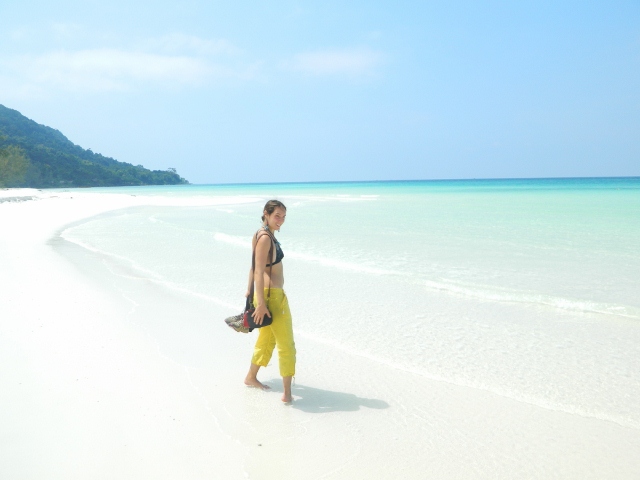
  • Escape to Paradise


    The universe provides. Yes, she really does, and I will explain the recent series of events that have bolstered my belief in that statement.  Three days ago I woke up at the Golden Fisth Guesthouse in Siem Reap, the developing Cambodian town twelve kilometers from Angkor Wat.  The temple ruins were as spectacular as I had hoped, with the murmurs of history humming beneath every stone, and I had spent two days biking back and forth to visit them.  I had also spent an enjoyable couple of evenings at the Angkor What? Bar with some new friends. In short, now I was ready to leave.
    I packed my bag (a process that has shortened from thirty minutes to ten), checked out, and spent a while deciding where I wanted to go next.  The boat to Battambang, a pretty colonial town a few hours downriver and one of my potential stops, had already left. Not wanting to waste a day, I bought a ticket to Sihanoukville instead and spent a decently comfortable night’s sleep on the ten hour bus to the coast.  In the interim, I began to hear rumors that Sihanoukville—praised for its pristine beaches and calm atmosphere—had been ruined by an excess of parties, neon paint, construction, loud music and loud tourists… exactly what I was not looking for.
    I arrived at 7am and set out on foot for town, as per usual, stubbornly ignoring the tuk tuk drivers’ warnings that it was eight kilometers away. Eight means four, generally, which is manageable.  I must have taken a wrong turn somewhere along the way, because after well over an hour I arrived not at the beach, but at the port.  It is a large, dirty collection of warehouses, smog, street food I don’t want any part in, construction, and minimal signage.  Frustrated and unwilling to retrace my steps, I formed a plan B.  Maybe I shouldn’t be stopping in Sihanoukville at all, I thought.  Maybe this means I should be continuing straight to the islands, said to be some of Southeast Asia’s finest.
    I found my way to the passenger ferry area where a few tourists from the Czech Republic were waiting.
                “Where are you guys going?” I asked.
                “Koh Rong.”
                “Is it a nice place?
                “We hope so!” They laughed.
                “Alright, works for me!”  Tickets were twenty dollars and the boat left four hours later.  I bought my ticket, found breakfast (hunted down breakfast, really), and played cards and chatted until 2pm—departure time.  In the interim, I flipped through my friends’ Lonely Planet and realized the island was a bit beyond my budget.  Oops! Perfect timing for Dave to step on the scene. The dreadlocked Aussie appeared around 1pm wearing angry birds shorts and carrying bags of supplies to the docks.  I guessed that he must work on the island.  He owns two guesthouses, in fact, one about to open, and that is how by the end of the two hour boat ride I had work decorating the soon-to-be Vagabonds Bar in exchange for room and board.  And that is how, less than twenty-four hours after leaving Siem Reap I found myself behind the bar of Island Boys Guesthouse mixing drinks and drinking in my fully affordable  new island life.
    So if you don’t hear from me over the next week, it is because I am temporarily lost in paradise with a lot to get done.  You can call it luck, fate or providence, but I am exactly where I was meant to end up, and I credit the universe.
  • Everything is Possible; Nothing is Free


    The hub of my front tire was bent at a worrisome angle. The brakes screeched so loudly they forgot to perform their intended function.  The bell did not ring and my feet did not reach the ground, but paying 10,000 kp, or $1.25 per day, I couldn’t complain about my rented bicycle.  It carried from the northwestern tip of Don Dep four kilometers along a wide dusty path to the southern side of the island, across a bridge to Don Khone, around, and back—about 25 kilometers in total—and never once muttered about the heat of the midday sun, which is more than I could say.  Don Det and Don Khone are two of the largest of the four thousand[i]islands that break up the Mekong River at the south of Laos.  I stayed on Don Det for four nights instead of my expected two, lolled into oblivion by the heady lotuses of palm trees, green water, good company and late-night bonfires.
    Both Don Det and Don Khone are incredibly flat, and my bicycle and I managed to navigate them easily enough. I stopped to see the Phapheng Falls—the massive series of cascades and rapids that thwarted 19thcentury French efforts to chart a water route from Vietnam to China.  I still haven’t seen the Phapheng Falls because when asked to pay a 25,000 kip entrance fee (approximately $3 and by all accords an inconsequential sum) I had a minor breakdown and went on my way instead.  Let me explain… I am more than happy to give my money to fledgling tourism industries, support the countries I am visiting within my means, and in normal circumstances I would never forgo a stunning natural sight over three measly dollars.  However, at that particular moment, something inside me snapped, perhaps triggered by the cold and offhanded attitude of the ticket taker: I wanted my humanity back! I was tired of being a wallet on legs, and I could not bear, at that moment, to pay for one more thing.
    A few hours later, repenting somewhat and feeling rather silly, I thought about doubling back, but the distance left to travel and the thought of the ticket taker’s face deterred me and I continued on without another thought for the waterfall.  I am not the only foreigner to lose patience with the aggressive profiteering in Southeast Asia, and I think I conducted myself relatively well.  In my two weeks in Laos, I witnessed shameful shouting matches between backpackers and tuk tuk drivers over a couple of dollars’ misunderstanding; I watched haggling turn ugly over the last quarter, and I saw smiles turn to anger in countless market interactions.
    In most of Asia, where haggling is accepted and even expected, the problem lies not in the bargaining itself, but in its tenor.  Backpackers especially complain that the locals try to cheat them and see in them only potential profit; locals complain that backpackers, who measure their poverty by a different scale, are stingy, want everything “cheap cheap” and ask rudely.  Both sides give reasonable cause for the other’s accusations.
    Everyone wants to be treated like a person. No one wants to feel like a tray of samosas or a wallet on legs, or a scheming villain.  In my opinion, for tourism to truly succeed someplace, a country’s motivation for drawing visitors cannot be solely monetary.  Obviously tourism is an industry and its purpose is to generate income, but when the desire exists to share one’s culture with outsiders, welcome them into it and benefit from their presence not only in a financial sense, transaction takes the leap to interaction.  In this best case scenario, we break the too-common boom-bust cycle of the tourism industry and see the birth of a new sustainable development model, with tourists returning regularly to places that are welcoming— neither “untouched” nor “ruined,” but real, warm, and human.


    [i]An approximate measure which I suspect was chosen for its poetic appeal in collusion with the ministry of tourism.
    ~
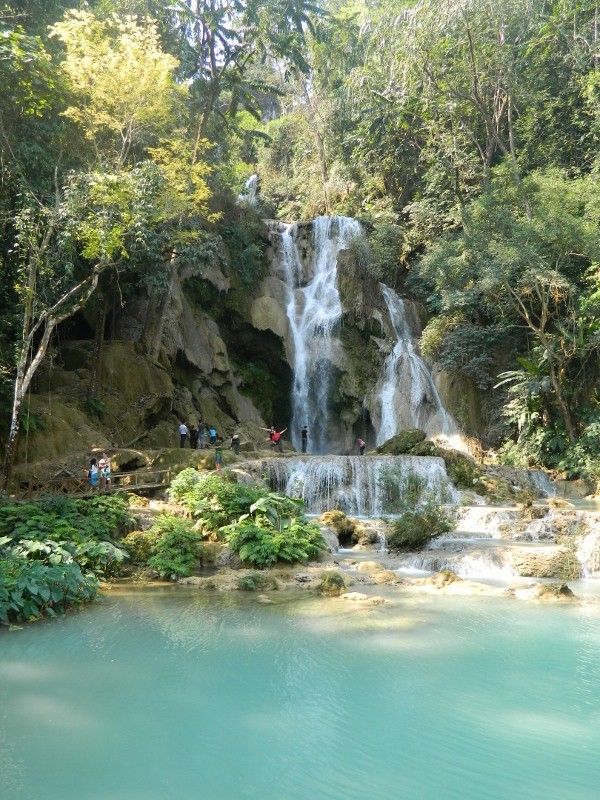
    Another beautiful waterfall in Laos, which I did pay to see. 🙂
  • In Defense of Aimless Wandering

    In Defense of Aimless Wandering

    Somehow two months have managed to sneak by me since I last posted anything.

    In that time I have tried every tropical fruit available in Sri Lanka, spent a night with my family on a houseboat in Kerala, celebrated Christmas Eve with a very drunken Keralan Santa Claus, celebrated New Year’s Eve with my big brother in Varkala, completed an intensive yoga teacher training in Goa, learned about energy healing, overstayed my Indian visa, traveled 40 hours by train from Goa to Calcutta to get an exit visa, sat on the stoop of a man named Asheef and listened to his life story, eaten every kind of street food, sampled scorpions in Bangkok, learned how to make curry paste, biked 70 kilometers to a waterfall in Laos, kayaked from one city to the next, explored a massive cave, avoided abduction by tuk tuk, gotten sick, gotten better, rushed, relaxed, walked, danced and wandered.

    Whew! The longer I’ve put off catching up, the more daunting the task has become. Since I couldn’t hope to fill in all the gaps, I will call that caught and move on to a topic that has long occupied my thoughts, especially in the last couple weeks…

    Ah, aimless wandering! Some would denigrate you, belittle and besmirch your name, but I would like to come to your defense. Each day, I wake up with no set plan, no idea where I will be tomorrow, and no worries. Each day stretches out before me in an infinite rainbow array of possibility, so bright that the future beyond resembles Sri Lankan hill country, where thick gray fog conceals green valleys of unknown depth.

    In moments of doubt I worry that this traveler’s lifestyle I have chosen to adopt for a few months might be frivolous, or that others may judge it so. But then I remind myself: I spend each day from sunrise ‘til well after dark with my eyes, mind and heart wide open—how many people can truly say that? Each day is dedicated to the new, consecrated by the unknown and celebrated by the joy of movement.

    If life is what happens when you’re busy making other plans (thanks, Jack), then maybe, just maybe, it is only without direction that we can truly live.

    I suspect I may seem to be glorifying an ambitionless, idle existence, writing a slacker’s manifesto as it were. Not so. If plans are the sticky rice of life, then flexibility and spontaneity are the hot red curry that makes that rice not only edible, but beautiful.  I would make the distinction between life without destination and life without intention—the former can manifest in aimless wandering, while the latter results in meaningless grasping.

    It is when we wander with purpose that we become frustrated, lost in the twists and curves of an unfamiliar city, unable to arrive at our destination.  But when aimless, without direction, wandering realizes its full potential, and we find suddenly, on arriving, where we were heading all along.  The best swimming holes, cafes, temples, parks and people are not to be found, let alone enjoyed, in a hurry.

    To wander aimlessly takes courage, to defy society’s demands for plans and commitments; confidence, to stand by a pursuit that on the surface has minimal value; and perhaps a wisp of insanity and a shred of common sense, to know when to keep going, and when to stop, respectively.  In small doses it can cure most ills, and in large ones it is a lethal injection to normal life.  I defend it wholeheartedly but within reason.

    To you, aimless wandering, without whom every journey would be routine.

  • 11 Things I Won’t Miss About Nepal

    On the (almost) eve of my departure, I have prepared this short rant, lest you mistakenly believe that I liked everything about my home of the last 3.5 months. The things I will not miss about Nepal are:

    1. The spitting. I don’t care if it’s culturally acceptable, hacking and spitting is still gross.
    2. The dogs. I have never before felt absolute hatred for any dog, but when gangs are barking outside my window at four in the morning, I am far too sleep-deprived to feel anything else.
    3. Specifically Lucky, SIT’s dog.
    4. Being talked about in my presence. Yes, I mean you, homestay family. I might not understand everything you say, but I know when you’re talking about me!
    5. The staring. It may be a cross-cultural phenomenon, doesn’t mean I have to like it. Besides, this is Nepal, I know I’m not that much of a novelty.
    6. Load-shedding. Twice-daily power cuts on a rotating schedule. It certainly made me appreciate the luxury of constant electricity, but I won’t miss it.
    7. Rice and potatoes. All the time.
    8. The honking. Unneccessary.
    9. The baby ladies (“please, my baby is hungry”) who borrow babies and will sell the milk you buy them back to the store and split the profits.
    10. The pollution. Carbon emissions control?
    11. Kathmandu’s Indian Embassy. Horrendous.

    Next stop India!

  • Existential Apple Juice

    A section from my soon-to-be-turned-in research paper. A little slice of life in Kagbeni and some more thoughts on authenticity.  Next post will be on a new theme, I promise.


                In academic discourse on tourism and authenticity, we often mistakenly assume that either tourists or local peoples can authoritatively define what is authentic.  In reality, authenticity, of experience as much as objects, is a transient and ever-changing concept, different for everyone.  True authenticity depends on one’s state of mind and openness to experience.  It can be contained in a single apple, a single moment, or a single-minded willingness to engage authentically.
                Less than a week into my stay at the Red House Lodge, I already had a Nepali name (Kalpana), a host of familiar faces in town, and essentially a Nepali family.  One morning, upon returning “home” from a walk, Tenzin’s daughter and employees called to me from the picnic table on the flat roof where they were shredding apples to make juice.  Kalpana! Bosnus, Kalpana.” They made space for me and I sat down on the edge of the table, trying to avoid the sticky bits of apple scattered about.  I insisted on helping, as by then they must have expected, picking up a hand-held metal grater (the kind I had only used to grate cheese), and joined my effort to theirs. 
    For more than an hour we worked in semi-silence, speaking to ask for more apples (apple, dinnus) or pass a bowl of browning mush to Ammis, who would squeeze it in handfuls to separate liquid from solid.  The only other sounds came from the rasping of small, green apples against metal, the occasional cry of hawks circling the crumbling medieval fort across the alley, and the drip drip drip of fresh-squeezed apple juice trickling into a plastic bucket.  It being an unusually still morning, the prayer flags adorning nearly every rooftop remained quiet and the strong Mustangi sun heated the air.  I changed into a T-shirt, the first and last time that my arms would see the sun in Mustang.  We paused sometimes to sample from the abundance of produce spilling from the deep wicker basket next to us, punctuating the music of shredding apples with the crunch of teeth on fruit.
    Apples of every variety grow well in the region around Kagbeni.  Marpha (elevation 2670 meters), a four hour walk south of Kagbeni, boasts the moniker “apple capital of Mustang,” but I preferred the tart crispness of the apples heaped around the picnic table that morning, harvested from Tenzin’s orchard in Pangling, just across the Kali Gandaki River less than an hour from the Red House Lodge.  Though the climate and altitude of Lower Mustang are ideal for the cultivation of apples, it is only in the last few decades that an apple economy has developed there.  Landowners have converted much of their farmland or unused property into orchards, and nearly every restaurant and guest house carries out its own small-scale apple juice-, cider-, and brandy-making operations.  Small bags of dried apples and bottles of apple brandy satisfy the demand of Nepali and foreign tourists alike for edible souvenirs.
    My skin warm and my hands coated with sticky brown apple remains, I smiled contentedly at the easy companionship of that moment, which transcended linguistic and cultural barriers.  Shoulder-to-shoulder with my Nepali didi (sister), I grated apple after apple, as quickly and as diligently as the rest, working towards the simple common goal of juice.  Moments like these cannot be manufactured, I remember thinking.  In their beauty, simplicity and spontaneity, such instances of connection and, yes, authenticity, are precious in their inimitability.  Isn’t that the conundrum of the tourism industry, which makes its millions by selling “real” experiences. 
    Some research on tourism today is employing the Heideggerian concept of existential authenticity to solve that riddle.  According to Heidegger’s philosophy, inherent meaning and connection exist, and it is these qualities that make experience possible.  In terms of tourism, when one approaches the world with “existential authenticity […], a state of Being in which one is true to oneself,” a unique experience of the world, understood from an individual perspective, becomes possible, and the tourist may experience that inherent meaning.  In these terms, authenticity is not a fixed, objective quality, but rather a state of mind, rendering it nearly impossible to package and market.  Taking the Maori’s staged cultural demonstrations as an example (which emerged as a response to non-Maoris producing cultural shows for tourists), “staging pseudo-events for tourists can, in fact, be expressions of host authenticity in deciding how to present themselves to others.”[1]  Whether a tourist witnessing this show finds it authentic is not the question here; the tourist who is attuned to his or her “existential self” will experience it authentically regardless.
    At six o’clock, the night before apple juice-making day, I ate dinner with the group of Ukranian trekkers in the rooftop dining room.  Candlelight cast faces and food into a dynamic interplay of shadow and warm glow, and we lingered over glasses of Tenzin’s mother’s homemade cider.  My dinner companions struck me at first as naïve and impressionable— every monastery, every person they met, and every interaction with local people awed or inspired them, it seemed.  They attempted to quiz their Nepali guide about himself through several layers of translation (from Russian to English to Nepali and back), saying, “we have been in Nepal trekking two weeks, but we don’t know any real Nepalis.”  Predictably, the attempt at conversation faltered, yet the more I reflect on this group of trekkers, the more I appreciate their unusual and sustained efforts at making connections.  Revisiting that evening through a Heideggerian lens, I wonder if their willingness to engage with everyone and everything they encountered and the sincerity of their desire to experience Nepal, uninformed and naïve though it may have been, might not have resulted in a truly authentic experience.
    The philosophy behind existential authenticity may appear hopelessly complex, but its implications for tourism study and marketing are straightforward yet rich in possibility.  If we admit that there is no objective authentic culture, that neither outsiders nor locals can make such a judgment, and we focus instead on individual authentic experience, existing mainstays of tourism marketing may prove misguided.  The shopkeeper who insists that, “this bracelet is really Tibetan. Really” might realize that her neighbor who converses and connects with customers does more business.  The tour guide offering to show his group the “real Mustang,” and its most meaningful cultural treasures, might lose out to the one who allows visitors to determine for themselves what is meaningful and seek for themselves authentic engagement with a foreign culture.
    Apple juice perhaps can be bottled, mass-marketed, and sold at a profit (though I believe it tastes best in small batches), but the existential authenticity contained in a moment of shredding apples at a warm picnic table cannot.  Experiences like those are invaluable, fleeting and individual; at best, a guide or tour might provide support for those tourists who wish to attain them.


    [1]Steiner, Carol J. and Reisinger, Yvette. “Understanding Existential Authenticity.” Annals of Tourism Research, Vol. 33, No. 2. Pp. 299-318.
  • When Cultural Sensitivity is Overrated and Mosquitoes Should Be Killed

    “Never step over people or tables. Don’t put books on the floor. Never point your feet at someone.” While we sat on cushions around the edges of the room, our Tibetan instructors listed for us the dos and don’ts of their culture.  “Don’t kill bugs; in Buddhism, you should show respect for all sentient beings.”  Girls should never reveal shoulders, knees or cleavage. Men and women shouldn’t touch. Never wear clothing inside out.  Presentation and cleanliness are very important to Tibetans. If you don’t follow these cultural guidelines, “you might make your families feel uncomfortable or offended.”

    My first night with my Tibetan homestay family, my homestay father zealously attacked several bu, bugs, crawling along the wall.  My second night, my homestay sister entered the room wearing pajama shorts and an inside-out T-shirt.  Day three, my homestay father wandered around with no shirt on, and day four my homestay mother wore her chuba (traditional Tibetan dress) with no shirt underneath it, revealing both cleavage and shoulders.  Their attitude, casual at all times, did not indicate any concern for the aforementioned cultural norms.

     I observed these incongruities with amusement.  My family’s behavior, so perfectly opposite from what my teachers had led me to expect, illustrates the limitations of cultural sensitivity.  In the documentary film, “Dalai Lama Renaissance,” the Dalai Lama said, “Sometimes I really find difficult dialogue with mosquito and my pain.  First mosquito come, sometimes I give blood, the second come, then the third, then difficult.”  If even the Dalai Lama feels the urge to kill mosquitoes, then we should hardly be surprised that my homestay father, an average lay Buddhist, might do the same.  The tendency to show an exaggerated amount of respect towards cultural practices not our own, to bow and scrape, even, to what we[1]don’t understand is in my opinion a little bit silly.

    Undoubtedly, our teachers’ advice proved relevant for many of my peers, but I wonder if the flood of instructions ultimately serves anyone well.  “You will make mistakes,” they concluded, “but don’t worry—Tibetans love to laugh, and they don’t hold grudges!” If breaking the rules will result in laughter, are we better off forgetting them? No; they still teach us a lot about another culture.  Nonetheless, as we worry about political correctness, cultural sensitivity and respect, I think we would be well served to not take any of it too seriously.

    The view from my roof in Bouddha!

    [1] By we I mean self-aware Americans, SIT students, anthropologists, etc…
  • Why Travel

    Killing two birds with one stone: First essay of the semester, first blog post!

    Why? 

    More often than not, when I informed people this summer that I would soon be leaving for Nepal, they asked me why. Why Nepal? Why leave Vermont? Why?  After two years at Middlebury College, where travel, like exercise and flannel shirts, seems to be self-evident, I was taken aback.  Why not, of course.  To study to learn to adventure to explore to experience.  Is that not reason enough?  Nestled in the idyllic green mountains of Stowe, Vermont, where I lived and worked for the summer, I repeatedly encountered that most derisive of queries: why.  I felt that inherent in that single word, whether spoken in earnest, in confusion or in horror, lay another, insistent question.  Why travel?

    For the first time, I sought to defend a passion whose worth I had always believed to be obvious.  I travel because to read about the world is not enough.  To know, to truly understand those places practices people beyond our immediate acquaintance, we must engage with them.  As I see it, under the new demands of globalization we have an unprecedented responsibility to know the world that has been brought to our doorsteps.  The “other” (a long-time favorite of social scientists and a frequent guest in my own academic essays) now routinely faces us from television sets, newspapers and computer screens, but our awareness halts there.  The many “others” outside this insular, Western, American society approach closer and closer along with their worlds, and continued resistance to knowing them demonstrates a pigheaded denial.  Cross-cultural learning, and ultimately understanding and tolerance, is not a choice, but a necessity.  Travel, then, when feasible, is necessary as well.

    Following the Dalai Lama’s 1959 flight to India and statement that since the PLA’s arrival in Lhasa “the Tibetan government did not enjoy any measure of autonomy,” the New China News Agency criticized his “so-called statement,” responding that “Tibet’s political and religious systems were all laid down by the Central Government in Peking… In modern history the so-called Tibetan independence has always been a scheme of the British imperialists for carrying out aggression against China…”[1]  Such gross distortions of reality did and will proliferate under the influence of world powers like China.  Statements such as these have and will become truth, picked up by media and parroted to the world.  This new truth, once accepted by a group at large, becomes for all intents and purposes reality.  Hegemony, in a word.

    When I mentioned that unfortunately my itinerary would not include a stop in Tibet and someone responded, “Is that still around?” I witnessed the consequences of more than half a century of distortion and untruths.  When, working as a waitress, I told a table about my upcoming trip and one woman said, “Nepal? Isn’t it all backwards over there?” I didn’t bother responding, but these incidents are why I believe in travel.

    Do I travel, then, to combat hegemony and engender large-scale cross-cultural understanding? My goals are hardly so lofty.  I travel to know and experience the world at an individual level.  When I examine my motives, I find, underlying the basic urge to explore, the hope that in some small way I might approach this higher objective as well.  My drive, however, remains personal: to study to learn to adventure to explore to experience.  And yes,Why not?


    [1] Avedon, John F. “In Exile from the Land of the Snows.” Harper Perennial: 1997. P68
    **Many thanks to the beautiful, brilliant Emma Pask for listening to me when I first tried to articulate these thoughts, hopefully they’ve made some kind of progress since then.