Tag: travel thoughts

  • Journeys All The Way Down

    Goes into the post office to mail home some books… 30 minutes and 90 stamps later ^^

    Once, a great guru came to a small village. 

    He gave a long speech and held forth on many subjects, and he claimed that the world rested on the back of four elephants. These, in turn, stood on the back of a turtle.

    After the wise man had finished talking, an old woman came to ask him a question.

    “Guru-ji,” she said, “You say the world is held by four elephants, which in turn are standing on the back of a turtle. But I want to know, what is the turtle standing on?”

    The man’s eyes sparkled as he answered, “Why, it’s standing on the back of another turtle.”

    “But what is that turtle standing on?” asked the old woman. 

    He smiled and said, “Madam, it’s turtles all the way down.”

    The above is an amalgamation of a dozen versions of one of my favorite philosophical tales (variously attributed to Eastern and Western lore). It comes to mind today as I slowly, dare I say reluctantly, pack my things and prepare to leave Cape Town.
    Why, I’m not exactly sure, but I think its suggestion of infinite yet symmetrical unknowns appeals to me in this moment of transition.
    As I clear out the fridge, eating my last grapefruit, savor my last coffee at my favorite cafe, enjoy a last (unseasonably hot) afternoon at Clifton Beach and write a “last blog post” before shipping off to my next destination, I seek a clever way to avoid the “lasts” altogether.
    An enigmatic symmetry and circularity have entered into my travels lately. Returns and revisits abound, and endings, more often than not, prove to be intermissions.
    And so as I peer into the infinite unknowns ahead, I suspect there is more circularity in my future. Journeys bending and spiraling in on themselves in unexpected ways.
    After my last coffee, I go to the post office to mail home a few notebooks’ worth of extra weight. Thirty minutes later, I leave behind a medium-sized envelope impressively plastered with 90 stamps.
    The scenario is comical and exaggerated; together, the post office teller and I systematically paste rows of stamps onto the package.
    I’m reminded of other boxes and envelopes I have shipped from other locations—usually filled with items whose monetary value falls far short of the cost of shipping. (Of course, you can’t put a price on memories.) Often accompanied by absurd postage situations.
    Circularity and symmetry.
    No “lasts” in sight.
    If I were to ask a wise man to surmise my future, I think I could guess at the conversation:

    “What comes after today?” 

    “It’s another journey ahead for you, of course.”

    “And what comes after that journey?”

    “Why Madam, it’s journeys all the way down.”


    Journeys all the way down…

    ***
  • Vagabonding vs Bonding: On Staying in Touch

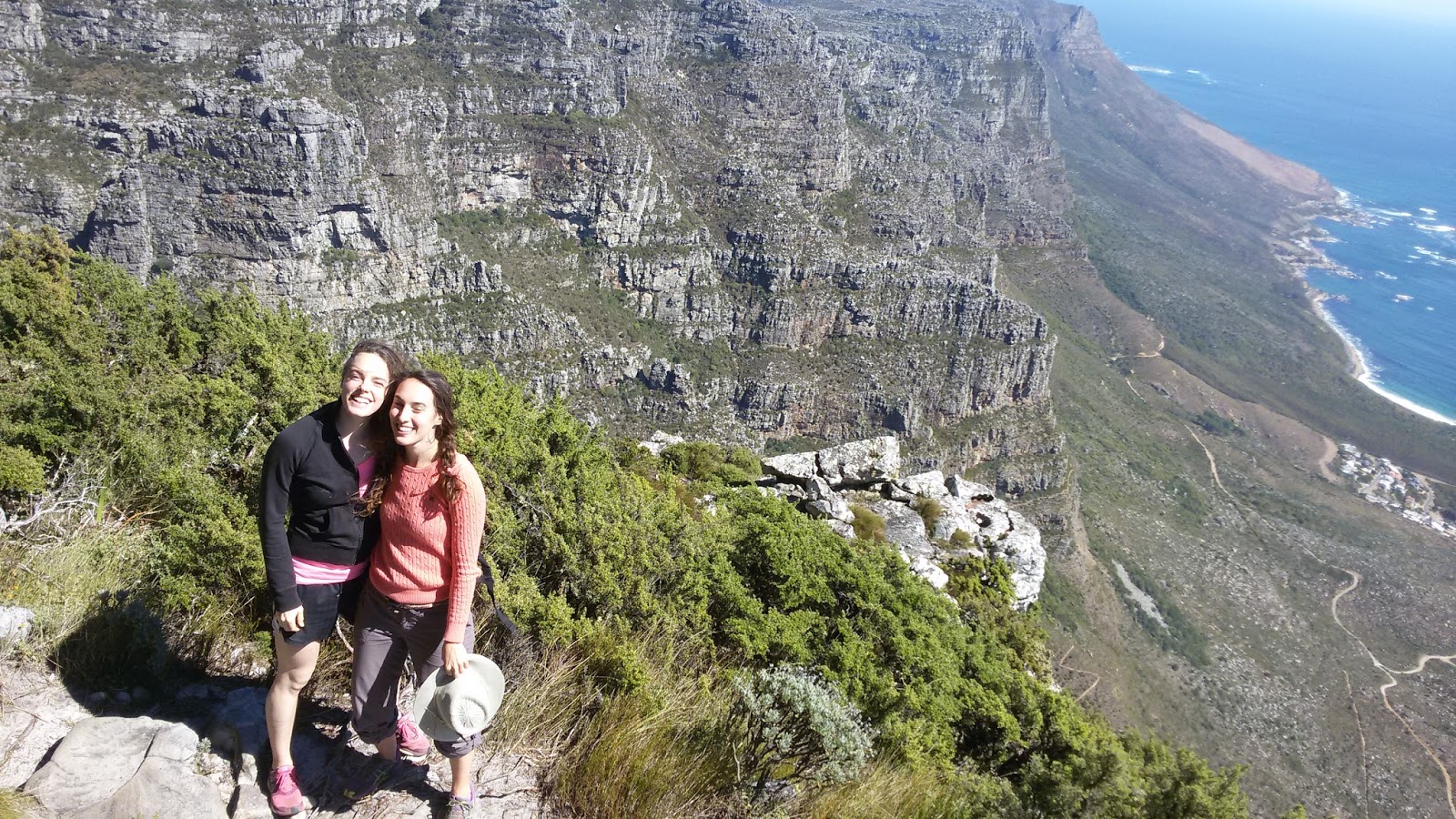
    Reunited in Cape Town: Hiking Table Mountain
    Is it hard to form deep, enduring friendships when you’re always moving around?
    I get that question a lot.
    The answer, as you could probably guess, is no and yes.
    My close friends and family span the globe, but I know I could call any one of them today—or, better yet, show up at their doorstep—and they would offer me all the love and support I could need. Of course, it goes both ways… minus the doorstep, which I don’t always have.
    And then, I typically find it easy to connect with the people around me, wherever I find myself.
    My neighbor? New friend and dance buddy.
    My housemate? New friend and hiking buddy.
    Strangers on a train? You get the idea.
    Answer one: Depth is easy. So no, it’s not difficult to connect deeply—be it for an hour, a week or a month. The more layers of artifice I burn, the more easily, and more deeply, I find connection—everywhere.
    But then there’s that other, more elusive quality: endurance. 
    Does it last? How? And if it doesn’t, how meaningful is a friendship formed in Thailand and set to rest in Laos? How deep does connection really run if it can’t follow me across borders and years?
    Answer two is longer…
    Recently, a close friend from university paid me an impromptu visit in Cape Town. Keeping the spontaneity flowing, we rented a car, picked it up the next day, and drove nearly 1,000 kilometers east, toward the Garden Route (a popular region for tourists) and a particularly beautiful place called Nature’s Valley (though we didn’t know yet that we were going there).
    As we drove on the wrong side of the road through endless stretches of caramel-colored hillsides, we caught up on the milestones of the last year of our lives. As we hiked through fynbos (vegetation unique to the Western Cape) and down to wild, windswept beaches, we discussed philosophy and travel, mistakes and purpose. As we pitched our tiny camping tent amidst rows of elaborate palatial campsites in a dilapidated caravan park, we laughed like no time at all had passed.
    Time had passed. Clear from the very new lines around my eyes and the shifting sands of love, death and discovery that shaped the contours of the interim months—or was it years?—of our lives.
    And yet, connection had endured.

    Roadside picnic on the Garden Route, and a very rare selfie.
    I could list a dozen more examples off the top of my head. Old friends joining me for segments of my travels; new friends opening their homes to me when I arrive in their city; strangers offering me a place to sleep, and becoming friends through that inimitable alchemy of giving and gratitude.
    And then there are the other friendships, the ones that take root in the rich soil of new experiences shared, yet wither when transplanted to the barren realms of social media and virtual communication—or perhaps they refuse to leave in the first place.
    Still, these, too, endure in their own way.
    A note out of the blue from a passing acquaintance met several years prior.
    A supportive comment on an article from a familiar face whose name I had forgotten.
    An unexpected coffee with a high school friend with whom correspondence had been sporadic and stunted.
    Silence doesn’t always mean disinterest.
    I should know, since I rarely hear from many I consider my closest friends.
    Distance doesn’t mean detachment.
    I should know, since I repeatedly choose to be continents, miles and time zones away from my loved ones.
    Staying in touch is remarkably difficult for an era of unprecedented “connectedness.” I have nothing to brag about—those who know me will be sure to tell you—but I am constantly working to do better.
    I’ll repeat: distance doesn’t mean detachment. 
    Connection is there. Depth is there. Consistency? We’re all working on it. 

    Forced to choose between travel and connection (that is, vagabonding and bonding), I’ll choose “C” every time. No and yes. Both. I think it’s possible.

    ***
  • Minibus Freedom: On Risk and Reward

    Stand-Up Paddleboarding (well, kneel-up paddleboarding) in Smitswinkel Bay.

    “Better the devil you know than the devil you don’t…”
    The sun beats down on my left arm, and the wind blows strong from the sea. I watch waves break and sparkle offshore as my minibus taxi races down the coastal road from Hout Bay to Cape Town.
    The views are magnificent. Breathtaking. Spectacular.
    Although, my fellow passengers seem desensitized to the sight, for which we pay 12 rand ($0.75) each.
    South African music blasts from the speakers, a mix of African polyrhythmic beats, electronic pulse and gospel-like vocals. The driver skips tracks on the mix CD—yup, mix CD—as he holds a cell phone in the other hand, seemingly impervious to the perils of this endeavor.
    These minibus taxis—cheaper and faster than a regular bus, and far cheaper than a cab—evoke a sense of freedom that their more staid (and safer) counterparts do not. Diverse rhythms, accents and languages swirling in my ear, unfettered ocean wind in my hair, shimmer of merciless heat in the air, my senses tingle, come alive to welcome the spectrum of experience on offer.
    It is more than physical freedom, though that is part of it. (By now I know the fastest, car-less route to just about anywhere I want to go in Cape Town.) It is more than the speed and ease of movement, more than the volume of wind and music, and more than the independence of needing to rely on no one to go wherever I please.
    No, if I am honest with myself—and you—there is another kind of freedom epitomized by these minibus journeys, which eclipses all the others.
    It is the freedom of choosing my own risks.

    Cape Town has huge populations of great white sharks in its waters, but that doesn’t
    stop dozens of surfers, paddleboarders and swimmers from getting out there every day.
    I’m not talking about risk-seeking behavior here. Rather, I believe most of us take most of our risks unconsciously. We drive our cars, smoke our cigarettes, drink our six packs of beer, eat our pesticide-laden food—that is, dance with our proverbial devils—all the while pretending, or perhaps believing, that our existence is safe. Secure. Unthreatened.
    I have written about this before, but maybe never so explicitly.
    I believe it is because we tend to ignore risk (or rather, complacently engage in it) where it is an accepted norm, that consciously, actively choosing our risks can inspire such a deep sense of freedom.
    People ask me, how can you hitchhike, take the minibus taxis, travel alone, go out alone, [fill-in-the-blank] as a woman, a foreigner, a young person, a small person? Aren’t you scared?
    Aren’t you scared when you cross the street, go to the mall, eat your food, send your children anywhere alone, smoke your cigarette, drive your car? How can you be a human being in this world—frail, feeble, mortal, vulnerable—day after day after day?
    That is, essentially, the question you are asking me.
    Better the devil we know. Better the risk we acknowledge.
    There is risk everywhere. We are never safe. We are weak, mortal, vulnerable to the vagaries of the world every day of our lives.
    Yet, we cross the street. We live anyway.
    I know the risks I take, and I choose them willingly, because the benefits (ah, the benefits, story for another time) far outweight them.
    The other side of the street; the end of the dance; the other side of risk?
    It’s worth it.
    On one level, my choices bring me joy, full-bodied experience, and inspiration

    But if you wanted to get philosophical about it, each time I choose my own risks, I also acknowledge and make peace with my own mortality—and that is a powerful freedom, indeed.

    Smitswinkel Bay.

    ***


  • The Bittersweet Beauty of Goodbye

    If I sift through the shadowy pathways of my memory, I will touch a hundred moments of parting and a thousand words of farewell in an instant.
    A woman stands on a provincial train station platform with her son, waving goodbye, goodbye, goodbye as my train pulls away.

    A friend hugs me in the pre-dawn shadows of an empty parking lot, then stands aside as my bus coughs to life and I step inside.

    An open window lets in dust and exhaust fumes and the last echoes of Good luck!

    The sterile lights of an airport terminal look on as I hug loved ones goodbye; they stay to watch as I pass through security and disappear.

    A last smile at the threshold before the house, car, bus, taxi, train door closes. A last wave. A last glance.
    These memories are steeped in the mixed emotions that partings will inevitably evoke—the fragrant cinnamon of nostalgia, and the piquant tingle of anticipation; the bitter smoke of an ending, and the sweet pine needle smell of journeys beginning.
    When we travel often, some things become easier with practice.
    We learn to sit with discomfort, be it overpacked buses, insufficient legroom, long flights, missed meals or interminable waiting—for delays, friends, food and horizontal sleep. And we come to accept a certain level of stress, uncertainty, insecurity—all fundamental tenets of life on the road—as the norm.
    We learn the language of timetables and airport terminals, maps and foreign street signs, and perhaps we come to navigate these worlds with a degree of ease. We find ourselves at home in a sea of strangers, untroubled by change—exhilarated, even.
    And finally, we become accustomed to goodbyes (comfortable may be too strong a word). Without a doubt we come to realize the ineptitude of words—the insufficiency of phrases like, I’ll miss you, See you soon, Good luck with everything, or even the more sardonic, Have a great life and, See you when I see you—to serve in these situations.
    We become accustomed to goodbyes, yet there is no art to them, or none that I have found. No failsafe formula. No skillful lyricism to master.
    Each one is unique in its blend of sadness, resignation, looking forward and looking behind.
    Each one is, in its singular fashion, beautiful. 
    Or, this is what I am beginning to believe. For, more than cinnamon nostalgia or pine needle anticipation, a goodbye is steeped in love. Platonic, familial, romantic, age-old or brand new, this  is love surrendered to the utter unknowability of what lies beyond this moment.
    If that love, tempered by the bittersweet awareness of impermanence, is not beautiful, then I don’t know what is.

    And so, as I say See you soon, Good luck, I’ll miss you, and Goodbye to friends and loved ones in the U.S. and turn toward the next leg of my journey, I hold onto that beauty, and my smile smells like cinnamon and pine needles, chili and smoke.

    ***
  • Next Up, Cape Town: Meeting the Voice of Intuition

    Chapman’s Peak, near one of my possible next homes.
    The flights are booked.
    Philadelphia —> NYC —> Amsterdam —> Helsinki. Short pause. Helsinki —> London —> Cape Town.
    Don’t ask. Flights, once booked, are very difficult to reroute.
    Why Cape Town?
    Summer.

    Why else? Well then, summer, right time zone for work schedule, visa on arrival, not Europe (I’m at the end of my 90-day limit for Schengen Zone), ocean, low cost of living, mountains, city…
    But actually, none of that really, truly answers your question: Why Cape Town?
    Yes, those are all reasons why it’s a good choice, yet my choice did not stem from them. Rather, Cape Town felt right, and the rational reasons followed.
    Too “woo woo” for you? Consider this: Whenever we have a decision to make, there is a part of us (call it intuition, gut instinct, whatever you will) that knows the “right” answer before we do. We can arrive at it by logic, or we can skip the winding road and hop straight to our destination—what feels right is right.
    You argue, but this is how drug addicts, hedonists and psychiatric patients are made—acting on impulse. I counter, impulse is not the same as intuition. I sat with my decision to head to Cape Town for nearly two weeks before buying tickets. I reconsidered all my other options, gave logic its chance to sort through the possibilities. But my intuition didn’t waver:
    Warm air, ocean tides—a chance to learn to surf, finally!—and hiking trails, even horses, and then all the things a city can offer: a blank slab of the unknown where you can inscribe the next months of this adventure word by novel word.
    It should come as no surprise that the unknown and my intuition are particularly enmeshed. What feels “right,” more often than not, is what appears shrouded in mystery—the yet-to-be-revealed of a new culture, new community, new dance, new sport, new path, new chance. 
    Of course, that is my “what feels right,” and I neither suggest nor expect it should be the same for another.
    It is only interesting, and instructive, to note where our intuition points us, time after time.
    When we hold a question in our mind’s hands, turning it this way and that, asking where, who, what, when and, most of all, why—what is the first voice to answer, and what does it say?
    Hello, intuition, nice to meet you!

    Cape Town, you say? I trust you.

    Trust. Jump. Fly. Photo Credit: Toni Toreno, Cambodia.
    ***

  • Revisiting

    “Revisiting” Sicily

    I have rarely been one to visit the same place twice.

    I always used to squirm uncomfortably when new friends, by way of goodbye, would ask when I was coming back, because I knew I didn’t know. I didn’t know if I would, indeed, be coming back.
    Lately, however, I meet those new friends’ eyes and say with confidence, “I’ll see you next time,” because I’ve since learned that the universe likes nothing more than to send us what, where and whom we least expect. (It seems to particularly delight in setting me down on the same path twice.)
    I can never say when or where or how this next meeting will occur, but it no longer seems so far-fetched to expect that it will.
    You see, though I was never one to visit the same place twice—the pull of the uncertain new always stronger than that of the friendly and inviting known—I can no longer claim this to be so. In the last two and a half months, I have revisited: Rome, Sicily, London and Amsterdam. I have seen friends made in Serbia, Kenya, Germany, India and Vermont.
    As I write this, I am en route to Helsinki for visit number 2.
    Lonely shoe, Helsinki.
    For a serial seeker of new places, it is an odd thing to go back to—to revisit—a place.
    And then, as most strange things are, it is also wonderful.
    I find, in revisiting, that such an act does not in fact exist; it is impossible to visit the same place twice. Friends cut their hair, or grow it; beloved restaurants close, and new ones open; memories, friendships and connections are planted, and new experiences grow from those seeds.
    More important than anything, my perspective—ever evolving, never exactly the same—makes of each “known” something entirely new, and so, in going back, I find I am always going forward, after all.
    The repercussions of this fact are almost terrifying in their magnitude. For each step that I take, there are infinite possibilities, not only ahead of me, but behind me as well. The tree that I see in summer might present itself entirely anew stripped bare in winter; the rose in bud another matter altogether in flower; the city of my 17-year-old travels lent a thousand shades of nuance by seven years’ distance.
    And so?
    And so.
    Sunset on the plane…
    Always moving onward, but am I?
    Maybe I am no longer “not one to visit the same place twice.” Maybe only now does it truly sink in that “everything” or “everywhere” is a receding mirage, the pursuit of which can carry us in endless circles.
    And still, I pursue it—encouraged, not dissuaded by the ever-expanding nature of the illusion—I willingly, obligingly circle back, and forward, and back again.
    Moving forward, or backward, exploring the new, or revisiting the old, I find the unknown in everything everyone everyplace, and I am inspired, in-spiralled, enthralled…
    “It’s no use going back to yesterday, because I was a different person then.” — Lewis Caroll
     
    ***
  • Strangers on a Train

    “We’re on our way to bible study,” says my friend. (He likes to make up stories, but let’s get real, who doesn’t?)

    It’s 10:00 pm, and we’re on the Circle Line, retracing our steps into Central London after hopping the wrong train. Across from us sits a young couple—friendly, talkative, and maybe a touch too willing to believe his absurd stories. They are sipping from a water bottle of vodka and fanta, on their way to a night out “raving.”
    Thus begins my Saturday night this past weekend. My friend alights at King’s Cross Station to head home, and I follow these strangers (soon to be friends) to Fabric, one of London’s most famous House clubs.
    We will meet another stranger on our way out of the Tube, and together walk to the venue. We will spend the next four or five hours dancing to some of the best House music I’ve heard in a year, adding new strangers (new friends) to our group as we went, and they will become, over the course of the night, no longer strangers.
    And all because we had all looked up across the aisle of a Circle Line train and said hello.
    A week prior, I went to meet my coworker in Oxford for the first time. On the trip home, the train was rush-hour packed—standing room only. Series of unexpected events, I found myself squished next to a fellow American; as foreigners are wont to do, we struck up a conversation, found it fascinating, and continued it over a particularly delicious dinner in Notting Hill.

    And all because I had asked (in my unmistakably American accent), “Is this the train to London?”
    When did we grow afraid of strangers? When did the popular wisdom for travelers shift from, trust the road and the good Samaritans who walk it, to, trust no one? When did two strangers—or four strangers—talking on the train become the exception, rather than the rule?
    I have an advantage, in that nothing about my thin five foot five frame and wide smile inspires fear or mistrust. There are fewer barriers for me to cross to arrive at the human beings inside their protective circles.
    Some of my most entertaining nights out, fascinating conversations and closest connections have occurred simply because I looked up and said hello. Though I occasionally forget and succumb to the comfortable bubble of my own world, I try to make a rule of talking to strangers—I have yet to regret it.
    And then, when you think about it, aren’t we all just strangers on a train?
    Busy watching for our station, looking out the window, or within, or anywhere but around us, we don’t realize that the train is it. There are no stations, no stops, and for all we know no destination.
    Our fellow passengers? We’re stuck with them—better hope they don’t smell—and we can make of that a party or a burden. The Buddhists will tell you the train is an illusion; the Jews will tell you it’s the only thing that’s real. One thing I know for certain: It’s what we make of the ride that counts.
    So we can either look up and say hello, and make the journey worthwhile, or we can keep staring at our shoes, waiting for the conductor to call our stop.

    Try saying hello to a stranger today and see what happens. Maybe they’ll tell you their life story. Maybe they won’t respond. Maybe that stranger will change your life—or your day, or your next ten minutes. But no matter what, isn’t it more interesting than your toes?

    ***
  • Traveling Light: “Only What I Can Carry” Photo Project

    Traveling Light: “Only What I Can Carry” Photo Project

    Saturday, October 3rd, 2015. Helsinki, Finland.

    [This is only an excerpt from a longer piece about this project written for elephant journal. For the full story please click here.]

    The afternoon sun is kissing the tops of the pines surrounding my friend’s house, and I am packing.

    I’ve had an idea in my head for months now, and seeing as I’m in no hurry for once, this seems like the perfect opportunity to realize it.

    I’ve been living out of my purple, 60-liter Osprey backpack for just under a year now. This is the second time I’ve done so, and I can pack in 10 minutes—15 tops—when needed.

    Today, though, I take my time to fold my clothing into neat piles and gather every last small belonging into a compact square in the center of the floor.

    I’m not exactly sure why, but taking stock seems important…

    The more I travel and the longer I wander, the better I understand how much I need, and how much I am able to carry. (And still, always, it is too much.)

    More and more, too, I recognize the difference between need and desire—the meaning of priorities. I don’t need even half of what I choose to carry with me. I do in fact need my laptop for work, and maybe a few changes of clothing and some warm layers.

    But my practice poi? Small bag of jewelry? Pretty shirts, oversized headphones and red lipstick? Indulgences and whimsy—and I know it…

    What I keep—I recognize I keep out of attachment, not out of necessity…

    This is only what I can carry.

    Some of it I need; some of it I want, but if it’s too much weight or doesn’t all fit, something has to go.

    This isn’t for everyone; hell, it may not always be for me. Nevertheless, this is a viable way to live, and—I believe—a powerful exercise in living simply.

    I hope these images might inspire you to try the same—even if it’s only for a walk around the block! 😀

    [This is only an excerpt from a longer piece about this project written for elephant journal. For the full story please click here.]

  • Reflections on a Birthday: Wandering, Searching, & Answering the Call

    Yesterday, I turned 24.

    The past year has been anything but boring as vagabonded my way from Europe to Africa to the U.S. and back, teaching yoga, doing marketing, starting work at elephant journal and publishing over 100 pieces of writing along the way.

    Some of it I’ve written about here; much of it I haven’t. I’m committed to keeping this a travel blog only, and so today, that’s what I’d like to focus my birthday reflections on: this journey.

    A little over a year ago, I decided to go on a vision quest—four hungry days and nights alone in the Vermont wilderness.

    I was looking for something… I didn’t find it.

    I found nothing, in fact, save for a few lovely dragonflies, ducks, and one very long, very cold night stranded beneath the stars.

    Traveling—maybe—is a little bit like that.

    First, we answer the call. Second, we set out into the unknown. And third… third maybe we bring back nothing from our journey. What then?

    As I’ve written before, I’m not searching for [fill in the blank], and so it’s very unlikely that I’ll find “it” anytime soon. And sometimes I find myself stranded beneath those metaphorical stars—cold, hungry or lost… or all three!—and I wonder how the hell I ended up there. What crazy, impulsive, excellent decision got me there?

    But it’s always the right place.

    The stars never wonder why I’m there; they know, and at least that’s one of us.

    You see, I have a philosophy I love about journeys, choices and life, and it basically goes like this:

    Each of our lives is like a forest, or a valley, a mountain a desert, etc—it doesn’t matter—absolutely covered in paths.

    When we look around, we see all of those paths—infinite options, possibilities—choices to be made.

    But when we look behind us, we see only one path—our footsteps in the sand, tracks through the woods, etc—our path.

    That path—our path—is the only path we could have walked, because it is the one we have walked. And each choice we make—once it is made—is the only choice we could have made, because there it is behind us—another footprint, another step on our path—past.

    We answer the call; we make our choices. 


    I find this outlook deceptively simple, quite practical and deeply compelling. Maybe you will too.
    When I look at the year behind me, I see each step that has brought me to this place (a cozy couch in London, England at this particular moment). I regard that winding journey without regret and with no small measure of appreciation, for without it I would not be here—the only place I could possibly be.

    When I look at the year ahead, well, I do so with butterflies in my stomach and wings on my heels, because the forest is so vast—the paths so numerous—that I can take in but a fraction of it at a time.

    And that is every life—not only mine. Every year, every birthday, every moment and every step.

    I believe that, and the stars agree.

    Thank you for being a part of this journey—as a reader, a friend, a star, or all three!

    ***
  • I Want to Do All of the Things

    This is not a bucket list.

    I wrote this list a few weeks ago as the realization dawned on me that, without exaggeration, I want to do “all of the things.”

    There is not a country I wouldn’t want to visit, a language I wouldn’t like to study, an art or dance I wouldn’t want to learn or a food I wouldn’t want to try.

    Whenever someone shares a story of adventure, I listen carefully—not only out of friendly curiosity, but also out of a vested self-interest—making mental notes for the day I can follow their trail, or blaze my own.

    In the invigorating—and overwhelming—rush of ideas that tends to accompany an “I want to do all the things” epiphany (it’s not my first) I decided to try something new.

    I decided to write it all down.

    This list is a work in progress. I have surely forgotten things, and will doubtless add other ideas I haven’t even thought of yet. The list of places on the left is woefully incomplete, and I know I’m missing something major… no matter.

    One thing is certain, however: This is not a bucket list.

    These are not things I’m hoping to do some day in the future, before I “kick the bucket”; rather, these are (all) things I want do do now. Tomorrow. Next month. As soon as possible… It might take a decade or five, but I’m starting yesterday.

    My list includes the following items:

    • Travel the TransSiberian (or TransMongolian) Railway
    • Go to Argentina to study Tango—and Spanish
    • Go to Brazil to study Capoeira—and Portuguese
    • Travel across a country by horseback
    • Join the circus (learn a circus skill first)
    • Travel through Poland and Eastern Europe with my grandmother’s suitcase.
    • Chase the Northern Lights (I tried last week… no success)
    • Hike the Long Trail (VT)
    • Climb some tall mountains
    • Find a way to contribute—anywhere… everywhere.

    That’s just a few.

    Is it an extraordinary privilege to be able to look at every single item on this list as a real possibility? Absolutely yes. Am I still searching for the right way to be of service as I pursue these passions? Of course—although, since starting work at elephant journal I feel more assured of that side of things.

    Perhaps most importantly, why? Why do I want to do/try/learn/see all this?

    Why the tireless pursuit of adventure?

    A little secret: There is no why.

    There are secondary reasons—to learn, understand and grow are all real and valid motives. But they are secondary. The primary “reason why” is formless.

    Because.

    Adventure, travel, wandering, journeying for me have always been (and may always be) a raison d’être. A “why” unto themselves.

    That is, I do not wander because ______, or travel to _______; but rather, when in movement, when in the pursuit of adventure, I have no need of why’s.

    I do not wonder why I am here, what I should be doing or what my purpose is… I simply am.

    And so I want to do “All of the Things,” because so long as this list (and its much longer mental counterpart) are close to my heart, my wings beat of their own accord. Existence, then, is its own end—and that is every thing.

    So… what’s on your list?
    ***
    [I’ll be in London now through (almost) the end of October. Checking in after 2 weeks in Helsinki, Finland, which were so packed with adventure I haven’t had time to write about them yet! Much more to come on that very soon.]

  • What is this Feeling? …Nostalgia??

    Stunning views from my seat flying Catania, Sicily to Istanbul (on my way to Stockholm…
    I should not have opted to fly that way, and now I have no luggage… ah, well… collateral.)

    Lately, I’ve been experiencing a sentiment I’ve never known before.

    A strange tightening in my chest when it’s time to pack.

    An odd sensation as I watch the ground shrink below me during take-off.

    An unfamiliar twinge as I lift my hand to wave goodbye.

    I feel excited to be continuing on to the next place—of course, that goes without saying, and, I suspect, will never change.

    And yet… and yet…

    I think I would call it nostalgia, this new feeling.

    First it was Zanzibar, and now Sicily.

    Maybe I’m growing sentimental in my old age. (Just kidding—my old age is a long, long way away!) Maybe I’m allowing the places (or these people… or these lives, discretely wrapped packages of time, space and possibility) I briefly inhabit to reach a little bit deeper than I used to—sending out just the finest roots beneath my skin.

    Or maybe it’s an inevitable side-effect, which has simply run unrecognized along the sidelines up until now.

    Wherever it comes from, this nostalgia weaves a duskier hue at the edges of my leave-takings. A slight reluctance (never stronger than the bolder urge to continue on, but there nonetheless). A bittersweet recognition that I may in fact miss this place (these people… this time… this particular configuration of life)—that I was happy here.

    It’s the taste of the last sip of hot chocolate, and the color of the faded corner of a photograph. Savoring. It’s the feeling of lingering before standing up to leave a cafe… and it adds, I think, a lovely dimension to each journey onward—a depth, a balance to anticipation.

    While this feeling—this nostalgia—is unfamiliar to me, I welcome it. I acknowledge it (for it undoubtedly deserves its place in the scheme of things), and then I leave it beside the photographs, memories and written pages—where it belongs.

    So. Nolstalgia… welcome to the adventure!

    ***
    Greetings from Stockholm, Sweden, where I am visiting my oldest friend for the week. My luggage is dwelling in Istanbul at the moment, but I will be sharing some amazing shots from Sicily as soon as it finds it’s way over here!
    ***
  • Being versus Seeing


    So, what are you doing here?

    They say it kindly—with honest curiosity—and they say it in Italian, but that is the question.

    The woman at the cheese shop who patiently helps me taste 10 local varieties before wrapping up my selections. The barista at the cafe on the large piazza near my apartment. The elderly gentleman who insists on guiding me through the steep valley from Ragusa (the newer city where I stay) to Ragusa Ibla (the old medieval part of town).

    They want to place me, and I want to help them.

    Entering the valley.

    I explain, in as few words as possible, my work-travel creation. That is, more working than traveling; more living than exploring.

    And, sheepishly, I recall inwardly how disappointing a tourist I have been…

    I managed to climb the bell tower of the main cathedral. I spent an hour in Modica, one of the next towns over, tasting chocolate made the traditional (unbelievably delicious) way and eating granita. I’ve visited a few beautifully restored churches (a huge earthquake in 1693 destroyed most of the older architecture, and I’ve wandered many of the small, hilly streets, eating gelato, canoli or any other treats I stumble upon. I have the good fortune to be staying with two teachers, and have attended a few dinners, lectures and expositions with them, too.

    Cattedrale di San Giovanni Battista (and the piazza)

    It’s not nothing, but it’s not much, considering I’ve been here 10 days already. Compared to past trips, when I managed to cover as many countries in a month and spent entire days on an expedition to see a city from top to bottom, it’s not much at all.

    What’s changed? Quite a bit…

    These days, I don’t have so much free time.

    Between trying to regain a daily yoga practice after injuring my hip, working six to seven hours, chatting with my hosts (my Italian gets better by the minute!), cooking all my meals and trying to write besides, I watch my days fill up fast.

    Most days, I’m happy to get a walk in, a visit to the market and maybe an hour at a cafe.

    In the valley: gate to nowhere.

    So when I feel “guilty” for not doing or seeing as much as I can while I’m in this new town—this place I’ve never been before—I gently remind myself that actually, I’m not here to visit, to tour, or to see.

    I am here to be.

    Not, I am in Ragusa to ____.

    Rather, I am in Ragusa.

    That’s all.

    Ragusa Ibla.

    It’s a subtle shift, but it relieves some of that odd pressure of being a tourist or traveler—here to see, absorb and record as much as possible.

    And I find I am only capable of this shift because I have “an excuse.” I’m working, I’m not on vacation, I’m girando (moving around), but I’m not a tourist… blah, blah blah. Excuse or no excuse, maybe this is the way to do it—for me. (You can do it however is the right way for you, of course.)

    Seeing what I see and doing what I manage to do, but moving my focus away from quantity of recordable events, I can experience my existence here without expectations. The same way I would anywhere, without the badge of “travel” tacked onto the box where I store and process those stories.

    What does it mean to focus on “being” in a place, rather than “seeing” a place?

    Well, that’s what I’m figuring out right now… I’ll let you know.

    Ragusa Ibla.

    ***

  • Why Am I Here?

    2:00 a.m. Rome, Italy. Fiumicino Airport.

    I arrive haggard, disoriented and ready to drop after a red-eye from Detroit, a 12-hour layover in Amsterdam, and a much delayed flight to Rome.

    Naturally, my pack is last to appear at the baggage claim.

    Even so, I fall into a taxi (my only option at this hour) reluctantly—unaccustomed to paying so much for so little. I direct the driver to Trastevere—my favorite Roman neighborhood, where I will spend the next five days. My Italian, which received a surprising amount of use in Africa, rises quickly to my tongue.

    I sit back, desperately wishing, but unable, to sleep.

    As the damp night speeds past my window, I watch it in a daze. Thanks to some alchemical blend of exhaustion and disorientation, I feel none of my usual enthusiasm.

    And for what may be the first time in my entire life, I find myself wondering, “Why am I here?”

    The answer is simple to a fault. I chose to come to Italy (rather than return to Zanzibar) because 1. I love Italy, 2. I speak Italian, and 3. It was easy to get here from Amsterdam, where I had an un-cancelable flight to anyway.

    I have many times answered the question, “Why travel?” for my own benefit and others’. I have many times defended wandering as a path and destination unto itself. So why ask, why am I here? Why now, when finally I have a great job that I love and the first green shoots of a writing career to show for my efforts over the last year and a half?

    Perhaps it is the openness of it all—my life, that is. The lack of timeline, the total freedom of movement, the sheer vastness of being, which, when made reality, frankly baffles me.

    If you asked me right now why I am here, what I am going to do or where I am going—in the metaphysical, not the practical sense of the words—I would answer you honestly: I don’t know.

    Right now, though, a few crumbs remain scattered from my meal over the red and white checkered tablecloth. A nearly-empty glass of red wine sits before me, and across the lane, a mesmerizing wall of quivering paper butterflies. Beside that, a pile of selfie sticks.
    Tourists wander by in their summer dresses and Sophia Loren style hats, carrying cones of gelato or holding hands. The cobblestones are worn and smooth here, and high yellow walls rise up into the night. The streets are lined with tiramisu kisses, echoes of tambourine music, and spiralling jewelry I would like to buy. The air breathes slowly, wafting the scent of basil, garlic and bread through the scene.
    In this moment, then, I do not ask, “Why am I here?” 
    I am simply here.
    That–so simple and yet so profoundly complete–is the point. I am here. Tomorrow I will be here, and the day after that, and every day, hour, moment following.
    A hundred voices clatter against the wall–Italian, French, English, Spanish and others I can’t understand–and I am here, listening.
    The tang of red wine (della casa, of course) lingers on my tongue, and I am here, tasting.
    A yellow glow bathes the faces of visitors walking their dream across the butterfly wall, and I am here, watching. I am grateful to call this my reality.
    The particularities of the scene around me confront my senses–the man selling lighters shaped like toilet seats; the couple beside me who have returned to this same restaurant after visiting two years ago; the tap tap of gold heels on cobblestones; the clutter of languages in my ear; the fatigue of lingering jet-lag–and I am here, living in it.
    Why am I here?
    That I don’t know, but I am.
    ***
  • I Might Really Miss This Place

    A rainbow came out especially for my “picture-taking day.”

    As I prepare to leave Zanzibar (Nungwi, more specifically; East Africa, more broadly), the place that has begun to feel like home, I find myself struck by surprising waves of nostalgia…

    With one foot over the proverbial threshold, I observe this place with the forgiving nostalgia of things already past.

    Mambo poa? Poa, vipi? Poa poa. Za asubui? Salaama, na wei wei? Mzuri sana. Mzima. Mzima.

    The daily greetings—long and impossible to translate (in all honesty, I don’t know the meanings so much as the sense)—through which I finally navigate with ease after months in the region.

    For Travellers: Next door to my home, Kipangani Villa.
    The familiarity of Hafizi, the vegetable guy, Chef, the owner of “Chef’s Baking Shop,” and several other business owners and neighbors who, day by day, have slowly accepted my presence in their world—though I will never “fit in” here. To a few, I am not anonymous—more than a transient foreign face—and that means something.

    Chef’s Baking Shop (and Restaurant).

    Hafizi, the vegetable (and fruit) guy.

    My hard-won comfort—with the basics of Ki-Swahili; with the daily trials of moving through an unfamiliar cultural and physical landscape; with all the tiny frustrations that sometimes build… and sometimes fade into irrelevance.

    The neighborhood cow.

    Road to my house.

    The herds of cows on uneven dirt tracks, which I pass through on my borrowed bicycle with its one brake and working bell on my way to work; the brief but regular power outages and occasional mysterious absence of water in the taps; the proliferation of rambutan spiders, mangos and goats and the scarcity of apples, cheese pets and pavement; the trash cart hitched to a skinny cow, the call to prayer at sundown and the rocks that bite holes in my sandals.

    Nungwi Village.

    All of it—tiny details insignificant to some, inconveniences to others—to me, these minutiae are the source of my nostalgia. They are symbols, signifying that I am “there”: someplace far far older than I, but new to me. Not “here” in the familiar, alike, easy—“elsewhere,” and thriving in it.

    Second-to-last sunset.

    And then there are the sunsets over the ocean, the orange-gold breeze as I teach yoga, the palm trees and the beach; the sumptuous Arabic-style décor of restaurants that charge less than MacDonald’s for a feast, the silhouette of dhow sails on the horizon—the part from guidebooks and travel adverts is also here, though far more complicated than the brochures would have you believe.

    Of course, a hundred moments of frustration, anger, discomfort, exasperation and rage punctuate that seeping, honeyed nostalgia, reminding me why I am leaving—why I am ready to go.

    Nonetheless, I think I might really miss this place.
    As I write this, I am sipping my last cappuccino at the Zanzibar Coffee House (my favorite place in Stone Town) and uploading the handful of pictures I managed to take in my last days on the island. I will go to the airport this evening and travel about 40 hours for a brief visit with my family in Vermont.

    Next stop: Sicily.

    I hover in the place of in-between’s as I figure out what is next—uncertainty looms as always in shades of vibrant expectation and somber apprehension. I am reminded, again, that home is a thing that fits in a cupboard in my mind… the trick is remembering where I left the keys.

    ***

  • The Joker

    Photo: Wikimedia Commons

    His eyebrows are raised at the center in a perpetual arc of surprise.

    A cap typical of observant Muslim men in Zanzibar perches over his round, childlike face, but he resides squarely in middle age. He wears a blue t-shirt and blue jeans, and in his arms he holds a little girl dressed in powder blue satin.

    She is not his daughter.

    Throughout the bus journey from Nungwi to Stone Town, each time a child arrives at the back of the open-air bus, the man immediately reaches down to lift it on board. Sometimes he returns it to the parent, sometimes he holds it on his lap.

    The children are unfazed, far more concerned with staring at me through kohl-rimmed eyes. He is normal; I am not.

    At one point, the man holds two children on his lap. He is a joker—comical expressions etched on his face. He loves children, he says. It becomes a joke: the women around him laugh each time he jealously pulls a child into the bus and onto his lap. No one thinks it odd, and no one at all questions his motives, as would surely happen in the U.S.

    He loves children, he says, and it is his great luck that there are so many aboard today.

    Maybe he has no family of his own. Maybe he is unable to have children. I don’t know, nor would I ask; nor could I understand the answer had I wanted to.

    Watching the man before me—the joker in the blue shirt and blue jeans, little doll baby dressed in blue satin on his lap—I can’t help but smile along with the other women.

    Photo: Wikimedia Commons

    This is one of the things I love about Zanzibar, and places like it: When it comes to minding children, everyone helps everyone. Neighbor helps neighbor; kin help kin; strangers help strangers.

    When a mother and her child approach a bus (more of an open-air, low-back truck), ten pairs of hands instantly reach to lift the child into the vehicle and hold it steady.

    You won’t see that in the U.S. or most of Europe (although, to be fair, getting on the bus in the U.S. is not quite the same ordeal). There, if a man went to hold a child he didn’t know, he would probably be screamed off the bus.

    I love the trust and community underlying the scene before me.

    That said, my appreciation is hardly romantic. This is one context… Where is that community when it comes to the “every man for himself” mentality of Nungwi businesses? I want to know. Where is that trust and support when business owners attempt to navigate the cloudy waters of the tourism industry, stepping on one another to keep from drowning? I don’t see it.

    Still, the man with the round, surprised face makes me smile today. I consider—not for the first time—that I will really miss this place.

    ***