Author: Toby

  • One Reason I Am in Love with Cape Town

    South Africa—Cape Town included—is a complicated place. 

    It is complex, fraught with tension and not particularly safe. It is fascinating, for this half-anthropologist, half-writer (and 100% curious human being), and it is sad. Cape Town, specifically, is diverse, vibrant, disjointed, anachronistic, cosmopolitan, wild, chilled, cohesive and embattled, all at once.
    It is the kind of city you fall in love with.
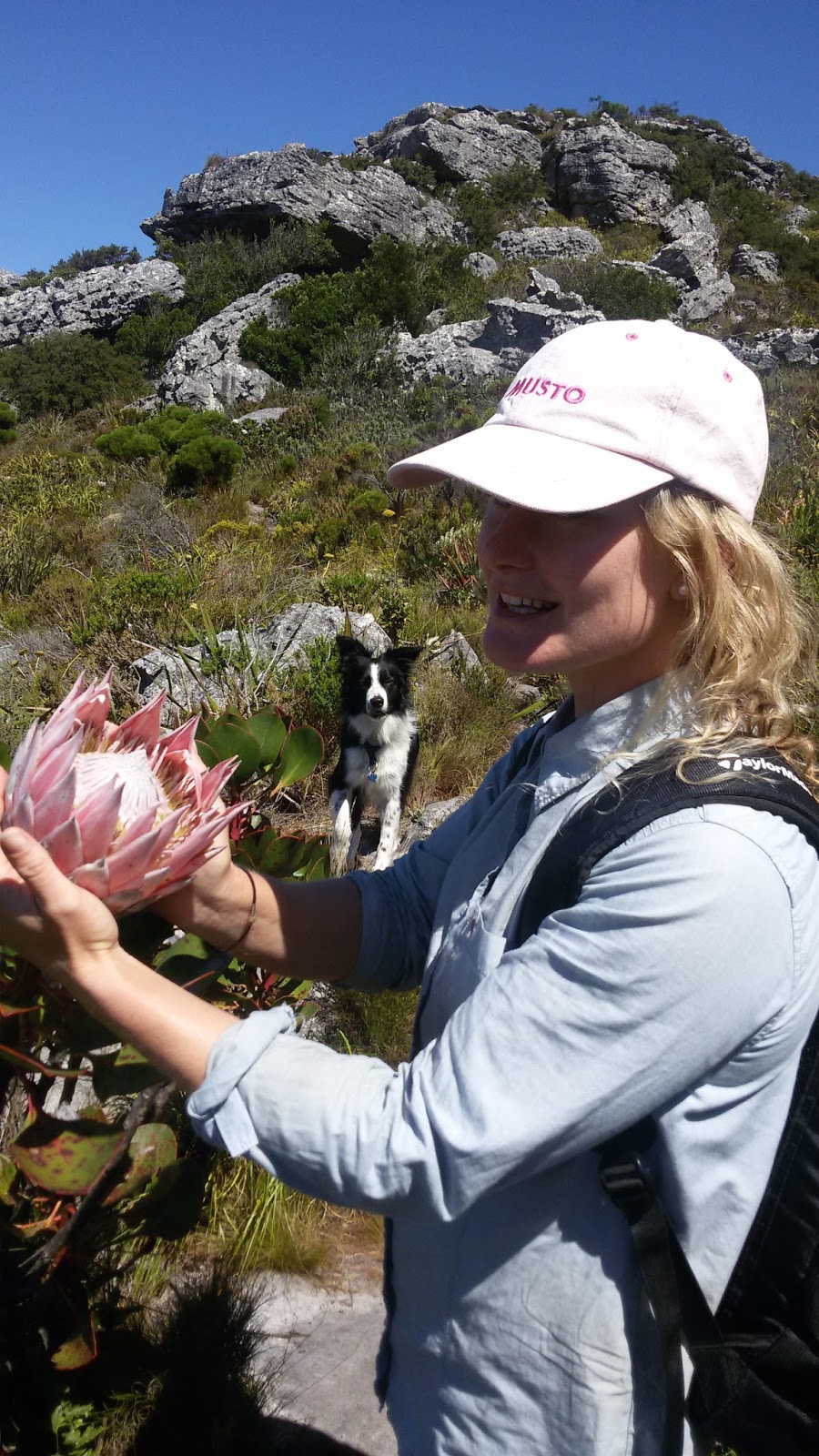
    But you could take all that away, and I would still love Cape Town for the simple fact that this natural beauty
    is everywhere.

    Mountains. Lakes. Oceans. Rivers.
    Sparkling cobalt water,
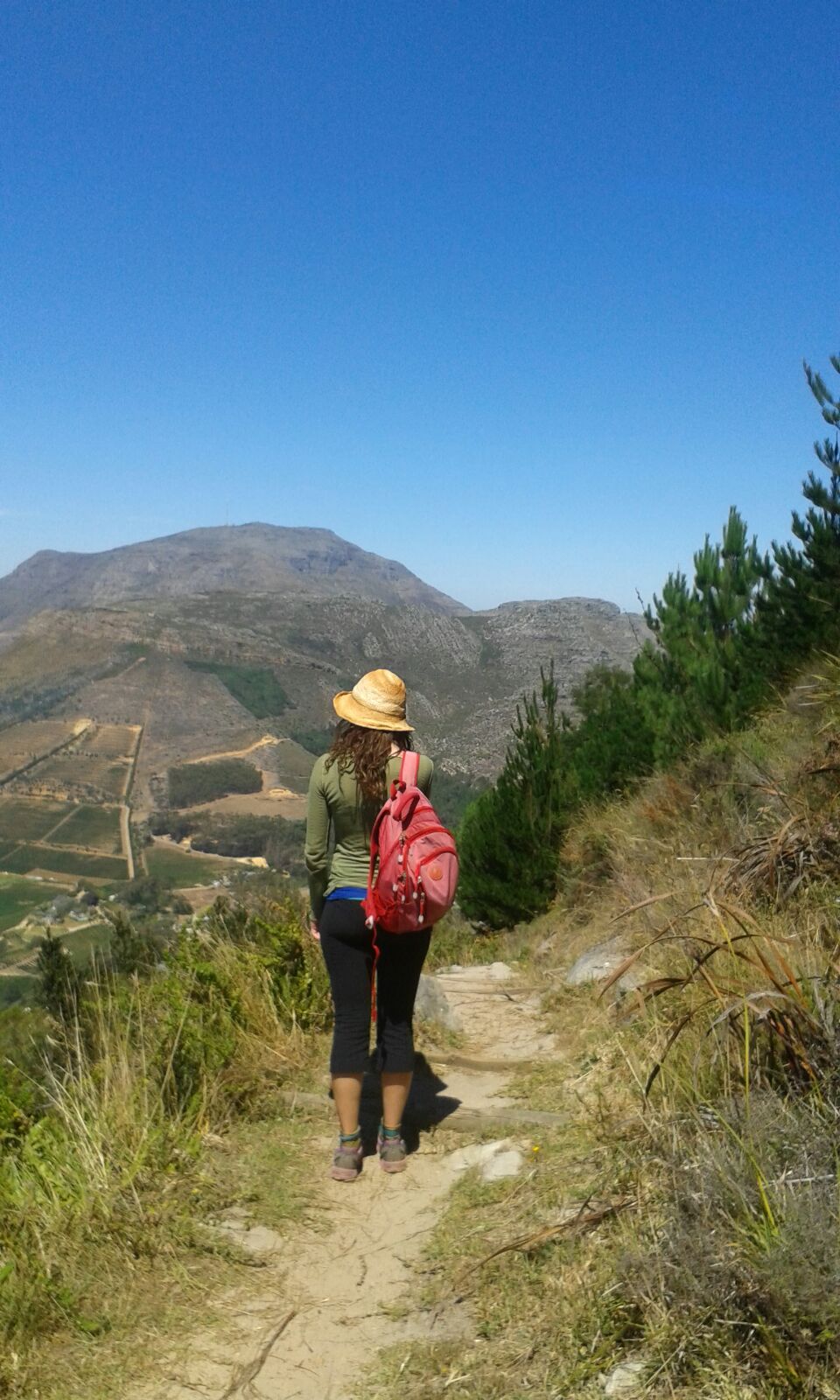
    An ecosystem like nowhere else in the world, and more hikes than I could possibly cover in 3 months of weekends,
    All literally within the city.
    No adjectives could do these mountains justice, but they are enough to steal your heart.
    ***

  • My 9 Favorite South African Words & Phrases (so far)

    This guy knows what I’m talking about.

    Just a short one for today, as I want to spend the remainder of my day off out there in the sunshine!

    South African English has proven to be full of delightful expressions that are just too good not to pick up. If you hear me using these in everyday speech, now you’ll know what the heck I’m talking about. Spend enough time here, and I bet you’ll find yourself using these words too!
    Without further ado…

    My 9 Favorite South African Words & Phrases (so far):


    1. Lekker
        (Nice, great, good. Can be used to describe just about anything. From the Dutch word.)

    2. Robots
        (Traffic Lights. I have no clue why they’re called robots.)

    3. Isit? 
        (Is that so? Really? Oh yeah? Response to just about anything. Hard not to use once you start.)

    4. Braai
        (Barbecue, both the verb and the noun. But somehow way more fun to talk about.)

    5. Boet (5b. Bru)
        (A bro, “bru” then being the term boets would use to address one another… as I understand it.)

    6. Yoh!
        (An exclamation of surprise, like “wow!” Pronounced with an aspiration on the “Y.”)

    7. Aswell 
        (Me too. Emphasis on the “as.”)

    8. Now now
        (Expresses immediate action—kind of. This should be #1, as it’s my new favorite expression.)*

    9. Shebeen 
        (An illegal shop/drinking establishment. I haven’t been yet, but I can’t wait to go so I can use this word more frequently.)**

    Well, there you have it. Come visit me in Cape Town—and you won’t be entirely lost in the verbaiage.

    South African friends? Feel free to correct me if I got something wrong. Or share your favorite words, and I’ll add them to the list!

    ***

    *The precise meanings of “now now” and its close counterpart, “just now” are quite nuanced and difficult to describe succinctly. Suffice it to say that neither of these actually promise imminent action.
    **Update: Shebeens are no longer illegal, it would seem, and now hold licenses like any other store/restaurant in Cape Town… though it seems likely that illegal shebeens still exist!
  • Minibus Freedom: On Risk and Reward

    Stand-Up Paddleboarding (well, kneel-up paddleboarding) in Smitswinkel Bay.

    “Better the devil you know than the devil you don’t…”
    The sun beats down on my left arm, and the wind blows strong from the sea. I watch waves break and sparkle offshore as my minibus taxi races down the coastal road from Hout Bay to Cape Town.
    The views are magnificent. Breathtaking. Spectacular.
    Although, my fellow passengers seem desensitized to the sight, for which we pay 12 rand ($0.75) each.
    South African music blasts from the speakers, a mix of African polyrhythmic beats, electronic pulse and gospel-like vocals. The driver skips tracks on the mix CD—yup, mix CD—as he holds a cell phone in the other hand, seemingly impervious to the perils of this endeavor.
    These minibus taxis—cheaper and faster than a regular bus, and far cheaper than a cab—evoke a sense of freedom that their more staid (and safer) counterparts do not. Diverse rhythms, accents and languages swirling in my ear, unfettered ocean wind in my hair, shimmer of merciless heat in the air, my senses tingle, come alive to welcome the spectrum of experience on offer.
    It is more than physical freedom, though that is part of it. (By now I know the fastest, car-less route to just about anywhere I want to go in Cape Town.) It is more than the speed and ease of movement, more than the volume of wind and music, and more than the independence of needing to rely on no one to go wherever I please.
    No, if I am honest with myself—and you—there is another kind of freedom epitomized by these minibus journeys, which eclipses all the others.
    It is the freedom of choosing my own risks.

    Cape Town has huge populations of great white sharks in its waters, but that doesn’t
    stop dozens of surfers, paddleboarders and swimmers from getting out there every day.
    I’m not talking about risk-seeking behavior here. Rather, I believe most of us take most of our risks unconsciously. We drive our cars, smoke our cigarettes, drink our six packs of beer, eat our pesticide-laden food—that is, dance with our proverbial devils—all the while pretending, or perhaps believing, that our existence is safe. Secure. Unthreatened.
    I have written about this before, but maybe never so explicitly.
    I believe it is because we tend to ignore risk (or rather, complacently engage in it) where it is an accepted norm, that consciously, actively choosing our risks can inspire such a deep sense of freedom.
    People ask me, how can you hitchhike, take the minibus taxis, travel alone, go out alone, [fill-in-the-blank] as a woman, a foreigner, a young person, a small person? Aren’t you scared?
    Aren’t you scared when you cross the street, go to the mall, eat your food, send your children anywhere alone, smoke your cigarette, drive your car? How can you be a human being in this world—frail, feeble, mortal, vulnerable—day after day after day?
    That is, essentially, the question you are asking me.
    Better the devil we know. Better the risk we acknowledge.
    There is risk everywhere. We are never safe. We are weak, mortal, vulnerable to the vagaries of the world every day of our lives.
    Yet, we cross the street. We live anyway.
    I know the risks I take, and I choose them willingly, because the benefits (ah, the benefits, story for another time) far outweight them.
    The other side of the street; the end of the dance; the other side of risk?
    It’s worth it.
    On one level, my choices bring me joy, full-bodied experience, and inspiration

    But if you wanted to get philosophical about it, each time I choose my own risks, I also acknowledge and make peace with my own mortality—and that is a powerful freedom, indeed.

    Smitswinkel Bay.

    ***


  • Post-Apartheid South Africa and “Post-Racism” America

    A totally irrelevant picture of Clifton Beach at sundown—Camps Bay, sundown.
    Yes, there is an analogy to be made here.
    Excuse me friends, I’m going to digress from my usual steady word diet of adventure tales and travelogue to get just a little bit political…
    I’ve had an unprecedented number of responses to my first (and, I thought, fairly innocuous) post about Cape Town, “High Security,” so much so that I feel the need to write a follow up. What I have to say is in no way a judgement of any individual reader or responder. I don’t know you, and I withhold any opinion about your life, social beliefs or general good-will as a person (in fact, I’m sure you’re all good people—most are).
    However, this is a judgement on a system—two systems, in fact—and how we can talk about them.
    In July of 2015, one of the best explanations I’ve seen made the internet rounds to clarify why exactly answering #AllLivesMatter to the rallying call of #BlackLivesMatter is, well, missing the point. Below is an excerpt from Reddit user Geek Aesthete’s answer:

    “Imagine that you’re sitting down to dinner with your family, and while everyone else gets a serving of the meal, you don’t get any. So you say “I should get my fair share.” And as a direct response to this, your dad corrects you, saying, “everyone should get their fair share.” Now, that’s a wonderful sentiment — indeed, everyone should, and that was kinda your point in the first place: that you should be a part of everyone, and you should get your fair share also. However, dad’s smart-ass comment just dismissed you and didn’t solve the problem that you still haven’t gotten any!
    The problem is that the statement “I should get my fair share” had an implicit “too” at the end: “I should get my fair share, too, just like everyone else.” But your dad’s response treated your statement as though you meant “only I should get my fair share”, which clearly was not your intention. As a result, his statement that “everyone should get their fair share,” while true, only served to ignore the problem you were trying to point out.
    […]
    Just like asking dad for your fair share, the phrase “black lives matter” also has an implicit “too” at the end: it’s saying that black lives should also matter. But responding to this by saying “all lives matter” is willfully going back to ignoring the problem. It’s a way of dismissing the statement by falsely suggesting that it means “only black lives matter,” when that is obviously not the case. And so saying “all lives matter” as a direct response to “black lives matter” is essentially saying that we should just go back to ignoring the problem.”
    (For great further discussion, check out this article on Fusion or this one in the guardian.)

    That implicit “too” exists everywhere in critical discussion of racism—both in the U.S., and in South Africa, which I currently call home. I am hardly more enlightened on the racial, political and social complexities of South Africa than I was a week ago, at the time of writing “High Security,” but I think I still have have something valuable to offer by way of this analogy.
    The implicit “too.”
    It is there when activists in the U.S. say, “Black Lives Matter,” because up to now these lives have mattered less to our legal (and social and educational and economic) institutions.
    When others answer, “but, All Lives Matter,” they, “willfully go back to ignoring the problem.” That is, they ignore all the conditions that have created the need for such a statement in the first place. Furthermore, they in turn implicitly erase centuries of racial violence, injustice, intolerance and bigotry, filing history away into that closed box conveniently labeled, “Not Anymore.”
    The implicit “too” is there when I say, “there is a wealth gap in this country, much of which is divided along racial lines,” and a South African white responds, “but there are poor white South Africans, too.”
    Indeed, there are, and they have certainly not benefitted from the post-Apartheid systems put in place to (attempt to) correct a long history of colonial oppression. Yet, to address real racial income inequality in South Africa* by saying that white South Africans suffer poverty too is to once again willfully avoid the unavoidable: racism and inequality are still massive problems, here, as in the U.S.
    In much the same way, saying, “but there’s so much crime within those communities, too,” when we bring up the issue of police violence toward people of color, is a whole lot like saying, “but there is corruption amongst black South African politicians, too” when someone else decries past actions of Afrikaans leaders in this country. Indeed, it is true, but the former does not invalidate the latter. To answer in this way is, just maybe, to suggest that police violence (or Apartheid violence) is somehow less upsetting, less in need of remedying, less bad because that “black-on-black crime” (or that new corruption) also exists.
    Let’s take this one step further.
    The spirit of the implicit “too” similarly comes into play when we in the U.S. bring up the issue of institutional racism, that is, racism that exists at the institutional level—which is both greater and more subtle than any individual’s lack-of-racism. When someone says, “racism still exists in America,” those who would answer, “but I’m not a racist,” miss the point. The issue does not lie with them (and, by the by, neither does the fault, though that’s somewhat of a more complex question), but rather with the system to which they are inexorably tied.
    Similarly, when the topic of racism in pre- and post-Apartheid South Africa arises, arguing, “but I had/have non-white friends,” or, “but some schools were already mixed,” or even, “but not everyone was racist, bigoted, intolerant, hateful, violent, fill-in-the-blank,” is the same as a white American today saying, “but I have black friends,” (and so there must not be racism), or, “but my neighborhood is so diverse,” (so there is no socioeconomic disparity), or, “but my family didn’t have slaves,” (and so, slavery didn’t exist?).
    The individual experience of tolerance and friendship does not change the historical fact of the Apartheid system. The individual history of love does not change a national history of hate. To pretend otherwise is to ignore the reality that the majority of South Africans faced under the Apartheid system. 

    It is to be complice to an unjust system, past or present. 
    It is to ignore yesterday and sugar-coat today, in the hopes that tomorrow will be better.
    But until we acknowledge yesterday for what it was, and see today as it is, tomorrow isn’t going to look any different.
    In the U.S., and in South Africa.
    And that, in my humble opinion, is what post-Apartheid South Africa and “post-racism” America have in common.

    ***
    *Interesting tangential reading here, here and here.
  • High Security

    The view from my patio, Hout Bay, Cape Town.

    Hout Bay, Cape Town, South Africa
    “You need to watch that the gate closes to make sure no intruders get in,” says my neighbor.
    To enter the compound where I live, I click the green button on the remote attached to my set of keys, then press it again to close the gate behind me. To enter the cottage where I’m living, I must unlock a metal grate outer door, then the regular house door. I live in one of the calmest areas of Cape Town—it is like this everywhere (but this is nothing, so I’m told, compared to Joburg).
    From my back patio (which includes a garden and pool), you can just make out the township that lies a couple kilometers away.
    The bus I took from the City to Hout Bay a few days ago drove through the township, and the corrugated iron building materials, open front barbershops and markets, cows, snaking roads and general vibrancy marked a stark contrast with the carefully gated houses on my street.
    The juxtaposition is not lost on me.
    I have been in Cape Town for seven days now, and it seems necessary to get this out of the way before I begin to write anything else about my life here.
    The high security is the first thing I noticed when I arrived (truly unlike anywhere I have ever traveled), and all that it implicitly reveals about this place underlies everything else—or such is my impression. I could hardly boast any depth of understanding of these complex social, political and racial tensions, so for now, suffice it for me to say that they are there, and to share these few observations and facts:
    • The current unemployment rate in South Africa is between 25 and 45%, depending on whom you ask.
    • When I walk the three kilometers from my house to the supermarket, I am typically the only white person on foot.
    • When I take the minibuses (similar to matatus in Kenya), I am the only white person on the bus, too.
    • There is a massive wealth gap.

    • Racial tension is very real, and politically fueled.
    • Theft, break-ins and other crimes are extremely common (the high security isn’t just paranoia).
    • Apartheid ended in 1994; that’s nearly 22 years ago. (Although, coming from the U.S., I’d call that quick progress!)
    • When I asked my Uber driver about the social climate in Cape Town, he continued to call me “ma’am” as he proceeded to heatedly discuss the circumstances that he and his community and family face. (“Ma’am, I was black enough to fight in the riots against apartheid, but I was not black enough to get a job in the new government after the elections.” “Ma’am, the people in my community, when they vote now, they don’t see boxes; they see color.”)
    Right, so what does it all mean?

    That is probably something I will spend the next few months investigating in depth. However, I feel it is necessary to offer these initial comments and observations as prelude to future posts on Cape Town—whether it seems relevant to those topics or not, everything is always connected.

    ***
  • Helsinki Snapshots


    Monday, 11 January 2016
    It is 2:30 pm, and the sky already seems to be getting dark as I make my way to the Helsinki airport… in a taxi (gasp! I know! But my tennis shoes and single layer of pants just aren’t going to make it to the bus stop in this -20º C weather). 
    Somehow I have managed to visit this city three times over the past several months, for a total of six or seven weeks, and it’s about time I shared some snapshots of life here. What I lack in photos (I’ve taken very few) I’ll try to make up for with riveting description…
    The in-between bingo sets show… it’s pretty much what it looks like.
    Sunday nights find me at Mascot cafe with my friend Ella (and her friends) for bingo. A young, rambunctious crowd plays for free drink vouchers and the satisfaction of winning. They sing along with the flamboyant host (an out-of-costume drag queen who hardly looks his 40 years) for certain numbers—“I am 16 going on 17…” “when I’m 64…”—and cheer loudly whenever a player gets Bingo! I begin to get a solid grasp on Finnish numbers just in time to leave.
    Two locals sitting outside the fray stop me this week on my way to the door to ask what’s happening. But isn’t bingo just for old people? They say. Sometimes not, apparently! It is always when I can tell a local something they didn’t know about their own city that I begin to feel I have really settled in.
    Mascot, a down-to-earth bar with a lobby plastered with graffiti-letter posters advertising underground events, also plays host to Helsinki’s first spoken word festival, among other things.

    German Sparkle Party capture (not mine).
    My friend’s house in Käpylä, where I am very kindly welcomed as a long-term guest (maybe there is no Finnish saying about houseguests and fish…) is green. Snow covers the front lawn; when I first arrived it was autumn leaves and apples instead. Seven unique individuals coexist there with surprising harmony, and instantly make me feel at home. We practice jiujitsu on the tatami mats in the attic (later we will move the mats to make room for a massive “German Sparkle Party” (warning, click at your own risk) complete with mojito bar and black light dance floor.) and we play pinball on a vintage machine in the living room while sipping Salmiakki (licorice liqueur). In proper Finnish fashion, I become thoroughly addicted to the sauna in the basement. I learn that if you add a splash of beer to the ladle of water before tossing said water onto the hot stones, it makes a delightful smell (really). 
    Elephant journal HQ, Helsinki—my coworker, Sara and I working at the kitchen table.
    From the small kitchen table where I work, I can watch the light changing outside, fat snowflakes drifting lazily past the window or bunnies appearing from behind trees.
    The bouldering gym where I go to climb a couple times a week is small, but intense. Typically crowded and obscured by a haze of chalk, its routes challenge me and always hold my interest. In an open loft workout area, I observe people displaying more varied exercise routines than I have ever seen in my life. I become noticeably stronger over the weeks that I train here.
    At my favorite supermarket, I learn to distinguish between smoked and raw salmon, free-range and organic eggs, full fat and lactose-free milk, and more kinds of berries than I can name even now. My Finnish vocabulary seems to consist of equal halves food words and profanities.

    The hill.
    Finally, a quick walk from the house I briefly call home brings me to the top a small hill (the highest in Helsinki) topped with crumbling bunkers and criss-crossed with paths. When I don’t want to go anywhere else, I step outside, turn right and then right, and make my way there.

    ***

    Welcome to (what was) my world for a short while, I hope you enjoyed the tour! As of yesterday, I am now in Cape Town, South Africa—currently settling in, but lots more on this new place to come!
  • The Bittersweet Beauty of Goodbye

    If I sift through the shadowy pathways of my memory, I will touch a hundred moments of parting and a thousand words of farewell in an instant.
    A woman stands on a provincial train station platform with her son, waving goodbye, goodbye, goodbye as my train pulls away.

    A friend hugs me in the pre-dawn shadows of an empty parking lot, then stands aside as my bus coughs to life and I step inside.

    An open window lets in dust and exhaust fumes and the last echoes of Good luck!

    The sterile lights of an airport terminal look on as I hug loved ones goodbye; they stay to watch as I pass through security and disappear.

    A last smile at the threshold before the house, car, bus, taxi, train door closes. A last wave. A last glance.
    These memories are steeped in the mixed emotions that partings will inevitably evoke—the fragrant cinnamon of nostalgia, and the piquant tingle of anticipation; the bitter smoke of an ending, and the sweet pine needle smell of journeys beginning.
    When we travel often, some things become easier with practice.
    We learn to sit with discomfort, be it overpacked buses, insufficient legroom, long flights, missed meals or interminable waiting—for delays, friends, food and horizontal sleep. And we come to accept a certain level of stress, uncertainty, insecurity—all fundamental tenets of life on the road—as the norm.
    We learn the language of timetables and airport terminals, maps and foreign street signs, and perhaps we come to navigate these worlds with a degree of ease. We find ourselves at home in a sea of strangers, untroubled by change—exhilarated, even.
    And finally, we become accustomed to goodbyes (comfortable may be too strong a word). Without a doubt we come to realize the ineptitude of words—the insufficiency of phrases like, I’ll miss you, See you soon, Good luck with everything, or even the more sardonic, Have a great life and, See you when I see you—to serve in these situations.
    We become accustomed to goodbyes, yet there is no art to them, or none that I have found. No failsafe formula. No skillful lyricism to master.
    Each one is unique in its blend of sadness, resignation, looking forward and looking behind.
    Each one is, in its singular fashion, beautiful. 
    Or, this is what I am beginning to believe. For, more than cinnamon nostalgia or pine needle anticipation, a goodbye is steeped in love. Platonic, familial, romantic, age-old or brand new, this  is love surrendered to the utter unknowability of what lies beyond this moment.
    If that love, tempered by the bittersweet awareness of impermanence, is not beautiful, then I don’t know what is.

    And so, as I say See you soon, Good luck, I’ll miss you, and Goodbye to friends and loved ones in the U.S. and turn toward the next leg of my journey, I hold onto that beauty, and my smile smells like cinnamon and pine needles, chili and smoke.

    ***
  • The Men Who Saw (A Poem of Sorts)


    Happy New Year!

    This is not the typical style of work I share here, but I’ve been sitting on this whimsical little poem for quite a while now, and I figure now is as good a time as any to share it. May this be a light-hearted reminder to open our eyes (in all senses of the phrase) to the beauty of those people and places around us in the coming year…

    ***
    The Men Who Saw

    Once, the world was full of men who looked
    with eyes as big as pans to cook—
    Jaws hanging low, right down to the floor,
    they looked and looked, ’til they could look no more.
    The women and girls, and little boys too,
    Could not understand all this looking to do—
    And they shouted and pleaded to those big staring eyes
    To just once sink deeper, and see them inside.
    But the men who looked did not know what they meant;
    Their days in looking and staring they spent…
    Until one day a blind man appeared in their midst
    And taught the men the lesson they’d missed.
    At the first the men could not see why
    This blind one’s attention brought so many smiles—
    The women and children explained it all:
    Though he could not look, he saw straight to their souls!
    The men who looked hemmed and pondered;
    They scratched their heads and thought and wondered.
    At last one of their lot closed his eyes in amazement,
    And refused to open them, despite much persuasion.
    “I’ve got it, my friends!” He shouted with glee.
    “The blind one’s vision is fine; the fault lies with me.
    Though we look and we stare every day of our lives,
    The world that we know is a palace of lies!”
    And so the men who looked became the men with eyes closed,
    and they finally knew what it meant to see souls.
    Nevermore would they suffer such empty stares,

    when the truth which they sought—beyond closed eyes was there.

    ***
  • Next Up, Cape Town: Meeting the Voice of Intuition

    Chapman’s Peak, near one of my possible next homes.
    The flights are booked.
    Philadelphia —> NYC —> Amsterdam —> Helsinki. Short pause. Helsinki —> London —> Cape Town.
    Don’t ask. Flights, once booked, are very difficult to reroute.
    Why Cape Town?
    Summer.

    Why else? Well then, summer, right time zone for work schedule, visa on arrival, not Europe (I’m at the end of my 90-day limit for Schengen Zone), ocean, low cost of living, mountains, city…
    But actually, none of that really, truly answers your question: Why Cape Town?
    Yes, those are all reasons why it’s a good choice, yet my choice did not stem from them. Rather, Cape Town felt right, and the rational reasons followed.
    Too “woo woo” for you? Consider this: Whenever we have a decision to make, there is a part of us (call it intuition, gut instinct, whatever you will) that knows the “right” answer before we do. We can arrive at it by logic, or we can skip the winding road and hop straight to our destination—what feels right is right.
    You argue, but this is how drug addicts, hedonists and psychiatric patients are made—acting on impulse. I counter, impulse is not the same as intuition. I sat with my decision to head to Cape Town for nearly two weeks before buying tickets. I reconsidered all my other options, gave logic its chance to sort through the possibilities. But my intuition didn’t waver:
    Warm air, ocean tides—a chance to learn to surf, finally!—and hiking trails, even horses, and then all the things a city can offer: a blank slab of the unknown where you can inscribe the next months of this adventure word by novel word.
    It should come as no surprise that the unknown and my intuition are particularly enmeshed. What feels “right,” more often than not, is what appears shrouded in mystery—the yet-to-be-revealed of a new culture, new community, new dance, new sport, new path, new chance. 
    Of course, that is my “what feels right,” and I neither suggest nor expect it should be the same for another.
    It is only interesting, and instructive, to note where our intuition points us, time after time.
    When we hold a question in our mind’s hands, turning it this way and that, asking where, who, what, when and, most of all, why—what is the first voice to answer, and what does it say?
    Hello, intuition, nice to meet you!

    Cape Town, you say? I trust you.

    Trust. Jump. Fly. Photo Credit: Toni Toreno, Cambodia.
    ***

  • Will the Real Santa Claus Please Stand Up?

    “Joulupukki” by Lauri Rantala from Espoo, Finland – Santaclaus at Helsinki Cathedral.

    Consider this my holiday blog post. I could talk about Hanukkah (the holiday I celebrate), or Christmas markets (delightful all around the world), or any number of things. But why would I when scary monsters and mythology are on the menu?

    ***

    It is September, and I am walking through the the Finnish tunturi (mountains in Lapland, way North), the setting sun to my right. Low bushes, a few turned to orange, carpet the ground. The trail is wide and mostly flat, and it carries me and my hiking partner past Pyhäkero (Sacred Mountain), herds of reindeer silent as dusk and rocca (unique shards formed by the freezing of water in crevices of rock and their subsequent explosion).

    As the colors in the sky deepen and a nighttime chill settles over this landscape, I learn the real story of Santa Claus and his Nordic predecessor, Joulupukki (Yule Goat).

    A terrifying creature with a goat’s skull for a head and flaming eyes, Joulupukki—so it is said—appears at homes during the Christmas season, demanding food, occasionally taking away those who have not been good. He dresses in gray furs and sows fear wherever he walks.

    Jolly Saint Nick, is it?

    Eventually, this Joulupukki became more or less synonymous with the Christian Santa we all know today. Funny how we always seem to do that to the less cuddly figures of mythology.

    As I listen to this alternate (and, I must admit, much more interesting) Yuletide legend, I consider the gray, shifting light of this place and conclude it is much better suited to such a dark and mystical creation than a rotund, white-bearded figure in red.

    Near Rovaniemi, where the train from Helsinki leaves us and we begin our journey, there is a place called The North Pole, where tourists seeking a merrier experience can visit Santa Claus’ Village.

    I opt out. Biting wind, icy mountain lakes and ever-so-slightly magical mountains do so much more justice to this fascinating culture.

    As for Joulupukki, the “real” Santa Claus? No, I didn’t run into him. But, it wouldn’t have surprised me if I had…

    ***

    {Update: Family matters brought me back to the U.S. sooner than my planned visit, and I have been quietly and busily staying under the radar in Michigan these past few weeks. I’ll be in the Northeast a few weeks longer, then it’s on to the next adventure. Where is that, you ask? …I’ll let you know when I do!}
  • Tallinn Snapshots

    Greetings from Tallinn!

    On Monday, my friend and I took the 2-hour ferry from Helsinki, Finland to Tallinn, Estonia.

    Our mission? Like nearly every other passenger on board, buying alcohol. Tallinn, evidently, is the everyman’s solution to avoiding Finland’s high taxes and stocking up on liquor for parties and general consumption.

    With a house party coming up this weekend, we had an important task to complete, and an extra seven hours to explore Tallinn… Here’s just a taste:

    The ferry itself is six stories tall, boasting its own liquor store, luxury “trends” store and nightclub—where drinking habits go to breed and a night out consists of a round trip to Tallinn without ever leaving the boat.

    The breakfast buffet offers Karelian tarts (hailing from the Finnish region of Karelia, pastries full of rice, topped with a special “egg butter”), smoked salmon and cold cuts, mysterious meatballs and an assortment of very particular cured fish. We spend the entire trip to Tallinn slowly working our way through it all.

    My favorite poster from the day.

    Tallinn’s Old Town winds away from the harbor, a pleasant mix of cobblestones I’m still feeling in my sore legs, kitsch tourist restaurants loosely modeled after medieval times, posters that seem stuck in another century, souvenir shops and folk art galleries.

    My friend, travel sister and current host, posing with an eye-catching door.

    Outside one of those restaurants, bored waiters crouch down to scatter crumbs to a few pigeons. Next door, a woman in full-on (presumably) traditional Estonian garb acts as a human signboard—brightly colored embroidery, tightly braided pigtails and elaborate headdress demanding the passerby’s attention. We try to covertly get a picture of her… and fail:

    I think she saw us…

    But, we are photo-bombed brilliantly by a passing stranger, which makes up for it:

    Never seen this guy before in my life.

    I spot Captain Jack Sparrow walking down one of the main streets, swagger and all. I get a little bit too excited, fumbling with my camera and missing the photo op. I still wonder what restaurant he was promoting.

    As Jack Sparrow disappears down the street, we follow the sound of a Steel HandPan to a busker, and I meet my soulmate in puppy form:

    More puppy pictures to come.

    As is the case in dedicated tourist towns the world over, we are met with considerable indifference by a considerable portion of Tallinn’s population, with some friendly exceptions. As dusk falls (around 4p.m. in this part of the world), exhausted from some combination of cobblestones and cloudy skies, we settle in for a dinner of Modern Estonian Cuisine before making our way back to the ferry.

    Tallinn at dusk—beautiful.

    It’s a good day.

    ***
  • Stockholm Snapshots

    Believe it or not, this is right in Stockholm!

    I’ve fallen behind. There are several cities I have seen and enjoyed without writing a single word… And so now I’m revisiting not only in person, but also in spirit as I backtrack to bring you these snapshots.

    Stockholm first.

    (Evidently I have almost no pictures, so these will mostly be word snapshots.)

    I arrive in Stockholm in mid-September to visit my oldest friend (for all intents and purposes my big sister) in her new Swedish life. She and her boyfriend graciously share their one-bedroom apartment with me for a week, and I get in what sightseeing I can between work and catching up.

    We bake miniature apple pies for fika, Sweden’s infamous coffee and cake time, and cook kugel (noodle casserole) and brisket (Jewish soul food) for a belated Rosh Hashanah celebration.

    Based on the tradition of fika alone, I should probably move to Sweden.

    I also discover morotsmuffins (the most delicious carrot cake muffins in existence, with cardamom and cream cheese frosting), of which I unfortunately have no photographic evidence. (Ben & Jerry’s, on the other hand, I find myself morally obligated to document—the VT brand has officially gone global.)

    Ben & Jerry’s in Stockholm? Oh yeah!
    (No, I didn’t buy any. Morotsmuffins, remember?)

    I dip my toes into my friend’s life here, meeting friends and learning a few useful Swedish phrases: “tak” (thanks), “hey” (you guessed it, hey) and “var festin mit fulla killor?” (where’s the party with the drunk guys?) I think I should be all set, no?

    We also discuss politics and the refugee crisis (with Sweden poised to take in 200,000, it’s a particularly salient topic), but that is a far more serious discussion for another time.

    Entrance to Haga Park.

    Haga Park, just minutes from my friend’s Solna apartment, is a sprawling oasis sprinkled with a few architectural oddities. “Am I really in Stockholm?” I write as I watch the shadows grow over a massive lake. Difficult to believe.

    Haga park—attempted dusk capture.

    And lastly, wandering through Gamla Stan (Old Town) on my rainy day off, I stumble upon a marching band playing Abba’s “Dancing Queen” as a motley group of protesters waits to march through the square—one of many wonderfully incongruous details I observe over the course of the week.

    I might as well stop there, as nothing could be better…

    ***

    (Stay posted for Helsinki and Amsterdam/Haarlem snapshots!)

  • Revisiting

    “Revisiting” Sicily

    I have rarely been one to visit the same place twice.

    I always used to squirm uncomfortably when new friends, by way of goodbye, would ask when I was coming back, because I knew I didn’t know. I didn’t know if I would, indeed, be coming back.
    Lately, however, I meet those new friends’ eyes and say with confidence, “I’ll see you next time,” because I’ve since learned that the universe likes nothing more than to send us what, where and whom we least expect. (It seems to particularly delight in setting me down on the same path twice.)
    I can never say when or where or how this next meeting will occur, but it no longer seems so far-fetched to expect that it will.
    You see, though I was never one to visit the same place twice—the pull of the uncertain new always stronger than that of the friendly and inviting known—I can no longer claim this to be so. In the last two and a half months, I have revisited: Rome, Sicily, London and Amsterdam. I have seen friends made in Serbia, Kenya, Germany, India and Vermont.
    As I write this, I am en route to Helsinki for visit number 2.
    Lonely shoe, Helsinki.
    For a serial seeker of new places, it is an odd thing to go back to—to revisit—a place.
    And then, as most strange things are, it is also wonderful.
    I find, in revisiting, that such an act does not in fact exist; it is impossible to visit the same place twice. Friends cut their hair, or grow it; beloved restaurants close, and new ones open; memories, friendships and connections are planted, and new experiences grow from those seeds.
    More important than anything, my perspective—ever evolving, never exactly the same—makes of each “known” something entirely new, and so, in going back, I find I am always going forward, after all.
    The repercussions of this fact are almost terrifying in their magnitude. For each step that I take, there are infinite possibilities, not only ahead of me, but behind me as well. The tree that I see in summer might present itself entirely anew stripped bare in winter; the rose in bud another matter altogether in flower; the city of my 17-year-old travels lent a thousand shades of nuance by seven years’ distance.
    And so?
    And so.
    Sunset on the plane…
    Always moving onward, but am I?
    Maybe I am no longer “not one to visit the same place twice.” Maybe only now does it truly sink in that “everything” or “everywhere” is a receding mirage, the pursuit of which can carry us in endless circles.
    And still, I pursue it—encouraged, not dissuaded by the ever-expanding nature of the illusion—I willingly, obligingly circle back, and forward, and back again.
    Moving forward, or backward, exploring the new, or revisiting the old, I find the unknown in everything everyone everyplace, and I am inspired, in-spiralled, enthralled…
    “It’s no use going back to yesterday, because I was a different person then.” — Lewis Caroll
     
    ***
  • Strangers on a Train

    “We’re on our way to bible study,” says my friend. (He likes to make up stories, but let’s get real, who doesn’t?)

    It’s 10:00 pm, and we’re on the Circle Line, retracing our steps into Central London after hopping the wrong train. Across from us sits a young couple—friendly, talkative, and maybe a touch too willing to believe his absurd stories. They are sipping from a water bottle of vodka and fanta, on their way to a night out “raving.”
    Thus begins my Saturday night this past weekend. My friend alights at King’s Cross Station to head home, and I follow these strangers (soon to be friends) to Fabric, one of London’s most famous House clubs.
    We will meet another stranger on our way out of the Tube, and together walk to the venue. We will spend the next four or five hours dancing to some of the best House music I’ve heard in a year, adding new strangers (new friends) to our group as we went, and they will become, over the course of the night, no longer strangers.
    And all because we had all looked up across the aisle of a Circle Line train and said hello.
    A week prior, I went to meet my coworker in Oxford for the first time. On the trip home, the train was rush-hour packed—standing room only. Series of unexpected events, I found myself squished next to a fellow American; as foreigners are wont to do, we struck up a conversation, found it fascinating, and continued it over a particularly delicious dinner in Notting Hill.

    And all because I had asked (in my unmistakably American accent), “Is this the train to London?”
    When did we grow afraid of strangers? When did the popular wisdom for travelers shift from, trust the road and the good Samaritans who walk it, to, trust no one? When did two strangers—or four strangers—talking on the train become the exception, rather than the rule?
    I have an advantage, in that nothing about my thin five foot five frame and wide smile inspires fear or mistrust. There are fewer barriers for me to cross to arrive at the human beings inside their protective circles.
    Some of my most entertaining nights out, fascinating conversations and closest connections have occurred simply because I looked up and said hello. Though I occasionally forget and succumb to the comfortable bubble of my own world, I try to make a rule of talking to strangers—I have yet to regret it.
    And then, when you think about it, aren’t we all just strangers on a train?
    Busy watching for our station, looking out the window, or within, or anywhere but around us, we don’t realize that the train is it. There are no stations, no stops, and for all we know no destination.
    Our fellow passengers? We’re stuck with them—better hope they don’t smell—and we can make of that a party or a burden. The Buddhists will tell you the train is an illusion; the Jews will tell you it’s the only thing that’s real. One thing I know for certain: It’s what we make of the ride that counts.
    So we can either look up and say hello, and make the journey worthwhile, or we can keep staring at our shoes, waiting for the conductor to call our stop.

    Try saying hello to a stranger today and see what happens. Maybe they’ll tell you their life story. Maybe they won’t respond. Maybe that stranger will change your life—or your day, or your next ten minutes. But no matter what, isn’t it more interesting than your toes?

    ***
  • Traveling Light: “Only What I Can Carry” Photo Project

    Traveling Light: “Only What I Can Carry” Photo Project

    Saturday, October 3rd, 2015. Helsinki, Finland.

    [This is only an excerpt from a longer piece about this project written for elephant journal. For the full story please click here.]

    The afternoon sun is kissing the tops of the pines surrounding my friend’s house, and I am packing.

    I’ve had an idea in my head for months now, and seeing as I’m in no hurry for once, this seems like the perfect opportunity to realize it.

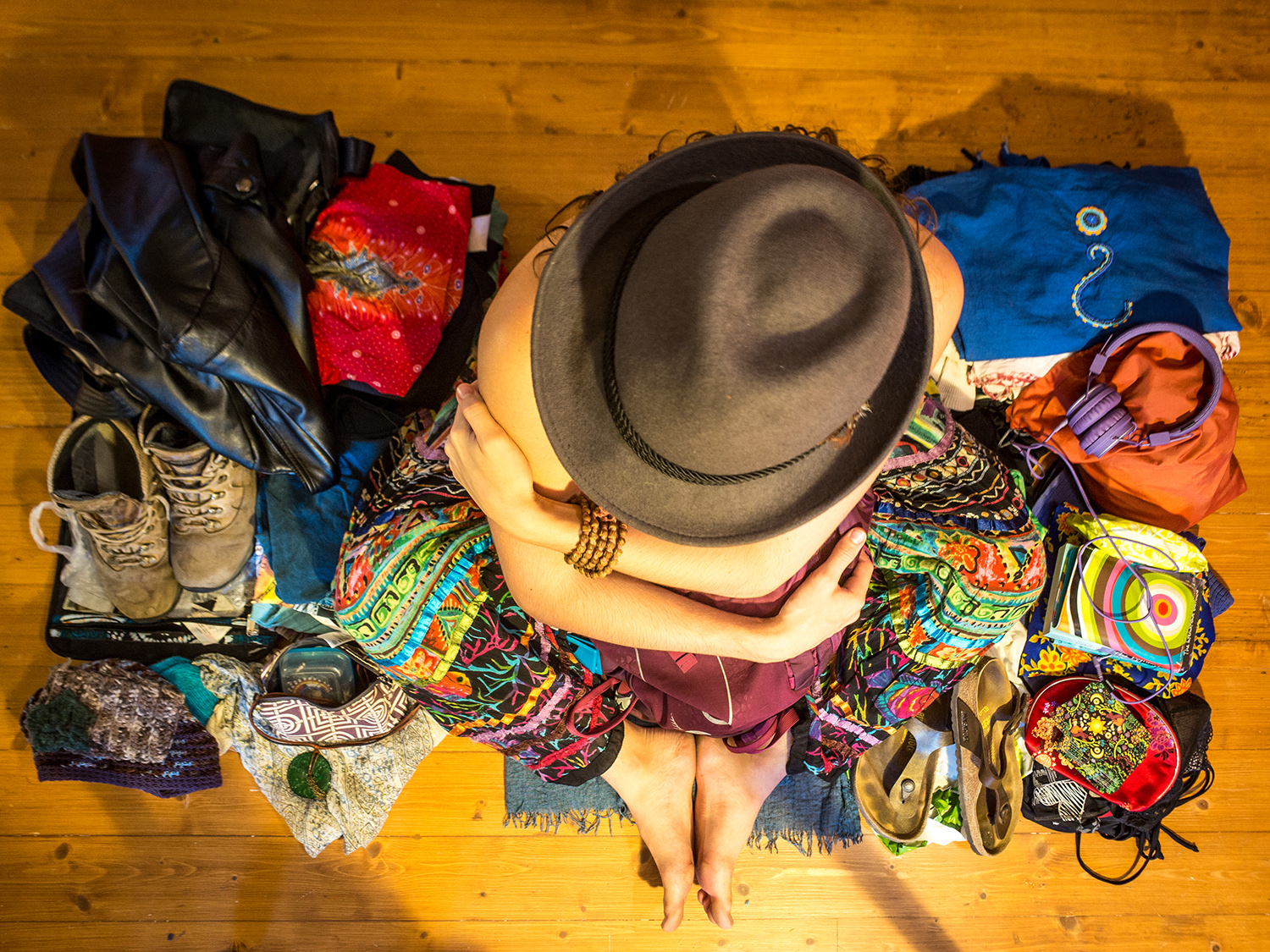
    I’ve been living out of my purple, 60-liter Osprey backpack for just under a year now. This is the second time I’ve done so, and I can pack in 10 minutes—15 tops—when needed.

    Today, though, I take my time to fold my clothing into neat piles and gather every last small belonging into a compact square in the center of the floor.

    I’m not exactly sure why, but taking stock seems important…

    The more I travel and the longer I wander, the better I understand how much I need, and how much I am able to carry. (And still, always, it is too much.)

    More and more, too, I recognize the difference between need and desire—the meaning of priorities. I don’t need even half of what I choose to carry with me. I do in fact need my laptop for work, and maybe a few changes of clothing and some warm layers.

    But my practice poi? Small bag of jewelry? Pretty shirts, oversized headphones and red lipstick? Indulgences and whimsy—and I know it…

    What I keep—I recognize I keep out of attachment, not out of necessity…

    This is only what I can carry.

    Some of it I need; some of it I want, but if it’s too much weight or doesn’t all fit, something has to go.

    This isn’t for everyone; hell, it may not always be for me. Nevertheless, this is a viable way to live, and—I believe—a powerful exercise in living simply.

    I hope these images might inspire you to try the same—even if it’s only for a walk around the block! 😀

    [This is only an excerpt from a longer piece about this project written for elephant journal. For the full story please click here.]