Category: Africa

  • Journeys All The Way Down

    Goes into the post office to mail home some books… 30 minutes and 90 stamps later ^^

    Once, a great guru came to a small village. 

    He gave a long speech and held forth on many subjects, and he claimed that the world rested on the back of four elephants. These, in turn, stood on the back of a turtle.

    After the wise man had finished talking, an old woman came to ask him a question.

    “Guru-ji,” she said, “You say the world is held by four elephants, which in turn are standing on the back of a turtle. But I want to know, what is the turtle standing on?”

    The man’s eyes sparkled as he answered, “Why, it’s standing on the back of another turtle.”

    “But what is that turtle standing on?” asked the old woman. 

    He smiled and said, “Madam, it’s turtles all the way down.”

    The above is an amalgamation of a dozen versions of one of my favorite philosophical tales (variously attributed to Eastern and Western lore). It comes to mind today as I slowly, dare I say reluctantly, pack my things and prepare to leave Cape Town.
    Why, I’m not exactly sure, but I think its suggestion of infinite yet symmetrical unknowns appeals to me in this moment of transition.
    As I clear out the fridge, eating my last grapefruit, savor my last coffee at my favorite cafe, enjoy a last (unseasonably hot) afternoon at Clifton Beach and write a “last blog post” before shipping off to my next destination, I seek a clever way to avoid the “lasts” altogether.
    An enigmatic symmetry and circularity have entered into my travels lately. Returns and revisits abound, and endings, more often than not, prove to be intermissions.
    And so as I peer into the infinite unknowns ahead, I suspect there is more circularity in my future. Journeys bending and spiraling in on themselves in unexpected ways.
    After my last coffee, I go to the post office to mail home a few notebooks’ worth of extra weight. Thirty minutes later, I leave behind a medium-sized envelope impressively plastered with 90 stamps.
    The scenario is comical and exaggerated; together, the post office teller and I systematically paste rows of stamps onto the package.
    I’m reminded of other boxes and envelopes I have shipped from other locations—usually filled with items whose monetary value falls far short of the cost of shipping. (Of course, you can’t put a price on memories.) Often accompanied by absurd postage situations.
    Circularity and symmetry.
    No “lasts” in sight.
    If I were to ask a wise man to surmise my future, I think I could guess at the conversation:

    “What comes after today?” 

    “It’s another journey ahead for you, of course.”

    “And what comes after that journey?”

    “Why Madam, it’s journeys all the way down.”


    Journeys all the way down…

    ***
  • Coffee Culture, Slow Food, and Why Cape Town Has Both

    Coffee Culture, Slow Food, and Why Cape Town Has Both

    cape town coffee culture slow food

    A side alley off Buitenkant Street, Gardens, City Center, Cape Town

    The first sip is bitter, sour, almost acrid, before my palette adjusts and the taste mellows into a more complex configuration of nutty, earthy, sweet and rich.

    This is good coffee.

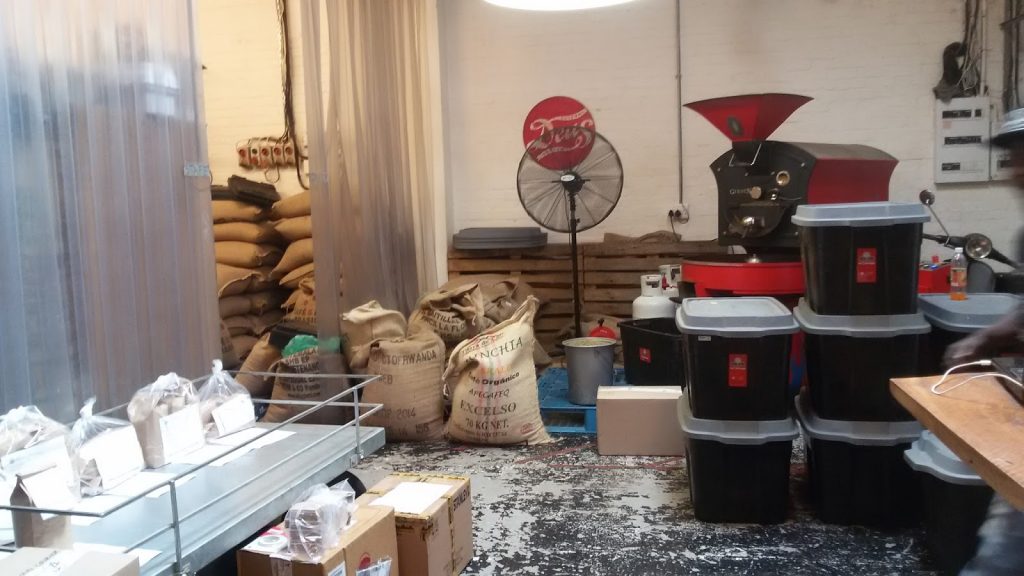
    I’m sitting at my favorite Cape Town cafe, Deluxe Coffee (also called YARD, the Dog’s Bollocks and the Bitch’s Tits), where motorcycle parts, vintage bicycles and canvas sacks of wholesale coffee beans make for original decor.

    I’ve occupied this stool at the counter for well over an hour now, and nobody cares. Par for the course.

    Cape Town has an exceptional coffee culture. (The reason I’ve consumed more coffee in the past three months than probably the last three years prior—well, that, and the fact that a cappuccino costs a bit more than a dollar.)

    What is “coffee culture”?

    Well, to answer in negatives, the U.S. does not have a coffee culture—or a cafe culture, to be more precise. A coffee culture does not “run” on coffee (like Americans run on Dunkins), but rather stops. Sits. Stays. Connects.

    And when you stop to taste your “cup of joe,” quality matters. Deluxe Coffee may be my favorite spot, but easily half a dozen others tie for second. There is a lot of good coffee in this city.

    To-go cups are more rare, too, and at least among my friends, “going for coffee” is an hour(s)-long undertaking—not a five-minute quick fix.

    Cape Town generally moves more slowly. Less rush, less stress, none of the high-powered, shiny, corporate velocity of New York, London or Hong Kong. None of the humorless, chain-brand cafes, either.

    Starbucks hasn’t made it to Cape Town, yet, but I hear it’s coming. When it gets here, I hope Cape Townians will put it out of business.

    In a cafe culture, independent roasters, brewers and purveyors of coffee thrive. Character and personality matter—or maybe that’s just me.

    And I think there’s a common denominator between coffee cultures and Slow Food. Shared values. An appreciation of quality, and a willingness to wait for it.

    Many of the cafes where I go to do work have some of the worst service I have seen anywhere in the world. Friendly, but extraordinarily slow.

    But, good food. Good coffee.

    See the connection? I do.

    I am more than a little bit enamored of the Slow Food movement—and of Cape Town’s coffee culture.

    I like the pace, the time for detail, the space for real connection. This is what a cafe should be, in my opinion.

    This is how coffee should taste. This is how life should move.

  • Playing Tourist—Because, Penguins

    More tourist-ing on the way to the Garden Route.

    Sometimes, it’s fun to play tourist in your own town—or, you know, any town.

    Funny, coming from me, the anti-tourist. I know.

    And sure, I believe the following to be true:

    1) There are no “have to’s” in travel. (No must-see’s, no can’t misses. Things are only as meaningful as the value we ascribe to them.) 

    2) Tourist traps are just that—traps. (You want me to pay how much to play with a tiger? Which, by the way, I’m pretty sure has been drugged.)

    3) There’s nothing better than simply being wherever we are. (Sitting at my “local” cafe all day reading? Check. Wandering aimlessly through a new city? All the time.)

    Still, once in a while, the tourist things call.

    Because, well, penguins.

    Need I say more?

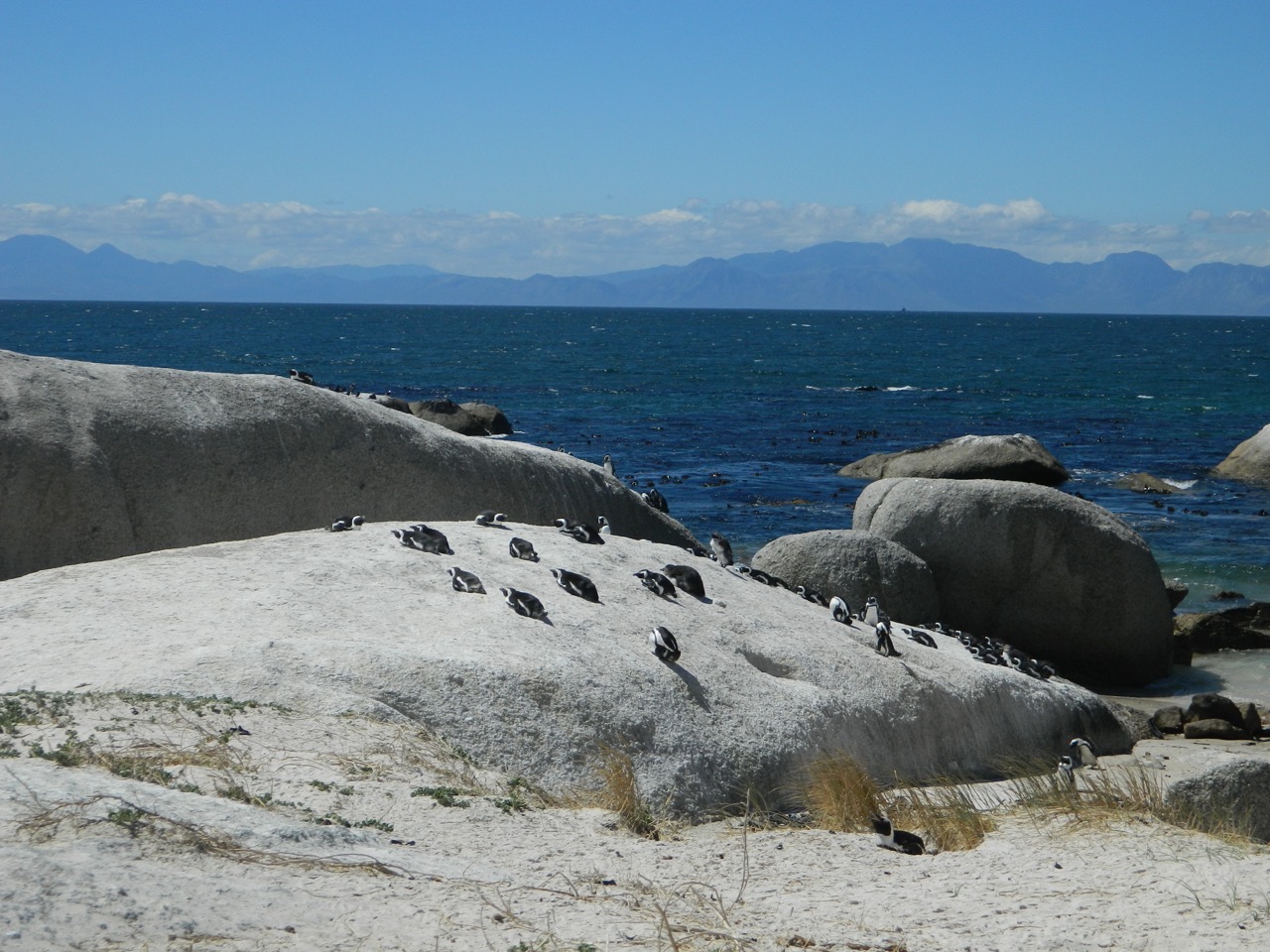
    Tuesday before last found me and a friend driving south out of Cape Town, bound for Boulders Beach and Simon’s Town.

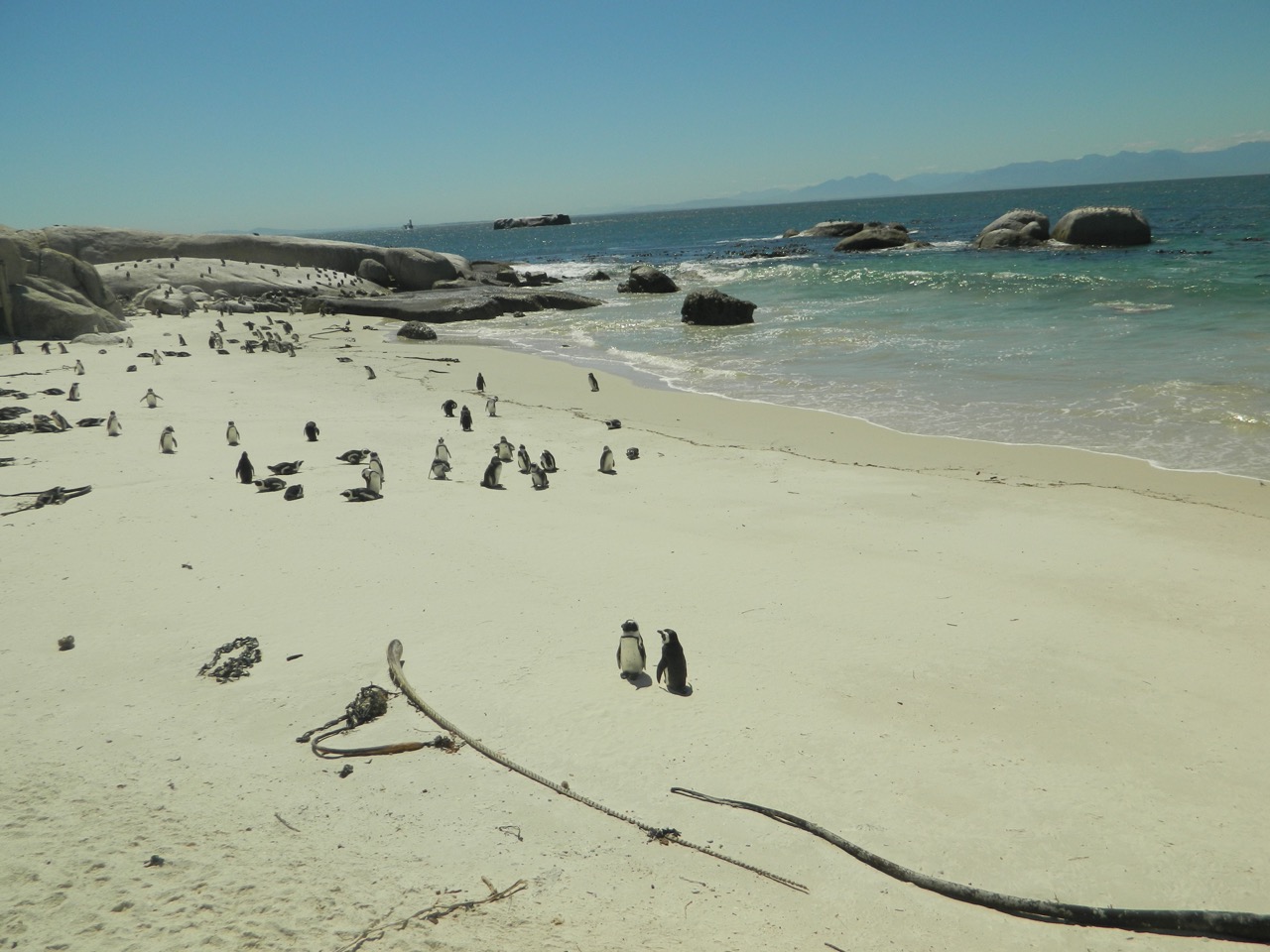
    Boulders Beach, if you didn’t know, is home to the largest colony of African penguins in town. They come for the slightly-warmer-than-icy water, and stay for the spectacular turquoise water and blinding white beaches.

    Oh wait, that’s us. The penguins just come for the warm water. Thousands of them.

    Flop.

    And yup, they are adorable.

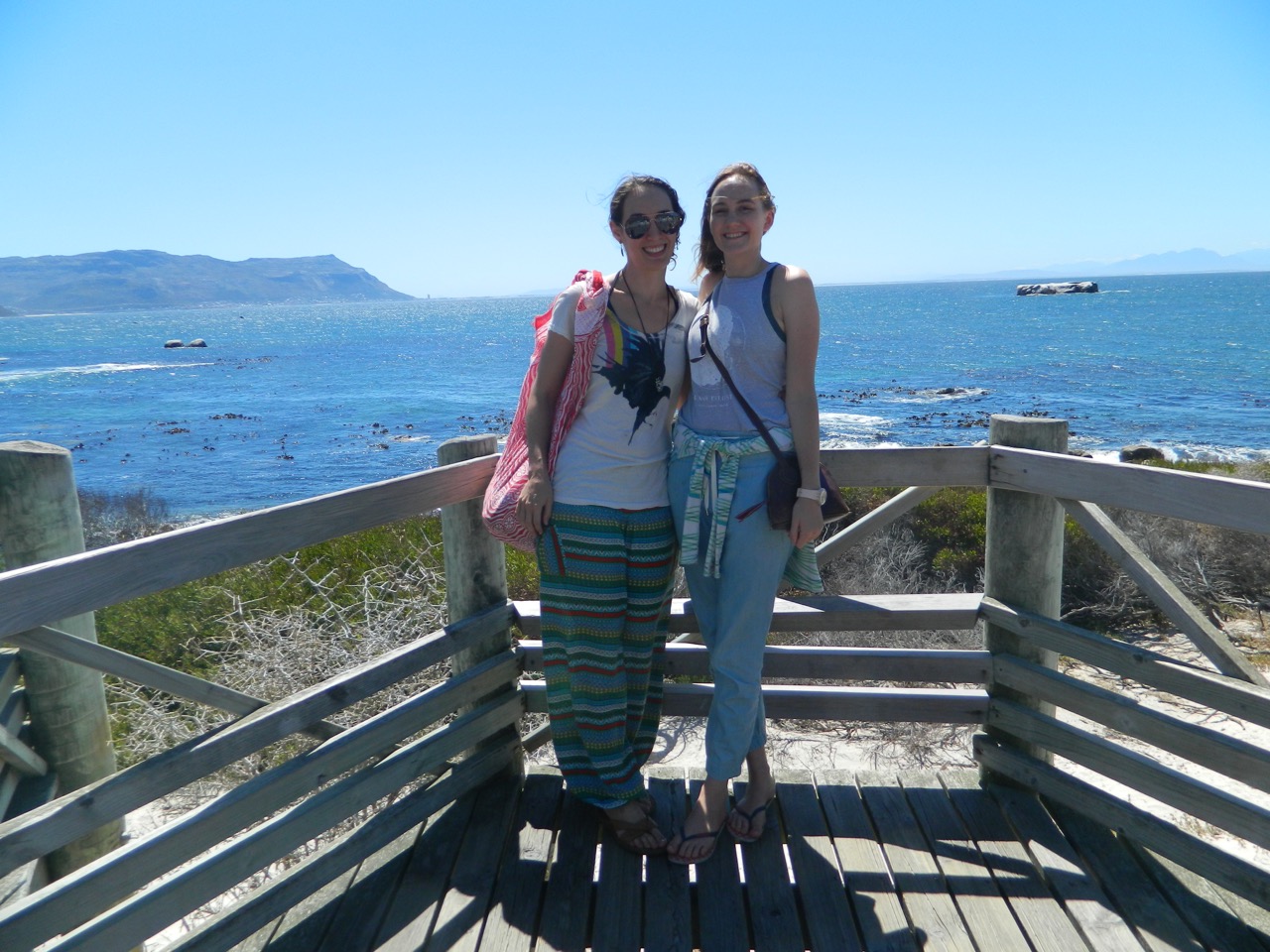
    So there we were, one local and one wannabe-local standing on the viewing platforms along with dozens of other camera’d, sunblock’d and visor’d observers, utterly entertained.

    Funny, because the penguins seem committed to accomplishing as little as possible during their stay at Boulders Beach (the ultimate beachgoers). I watched one duo (African penguins mate for life) for a solid ten minutes, and neither moved a muscle.

    “Do you wanna do something else?” “No.” “Good, me neither.”

    They are also brilliant waddlers and unrivaled loafers.

    Afterward, we ate fish and chips, wandered through beachside shops oddly reminiscent of New England charm, and reviewed our pictures.

    These are our happy penguin faces.

    Sometimes, it’s fun to play tourist.

    You get to see penguins, climb spectacular mountains or window shop on streets overflowing with “custom designed African culture.”

    Shop on Long Street—my favorite street for tourist-ing.

    Fun. Nothing more, maybe, but nothing less, either.

    Many penguin acquaintances were indeed made.

    ***
  • Cape Town Snapshots

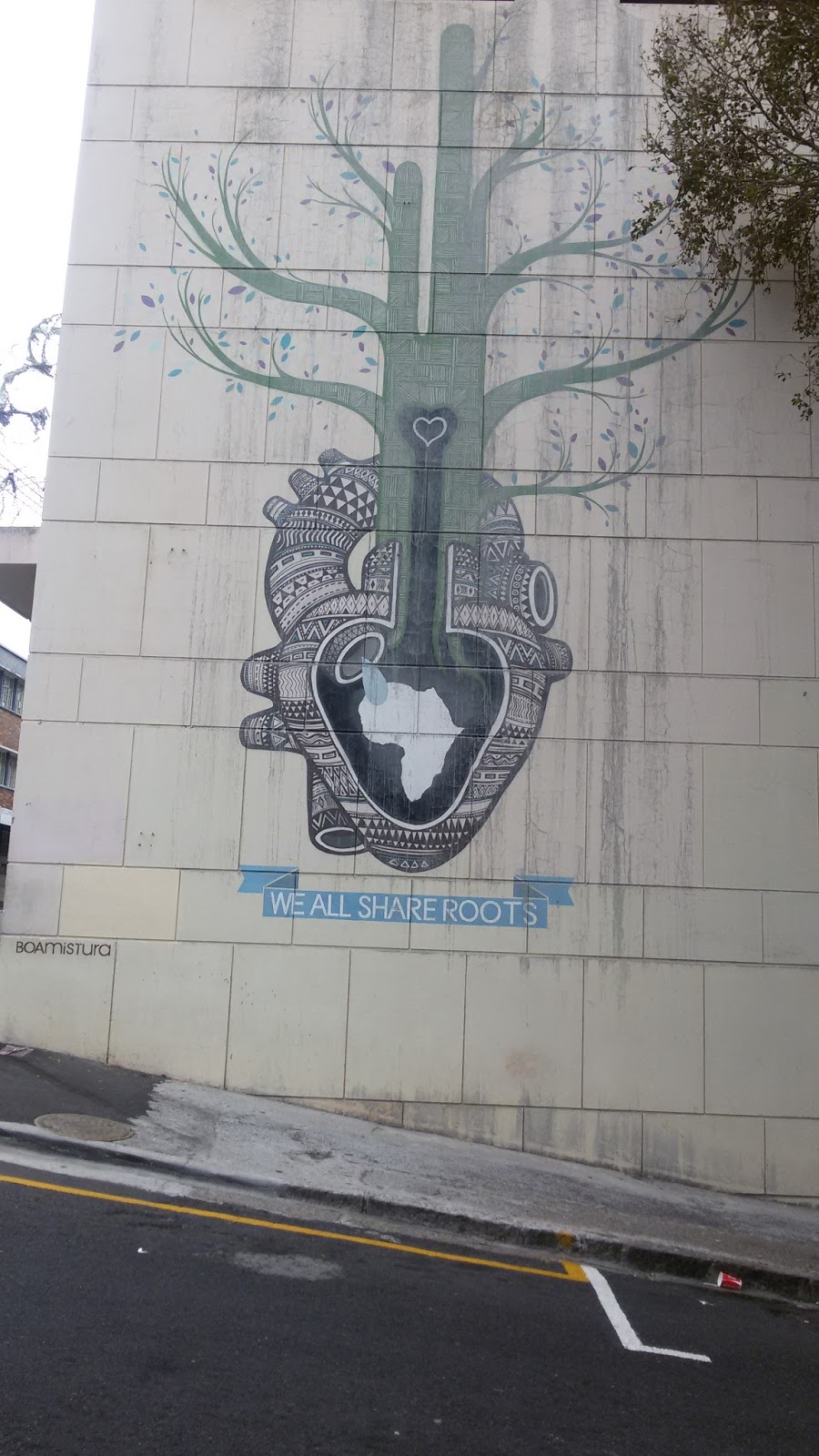
    Street art near Assembly, Cape Town.

    Are these snapshots I share so often an exercise in lassitude or creativity?

    I’ll admit I write them when I can’t think of a full article I want to lay out. At the same time, I think they might capture more of life in fewer words than any other format. I hope they serve to inspire your imaginations and whet your appetite to form your own snapshot memories of these places.

    Cape Town Snapshots:

    ***

    Two long-legged, long-necked birds cross the road near the Civic Center. One, then the other. Each looks both ways, takes a few steps, stops, looks, and steps again. Traffic flows around them. Their mother must have taught them about looking both ways.

    ***

    The wet sand along Long Beach, Kommetjie reflects the mountains in the early morning light. My friend’s golden retriever, a streak of ocher against shads of blue, plays in the surf.

    ***

    Saucer-eyed children materialize around the outdoor table off Long Street where my friend and I have just begun to eat our vegan lasagna and salad. Plant, the restaurant is called. The danger of sitting outside to eat in Cape Town: the reality of the city is on the same side of the window as you.

    ***

    The white-haired sales clerk at the Simon’s Town boutique is more interested in conversation than sales. “Nobody really needs any of this,” she confesses, “but sometimes you just have to buy something nice for yourself!” She laughs. When she hears my friend speaking in Afrikaans on the phone she says excitedly in her high, soft voice, “You have an Afrikaans friend! She’ll be your friend for life.” We all smile.

    ***

    Heaps of fresh fruit in every supermarket. Most (or all) of it grown here. Mangos, avocados and pomegranates, oranges, peaches and nectarines, papaya, apples, plums and grapes. I am spoiled for choice, wish I could buy some of everything, but know I couldn’t possibly eat it all fast enough. Choose just one or two each time I buy my groceries.

    ***
    We teach the students, all in their last years of high school, how to copy and paste, type in urls on a browser and do basic formatting in Word. I am helping my friend with the class he volunteer teaches on Monday afternoons in Masiphumelele, a township near Kommetjie. I never thought I had any computer skills to speak of—I realize I was wrong.
    ***

    The train to the coastal area south of Cape Town emits a banshee screech each time it heaves to a stop. Pick a compartment with lots of people, and don’t carry valuables, I was advised. The train is full of everyday commuters and seems mundane and secure, but I’ve heard the stories and I know looks can be deceiving.

    ***

    A cross between a motorcycle bar and a hipster cafe (my friend’s words, not mine) of my favorite cafes in Cape Town serves the best coffee and a morning’s worth of decorations to occupy the unhurried observer. No mirrors. In the bathroom, only a bare, framed cement square with black painted letters spelling, “You Are Fucking Amazing.”

    ***
    Thick fog rolls down over Table Mountain as the sun drops and the air chills. The “tablecloth,” this misty white blanket is called. It covers and reveals, slowly, silently. The city hides and reveals, slowly, silently. Every day a new facet. Every day a new mystery.

    View of False Bay from the southbound train.
    [Penguins and beaches—lots of pictures on the way, just as soon as I get them onto my computer!]
  • Kindness as an Act of Radical Subversion

    Where I don’t hitchhike. (C’mon, I’m not crazy!)
    “I haven’t told anyone this yet—not even my business partner,” said Jack.
    Two pairs of bluebell eyes stared at me gravely—Jack’s, and his infant son’s. Our Jeep sat in Cape Town traffic at the edge of the City Bowl.
    Well, their Jeep, to be precise, since I was just the friendly neighborhood hitchhiker.
    Jack’s secret? I’m not going to tell, of course But it had to do with life choices and changes and quitting one job for another.
    Traffic began to flow, and the lush greenery of Constantia Nek blurred outside, then transitioned to cityscape as we entered Cape Town proper. Jack is hardly the first stranger to tell me his life story—nor, I suspect, will he be the last.
    When a hitchhiker enters a car, we enter into a tacit agreement with our driver. We are storytellers, listeners and, most of all, amiable company. We may not offer gas money, but the goods we trade in—words—are far more valuable.
    “I don’t know why I’m telling you all this,” Jack mused as we neared my destination (Jack would continue on to the airport to pick up his wife), “it’s like you’re my unofficial shrink.”
    Yes, we’re that, too.
    As I found my way around during my first weeks in Cape Town I often walked or hitchhiked to get from point A to B. (I’ve since moved into the city, and do less of both.)
    When I walk, I make a point of meeting the gaze of each person I pass (their responses are alternately inquisitive, friendly and mildly hostile), smiling and saying, “hello.”
    When I hitchhike, I introduce myself and make conversation. Those with whom I temporarily share that journey meet my gaze, smile and respond in kind.
    In the past couple months, I have met a fellow Bostonian, a Singaporean family, a young surfer and an aging contractor—just to mention a few. Each one unique. Each one kind enough to stop for me. Hitchhikers are rare these days, though my local friends tell me they were once common.
    What does all this have to do with subversion?
    I will explain.
    In a world that expects the worst, I believe offering the best of ourselves is a fundamental act of radical subversion.
    In a society that sees mal-intent, hate, danger and selfishness everywhere—with or without due cause—what is more rebellious than goodwill, love and selfless support of our fellow human beings?
    I enjoy all manner of privilege and bias in my experience of kindness—as some will be quick to point out. A young white woman? Oh, yes, I enjoy more than my share of privilege.
    This fact is somewhat irrelevant, in the context of this discussion, however (although I will freely accede to its verity). For while none of us controls what the world gives to us—hate, or love; malcontent, or goodwill—each of us decides what we offer in return.
    Rebellion, sometimes, is a broad smile.
    Subversion, maybe, is the wide open arms of anyone who chooses love and trust in this crazy world.
    And in that case, what is more radically subversive than acts of kindness? What is more rebellious than accepting that kindness—with an optimistic smile?

    You may choose your own acts of subversion, make your own revolutions, but this—kindness, trust and love—is the revolution I want to be a part of.

    ***
  • One Reason I Am in Love with Cape Town

    South Africa—Cape Town included—is a complicated place. 

    It is complex, fraught with tension and not particularly safe. It is fascinating, for this half-anthropologist, half-writer (and 100% curious human being), and it is sad. Cape Town, specifically, is diverse, vibrant, disjointed, anachronistic, cosmopolitan, wild, chilled, cohesive and embattled, all at once.
    It is the kind of city you fall in love with.
    But you could take all that away, and I would still love Cape Town for the simple fact that this natural beauty
    is everywhere.

    Mountains. Lakes. Oceans. Rivers.
    Sparkling cobalt water,
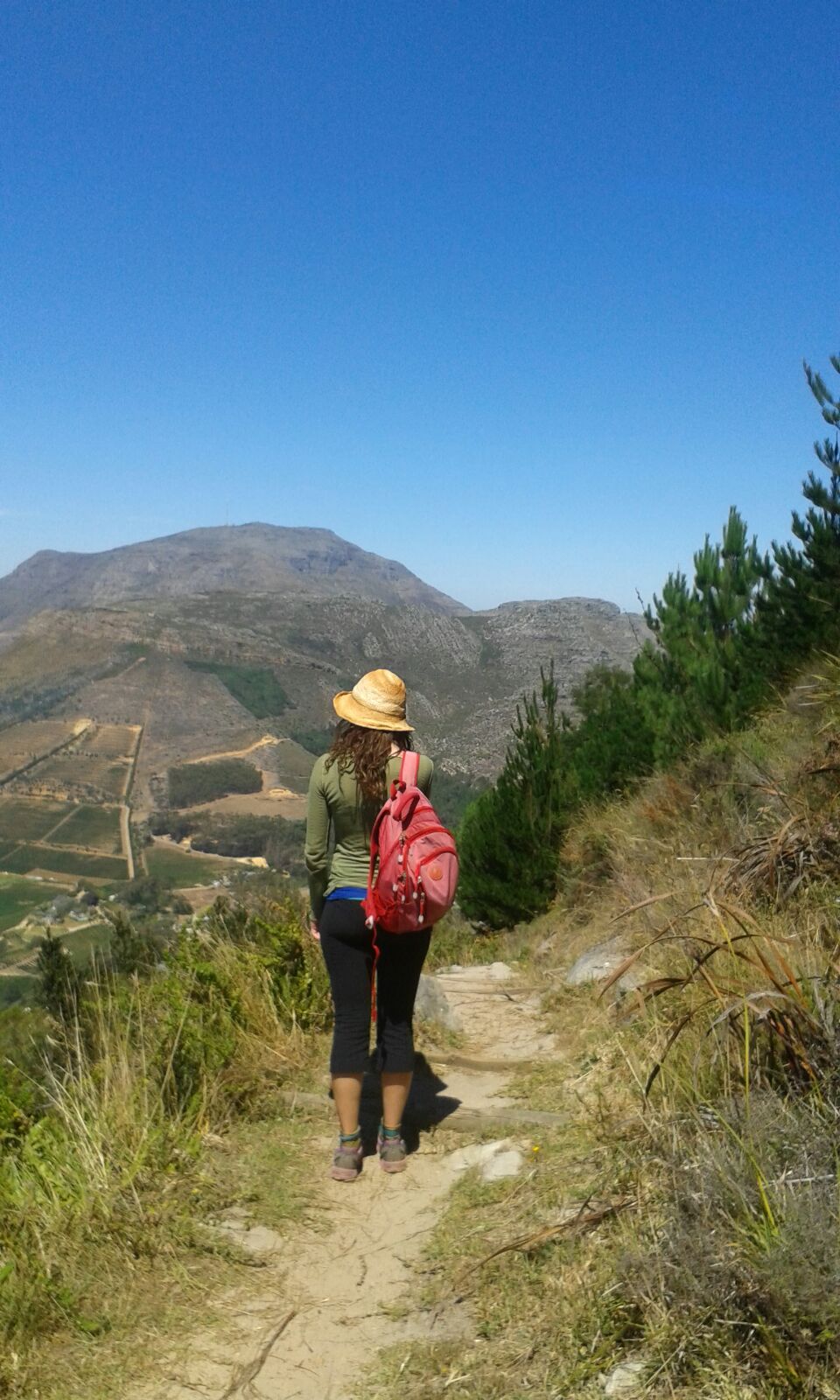
    An ecosystem like nowhere else in the world, and more hikes than I could possibly cover in 3 months of weekends,
    All literally within the city.
    No adjectives could do these mountains justice, but they are enough to steal your heart.
    ***

  • My 9 Favorite South African Words & Phrases (so far)

    This guy knows what I’m talking about.

    Just a short one for today, as I want to spend the remainder of my day off out there in the sunshine!

    South African English has proven to be full of delightful expressions that are just too good not to pick up. If you hear me using these in everyday speech, now you’ll know what the heck I’m talking about. Spend enough time here, and I bet you’ll find yourself using these words too!
    Without further ado…

    My 9 Favorite South African Words & Phrases (so far):


    1. Lekker
        (Nice, great, good. Can be used to describe just about anything. From the Dutch word.)

    2. Robots
        (Traffic Lights. I have no clue why they’re called robots.)

    3. Isit? 
        (Is that so? Really? Oh yeah? Response to just about anything. Hard not to use once you start.)

    4. Braai
        (Barbecue, both the verb and the noun. But somehow way more fun to talk about.)

    5. Boet (5b. Bru)
        (A bro, “bru” then being the term boets would use to address one another… as I understand it.)

    6. Yoh!
        (An exclamation of surprise, like “wow!” Pronounced with an aspiration on the “Y.”)

    7. Aswell 
        (Me too. Emphasis on the “as.”)

    8. Now now
        (Expresses immediate action—kind of. This should be #1, as it’s my new favorite expression.)*

    9. Shebeen 
        (An illegal shop/drinking establishment. I haven’t been yet, but I can’t wait to go so I can use this word more frequently.)**

    Well, there you have it. Come visit me in Cape Town—and you won’t be entirely lost in the verbaiage.

    South African friends? Feel free to correct me if I got something wrong. Or share your favorite words, and I’ll add them to the list!

    ***

    *The precise meanings of “now now” and its close counterpart, “just now” are quite nuanced and difficult to describe succinctly. Suffice it to say that neither of these actually promise imminent action.
    **Update: Shebeens are no longer illegal, it would seem, and now hold licenses like any other store/restaurant in Cape Town… though it seems likely that illegal shebeens still exist!
  • Minibus Freedom: On Risk and Reward

    Stand-Up Paddleboarding (well, kneel-up paddleboarding) in Smitswinkel Bay.

    “Better the devil you know than the devil you don’t…”
    The sun beats down on my left arm, and the wind blows strong from the sea. I watch waves break and sparkle offshore as my minibus taxi races down the coastal road from Hout Bay to Cape Town.
    The views are magnificent. Breathtaking. Spectacular.
    Although, my fellow passengers seem desensitized to the sight, for which we pay 12 rand ($0.75) each.
    South African music blasts from the speakers, a mix of African polyrhythmic beats, electronic pulse and gospel-like vocals. The driver skips tracks on the mix CD—yup, mix CD—as he holds a cell phone in the other hand, seemingly impervious to the perils of this endeavor.
    These minibus taxis—cheaper and faster than a regular bus, and far cheaper than a cab—evoke a sense of freedom that their more staid (and safer) counterparts do not. Diverse rhythms, accents and languages swirling in my ear, unfettered ocean wind in my hair, shimmer of merciless heat in the air, my senses tingle, come alive to welcome the spectrum of experience on offer.
    It is more than physical freedom, though that is part of it. (By now I know the fastest, car-less route to just about anywhere I want to go in Cape Town.) It is more than the speed and ease of movement, more than the volume of wind and music, and more than the independence of needing to rely on no one to go wherever I please.
    No, if I am honest with myself—and you—there is another kind of freedom epitomized by these minibus journeys, which eclipses all the others.
    It is the freedom of choosing my own risks.

    Cape Town has huge populations of great white sharks in its waters, but that doesn’t
    stop dozens of surfers, paddleboarders and swimmers from getting out there every day.
    I’m not talking about risk-seeking behavior here. Rather, I believe most of us take most of our risks unconsciously. We drive our cars, smoke our cigarettes, drink our six packs of beer, eat our pesticide-laden food—that is, dance with our proverbial devils—all the while pretending, or perhaps believing, that our existence is safe. Secure. Unthreatened.
    I have written about this before, but maybe never so explicitly.
    I believe it is because we tend to ignore risk (or rather, complacently engage in it) where it is an accepted norm, that consciously, actively choosing our risks can inspire such a deep sense of freedom.
    People ask me, how can you hitchhike, take the minibus taxis, travel alone, go out alone, [fill-in-the-blank] as a woman, a foreigner, a young person, a small person? Aren’t you scared?
    Aren’t you scared when you cross the street, go to the mall, eat your food, send your children anywhere alone, smoke your cigarette, drive your car? How can you be a human being in this world—frail, feeble, mortal, vulnerable—day after day after day?
    That is, essentially, the question you are asking me.
    Better the devil we know. Better the risk we acknowledge.
    There is risk everywhere. We are never safe. We are weak, mortal, vulnerable to the vagaries of the world every day of our lives.
    Yet, we cross the street. We live anyway.
    I know the risks I take, and I choose them willingly, because the benefits (ah, the benefits, story for another time) far outweight them.
    The other side of the street; the end of the dance; the other side of risk?
    It’s worth it.
    On one level, my choices bring me joy, full-bodied experience, and inspiration

    But if you wanted to get philosophical about it, each time I choose my own risks, I also acknowledge and make peace with my own mortality—and that is a powerful freedom, indeed.

    Smitswinkel Bay.

    ***


  • Post-Apartheid South Africa and “Post-Racism” America

    A totally irrelevant picture of Clifton Beach at sundown—Camps Bay, sundown.
    Yes, there is an analogy to be made here.
    Excuse me friends, I’m going to digress from my usual steady word diet of adventure tales and travelogue to get just a little bit political…
    I’ve had an unprecedented number of responses to my first (and, I thought, fairly innocuous) post about Cape Town, “High Security,” so much so that I feel the need to write a follow up. What I have to say is in no way a judgement of any individual reader or responder. I don’t know you, and I withhold any opinion about your life, social beliefs or general good-will as a person (in fact, I’m sure you’re all good people—most are).
    However, this is a judgement on a system—two systems, in fact—and how we can talk about them.
    In July of 2015, one of the best explanations I’ve seen made the internet rounds to clarify why exactly answering #AllLivesMatter to the rallying call of #BlackLivesMatter is, well, missing the point. Below is an excerpt from Reddit user Geek Aesthete’s answer:

    “Imagine that you’re sitting down to dinner with your family, and while everyone else gets a serving of the meal, you don’t get any. So you say “I should get my fair share.” And as a direct response to this, your dad corrects you, saying, “everyone should get their fair share.” Now, that’s a wonderful sentiment — indeed, everyone should, and that was kinda your point in the first place: that you should be a part of everyone, and you should get your fair share also. However, dad’s smart-ass comment just dismissed you and didn’t solve the problem that you still haven’t gotten any!
    The problem is that the statement “I should get my fair share” had an implicit “too” at the end: “I should get my fair share, too, just like everyone else.” But your dad’s response treated your statement as though you meant “only I should get my fair share”, which clearly was not your intention. As a result, his statement that “everyone should get their fair share,” while true, only served to ignore the problem you were trying to point out.
    […]
    Just like asking dad for your fair share, the phrase “black lives matter” also has an implicit “too” at the end: it’s saying that black lives should also matter. But responding to this by saying “all lives matter” is willfully going back to ignoring the problem. It’s a way of dismissing the statement by falsely suggesting that it means “only black lives matter,” when that is obviously not the case. And so saying “all lives matter” as a direct response to “black lives matter” is essentially saying that we should just go back to ignoring the problem.”
    (For great further discussion, check out this article on Fusion or this one in the guardian.)

    That implicit “too” exists everywhere in critical discussion of racism—both in the U.S., and in South Africa, which I currently call home. I am hardly more enlightened on the racial, political and social complexities of South Africa than I was a week ago, at the time of writing “High Security,” but I think I still have have something valuable to offer by way of this analogy.
    The implicit “too.”
    It is there when activists in the U.S. say, “Black Lives Matter,” because up to now these lives have mattered less to our legal (and social and educational and economic) institutions.
    When others answer, “but, All Lives Matter,” they, “willfully go back to ignoring the problem.” That is, they ignore all the conditions that have created the need for such a statement in the first place. Furthermore, they in turn implicitly erase centuries of racial violence, injustice, intolerance and bigotry, filing history away into that closed box conveniently labeled, “Not Anymore.”
    The implicit “too” is there when I say, “there is a wealth gap in this country, much of which is divided along racial lines,” and a South African white responds, “but there are poor white South Africans, too.”
    Indeed, there are, and they have certainly not benefitted from the post-Apartheid systems put in place to (attempt to) correct a long history of colonial oppression. Yet, to address real racial income inequality in South Africa* by saying that white South Africans suffer poverty too is to once again willfully avoid the unavoidable: racism and inequality are still massive problems, here, as in the U.S.
    In much the same way, saying, “but there’s so much crime within those communities, too,” when we bring up the issue of police violence toward people of color, is a whole lot like saying, “but there is corruption amongst black South African politicians, too” when someone else decries past actions of Afrikaans leaders in this country. Indeed, it is true, but the former does not invalidate the latter. To answer in this way is, just maybe, to suggest that police violence (or Apartheid violence) is somehow less upsetting, less in need of remedying, less bad because that “black-on-black crime” (or that new corruption) also exists.
    Let’s take this one step further.
    The spirit of the implicit “too” similarly comes into play when we in the U.S. bring up the issue of institutional racism, that is, racism that exists at the institutional level—which is both greater and more subtle than any individual’s lack-of-racism. When someone says, “racism still exists in America,” those who would answer, “but I’m not a racist,” miss the point. The issue does not lie with them (and, by the by, neither does the fault, though that’s somewhat of a more complex question), but rather with the system to which they are inexorably tied.
    Similarly, when the topic of racism in pre- and post-Apartheid South Africa arises, arguing, “but I had/have non-white friends,” or, “but some schools were already mixed,” or even, “but not everyone was racist, bigoted, intolerant, hateful, violent, fill-in-the-blank,” is the same as a white American today saying, “but I have black friends,” (and so there must not be racism), or, “but my neighborhood is so diverse,” (so there is no socioeconomic disparity), or, “but my family didn’t have slaves,” (and so, slavery didn’t exist?).
    The individual experience of tolerance and friendship does not change the historical fact of the Apartheid system. The individual history of love does not change a national history of hate. To pretend otherwise is to ignore the reality that the majority of South Africans faced under the Apartheid system. 

    It is to be complice to an unjust system, past or present. 
    It is to ignore yesterday and sugar-coat today, in the hopes that tomorrow will be better.
    But until we acknowledge yesterday for what it was, and see today as it is, tomorrow isn’t going to look any different.
    In the U.S., and in South Africa.
    And that, in my humble opinion, is what post-Apartheid South Africa and “post-racism” America have in common.

    ***

    *Interesting tangential reading here, here and here.
  • High Security

    The view from my patio, Hout Bay, Cape Town.

    Hout Bay, Cape Town, South Africa
    “You need to watch that the gate closes to make sure no intruders get in,” says my neighbor.
    To enter the compound where I live, I click the green button on the remote attached to my set of keys, then press it again to close the gate behind me. To enter the cottage where I’m living, I must unlock a metal grate outer door, then the regular house door. I live in one of the calmest areas of Cape Town—it is like this everywhere (but this is nothing, so I’m told, compared to Joburg).
    From my back patio (which includes a garden and pool), you can just make out the township that lies a couple kilometers away.
    The bus I took from the City to Hout Bay a few days ago drove through the township, and the corrugated iron building materials, open front barbershops and markets, cows, snaking roads and general vibrancy marked a stark contrast with the carefully gated houses on my street.
    The juxtaposition is not lost on me.
    I have been in Cape Town for seven days now, and it seems necessary to get this out of the way before I begin to write anything else about my life here.
    The high security is the first thing I noticed when I arrived (truly unlike anywhere I have ever traveled), and all that it implicitly reveals about this place underlies everything else—or such is my impression. I could hardly boast any depth of understanding of these complex social, political and racial tensions, so for now, suffice it for me to say that they are there, and to share these few observations and facts:
    • The current unemployment rate in South Africa is between 25 and 45%, depending on whom you ask.
    • When I walk the three kilometers from my house to the supermarket, I am typically the only white person on foot.
    • When I take the minibuses (similar to matatus in Kenya), I am the only white person on the bus, too.
    • There is a massive wealth gap.

    • Racial tension is very real, and politically fueled.
    • Theft, break-ins and other crimes are extremely common (the high security isn’t just paranoia).
    • Apartheid ended in 1994; that’s nearly 22 years ago. (Although, coming from the U.S., I’d call that quick progress!)
    • When I asked my Uber driver about the social climate in Cape Town, he continued to call me “ma’am” as he proceeded to heatedly discuss the circumstances that he and his community and family face. (“Ma’am, I was black enough to fight in the riots against apartheid, but I was not black enough to get a job in the new government after the elections.” “Ma’am, the people in my community, when they vote now, they don’t see boxes; they see color.”)
    Right, so what does it all mean?

    That is probably something I will spend the next few months investigating in depth. However, I feel it is necessary to offer these initial comments and observations as prelude to future posts on Cape Town—whether it seems relevant to those topics or not, everything is always connected.

    ***
  • Next Up, Cape Town: Meeting the Voice of Intuition

    Chapman’s Peak, near one of my possible next homes.
    The flights are booked.
    Philadelphia —> NYC —> Amsterdam —> Helsinki. Short pause. Helsinki —> London —> Cape Town.
    Don’t ask. Flights, once booked, are very difficult to reroute.
    Why Cape Town?
    Summer.

    Why else? Well then, summer, right time zone for work schedule, visa on arrival, not Europe (I’m at the end of my 90-day limit for Schengen Zone), ocean, low cost of living, mountains, city…
    But actually, none of that really, truly answers your question: Why Cape Town?
    Yes, those are all reasons why it’s a good choice, yet my choice did not stem from them. Rather, Cape Town felt right, and the rational reasons followed.
    Too “woo woo” for you? Consider this: Whenever we have a decision to make, there is a part of us (call it intuition, gut instinct, whatever you will) that knows the “right” answer before we do. We can arrive at it by logic, or we can skip the winding road and hop straight to our destination—what feels right is right.
    You argue, but this is how drug addicts, hedonists and psychiatric patients are made—acting on impulse. I counter, impulse is not the same as intuition. I sat with my decision to head to Cape Town for nearly two weeks before buying tickets. I reconsidered all my other options, gave logic its chance to sort through the possibilities. But my intuition didn’t waver:
    Warm air, ocean tides—a chance to learn to surf, finally!—and hiking trails, even horses, and then all the things a city can offer: a blank slab of the unknown where you can inscribe the next months of this adventure word by novel word.
    It should come as no surprise that the unknown and my intuition are particularly enmeshed. What feels “right,” more often than not, is what appears shrouded in mystery—the yet-to-be-revealed of a new culture, new community, new dance, new sport, new path, new chance. 
    Of course, that is my “what feels right,” and I neither suggest nor expect it should be the same for another.
    It is only interesting, and instructive, to note where our intuition points us, time after time.
    When we hold a question in our mind’s hands, turning it this way and that, asking where, who, what, when and, most of all, why—what is the first voice to answer, and what does it say?
    Hello, intuition, nice to meet you!

    Cape Town, you say? I trust you.

    Trust. Jump. Fly. Photo Credit: Toni Toreno, Cambodia.
    ***

  • I Might Really Miss This Place

    A rainbow came out especially for my “picture-taking day.”

    As I prepare to leave Zanzibar (Nungwi, more specifically; East Africa, more broadly), the place that has begun to feel like home, I find myself struck by surprising waves of nostalgia…

    With one foot over the proverbial threshold, I observe this place with the forgiving nostalgia of things already past.

    Mambo poa? Poa, vipi? Poa poa. Za asubui? Salaama, na wei wei? Mzuri sana. Mzima. Mzima.

    The daily greetings—long and impossible to translate (in all honesty, I don’t know the meanings so much as the sense)—through which I finally navigate with ease after months in the region.

    For Travellers: Next door to my home, Kipangani Villa.
    The familiarity of Hafizi, the vegetable guy, Chef, the owner of “Chef’s Baking Shop,” and several other business owners and neighbors who, day by day, have slowly accepted my presence in their world—though I will never “fit in” here. To a few, I am not anonymous—more than a transient foreign face—and that means something.

    Chef’s Baking Shop (and Restaurant).

    Hafizi, the vegetable (and fruit) guy.

    My hard-won comfort—with the basics of Ki-Swahili; with the daily trials of moving through an unfamiliar cultural and physical landscape; with all the tiny frustrations that sometimes build… and sometimes fade into irrelevance.

    The neighborhood cow.

    Road to my house.

    The herds of cows on uneven dirt tracks, which I pass through on my borrowed bicycle with its one brake and working bell on my way to work; the brief but regular power outages and occasional mysterious absence of water in the taps; the proliferation of rambutan spiders, mangos and goats and the scarcity of apples, cheese pets and pavement; the trash cart hitched to a skinny cow, the call to prayer at sundown and the rocks that bite holes in my sandals.

    Nungwi Village.

    All of it—tiny details insignificant to some, inconveniences to others—to me, these minutiae are the source of my nostalgia. They are symbols, signifying that I am “there”: someplace far far older than I, but new to me. Not “here” in the familiar, alike, easy—“elsewhere,” and thriving in it.

    Second-to-last sunset.

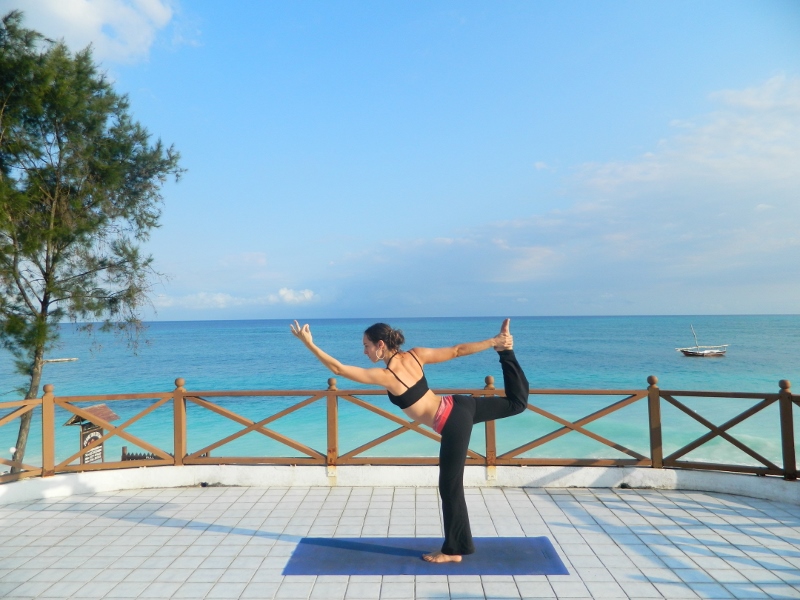
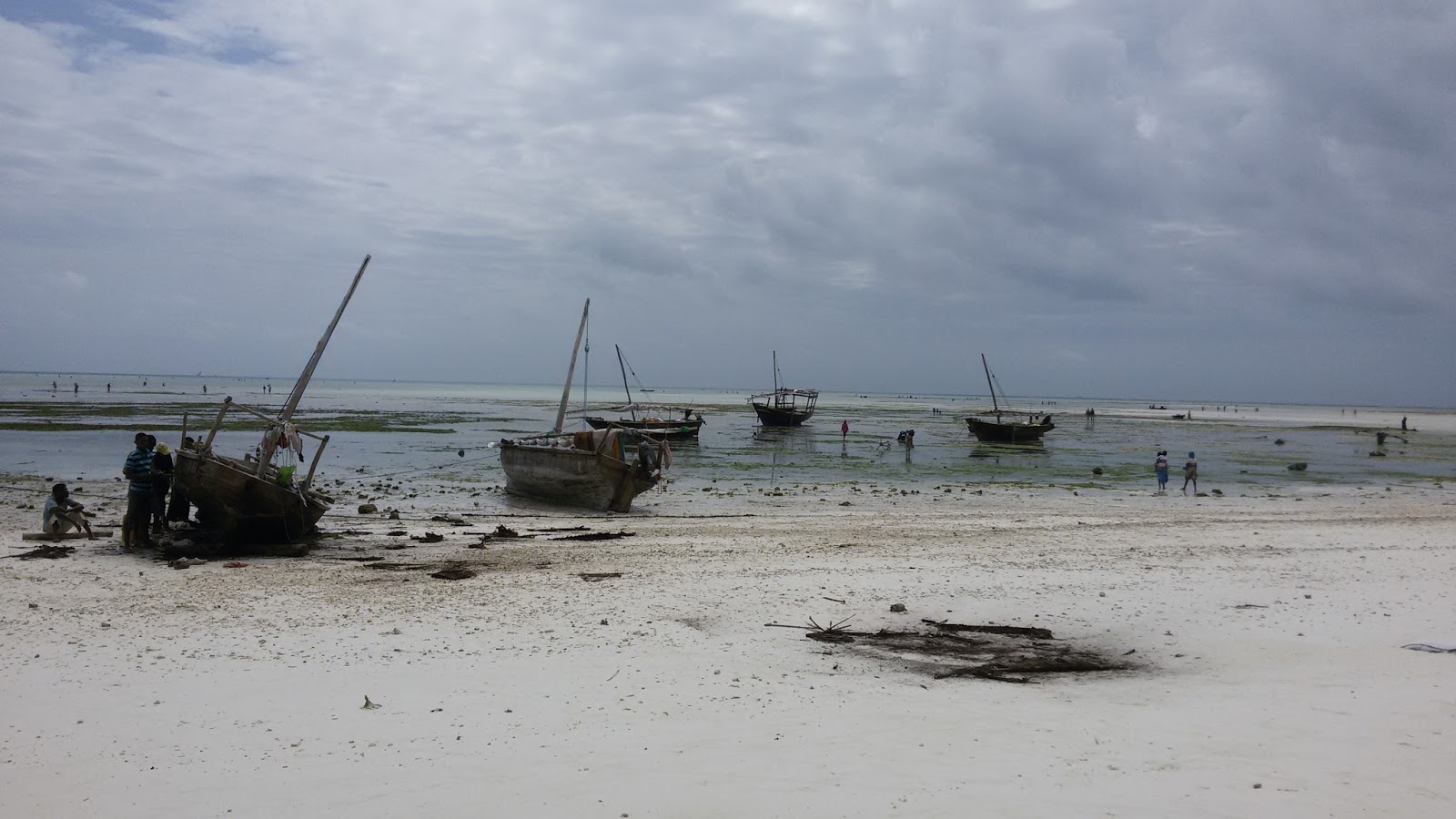
    And then there are the sunsets over the ocean, the orange-gold breeze as I teach yoga, the palm trees and the beach; the sumptuous Arabic-style décor of restaurants that charge less than MacDonald’s for a feast, the silhouette of dhow sails on the horizon—the part from guidebooks and travel adverts is also here, though far more complicated than the brochures would have you believe.

    Of course, a hundred moments of frustration, anger, discomfort, exasperation and rage punctuate that seeping, honeyed nostalgia, reminding me why I am leaving—why I am ready to go.

    Nonetheless, I think I might really miss this place.
    As I write this, I am sipping my last cappuccino at the Zanzibar Coffee House (my favorite place in Stone Town) and uploading the handful of pictures I managed to take in my last days on the island. I will go to the airport this evening and travel about 40 hours for a brief visit with my family in Vermont.

    Next stop: Sicily.

    I hover in the place of in-between’s as I figure out what is next—uncertainty looms as always in shades of vibrant expectation and somber apprehension. I am reminded, again, that home is a thing that fits in a cupboard in my mind… the trick is remembering where I left the keys.

    ***

  • The Joker

    Photo: Wikimedia Commons

    His eyebrows are raised at the center in a perpetual arc of surprise.

    A cap typical of observant Muslim men in Zanzibar perches over his round, childlike face, but he resides squarely in middle age. He wears a blue t-shirt and blue jeans, and in his arms he holds a little girl dressed in powder blue satin.

    She is not his daughter.

    Throughout the bus journey from Nungwi to Stone Town, each time a child arrives at the back of the open-air bus, the man immediately reaches down to lift it on board. Sometimes he returns it to the parent, sometimes he holds it on his lap.

    The children are unfazed, far more concerned with staring at me through kohl-rimmed eyes. He is normal; I am not.

    At one point, the man holds two children on his lap. He is a joker—comical expressions etched on his face. He loves children, he says. It becomes a joke: the women around him laugh each time he jealously pulls a child into the bus and onto his lap. No one thinks it odd, and no one at all questions his motives, as would surely happen in the U.S.

    He loves children, he says, and it is his great luck that there are so many aboard today.

    Maybe he has no family of his own. Maybe he is unable to have children. I don’t know, nor would I ask; nor could I understand the answer had I wanted to.

    Watching the man before me—the joker in the blue shirt and blue jeans, little doll baby dressed in blue satin on his lap—I can’t help but smile along with the other women.

    Photo: Wikimedia Commons

    This is one of the things I love about Zanzibar, and places like it: When it comes to minding children, everyone helps everyone. Neighbor helps neighbor; kin help kin; strangers help strangers.

    When a mother and her child approach a bus (more of an open-air, low-back truck), ten pairs of hands instantly reach to lift the child into the vehicle and hold it steady.

    You won’t see that in the U.S. or most of Europe (although, to be fair, getting on the bus in the U.S. is not quite the same ordeal). There, if a man went to hold a child he didn’t know, he would probably be screamed off the bus.

    I love the trust and community underlying the scene before me.

    That said, my appreciation is hardly romantic. This is one context… Where is that community when it comes to the “every man for himself” mentality of Nungwi businesses? I want to know. Where is that trust and support when business owners attempt to navigate the cloudy waters of the tourism industry, stepping on one another to keep from drowning? I don’t see it.

    Still, the man with the round, surprised face makes me smile today. I consider—not for the first time—that I will really miss this place.

    ***
  • In Zanzibar. Paradise has Cracks. (Poem)

    In Zanzibar. Paradise has Cracks. (Poem)

    In Zanzibar
    Fruit falls from trees–
    Like shimmering coins–
    And is trampled underfoot.

    No one wants to sell it
    When tourist dollars
    Taste so much sweeter.

    In Zanzibar
    Living is cheap
    But being a peacock
    Is free.

    Proud muscles;
    Proud feathers…
    Looks the same to me.

    In Zanzibar
    The clock starts
    At 6 o’clock–
    It’s rarely on time.

    The sunset is melted caramel
    On heaving tides,
    But no one wakes for sunrise.

    In Zanzibar
    If you read between the lines
    Hakuna matata doesn’t really mean
    No worries.

    In Zanzibar
    Glittering veils drape
    Over hair piled high,
    But eyes are dull.

    In Zanzibar
    Alcohol is haram
    But Konyagi is cheap–
    The rules change at night.

    In Zanzibar
    The sky is heavy
    And God is white.

    In Zanzibar
    Pole pole’ is a slogan
    Crafted from handicap.

    In Zanzibar.
    The rain is sudden.

    In Zanzibar.
    The colors are hard.

    In Zanzibar.
    Life is white and black.

    In Zanzibar.
    Paradise has cracks.

    In Zanzibar… In Zanzibar… In Zanzibar.

    In Zanzibar
    Fruit falls from trees,
    And I want to pick it up.

  • The Importance of a Quest

    Today, I spent an hour looking for soap.
    Not just any soap (those who know me will know how picky I am about my soap… shampoo, lotion and face wash too!), but a soap without chemicals, fragrance, glycerin or dye.
    As I walked down the uneven dirt road from the beach to the village—slick with mud from the rains that won’t stop this year—I thought about three things:
    First, I wondered if my skin would be red later from the inescapable equatorial sun, still hot-hot at three in the afternoon. Second, I considered the fact that a less stubborn person would have long ago sucked it up and bought any of the ten brands of Imperial Leather impersonators—all rich with the aromas of chemical fragrance and a lingering colonial stench. And last, I recalled countless similar hunts from this trip and others past, and I wondered why they were so important to me.
    I love a good quest.
    A walk through a crowded market becomes a treasure hunt when I am looking for an uncommon fruit, or a rare blend of spices. The simplest of goals—acquiring a cup of chai, the perfect gift, stamps or fish sandwiches; finding a historical monument; the beach; the highest outlook or the bus onward—transmutes the everyday into something vital and full of purpose.
    When I am looking for something, no matter how trivial, every interaction suddenly has a point. Intensity. Urgency. Meaning. Senseless conversation finds itself replaced by words imbued with the strongest magic: A reason for existing.
    I am not merely walking; I am searching. And a search is an adventure.
    Now, I will be the first to champion aimless wandering for the sake of wandering—searching not for,but because. A search for nothing is far preferable to no search at all. But a search for somethinganything—well, that is the best of all.
    As I stride from supermarket—proffering Dettol, Imperial Leather, medicated soap, skin lightening crap and a host of other pastel-hued and plastic-scented delights–to gift shop stocked floor to ceiling with everything but soap, I exchange the now familiar greetings and then ask for soap (sabuni ya kuoga). I explain in a mish-mosh of Swahili and English that I don’t want chemicals, and people are helpful, understanding, and repeatedly direct me onward, toward the village.
    Stepping into a shop selling only soap and flip flops, I am presented with more options. An unmarked, waxy pink bar, which I don’t trust because it is the color of pepto bismal. A new and equally off-putting brand of skin-lightening bullshit. And a bar of clove soap marked “herbal” and “home-made” on the box, on which the lack of ingredients at least allows for the possibility that it is actually chemical-free.
    I buy it and return home. My quest is complete.
    A search for soap—or chai, or the beach, or any number of things—is, on the one hand, silly and hardly worth thinking about. And yet, a quest is a quest, no matter how small. Those who have experienced the alchemical change that occurs when purpose is added to their day’s equation will understand that it is not the depth, but rather the presence of an objective that counts.
    Today, it was soap. Tomorrow perhaps it will be a decent cappuccino, gifts for my family or an empty stretch of shoreline. I won’t know until the next whim or need grips me and I set off again in pursuit of something, someplace or even someone (I may hate waiting, but it is another kind of purpose, after all).

    There is joy in wandering, and there is joy in searching simply because, but the single-mindedness of quest is a different, and I think necessary, component of travel and life.
    ***